9 Problem-Solving Skills to Look for in Event Staff
August 19, 2026

When an event goes off plan, staff either fix it fast or let it spread. That’s the whole point of this article.
I’d sum it up like this: if you want fewer guest complaints, shorter lines, and less on-site confusion, screen event staff for 9 core problem-solving skills before event day. That matters even more when 42% of organizations are not training staff, which leaves many teams weak under pressure.
Here’s what I’d look for right away:
This article explains what each skill looks like on the job, what kind of event problem it helps fix, and how I’d screen for it with interviews, role-plays, trial shifts, and supervisor notes.
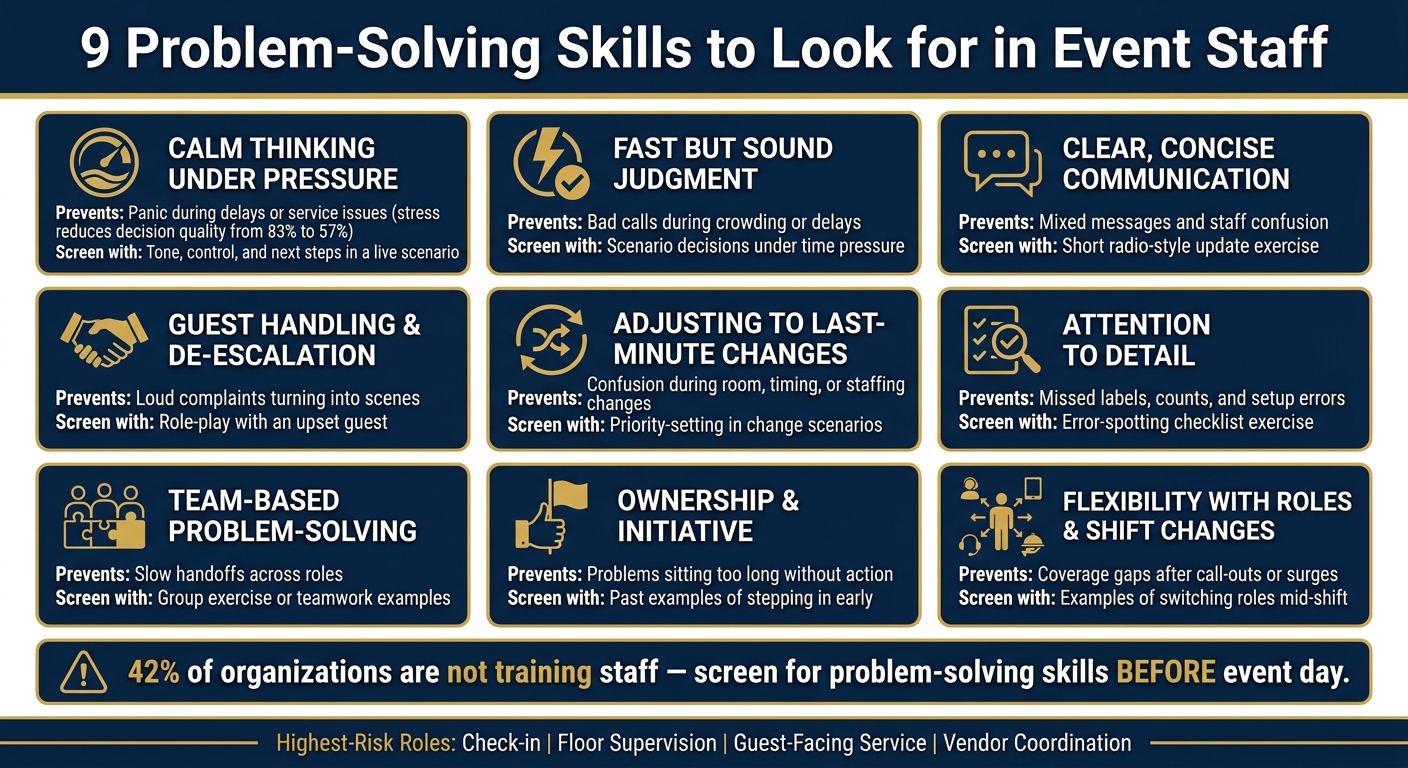
9 Problem-Solving Skills for Event Staff: Quick Reference Guide
| Skill | What it helps prevent | What I’d test |
|---|---|---|
| Calm thinking under pressure | Panic during delays or service issues | Tone, control, next steps |
| Fast, sound judgment | Bad calls during crowding or delays | Scenario decisions under time pressure |
| Clear, concise communication | Mixed messages and staff confusion | Short radio-style updates |
| Guest handling and de-escalation | Loud complaints turning into scenes | Role-play with an upset guest |
| Adjusting to last-minute changes | Confusion during room, timing, or staffing changes | Priority-setting in change scenarios |
| Attention to detail | Missed labels, counts, and setup errors | Brief review or error-spotting exercise |
| Team-based problem-solving | Slow handoffs across roles | Group or teamwork examples |
| Ownership and initiative | Problems sitting too long without action | Past examples of stepping in early |
| Flexibility with roles and shift changes | Coverage gaps after call-outs or surges | Examples of switching roles midshift |
If I were staffing a live event, I wouldn’t just ask who has experience. I’d ask who can think clearly, speak plainly, and act well when the plan breaks.
Waiting until something goes wrong to see how someone handles pressure is an expensive bet. At that point, guests are already watching, and there’s no do-over.
A recent meetings-and-events survey found that 42% of organizations are not training staff. That gap tends to show up fast: slower decisions, confused guests, and issues that didn’t need to turn into bigger scenes.
Strong problem-solvers also stop teams from working in silos. Say registration suddenly gets slammed. A solid floor support lead can pull in catering and front-of-house right away so the whole team adjusts together. That kind of coordination depends on people who can spot a problem before it spreads and send the right details to the right person, without overloading the team or leaving people in the dark. It matters even more when on-site staff need to move fast without waiting for a manager.
Behavioral interview questions tell you a lot more than a résumé. Ask candidates to walk through a real event problem, what they did, and what happened next.
You’re looking for clear, specific actions. Did they stop and assess the situation? Did they communicate well? Or did they jump in too fast and make the problem worse?
Not every role carries the same risk. Some jobs sit right at the center of the guest experience, where one poor decision can affect hundreds of people at once. Putting stronger problem-solvers in these roles helps protect the parts of the event that are easiest to disrupt.
| Role | Common Live Problems | Key Skills Needed |
|---|---|---|
| Check-in / Registration | Missing names, scanner glitches, long queues | Fast judgment, calm tone, quick workarounds |
| Guest-facing service | Dietary complaints, wait time frustration, seating mix-ups | De-escalation, flexible thinking, clear communication |
| Floor supervision | Crowd flow, vendor timing, program transitions | Situational awareness, rapid decision-making |
| Vendor coordination | Late arrivals, AV failures, load-in conflicts | Calm negotiation, schedule recovery |
| Shift coverage / Breakdown | No-shows, last-minute reassignments, teardown pace | Adaptability, task reprioritization |
A few simple screening methods can give you a much better read on how someone will perform on event day:
Role-plays can be especially useful. A fake registration glitch or a bar running short may sound simple, but those moments show you how a candidate communicates and decides in real time. Trial shifts do something interviews can’t: they let you record actual behavior before putting someone in a high-pressure role.
After each event, structured supervisor feedback helps build a track record you can trust. Those notes make it easier to assign the right people to higher-risk roles. Quickstaff can store skill notes on staff profiles, which makes it easier to place proven problem-solvers in the right roles and shifts.
With screening in place, the next step is knowing which problem-solving skills to prioritize.
Calm thinking under pressure means staying steady, thinking clearly, and giving people confidence while fixing the problem. It matters most when the event plan shifts in real time.
Pressure can make even simple tasks fall apart. Research on stress and decision-making found that stress combined with time pressure caused decision quality to drop from 83% to 57%, a 26-percentage-point decline.
That kind of drop shows up fast on the event floor. Picture a banquet captain whose entrée is running 20 minutes late. A calm captain doesn’t panic. They reshuffle tasks, update the client, and adjust drink service so guests stay comfortable while the kitchen catches up.
The best way to spot this skill is to test it before event day with a live scenario, not just a question in an interview. A check-in delay or service breakdown works well because it shows how someone responds when things get messy.
Look for a few clear signs:
Then use that response to place people in high-pressure roles or in lower-risk support roles. After each event, brief supervisor ratings can help track composure over time. This data is even more powerful when integrated into event staff scheduling software to help you assign the right people to future high-pressure shifts.
When staff act like they have the situation under control, guests usually read the problem as a small bump instead of a sign that the event is coming off the rails. That keeps service moving, protects timing, and stops small issues from turning into bigger ones.
Next, look for staff who can make fast, sound decisions without losing control of the room.
If calm thinking keeps staff steady, judgment is what points them toward the right move. Fast, sound judgment means making the right call under pressure - not just making a call fast.
On a live event floor, staff almost never get the full picture before something needs attention. That’s the job. They have to scan the situation, sort what matters most, and act without letting things spiral. In practice, that means weighing safety, crowd flow, and timing, then picking the fix that causes the least disruption. The goal isn’t speed for its own sake. It’s speed with risk checks still in place.
Take a backed-up registration line. A staff member with good judgment doesn’t stand there hoping it clears on its own. They open a second lane, redirect pre-registered guests, and update signage without clogging the front entrance. The line starts moving before it spills into the entry area.
The same kind of decision-making shows up all over event work:
Different problem, same muscle: read the room fast, choose the best next step, and keep the event moving.
The U.S. Office of Personnel Management notes that situational judgment tests present a work problem or critical situation and ask applicants to identify how they would handle it, measuring skills like conflict management, interpersonal skills, problem solving, negotiation, teamwork, and cultural awareness.
That makes this skill fairly easy to test in hiring. Give candidates a floor-level scenario and see how they think through it.
A simple example: ask what they’d do if the main course were running 20 minutes late and guests were starting to complain. Good answers usually include quick guest communication, coordination with the kitchen, and a plan that protects the rest of the event timeline. You’re not just listening for a fix. You’re listening for a fix that solves the problem now and avoids creating the next one.
It also helps to ask for a past example: tell me about a fast decision you made at an event without a supervisor present. What did you consider before acting? The best candidates can walk you through their reasoning, not just the result. That’s often where the difference shows. For more insights on managing teams, visit The Event Staff Blog.
When staff make fast, sound decisions, guests usually notice the smooth recovery - not the disruption itself. That’s the payoff. Small delays stay small instead of turning into visible service failures.
Poor judgment tends to do the opposite. One bad call can stack onto another and make a minor issue feel much bigger than it was.
This is why the skill matters so much in roles like registration leads, floor captains, and bar managers. Put strong decision-makers in those spots, and guest flow is far less likely to break down when plans shift.
For event staff, clear, concise communication means sharing the right information with the right people, in the right format, at the right time.
On the floor, that can be as simple as a server alerting the kitchen about a shellfish allergy or repeating details back to make sure nothing got lost. The channel matters too. Use radio for urgent issues, text or app updates for schedule changes, and face-to-face conversation for sensitive guest concerns. At live events, this skill shows up when a message needs to move fast from one team to another without getting scrambled.
Communication problems usually show up first at guest arrival, meal service, and program transitions. A small issue can snowball fast when the message is late, vague, or incomplete.
A kitchen delay can turn into guest frustration when servers don’t pass along a clear update. A last-minute room flip can slide into chaos when the handoff leaves out key details. The fix is simple: staff should state the issue, the location, and the next step in one short message. That keeps the problem contained instead of letting it ripple across the floor.
That is why this skill should be tested before staff are placed in guest-facing roles.
A short scenario works well. Ask candidates how they would explain a buffet delay over the radio if the kitchen is running behind. Strong candidates give a brief message that includes:
Weak answers are usually too vague or too long.
You can also ask a behavioral question about a time someone misunderstood their instructions and how they handled it. The best candidates don’t stop at the fix. They explain how they changed the way they communicated so the same issue was less likely to happen again.
Clear communication cuts complaints, keeps crowd flow steady, and helps the event feel controlled even when plans shift.
The next skill is knowing what to say when a guest is upset and the situation is already tense.
Clear updates can stop confusion before it starts. De-escalation matters when a guest is already upset. Guest handling and de-escalation means noticing rising tension, staying calm, and steering the conversation toward a safe, workable result while the event keeps moving.
This skill relies on active listening, a steady voice, calm body language, and the ability to give realistic options. It goes beyond normal service. Someone might be fine taking orders or answering basic questions, but that doesn't mean they can handle a frustrated, intoxicated, or confrontational guest.
This skill matters most at entrances, bars, check-in tables, and seating areas. These are the spots where guests run into rules, delays, and crowding.
A guest who's upset about a long bar line, denied entry, or a seating mix-up can shift from annoyed to disruptive fast if staff react badly. Guest-to-guest conflict can also happen at weddings and social events, so staff need to step in right away. The smart move is to handle it in private. Calling someone out in front of a crowd usually makes things worse. That's also why this skill is easy to spot in a scenario test.
A short role-play usually tells you more than a direct question. Give the candidate a situation like: "A guest is upset at the bar because they've been waiting 15 minutes and they're getting loud. Show me how you'd handle it."
Then watch for a few things:
Behavioral questions can help too. Ask about a time they dealt with an angry or difficult guest. Strong candidates don't stay vague. They explain what they said, how they kept their cool, and what result they got.
When staff handle conflict quietly and with control, the issue stays contained. Lines keep moving, and the main program stays on track. Guests who feel heard, even when they don't get exactly what they want, are much less likely to leave a negative review.
Once the conflict is under control, the next thing to look at is whether staff can adjust when the plan changes.
Plans change. At live events, that’s just part of the job.
Adjusting to last-minute changes means taking in new instructions, shifting priorities, and carrying out the new plan without throwing off the guest experience or causing confusion on the floor.
In plain English: staff need to read the change fast, decide what matters most, and communicate the update clearly. The best people don’t freeze or wait around for a blow-by-blow set of directions. They look at the situation, spot what’s most urgent, and move.
Last-minute changes are inevitable at live events. A keynote runs long. A room swap happens 30 minutes before doors open. A vendor delivery is late, or a key item is missing. Any one of these can throw the floor off.
Strong staff use event staff scheduling to reassign tasks first, then brief guests. That order matters. If the team handles the fix before talking around it, guests are much less likely to feel the disruption.
To screen for this, use a scenario that pushes someone to reprioritize on the spot.
Scenario-based questions work better here than asking whether someone can handle change. For example, ask how they’d respond if a bartender called out sick 45 minutes before a reception. Then listen for how they set priorities. Do they identify the biggest risk first?
Strong candidates tend to rank problems by urgency:
That instinct matters on event day. It helps staff deal with the issues that have the biggest effect first, instead of getting stuck on smaller details.
When staff handle changes well, guests see order instead of disruption. A room swap can still feel polished if staff are visible, guide people clearly, and give a simple explanation. Done well, it feels professional - not chaotic.
When changes happen quietly, or entry points are left short-staffed, confusion spreads fast and tends to stick.
Next, look for the detail-oriented staff who catch the small mistakes these changes can create.
Once staff can handle change, they also need the discipline to get the small things right.
Attention to detail means catching errors early and making sure setup, service, and cleanup match the brief. In event work, that might mean spotting a guest count that doesn’t match, noticing missing place settings, flagging incorrect wristbands, or seeing that a beverage station is running low. Those small checks matter because one minor slip can affect a lot of guests at the same time.
A missed dietary note, a guest list mistake, or a sign in the wrong spot can create problems that were easy to avoid. These may look small on paper, but they can have an outsized effect during a live event. And when they pop up in the middle of service, managers get pulled away from bigger priorities.
Scenario questions are a good fit here. Ask a candidate to explain how they’d set up a banquet room for 150 guests with mixed dietary restrictions. Then listen closely. Do they check counts, labels, and signage before moving ahead, or do they rush into setup?
You can also hand them a mock event brief with a few small inconsistencies and watch what they do. Some people plow ahead. Strong candidates stop, ask questions, and confirm the details before they act.
When detail-focused staff are on the floor, guests deal with fewer delays, fewer wrong orders, and less confusion. The event feels polished because the basics are done right.
This matters most in roles like:
In each of these areas, one missed detail can affect dozens of guests at once.
Detail on its own isn’t enough; staff also need to solve problems together.
Some event problems don’t stay in one lane. They cut across departments and need a shared response.
Team-based problem-solving means bringing the right people together, assigning tasks, and coordinating fast action across roles. That matters when one fix touches registration, service, and floor operations at the same time.
Some problems are simply too spread out for one person to handle alone.
Take a bartender calling in sick at a 300-person cocktail reception. That one change can affect guest flow, wait times, and floor service. The same thing happens with any issue that crosses roles. What happens next depends on how well the team lines up around one plan and carries it out together: fast handoffs, clear task splits, and a shared recovery that guests never notice.
That’s also why team-based problem-solvers do well in high-interaction roles like registration lead, floor captain, and vendor liaison. In these positions, one person’s decision can change what two or three other roles need to do next.
Ask candidates to talk through a time they helped solve a problem as part of a team during a live event. You want to hear clear communication, smart escalation, and a willingness to shift tasks when needed.
You can also run a short group exercise during orientation. Give a small team a mock scenario, like a delayed keynote or a badge printer failure, then watch how they respond. Pay attention to who shares updates, organizes next steps, and supports the team’s plan.
When team-based problem-solving is strong, issues get fixed before guests feel them. Staff look coordinated and calm, which tells guests the event is under control, even if something went sideways behind the scenes.
You’ll usually see it show up in a few ways:
The next skill is knowing when to step up and act without waiting for direction.
Even strong teams need people who step in before anyone asks.
Ownership means a staff member treats a problem like it's theirs until it's fully resolved, even if other teams are involved. Initiative means acting without being told when something clearly needs attention.
Together, these traits separate people who wait for direction from people who keep the event moving. A reliable employee follows instructions. A staff member with ownership notices gaps and fixes them before they turn into bigger problems. For example, someone with ownership and initiative can spot a registration bottleneck early and stop the line from backing up.
When ownership is unclear, tasks slip. If no one knows who is handling speaker check-in or buffet replenishment, things can fall through the cracks because no one feels responsible for the outcome.
Staff with strong ownership close that gap. When 20 extra guests arrived unexpectedly, the banquet captain checked inventory, coordinated with the kitchen, rearranged seating, and alerted the planner so service stayed on track.
The best signal usually comes from behavioral interview questions. Ask candidates to describe a time they noticed something going wrong at a past event or hospitality job and what they did next. Strong answers show that they acted early, followed through, and escalated only when approval was needed.
Scenario questions can help too. Ask, "You notice the bar line is 30 to 40 people deep and the bar is understaffed. What do you do?" Good candidates should explain how they would step in at once, fix what they can, and report the issue while the solution is already moving.
Reference checks give you one more layer. Former supervisors can often tell you whether a candidate takes responsibility and works without constant direction.
Fast, team-based recovery protects guest satisfaction and keeps the experience intact. Tasks stay owned, so problems don't stall the floor or pull managers away from bigger issues.
When ownership calls for a role swap or shift change managed via shift assignment software, flexibility becomes the next skill that matters.
When ownership calls for a role swap, flexibility is what keeps the fix in motion. Ownership gets the response started. Flexibility keeps coverage in place when that response means someone has to step into a new job.
Flexibility means a staff member can move into a different role, fill a gap, or adjust to a changed schedule during a shift change without letting service slip. It also means changing tasks fast while keeping the same level of service. In live events, people often need to help outside their usual lane. A check-in associate might need to move to crowd guidance. A server might need to jump in and help reset a room.
Call-outs, late vendors, and surprise guest surges can leave holes in coverage. Flexible staff can step in right away and keep things moving.
Scenario questions and reference checks work well here. Ask candidates to talk about a time they switched stations, covered for an absent coworker, or picked up a new task fast. Strong answers usually show three things:
That’s the line between someone who can pitch in and someone who can take a change in stride without throwing the floor off balance.
Guests notice the basics first: whether the line keeps moving and whether help shows up fast. Flexible staff help prevent visible gaps at check-in, service, and cleanup. When someone can switch roles on the floor without hesitation, the event has a better shot at keeping check-in lines clean, service on time, and problem-solving attentive, even when the plan changes at the last minute.
Knowing what skills matter is only half the work. The other half is putting the right people in the right places before things get messy. That’s where shift planning stops being admin work and starts acting like risk control by addressing common scheduling problems.
Once you know who handles problems well, put those people where issues are most likely to pop up. Think about the pressure points at an event: registration, entry doors, VIP seating, meal release, and room changeovers. Then staff those areas based on what each one calls for.
Save your steadiest people for the busiest, highest-pressure spots. Fast decision-makers fit best in floor lead or captain roles, where they may need to reroute staff or change timelines on the fly. Flexible team members often do best as floaters, moving between zones as needs change instead of staying stuck at one station.
It also helps to label shifts by function, not just location. A note like "Guest De-Escalation – Lobby" says a lot more than "Lobby Host." That kind of detail makes it easier for managers to spot weak spots before the event starts, like having too many seasoned staff away from guest-facing pressure areas.
Build in a 15% backup pool for no-shows. Tools like Quickstaff make this easier with automated waitlists, so you can invite more staff than you need and keep a vetted backup group ready when a gap opens.
Use availability tracking and waitlists to fill openings fast, without chasing texts or sorting through spreadsheets. That speed matters when the schedule suddenly changes. If a ceremony runs 30 minutes late, for example, you may need more people at the bar and fewer in setup with almost no warning.
Backups only help if they know what they’re walking into. Send role-specific briefs before arrival so staff understand duties, common pressure points, and escalation steps ahead of time.
Pre-event notes cut confusion when people need to switch roles fast. Quickstaff puts role notes, files, and event details directly on each shift, so staff can check their assignment on their phone before they even walk in. Use those shift notes to spell out duties, pressure points, and escalation contacts in one place. That also gives managers a clean way to catch coverage gaps before doors open.
After onboarding new event staff and shift planning, use this table to match each skill to the right role before event day. That usually means fewer guest-visible disruptions, faster recovery, and cleaner handoffs.
| Skill | On-the-Job Behavior | Event Problem It Addresses | Screening Method |
|---|---|---|---|
| Calm Thinking Under Pressure | Keeps their voice steady, follows protocol, and prioritizes tasks during a service disruption | Schedule overruns or AV failures that create guest-visible disruption | Ask about a time something went wrong at an event. Pay attention to their tone and whether they lay out clear next steps |
| Fast but Sound Judgment | Quickly reroutes guests to a secondary entrance when the main entry backs up | Bottlenecks at check-in or entry points that slow guest flow | Ask what they’d do if a long line formed at check-in. Look for someone who moves fast but still weighs risk |
| Clear, Concise Communication | Gives short, direct instructions and confirms understanding | Missed courses, late announcements, or confused staff due to vague direction | Ask them to brief another server on resetting a table. Look for short, direct instructions |
| Guest Handling and De-Escalation | Listens calmly to a seating complaint, acknowledges the frustration, and offers a realistic alternative | Guest complaints escalating into formal incidents or negative online reviews | Role-play a mild complaint about food temperature or seating. Watch how they stay composed and respond |
| Adjusting to Last-Minute Changes | Smoothly moves dinner up 30 minutes by checking with kitchen, bar, and AV | Same-day timeline, headcount, or floor plan changes that disrupt event flow | Ask how they’ve handled last-minute schedule changes. Look for structured responses, not panic mode |
| Attention to Detail | Spots missing allergen labels on a buffet and makes sure they’re added | Small errors like misplaced signage or incorrect table numbers that frustrate guests | Use a checklist exercise: show a setup with deliberate errors and ask what needs correction |
| Team-Based Problem-Solving | Quickly coordinates with coworkers to redistribute bussing and bar coverage | Service gaps caused by staff no-shows or breaks running long | Ask for an example of solving a problem with coworkers during a busy shift. Look for coordination and shared accountability |
| Ownership and Initiative | Notices trash overflowing near the dance floor and handles it | Emerging problems like spills or unstocked restrooms that guests notice before staff do | Ask them to describe a time they saw a problem at work and fixed it without being asked |
| Flexibility With Roles and Shift Changes | Jumps to coat check when guest arrival is heavier than expected, then returns to their original role | Unexpected staffing shortages or extended event hours that leave gaps in coverage | Ask how they handle role changes and schedule shifts. Flag vague or resistant answers |
In Quickstaff, store these notes in staff profiles so you can place proven problem-solvers in the right shifts before doors open.
Technical skills get staff on site. Problem-solving skills shape what happens when plans change.
Across all nine skills, the aim stays the same: deal with problems before guests ever notice them. These nine skills help stop small issues from turning into guest-visible failures. So the next step is practical, not abstract. Use these skills in job posts, interviews, training drills, and event scheduling so your best problem-solvers are placed in your highest-pressure roles.
When hiring, training, and scheduling all pull in the same direction, your team doesn’t just carry out a plan - they protect the guest experience when things go off script.
These skills matter across every event role, but they matter most in high-pressure or public-facing jobs, such as:
They help staff prevent bottlenecks, manage crowds, handle guest issues calmly, and respond well during incidents.
Swap generic classroom lessons for role-based, on-site drills. Walk the event route with staff, then use teach-back to make sure they know the main landmarks, entry points, and access areas.
Run shuttle, radio, and guest-direction role-plays in noisy, high-pressure settings. That helps you test clear communication, fast judgment, and how well staff handle late arrivals or everyday guest questions. Quickstaff can attach SOPs or shift notes so staff can review them before they arrive on-site.
Prioritize skills that support stability and safety under pressure. Start with clear communication and defined roles, because those two things do a lot to stop confusion during live events.
It also helps to have a clear chain of command and a way to share fast, accurate updates. Quickstaff can help keep schedules, assignments, and updates visible to everyone.