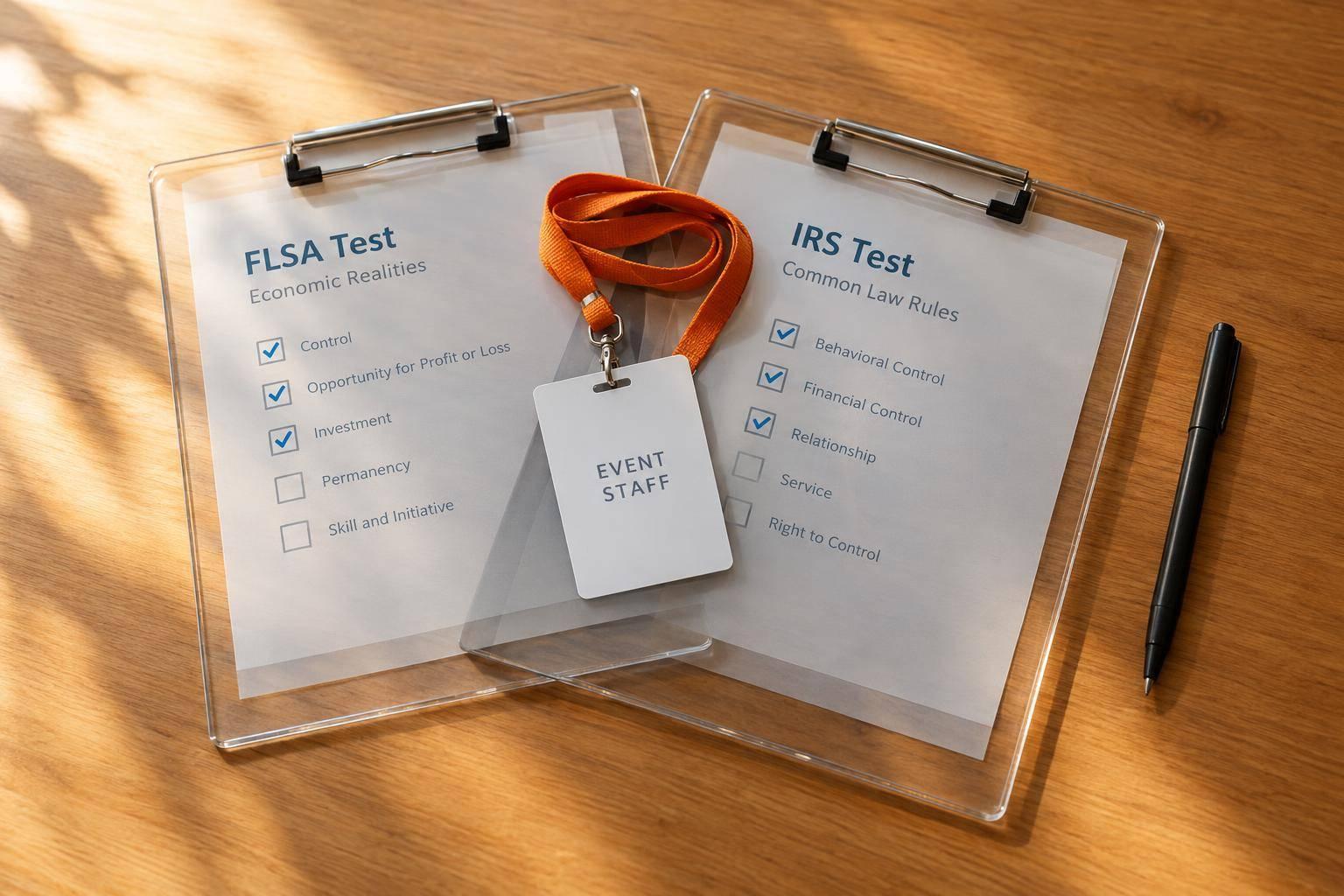
Florida Limits Local Shift Scheduling Rules
November 13, 2026

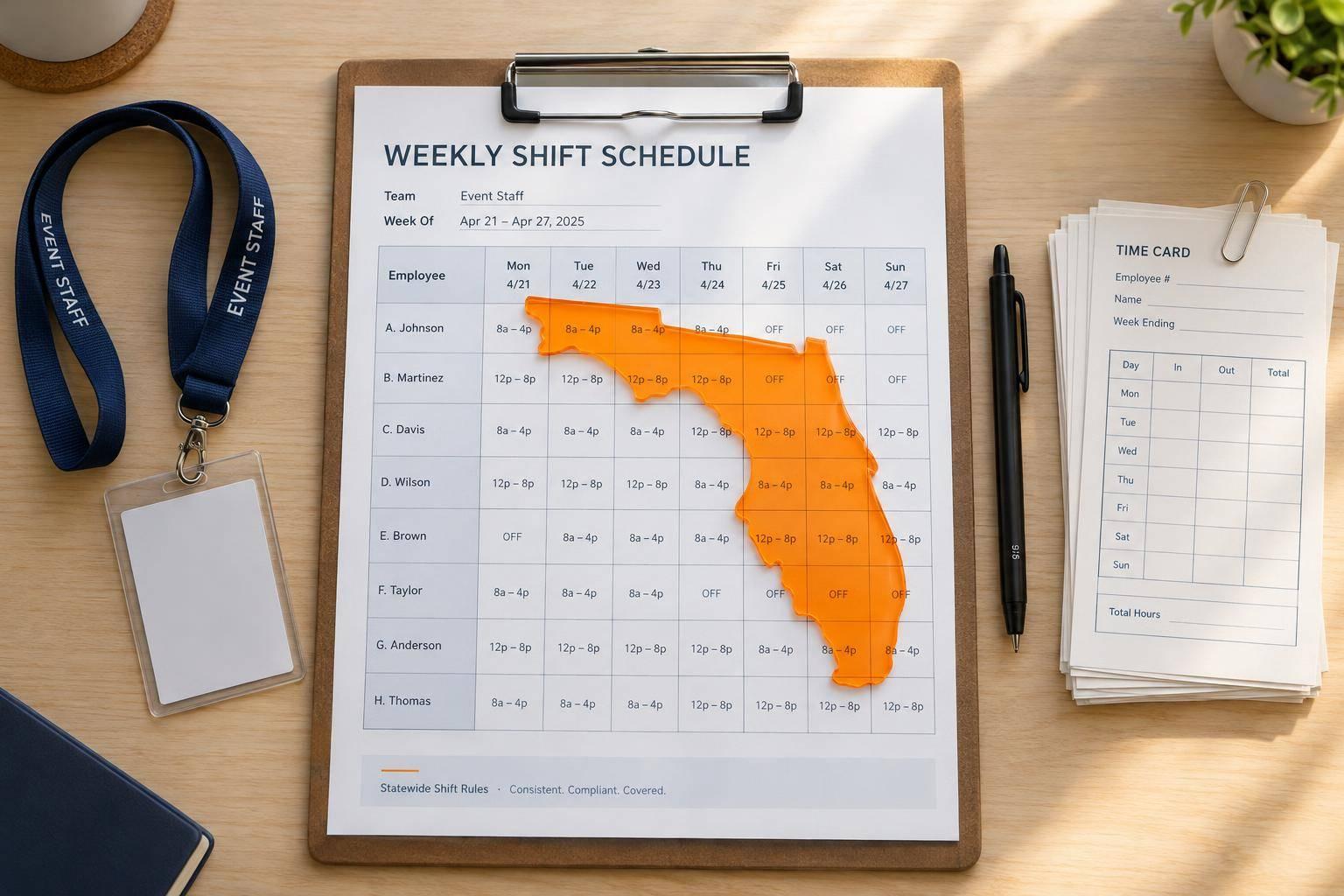
Florida generally bars cities and counties from setting scheduling rules for private employers. Under Florida Statutes § 448.077, that includes local predictive scheduling rules - but the statute does not set a statewide advance-notice period. This makes it critical to implement scalable event scheduling systems that can adapt to varying local requirements.
For event staffing teams, the key steps are:
Event staff scheduling software can help track assignments and messages, but it does not replace legal review or payroll records.

Florida Scheduling Rules: Review Before You Act
Judge the rule by its effect, not its label. A local health, safety, licensing, or nondiscrimination rule isn’t preempted simply because it affects staffing. A city’s schedule for its own employees differs from a rule that directs a private caterer’s scheduling. Section 448.077 targets the latter. This is why many caterers need event staff scheduling software to manage these complex compliance requirements. This distinction matters when a rule reads like a general policy but controls private-worker schedules.
Check any local rule requiring advance shift notice, premiums for late changes, limits on canceling or shortening shifts, mandatory offers of extra hours, or schedule logs.
Separate schedule controls from wage duties. A rule may mix scheduling requirements with recordkeeping or pay obligations. Review schedule-change logs separately from payroll, timekeeping, wages, and overtime. Keep payroll and timekeeping records: preemption of a scheduling rule doesn’t remove separate wage or overtime duties.
Scheduling clauses in municipal venue agreements or public-event staffing contracts may also face preemption. Flag terms that control shift notice, change premiums, offers of additional hours, or scheduling logs. Identify which government entity imposes each clause and check how it affects your event staff’s schedules.
Before disregarding a signed clause, have qualified Florida counsel check whether state or federal law, rules, regulations, or federal grant requirements support it under a statutory exception. Keep the agreement and related records until that review is complete. Don’t ignore the clause before counsel confirms preemption.
If a rule survives this review, separate it from the employment duties that still apply.
The next step depends on the statute’s narrow exception. A local scheduling requirement survives preemption under Section 448.077 only when expressly authorized or required by state or federal law, rule, or regulation, or pursuant to federal grant requirements.
Identify who imposed the requirement and what makes it binding. Is it a city rule, county rule, venue contract, or funding condition? Separate local measures from state and federal law, employer policies, collective bargaining agreements, and private client contracts. A private client’s arrival-time commitment is a contract term, not local law.
Keep the exact statutory provision, regulation, or grant clause that supports the exception. General authority or contract language alone isn’t enough. For federally funded events, review the award terms and any requirements they incorporate. Check the current official Florida Statutes before relying on the exception.
If the rule meets that test, distinguish it from duties that apply under other laws.
Use this distinction when reviewing an event staffing rule:
| Local scheduling measures potentially covered by preemption | Separate employment duties with their own legal sources |
|---|---|
| A city ordinance requiring advance notice of schedules or schedule changes | Minimum wage |
| A county rule requiring cancellation premiums or mandatory shift acceptance | Overtime and paid hours worked |
| A local policy requiring a private employer to keep a shift open or provide a particular number of hours | Compensable time |
| A government contract clause regulating private-employer scheduling without a specific legal or grant basis | Leave, discrimination, retaliation, safety, payroll, and recordkeeping duties |
Coverage depends on the legal source, the worker’s classification, and the facts. Review all three before changing staffing practices. Preemption does not excuse a separate leave or accommodation duty.
After confirming the rule’s source, document each schedule change and the hours worked.
If a local rule survives preemption review, use a written workflow for every permitted schedule change. That process should cover approval, worker notice, and pay tracking.
When guest counts change, document the revised staffing need before adding or removing roles. If venue access is delayed, keep the new call time separate from any waiting or reporting time, and confirm whether that time must be paid.
For weather cancellations, set a decision deadline. Tell workers whether the event is canceled, postponed, or delayed, and explain how to confirm receipt. For variable end times, share the expected finish and record any extensions.
Treat availability changes and replacements as separate steps. Confirm the original worker’s status, get the replacement’s acceptance, and keep only the current assignment active.
Use the same workflow to save the original offer, each change, and the final hours worked. Organize responses, timestamps, worker messages, and actual time records by event and worker. Assign someone to make each update.
Scheduled hours do not replace records of actual hours worked. Reconcile schedule changes with actual hours before payroll. Retain payroll and wage records, including schedules and time cards, for the required period. Check for longer applicable retention requirements and litigation holds; Section 448.077 does not set a scheduling-record retention period.
Track each change in the same file used for payroll and staffing.
| Event or change | Record to retain | Responsible manager |
|---|---|---|
| Initial request | Guest count, roles, call times, location, and original offers | Event or staffing manager |
| Worker response | Acceptance, decline, availability, and timestamp | Staffing coordinator |
| Guest-count or venue change | Client or venue notice, revised plan, approval, and worker notices | Event manager |
| Weather cancellation | Decision authority, weather or client notice, cancellation time, and acknowledgments | Operations manager |
| Variable end time | Expected finish, extension approval, worker notice, and actual finish | On-site supervisor |
| Availability change | Original availability, withdrawal or decline, and replacement acceptance | Staffing coordinator |
| Replacement | Reason, candidates contacted, final assignment, and updated event details | Staffing coordinator |
| Payroll reconciliation | Approved time record with actual hours worked and any deviations | Payroll or designated timekeeper |
Use Quickstaff to coordinate revised assignments, clear event details, messages, and reminders. It does not determine enforceability or replace legal review and payroll records.
For event staffing managers, Florida Statutes § 448.077 generally bars local governments from imposing scheduling rules on private employers, including predictive scheduling challenges. Preemption does not remove separate employment duties. Any exception must come from express state or federal law or a federal grant condition.
Use this checklist before treating a local scheduling rule as binding.
Usually, yes - but you must follow applicable scheduling notice rules, predictability-pay requirements, and collective bargaining agreement (CBA) terms. An employee’s acceptance doesn’t override legal requirements.
Before changing an accepted shift, record the original and revised assignments, timestamps, and the employee’s response or consent. Before updating payroll, recheck limits on hours and rest periods, pay premiums, and any required written offers.
No. Section 448.077 generally limits local scheduling mandates, such as advance schedule notice or predictability pay. It does not override obligations under private collective bargaining agreements or federal law.
Before applying scheduling rules, check whether a collective bargaining agreement covers your staff. Follow any stricter contract terms for shift limits, rest periods, or notice. Also, review the agreement for exceptions involving schedule changes or emergencies.
Federal law requires employers to pay for all time actually worked, including work done before a cancellation. Check any applicable collective bargaining agreements for reporting-time guarantees. These may require a minimum payment if a shift is canceled after a set cutoff.
Confirm which state and local notice and pay rules apply at the event location, and keep Florida’s limits on local scheduling mandates in mind.