Federal Equipment Rules for Catering Staff Under 18
November 13, 2026

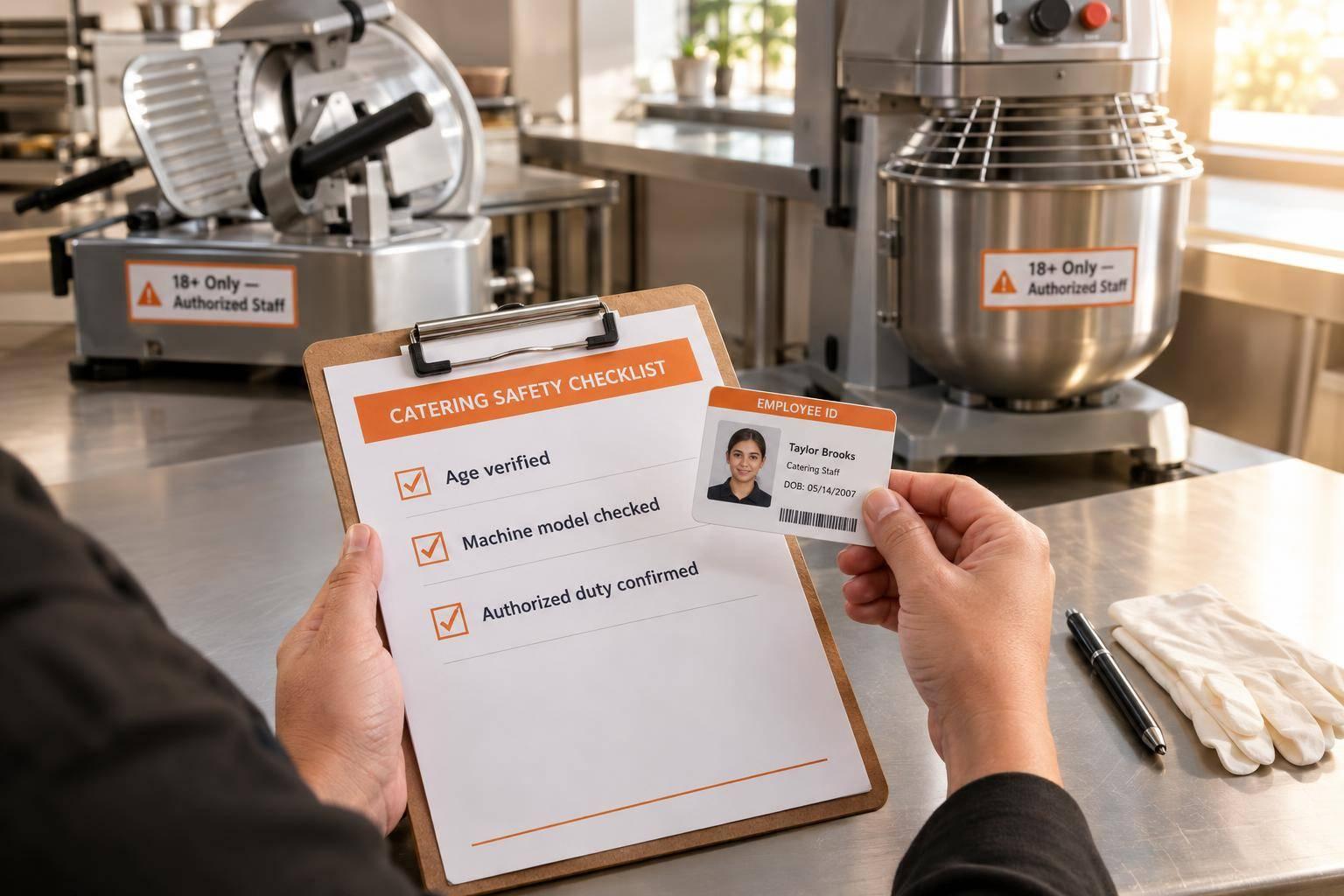
Catering workers under 18 cannot operate or clean covered meat-processing and bakery machines - even with adult supervision. Before assigning work, managers must check the worker’s age, the exact machine, and the task.
Scheduling software can share approved assignments. It does not decide whether the work is legal.

Under-18 Catering Equipment: Pre-Shift Compliance Check
Age eligibility is just the starting point. The machine and the task - not the job title - determine what a minor can do.
29 CFR § 570.61, Hazardous Occupations Order No. 10, prohibits minors from operating, feeding, setting up, adjusting, repairing, oiling, or cleaning covered meat-processing equipment. That includes individual parts and attachments. Having an adult run the controls while a minor feeds ingredients does not get around the restriction.
| Equipment category | Under-18 restriction | Does the product change the rule? |
|---|---|---|
| Power-driven meat slicers | All duties listed above are prohibited | No |
| Meat grinders, choppers, hashing or mixing machines, and patty formers | All duties listed above are prohibited | No |
| Meat and bone saws; powered poultry shears and related covered equipment | All duties listed above are prohibited | No |
| Food processors when used for meat or poultry | All duties listed above are prohibited | Yes; use for meat or poultry determines coverage |
Cleaning has narrow exceptions. Do not assign workers under 18 to hand-wash disassembled parts of covered meat-processing equipment. A minor may load a rack into an automatic dishwasher only without touching the parts. Check the handling process and state rules before using this approach.
Bakery rules also distinguish hand tasks from covered machine work. Under 29 CFR § 570.62, Hazardous Occupations Order No. 11, minors may measure ingredients by hand. But they cannot load, adjust, clear dough from, or dismantle a covered mixer unless a specific exception applies.
| Bakery equipment | Generally prohibited duties | Limited qualification |
|---|---|---|
| Horizontal and vertical dough mixers; batter mixers | Operating, assisting with operation, setting up, adjusting, repairing, oiling, and cleaning | Certain portable countertop mixers may qualify for an exception |
| Bread dividers, rounders, molders; dough brakes and sheeters | All duties listed above | No general federal exception identified in the cited rule |
| Combination bread-slicing and wrapping machines; cake-cutting bandsaws | All duties listed above | No general federal exception identified in the cited rule |
| Cookie and cracker machines | Setting up or adjusting | Review other duties separately; this is not blanket permission |
A countertop mixer qualifies only if it is lightweight, portable, comparable to household equipment, and not hardwired. It must also have motor power of 1/2 horsepower or less and a capacity of 5 quarts or less. Check the manufacturer’s specifications for the exact model. This exception does not cover meat or poultry processing, and it applies only to the exact machine and duty allowed.
For qualifying pizza-dough rollers, the limited exception allows operation - but not setting up, adjusting, repairing, oiling, or cleaning. Training, supervision, protective equipment, and unplugging the machine do not make a restricted task legal. Assign those duties to an eligible adult unless a specific exception applies.
Once equipment bans are clear, turn them into specific shift assignments. Create role codes for defined duties - not general kitchen help. Keep secure records of each worker’s age, permits, training, equipment permissions, and dated approvals. Track restricted tasks separately: operation, feeding, setup, cleaning, disassembly, adjustment, repair, and maintenance.
Records should show exactly who may do what - and on which machine. Before publishing shifts for workers ages 14–15, check permitted tasks and federal hour limits. Follow stricter state requirements where they apply.
For each machine, record its manufacturer, model, operating instructions, intended use, assigned task, and approval basis. Add classification notes when needed. If the machine or task is unclear, pause the assignment and check with the U.S. Department of Labor, the state labor agency, or counsel.
Recheck permissions whenever menus, venues, machines, staffing, or shift duties change. That includes added closing work. Use scheduling software to publish only assignments cleared by law and manager review.
Use Quickstaff to publish approved roles, keep shift and venue details in one place, and send reminders. Managers must check legality separately: Quickstaff does not verify age, classify machines, or enforce child-labor limits.
Include each shift’s approved role, machine limits, and closing duties in the event record. Require manager sign-off before making the assignment.
Use the rules above as your pre-shift checklist. Before each shift, check the worker’s age, the machine, and the exact duty. Keep workers under 18 off covered equipment unless a documented exception applies. Do not assign minors to hand-wash disassembled meat-processing parts.
For workers ages 16–17, apply a mixer exception only to the exact model the rule allows - and only for non-meat, non-poultry materials. Permit only the approved pizza-dough roller operation, and check that the machine meets the exception’s specifications. Match each approved exception to one worker, one machine, and one duty.
A student-learner exception requires approved-program records; school enrollment alone isn’t enough. Document that the worker is at least 16, along with the authorized duties, required supervision, and safety precautions. Keep every assignment within that scope.
Complete the checklist with federal, state, and local rules, documented approvals, and supervisor sign-off. Review it after birthdays or changes to equipment, attachments, meat or poultry recipes, venues, supervision, or exemption status.
Schedules should reflect legal permission, not create it.
Check with the state or local department of labor or health authority where the event takes place to confirm the rules for the specific equipment and task. When federal and state labor laws overlap, the stricter rule applies.
For staff under 18, check the rules for the task they’ll perform, not just their job title. Record the source, the date you checked, and the result.
Remove the minor from the prohibited task immediately to comply with federal hazardous-occupation rules and child labor standards. If equipment is involved, put safety first and reassign the worker to duties legally permitted for their age.
Review your scheduling practices to prevent similar errors. Use Quickstaff to help match minors with age-permitted duties when assigning shifts.
At check-in, run a final compliance check and verify each replacement’s eligibility before assigning restricted tasks. Update the roster right away and keep both versions. If you can’t verify eligibility for a task, assign the replacement only to non-hazardous roles or find another worker.
Quickstaff’s centralized event management and availability tracking help managers handle substitutions and support compliance checks.