Georgia Labor Protections for Event Staff Guide
August 29, 2026

If you hire event staff in Georgia, even for one shift, you need to get four things right: pay, worker status, minor rules, and safety. For most employers, the main pay rules come from federal law: $7.25/hour minimum wage, overtime after 40 hours in a workweek, and strict tip-credit rules for servers and bartenders. On top of that, Georgia has extra rules for labor pools, recordkeeping, and minors.
Here’s the short version: if you control the schedule, direct the work, and provide the tools, the worker will often count as an employee. That means you need correct time tracking, proper overtime pay, tip shortfall checks, and clear records. If minors are on site, you also need to watch hour limits, permits, and banned duties like lifts, driving, and rigging.
What I’d focus on first:
A few numbers matter most here: $2.13/hour is the tipped cash wage, the max federal tip credit is $5.12, and workers under age 18 cannot do many high-risk backstage or setup tasks. In plain terms, small payroll mistakes at one event can turn into wage claims when the same worker picks up shifts at several events in one week.
This guide breaks down the rules in a simple way so I can see what event employers in Georgia need to check before, during, and after each shift.
Once you've sorted out worker status, the next job is pay. That means getting hours, overtime, and tip rules right.
A lot of Georgia event workers - servers, bartenders, setup crews, and festival staff - are non-exempt. That means they must be paid at least $7.25 per hour. Georgia's state minimum wage is $5.15 per hour, but that lower rate applies only to employers that aren't covered by the FLSA. For most event employers, the federal rate is the one that matters.
Overtime starts at 1.5× the regular rate for any hours over 40 in a single workweek. Not per day. Not per event. So if a bartender works 42 hours in one week, those extra 2 hours must be paid at time-and-a-half.
The practical fix is simple: track every shift inside the same workweek, add up all event hours for each worker, and run payroll from that total.
Servers, bartenders, and banquet or catering waitstaff who regularly get more than $30 a month in tips count as tipped employees. Georgia uses the federal tip-credit rule. Employers can pay $2.13 per hour in cash wages and claim up to a $5.12 credit, but the worker's cash wages plus tips still have to equal at least $7.25 per hour.
Here's what that looks like in plain English. If a bartender works 20 hours and reports only $80 in tips, that's an average of $4.00 per hour in tips. Add the $2.13 cash wage, and total hourly pay comes to just $6.13. That's $1.12 below the minimum. In that case, the employer has to make up the shortfall by adding $22.40 in extra wages for that week.
There's one more catch. To use the tip credit, the employer has to tell workers about the cash wage, the tip credit, and the tip-pool rules. If that notice doesn't happen, the credit is off the table and the full cash minimum wage is owed.
Tip pools have limits too. They can include only employees who customarily and regularly receive tips, and managers or supervisors can never take a cut.
Georgia labor-pool workers must be paid in cash or by check, and they must get a stub or receipt that shows hours, rate, and deductions.
This gets a little messy when someone works several events in the same week - a weekend festival, a wedding, and a corporate dinner, for example. The clean way to handle it is to tag each shift with an event ID, then total all hours by workweek before payroll. Quickstaff puts event creation, scheduling, availability, waitlists, and reminders in one place, so teams can group hours by event before payroll runs. That helps employers spot overtime before it turns into a problem, split tipped and non-tipped hours, and make sure each pay stub matches the hours, rates, and deductions on file.
Keep wage records for at least four years for unemployment tax purposes and at least one year under state wage-record rules.
Those records also support the next step: minor-hour and safety checks.
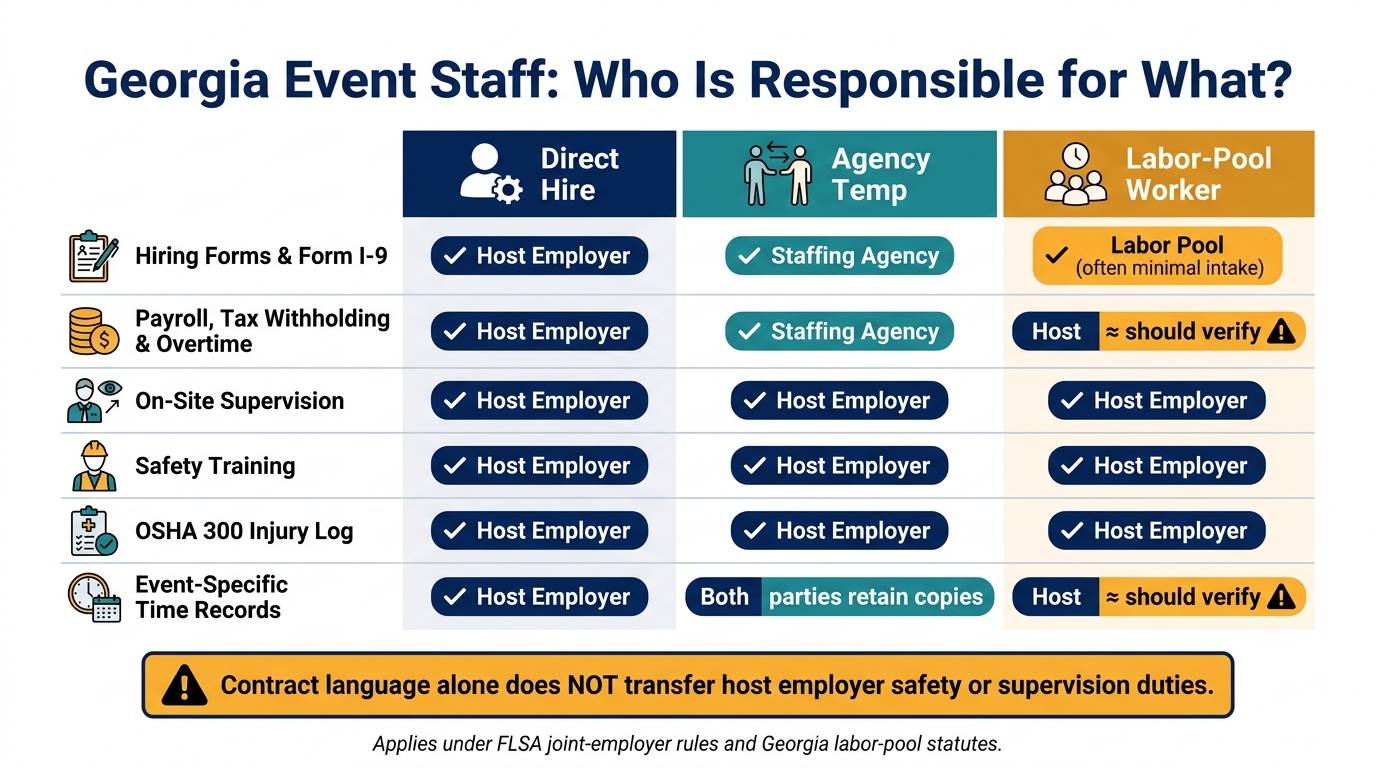
Georgia Event Staff Worker Types: Compliance Responsibilities at a Glance
Once pay rules are set, the next issue is control: who legally directs the worker?
Classification affects wages, taxes, and safety duties. Under the FLSA, the test is economic reality. It looks at profit or loss, investment, permanence, control, whether the work is integral to the business, and skill or initiative. Georgia unemployment law uses a different test, and it starts from employee status unless the worker runs an independent business and is free from control.
In day-to-day event work, this usually isn't hard to spot. If someone wears your uniform, uses your gear, and works the schedule you set, they're almost always an employee, not a contractor. A self-employed DJ or photographer is different. If they bring their own equipment, market their services to many clients, carry insurance, and set their own rates, they are more likely to qualify as a contractor. Even then, the full factor review still matters. Get this wrong, and the costs can pile up fast: back wages, overtime, taxes, workers' compensation, unemployment, and FLSA liquidated damages.
A pre-event classification checklist can save a lot of trouble. It should cover:
Managers should keep that checklist, any contractor agreement, and proof of the worker's business in the file.
Georgia law defines a temporary help contracting firm as a business that employs workers and supplies them to a third party while the client handles day-to-day supervision. In the event world, that firm often takes care of hiring paperwork, tax withholding, payroll, and overtime calculations.
But here's the part that trips people up: the host event company still shares responsibility.
Under federal joint-employer guidance, if your business sets schedules, directs on-site tasks, or can discipline or remove workers from an event, you likely share wage and safety duties. So even when an agency runs payroll, you still need to track actual hours worked, stop off-the-clock work, and flag payroll problems with the agency right away.
Georgia's labor-pool rules deal with a different setup: casual assignments that need little screening or training. These jobs come with specific worker protections. Neither the labor pool nor the host employer may charge fees for equipment or transportation to the job site. If your event company uses a labor pool, get written confirmation that those fees are barred and that workers receive hazard information before they arrive on site.
The chart below shows where each duty usually falls by worker type.
| Responsibility | Direct Hire | Agency Temp | Labor-Pool Worker |
|---|---|---|---|
| Hiring forms and Form I-9 | Host employer | Staffing agency | Labor pool (often minimal intake) |
| Payroll, tax withholding, and overtime | Host employer | Staffing agency | Varies; host should verify |
| On-site supervision | Host employer | Host employer | Host employer |
| Safety training | Host employer | Host employer | Host employer |
| OSHA 300 injury log | Host employer | Host employer | Host employer |
| Event-specific time records | Host employer | Both parties should retain copies | Host employer should verify |
Keep the host's control and training duties in writing. Contract language by itself does not move that duty to someone else.
Those same control and supervision facts also decide who must deal with minor-hour limits and site safety.
Once pay and worker status are set, the next step is simple: check age limits and site safety before you hand out event shifts.
Georgia child labor law and the FLSA both apply, and the stricter rule wins. In plain terms, younger teens face tighter scheduling limits, and all minors face limits on dangerous work.
Minors ages 14–15 may work only in non-hazardous jobs outside school hours and must have a work permit. Their time is capped at 3 hours on a school day, 18 hours during a school week, 8 hours on a non-school day, and 40 hours in a non-school week. They may work from 7:00 a.m. to 7:00 p.m. during the school year, with that window extended to 9:00 p.m. from June 1 through Labor Day. Georgia also bars them from working between 9:00 p.m. and 6:00 a.m. Work permits are obtained online, usually through the minor's school or the Georgia Department of Labor.
Workers age 16 and older do not need a Georgia work permit, except minors in entertainment, who must follow a separate certification process. Even so, hazardous-occupation bans still apply to everyone under 18.
Event work can get tricky fast when minors are part of the cast or crew.
If your event includes concerts, theatrical productions, live performances, or similar work, Georgia's minors-in-entertainment rules stack on top of the general child labor rules. Employers of performers under 18 must get written consent from the Commissioner of Labor and have the needed permit or registration in place before the minor starts performing. That rule also covers out-of-state minors who perform in Georgia. Georgia law bars infants from birth to 15 days old from working in any production.
Federal hazardous-occupation rules also set hard limits on backstage and setup work. Workers under 18 cannot operate or ride power-driven hoisting equipment, including manlifts, scissor lifts, cherry pickers, cranes, and high-lift trucks, all of which often show up during staging and lighting installs. Work involving elevated rigging from lifts or cranes is off-limits. Driving on public roads is barred for anyone under 17, and 17-year-olds may drive only under tight daytime conditions.
A good rule of thumb: keep minors on performance-related tasks, and leave rigging, driving, heavy equipment, elevated work, and late-night teardown to adults.
At events, age rules and safety rules often collide in the same space. Setup, teardown, crowd control, and guest-facing work can all happen at once.
Federal OSHA applies in Georgia, and both staffing agencies and host employers share responsibility for worker safety. On most event sites, the host employer is in the best position to spot hazards on the ground. So the host should handle site-specific hazard training and enforce safe work practices, while the staffing agency should provide general safety orientation and add training on workers' rights.
Before the event starts, complete a hazard assessment that covers:
Then share those findings with the staffing agency. PPE duties should also be spelled out in writing. That may include hearing protection near loud music, high-visibility vests for parking staff, and gloves for cleanup crews.
When minors are on site, supervisors need to know the age-based task limits, give safety instructions in plain language, and confirm that the minor understands the rules before the shift starts. It also helps to keep written records of supervision, training, and who handles escalation if something goes wrong. That makes OSHA compliance and child labor enforcement much easier to document.
Once pay, classification, and safety rules are in place, your records are what show you actually followed them. If a wage claim or audit lands on your desk, clean records can make all the difference. Georgia law requires employers to keep accurate records of each employee's name, address, occupation, daily and weekly hours worked, and wages paid each pay period. Keep those records for the longest period required under both Georgia and federal law.
For each event, keep a file that shows each worker's legal name, date of birth for minor-status checks, job role, pay rate, and employer of record - whether that's a direct hire, staffing agency, or labor pool. Track shift dates plus start and end times in one consistent format. For tipped workers, record the cash wage paid per hour, tips reported for each shift, and any tip pool arrangement. For minors, include copies of age documentation, work permits where they apply, and a duty log for each minor. Add safety training sign-in sheets and PPE records to the same event file.
A simple file structure helps a lot: organize records by event name or event ID, then by worker. That makes it much easier to pull records for one event during an audit. It also helps you check whether a worker's combined hours across several events in the same week led to unpaid overtime. Georgia law also bars false entries in employment records, so bad time logs aren't just messy - they can create legal trouble.
This gets much easier when scheduling and time tracking live in the same system. Paper sign-up sheets and spreadsheets can fall apart fast, especially when a server works three short shifts at three different venues in one week. That's where mistakes happen. A centralized scheduling platform helps managers track total hours for each worker across all events in a single workweek, not just one location.
Quickstaff puts event schedules, availability, reminders, and staff assignments in one place, which helps managers track hours by worker and by event. Role-based staff assignment also makes it easier to give minors only approved duties and flag shifts that would put them over allowed hours. Mobile reminders and centralized scheduling can also cut down on off-the-books changes that later turn into payroll disputes.
After you've handled pay, worker classification, and safety, the last step is backing all of it up with records. Keep complete event-by-event files and store them for the longest retention period required under Georgia and federal law. Good records help cut wage claims, audit risk, and payroll mistakes.
Yes. You have to add up all hours an employee works across different roles, events, or locations within the same 168-hour workweek.
You can’t split hours by job or event to get around overtime. If the total goes over 40 hours in a workweek, the employee must be paid 1.5 times their regular rate for those extra hours.
Use the economic reality test to look at the working relationship as it exists in day-to-day work.
A worker is more likely to be an employee when your business controls key parts of the job, such as their schedule, uniform, tasks, or the way the work gets done. The same goes if you pay them by the hour and they use tools your company provides.
Economic dependence also matters. If the worker depends on your business for income and handles tasks that sit at the heart of your business, they’re likely an employee.
A contract or job title by itself does not decide classification.
In Georgia, minors usually can't do hazardous work under federal and state child labor rules. For event jobs, that can include heavy physical tasks and using heavy equipment, like forklifts or specialized power machinery, especially for anyone under 18.
Georgia does not list event-specific banned tasks beyond these general child labor standards.