Washington Temp Event Worker Laws: 2026 Guide
August 19, 2026

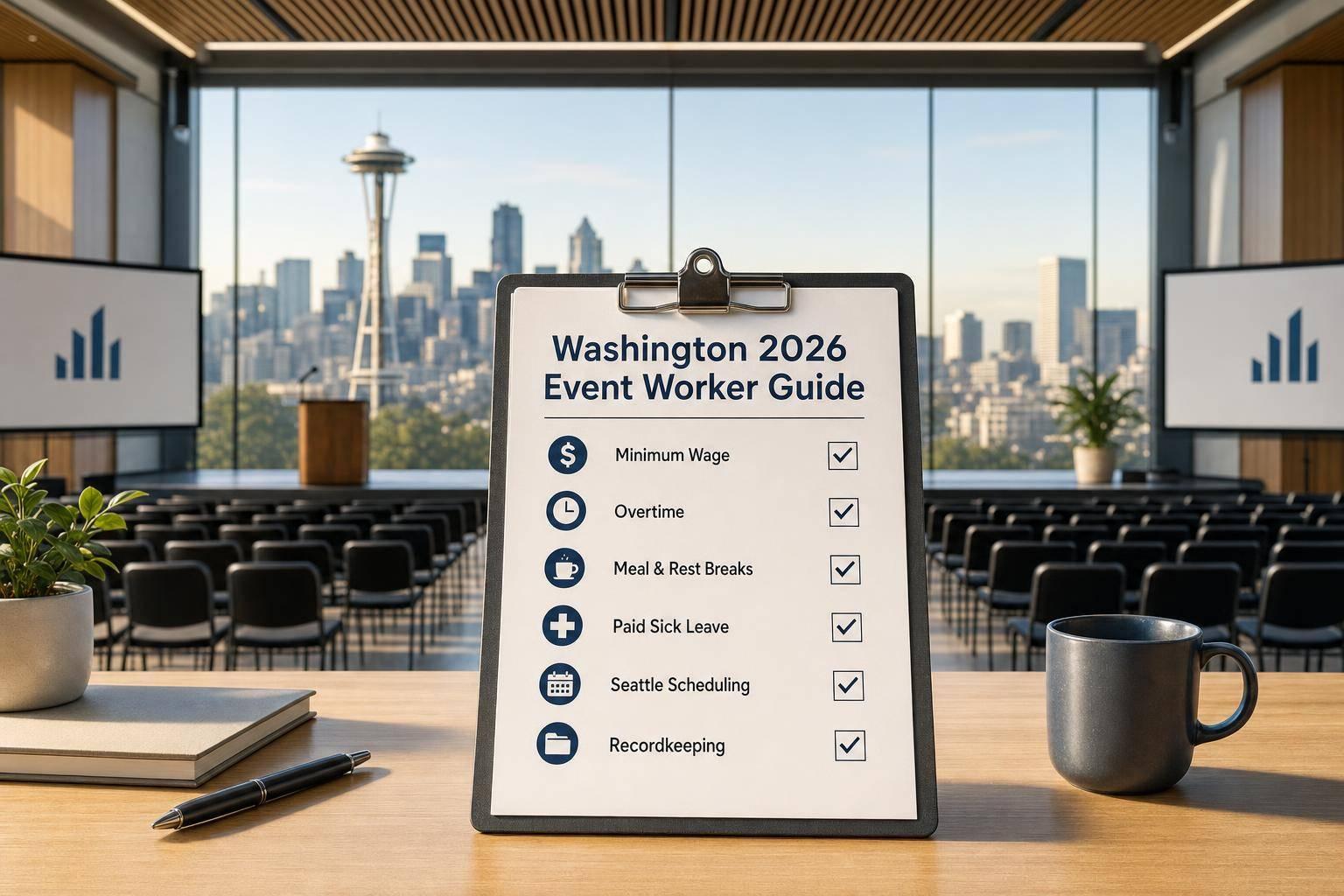
If you hire temp event staff in Washington in 2026, you need to get 7 things right: pay, overtime, breaks, sick leave, records, Seattle schedule rules, and job-site safety.
Here’s the short version: Washington’s state minimum wage is $17.13/hour in 2026, overtime usually starts after 40 hours in a workweek, paid sick leave accrues at 1 hour for every 40 hours worked, and payroll records must be kept for at least 3 years. If your event is in Seattle, local minimum wage rules may be higher, and some large food service or retail employers also face 14-day schedule posting rules.
If I were running event staffing, I’d check these first:
A few points cause most problems. One worker may do setup on Friday, bartend Saturday, and work teardown Sunday. If those hours sit in different files, overtime can get missed. The same goes for workers paid at more than one rate in the same week, or teams using service charges the wrong way.
And one more thing: Washington does not allow a tip credit. That means tipped staff still must get the full minimum wage in cash wages, before tips.
Below, I break the rules into plain steps so you can schedule shifts, run payroll, and keep records with fewer errors.
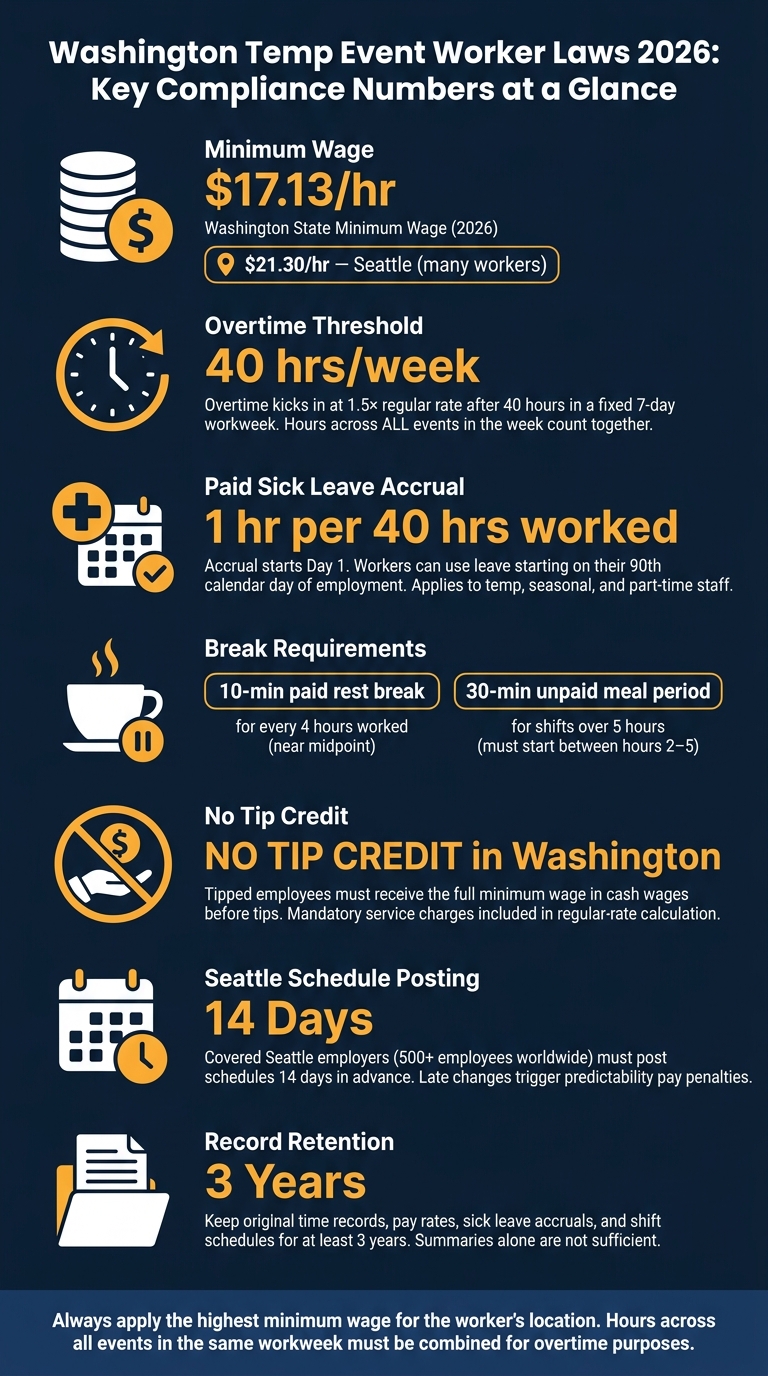
Washington Temp Event Worker Laws 2026: Key Compliance Numbers at a Glance
Washington's statewide minimum wage is $17.13 per hour in 2026. For workers age 14 or 15, the rate is $14.56 per hour, subject to youth labor rules.
Before you set pay rates, check the event location first. Seattle's 2026 minimum wage is about $21.30 per hour for many workers. If the city sets a higher local rate, use that rate.
Washington overtime law is pretty simple on paper: employees must receive 1.5 times their regular rate for all hours over 40 in a fixed seven-day workweek. The catch is in the setup. You need one fixed seven-day workweek, defined in writing, and you need to apply it the same way across all staff and events.
After the hourly rate is set, the next problem is how those hours stack up.
Overtime mistakes often happen when hours are split across multiple events in the same workweek, mainly when each event is tracked on its own. A worker might handle setup on Friday, serve a wedding on Saturday, and work a corporate brunch on Sunday. On separate schedules, that can look harmless. Added together, it can push the worker past 40 hours before payroll even sees it.
Role changes make things harder. If one person works different jobs at different pay rates in the same week, payroll has to calculate a blended regular rate before applying overtime. Miss that step, and the worker can be underpaid even if the hour count is right.
Service charges need close attention too. Washington does not allow a tip credit, so tipped employees still must be paid the full minimum wage in cash wages before tips enter the picture. And mandatory service charges are not tips. If workers get any part of those charges, that amount must be included in the regular-rate calculation. This comes up all the time at catered events and venues where service income is split across crews.
Shared staffing can turn into a mess fast. When a staffing agency sends workers to a venue or caterer, it may not be obvious who handles wage compliance. In some cases, both the agency and the host business can be treated as joint employers. That means both may share liability if hours are missed or overtime is not paid.
Most event payroll mistakes start with scattered records. If banquet staff hours are in one spreadsheet, bar staff hours are on paper sign-in sheets, and festival crew hours are buried in someone's email, there's no easy way to spot a worker's actual weekly total before payroll closes.
Quickstaff puts event assignments, availability, reminders, and shift details in one place. That gives managers a clearer view of total hours and helps cut payroll mistakes. The same visibility also helps with break tracking and sick-leave compliance in the next section.
Once pay is locked in, the next risk area is shift design.
Every nonexempt temporary or seasonal event worker must get a paid 10-minute rest break for every 4 hours worked, or major part of that 4-hour block. That break should be scheduled near the midpoint of the work period. Workers also need a 30-minute meal period on shifts over 5 hours.
Here’s how that plays out for three common event shifts:
| Shift Type | Duration | Rest Breaks Required | Meal Periods Required |
|---|---|---|---|
| Reception | 4 hours | 1 paid 10-min break | None (shift ≤ 5 hours) |
| Banquet | 6 hours | At least 1 paid 10-min break | 1 unpaid 30-min meal period (starts between hours 2–5) |
| Festival day | 10 hours | At least 2 paid 10-min breaks | 2 unpaid 30-min meal periods |
These examples assume workers are fully relieved during meal periods. If a shift goes past 10 hours, a second 30-minute meal period is required.
This is one of those rules that can trip up event teams fast. A break plan needs to be built before the event begins, not improvised in the middle of service. For guest-facing jobs like bar service or registration, it helps to assign a floater or cross-trained team member to step in during breaks so service stays steady while the law is followed.
Washington’s paid sick leave law applies to all employees, including temporary, seasonal, and part-time event staff. The accrual rate is 1 hour of paid sick leave for every 40 hours worked, and accrual begins on the first day of work. Workers can start using that leave no later than their 90th calendar day of employment.
Employees may use sick leave for their own illness or medical appointments, to care for a sick family member, or for certain safety-related reasons. In event work, this often shows up as a same-day callout before a shift. A server who wakes up sick before a Saturday wedding can use accrued sick leave for those missed hours, and the employer cannot retaliate for lawful use of that leave.
For workers who pick up recurring weekend assignments over several months, sick leave keeps accruing across all shifts and carries over, subject to the usual carryover cap.
Employers must give each worker written or electronic notice of sick leave rights at hire. They also must provide at least monthly written balance statements showing hours accrued, used, and remaining, often through payroll statements. One scalable event scheduling system for all event assignments makes this much easier and helps keep sick-leave accrual tied to actual time worked.
Scheduling also matters in Seattle, where posted-shift changes can lead to extra pay risk.
Washington does not have a statewide predictive scheduling law. Seattle’s Secure Scheduling Ordinance (SMC 14.22) applies to certain large food service and retail employers - generally those with 500 or more employees worldwide, and for full-service restaurants, at least 40 locations worldwide. Covered employers must post schedules at least 14 days in advance and pay predictability pay when they change a posted schedule inside that window.
Here’s how common scheduling practices compare in Seattle versus the rest of Washington:
| Scheduling Practice | Seattle (Covered Employers) | Rest of Washington |
|---|---|---|
| Added or moved hours | 1 extra hour of pay at regular rate | No penalty required |
| Canceled or reduced shift | Half pay for hours not worked | No penalty required |
| On-call shift not used | Half pay for hours not worked | No penalty required |
| Last-minute call-in | 1 extra hour of pay at regular rate | No comparable requirement |
| Close-to-open shift under 10 hours apart | 1.5× pay for hours worked in that window | No comparable requirement |
For caterers, venues, and staffing agencies working with changing rosters, schedule edits inside that 14-day window can trigger predictability pay. A canceled shift can mean half-pay for the scheduled hours. The plain takeaway: post schedules only when rosters are stable enough to avoid extra pay you could have avoided.
Those schedule changes also need to line up with payroll records.
When schedules, pay, or leave become a point of conflict, records do the heavy lifting. Once event staff scheduling is in place, those records show whether wages, breaks, and leave were handled the right way.
Washington requires employers to keep payroll and time records for at least three years. And that means the original time records, not just summaries.
For each worker, keep records showing name, address, job title, hire date, separation date, pay rate or rates, gross pay for each pay period, and hours worked. For workers covered by paid sick leave rules, track sick leave accrual, use, balances, plus hire and separation dates.
| Record Type | Why It Matters | Retention Note |
|---|---|---|
| Name, address, job title | Identifies the worker and role | At least 3 years |
| Dates of employment | Confirms coverage periods | At least 3 years |
| Pay rate(s) | Verifies minimum wage and overtime compliance | At least 3 years |
| Amount paid each pay period | Supports wage dispute resolution | At least 3 years |
| Hours worked (original time records) | Basis for overtime, sick leave accrual, and break compliance | At least 3 years |
| Sick leave accruals, balances, and use | Required for paid sick leave compliance | At least 3 years |
| Shift schedules and changes | Supports break and schedule-compliance records | At least 3 years |
Employees can ask for copies of their payroll records at a reasonable time.
These records become even more important when a staffing agency and a host employer divide the day-to-day work.
When a staffing agency supplies workers to a venue or event organizer, the job duties may split, but the legal duties do not vanish. Under Washington safety rules and wage-and-hour law, staffing agencies and host employers may both carry responsibility, depending on who controls hiring, scheduling, pay, and records.
| Responsibility | Direct-Hire | Agency-Supplied Staff |
|---|---|---|
| Payroll and overtime | Direct employer | Staffing agency (employer of record) |
| Sick leave administration | Direct employer | Staffing agency |
| Break compliance on-site | Direct employer | Host venue |
| Schedule communication | Direct employer | Host venue communicates assignments |
| Worker complaints (pay/leave) | Direct employer | Agency primary; host secondary |
| Worker complaints (safety/on-site) | Direct employer | Host primary; agency secondary |
| Payroll recordkeeping | Direct employer | Staffing agency; host venue keeps shift logs |
| Safety training records | Direct employer | Both parties maintain their own documentation |
That split should be written into the contract. If the agreement does not clearly assign roles, both sides may end up sharing liability for wage violations.
Safety records follow the same pattern.
Washington places safety duties on both staffing agencies and host employers, and both can be cited when rules are broken.
The staffing agency handles the front-end review. It must check worksite safety conditions before sending workers, provide general safety training in the worker's language, and tell workers how to report hazards. If the site is dangerous and the host employer will not fix the problem, the agency must pull its workers from the site.
The host employer handles the site-specific piece. Before a temp worker starts, the host must document expected hazards and share that information with the staffing agency. The host must also provide site-specific training, keep training records, and confirm completion to the agency within three business days. Put plainly: site-specific training is the host employer's job, and those records should sit alongside the rest of the compliance file.
The checklist below turns those duties into a pre-event compliance process.
With wages, breaks, leave, records, and safety duties already set, use this checklist for every event.
The goal is simple: run the same before-, during-, and after-event process for each shift so payroll, scheduling, and recordkeeping don’t drift off course.
Before the event, confirm the employer of record in writing. That could be the venue, catering company, staffing agency, or event organizer. Then apply the highest minimum wage tied to the worksite. Set meal and rest breaks into the shift plan before anyone clocks in. Washington requires a 30-minute meal period for shifts over five hours, and it must start between the second and fifth hour. The state also requires a paid 10-minute rest break for every 4 hours worked. Put those breaks into the roster upfront, not in the middle of a rush.
During the event, track actual clock-in and clock-out times, not just what was on the schedule. That part matters more than many teams think. You also need to watch weekly totals across all events, because overtime starts after 40 hours in the workweek.
After the event, reconcile all hours worked, update sick leave based on total hours worked, and keep time, pay, leave, and schedule records for at least three years. If Seattle scheduling rules apply, check any last-minute schedule changes and save those records too.
A few rules do most of the heavy lifting in day-to-day compliance.
If a staffing agency is part of the setup, spell out wage, sick leave, and recordkeeping duties in writing. Quickstaff can centralize scheduling, availability, and shift records to support that process. That helps keep payroll, scheduling, and documentation lined up from event setup through final pay.
Aggregate all hours a nonexempt employee works across multiple events within a single, fixed 168-hour workweek. Don’t average hours across multiple weeks - that can lead to overtime mistakes.
Track all compensable time, not just time spent at the event itself. That includes setup, teardown, cleanup, mandatory meetings, and travel between job sites. If someone works before the doors open or after the crowd leaves, those hours still count.
A centralized system like Quickstaff can help you monitor total hours across assignments in real time, so you can spot overtime before it becomes a payroll problem.
If Seattle rules conflict with state or federal law, the safest move is to follow the rule that gives the employee the greatest benefit.
In plain English: use the strictest standard for things like overtime, minimum wage, and meal or rest breaks. That helps you stay compliant across city, state, and federal rules.
Responsibility is often shared. In many cases, the staffing agency and the host employer are joint employers, which means both can be held accountable for compliance, including workplace safety and job-site hazards.
The staffing agency usually takes care of employment-related matters, such as workers’ compensation. The host employer, meanwhile, must provide the same safety protections as it does for its own staff, along with training on site-specific hazards.
If either side drops the ball, it can face consequences.