Temporary Worker Rights Under Federal Law
May 19, 2026


Temporary workers play a critical role in industries like events and hospitality. But did you know they’re entitled to many of the same protections as permanent employees under federal law? Here’s what you need to know:
Employers and workers alike must understand these rights to avoid compliance issues and ensure fair treatment.
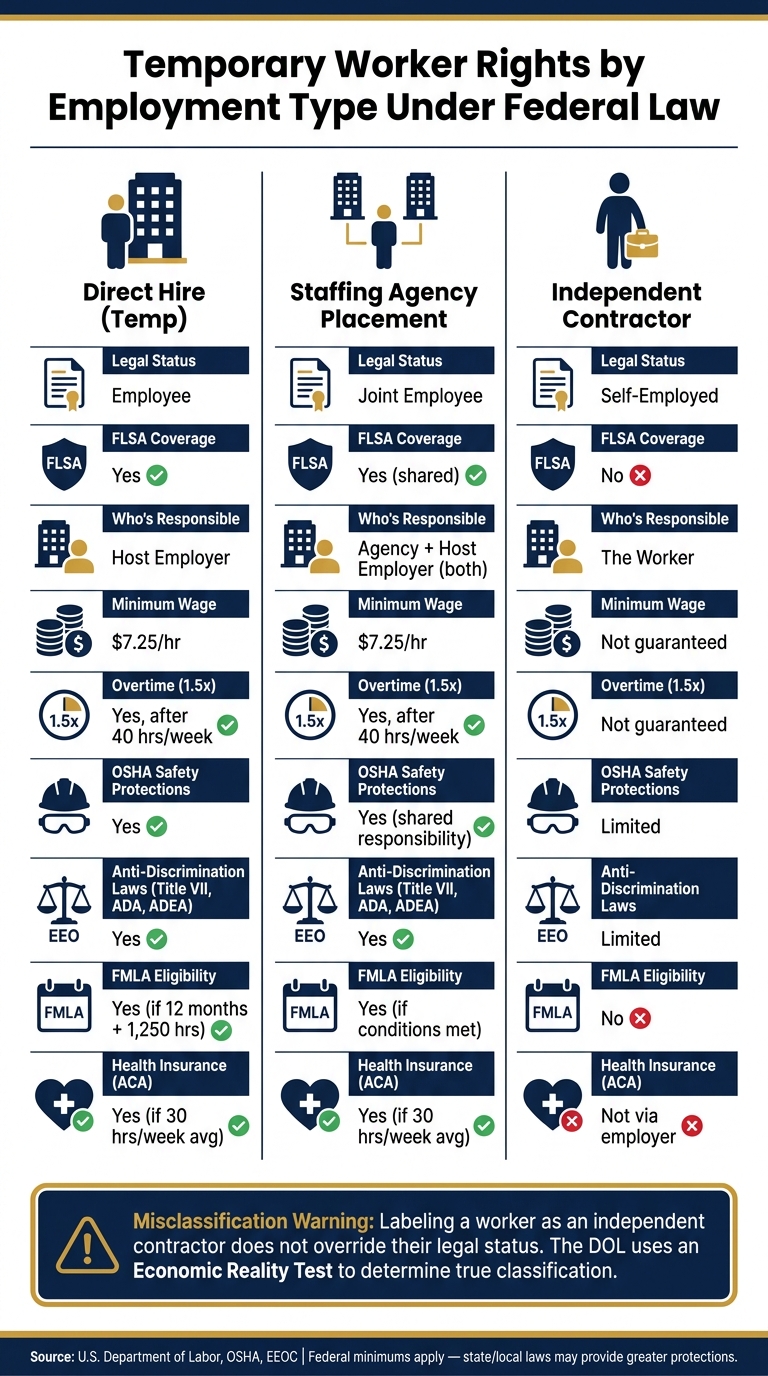
Temporary Worker Rights by Employment Type: Federal Law Breakdown
Federal law doesn’t officially define "temporary worker" as a separate legal category. Instead, the focus is on the nature and duration of the work relationship and whether the worker is classified as an employee or an independent contractor.
Temporary workers generally fall into one of three categories: direct hires, staffing agency placements, or independent contractors. Here's how each works:
The difference between an employee and an independent contractor isn’t based on job titles or contract language. As the U.S. Department of Labor (DOL) explains:
"Under the FLSA, a worker is an employee and not an independent contractor if they are, as a matter of economic reality, economically dependent on the employer for work - regardless of whether they sign an independent contractor agreement."
To make this distinction, the DOL uses an economic reality test, which currently includes six factors. However, this will soon shift to a five-factor test focusing on control and opportunity for profit or loss. These classifications play a key role in determining which federal labor protections apply.
A worker’s classification is crucial in understanding their legal rights. Temporary workers, when classified as employees, are entitled to the same protections as permanent employees. Federal laws like the Fair Labor Standards Act (FLSA), OSHA regulations, and anti-discrimination laws (e.g., Title VII and the ADA) apply equally to both groups.
Some benefits, such as leave under the Family and Medical Leave Act (FMLA), depend on factors like hours worked or length of service. However, core protections like wage standards and workplace safety apply from the first day on the job.
Things get trickier when staffing agencies are involved. In such cases, both the agency and the host employer may be considered joint employers, meaning they share legal responsibilities for the worker. OSHA emphasizes this shared accountability:
"The staffing agency and the staffing agency's client (the host employer) are joint employers of temporary workers and, therefore, both are responsible for providing and maintaining a safe work environment for those workers."
For example, if a catering company hires servers through a staffing agency, both parties share responsibility for wage compliance, safety training, and anti-discrimination measures. OSHA strongly recommends that both the agency and the host employer outline their specific roles - such as who handles safety training or recordkeeping - in a written agreement to avoid any gaps in responsibility.
Here’s a quick breakdown of responsibilities based on the type of worker:
| Arrangement | Legal Status | FLSA Coverage | Who's Responsible |
|---|---|---|---|
| Direct Hire (Temp) | Employee | Yes | Host Employer |
| Staffing Agency Placement | Joint Employee | Yes (shared) | Agency + Host Employer |
| Independent Contractor | Self-Employed | No | The Worker |
This framework ensures compliance with federal labor laws while safeguarding the rights and safety of temporary workers.
Temporary event workers are covered by clear pay regulations that ensure fair treatment and require employers to adhere to federal standards. The Fair Labor Standards Act (FLSA) outlines rules for wages, overtime, and deductions, which apply equally to temporary and full-time employees. Here's a breakdown of key wage-related rights for temporary event workers.
The federal minimum wage is set at $7.25 per hour for covered, nonexempt employees, whether they are temporary or permanent workers. This rate has remained unchanged since July 24, 2009. However, if state or local laws set a higher minimum wage, employers must pay the higher rate. Many states have implemented higher minimum wages, so it's essential to check local regulations when determining pay for temporary event staff.
Absolutely. Temporary workers classified as non-exempt are entitled to overtime pay if they work more than 40 hours in a workweek. Overtime is calculated at 1.5 times the regular hourly rate for all hours beyond 40. A workweek is defined as any fixed, recurring 168-hour period, which doesn’t have to align with the calendar week.
Overtime pay includes time spent on tasks like setup, teardown, pre-event meetings, and even waiting on-site if the worker is "engaged to wait". Ignoring overtime rules can be costly - just in fiscal year 2023, the Department of Labor (DOL) recovered $130.7 million in back wages due to overtime violations.
If a worker earns different hourly rates during the same week, the overtime rate must be calculated using the weighted average of all rates earned during that week.
Special rules apply to tipped workers, such as servers or bartenders at events. Employers can pay these workers a direct cash wage as low as $2.13 per hour, as long as their tips bring their total hourly earnings to at least $7.25. This system is known as a tip credit.
To qualify as a tipped employee under federal law, the worker must regularly earn more than $30 per month in tips. If tips fall short in any workweek, the employer must cover the difference to ensure the worker’s earnings meet the federal minimum wage - this is non-negotiable.
Employers can make certain deductions from a temporary worker's paycheck, such as costs for uniforms or tools, but there are strict limits. (See our event day checklist for common equipment needs.) Deductions cannot bring the worker’s hourly pay below $7.25 per hour, and they cannot reduce overtime pay.
The DOL makes this clear:
"Deductions made from wages for such items as cash or merchandise shortages, employer-required uniforms, and tools of the trade, are not legal to the extent that they reduce the wages of employees below the minimum rate required by the FLSA."
For example, a worker earning $8.00 per hour for 30 hours in a week can only have up to $22.50 deducted from their paycheck ($0.75 × 30 hours). Employers also cannot sidestep this rule by asking workers to pay for items out of pocket instead of through payroll deductions.
Temporary workers are entitled to the same workplace protections as permanent employees, covering both safety measures and anti-discrimination rights.
Absolutely. Under the Occupational Safety and Health Act (OSH Act), temporary workers must receive the same safety protections as permanent employees. These protections address various workplace hazards, including lockout/tagout procedures, heat-related illnesses, noise exposure, and bloodborne pathogens.
The host employer is responsible for providing site-specific safety training and daily oversight, as well as recording any injuries on OSHA logs. Meanwhile, the staffing agency ensures workers receive general safety instruction. If a temporary worker encounters an injury or hazard, they should report it immediately to both the staffing agency and the host employer.
Beyond physical safety, temporary workers are also safeguarded against discrimination.
Yes, federal anti-discrimination laws apply equally to temporary workers. These protections are based on who controls the work, not the terms of the contract. According to the U.S. Equal Employment Opportunity Commission (EEOC):
"Staffing firm workers are generally covered under the anti-discrimination statutes. This is because they typically qualify as 'employees' of the staffing firm, the client to whom they are assigned, or both."
Here’s a breakdown of key anti-discrimination laws:
| Law | Protected Characteristics | Employer Threshold |
|---|---|---|
| Title VII (Civil Rights Act) | Race, color, religion, sex, national origin | 15+ employees |
| ADA | Physical or mental disability | 15+ employees |
| ADEA | Age (40 and older) | 20+ employees |
| GINA | Genetic information, family medical history | 15+ employees |
| Equal Pay Act | Sex-based wage differences for equal work | Virtually all employers |
Both staffing agencies and host employers share responsibility for preventing and addressing discrimination. If discrimination occurs, both parties are accountable for taking swift corrective action.
Federal laws also protect temporary workers from retaliation. This means workers cannot be punished for reporting wage issues, safety concerns, or acts of discrimination. Retaliation - such as firing, demoting, cutting hours, or subjecting workers to increased scrutiny - is illegal. The U.S. Department of Labor makes this clear:
"Firing workers for raising safety concerns is illegal."
These protections extend to all workers, regardless of immigration status. If a temporary worker faces retaliation, they should document the original complaint and any retaliatory actions. For safety-related retaliation, a whistleblower complaint must be filed with OSHA within 30 days of the incident. For discrimination-related retaliation, workers generally have 180 days to file a charge with the EEOC.
Temporary workers often wonder about their rights beyond wages and workplace safety. Depending on their hours worked and duration of employment, they may qualify for leave, health coverage, and even retirement benefits.
Yes, temporary workers can qualify for leave under the Family and Medical Leave Act (FMLA), provided they meet specific conditions. To be eligible, a worker must:
"The 12 months of employment are not required to be consecutive in order for the employee to qualify for FMLA leave." - U.S. Department of Labor
This means that even if a temporary worker has had multiple assignments with the same employer, those periods of employment can be combined to meet the 12-month requirement. Eligible workers can take up to 12 weeks of unpaid, job-protected leave annually for reasons such as a serious health condition or the birth of a child. For those caring for an injured servicemember, the leave extends to 26 weeks.
Under the Affordable Care Act (ACA), Applicable Large Employers (ALEs) must offer health insurance to employees who work an average of 30 hours per week or 130 hours per month. Temporary workers who meet this threshold are entitled to coverage, as long as they are classified as employees rather than independent contractors.
Employers use one of two methods to determine eligibility:
Importantly, any paid time off is included in the calculation of the 30-hour average.
Yes, temporary workers can participate in employer-sponsored retirement plans, like 401(k) or 457(b) plans, if they meet the eligibility criteria. Typically, this requires:
California offers an example with its Part-time, Seasonal, and Temporary (PST) Employees Retirement Program. Workers excluded from the main CalPERS system must contribute 7.5% of their pre-tax wages to a PST account. If they later surpass the 1,000-hour threshold, they become eligible for CalPERS, and their PST funds are usually transferred to a 457(b) account after 75 days.
Temporary workers should carefully review their employer’s Summary Plan Description (SPD), as some plans may exclude "variable-hour" or "seasonal" employees from participation.
Compliance is more than just avoiding fines - it’s about building trust with your temporary workforce. For event businesses and staffing agencies, practical strategies are essential. One of the most important? Accurate time tracking, which forms the foundation of all compliance efforts.
The Fair Labor Standards Act (FLSA) requires employers to compensate workers for all time they're "suffered or permitted" to work. For temporary event workers, this could include:
These activities are generally compensable. Additionally, short rest breaks (up to 20 minutes) must be paid, while meal breaks (lasting 30 minutes or more) are unpaid only if the worker is fully relieved of duties. As the U.S. Department of Labor puts it:
"The workday... may be longer than the employee's scheduled shift, hours, tour of duty, or production line time." - U.S. Department of Labor
No matter what timekeeping system you use, the FLSA makes one thing clear: records must be complete and accurate. Or, as the Department of Labor states, "Any timekeeping plan is acceptable as long as it is complete and accurate."
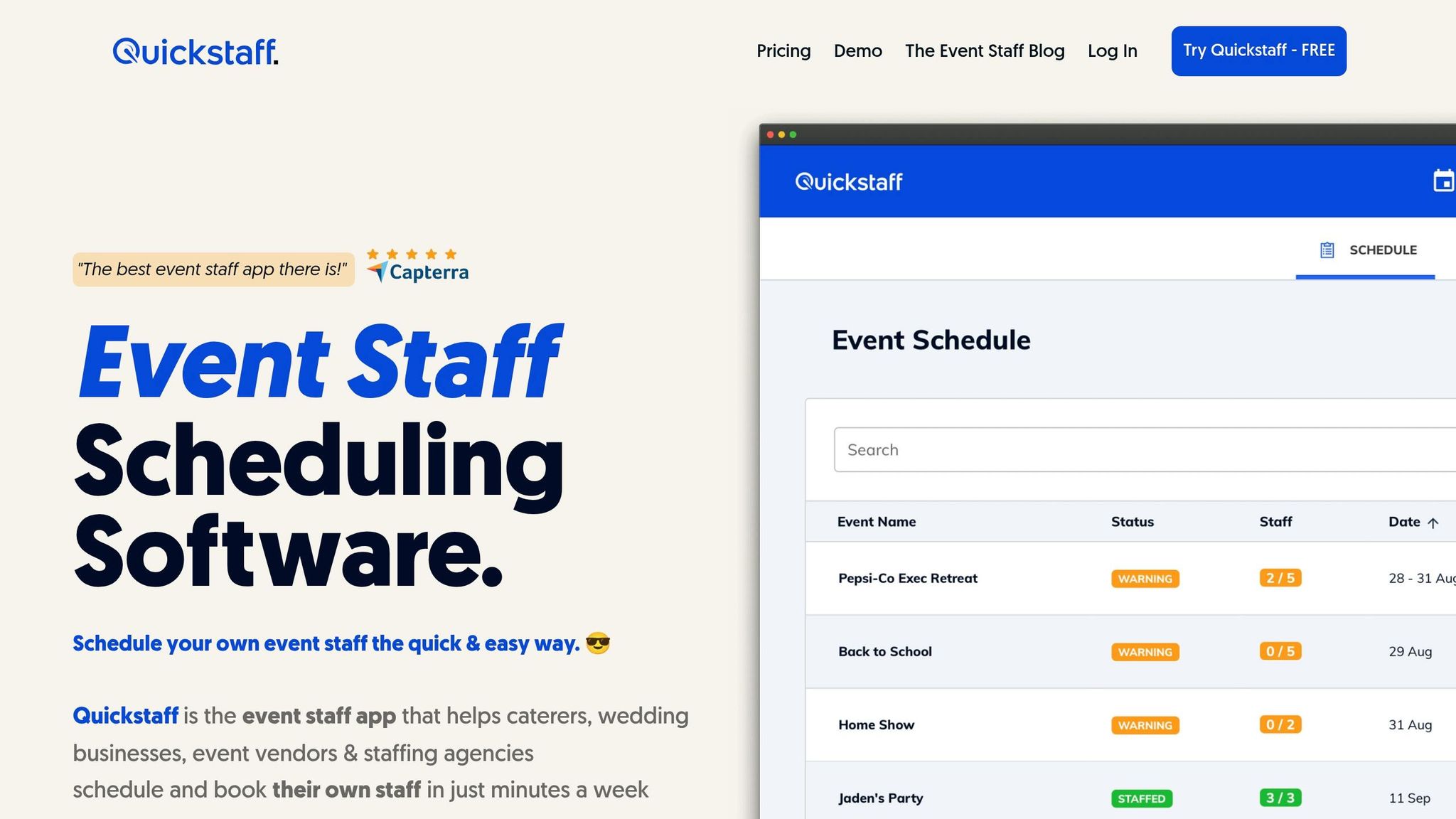
Coordinating temporary workers across multiple venues can be a logistical headache. That’s where Quickstaff comes in. Built for event vendors, caterers, and staffing agencies, Quickstaff simplifies temporary staff management. Its features include:
By keeping schedules clear and communication centralized, Quickstaff helps employers maintain the accurate records required for FLSA compliance. This not only prevents unrecorded overtime but also ensures smooth operations.
Accurate time tracking is just one piece of the puzzle. Employers must also maintain detailed records to meet federal requirements. While there’s no mandated format, key record categories include:
| Record Category | What to Include | Retention Period |
|---|---|---|
| Employee Identity | Full name, Social Security Number, address, birth date (if under 19), sex, occupation | 3 years |
| Payroll Records | Total wages paid, date of payment, pay period covered, deductions | 3 years |
| Timekeeping | Hours worked each day, workweek start day, and total weekly hours | 2 years |
| Wage Computation | Regular hourly rate, straight-time and overtime earnings, wage rate tables | 2 years |
These records must be available for Department of Labor inspections and can be stored either on-site or at a central office. For employees with fixed schedules, employers should document standard hours and note any exceptions.
If a staffing agency places workers with a client business, both parties may share responsibility for FLSA compliance and recordkeeping. Clearly defining responsibilities in staffing contracts can help avoid misunderstandings.
Lastly, remember that repeated or willful violations of minimum wage or overtime rules can lead to steep penalties - up to $2,515 per violation starting January 16, 2025. Keeping thorough, accurate records is one of the best ways to avoid these costly mistakes.
Temporary workers are entitled to the same fundamental protections as permanent employees under federal law, no matter how long their assignment is or what title they hold.
"A worker may be an employee under the FLSA regardless of the title or label they are given."
A crucial aspect of these protections is the concept of joint employer liability. For event businesses and staffing agencies, this means both the staffing firm and the client business share legal accountability for critical areas like wage compliance, safety training, and ensuring discrimination protections. As the EEOC explains:
"Staffing firms and their clients share EEO responsibilities toward these workers."
This shared accountability highlights the potential risks and costs of failing to comply with regulations.
And those costs can add up fast. Repeated violations can result in fines of up to $2,515 per incident. Clearly, maintaining compliance is far more affordable than dealing with penalties.
Platforms like Quickstaff can help businesses stay on top of compliance by streamlining scheduling and recordkeeping.
If your work is closely supervised, aligns with the company’s primary business activities, and follows their schedule and tools, you’re probably an employee. On the other hand, if you have control over how and when you work and operate independently, you’re likely an independent contractor. This distinction is determined by the federal economic reality test, which evaluates the specifics of your working relationship.
If you get injured while working, figuring out who's responsible often comes down to who oversees your work. The liability could rest with either the staffing agency or the host employer. As for workers' compensation, it's typically covered by the entity paying your wages - most often the staffing agency, though sometimes it might be the host employer.
If your paycheck doesn’t add up, start by double-checking your hours worked and your pay rate to ensure everything matches up. If things still don’t seem right, make sure to keep detailed records of your hours and wages. These records can be crucial if you decide to file a complaint with the Wage and Hour Division. Having clear documentation strengthens your case.