Do Temporary Event Staff Get Overtime Pay?
May 6, 2026

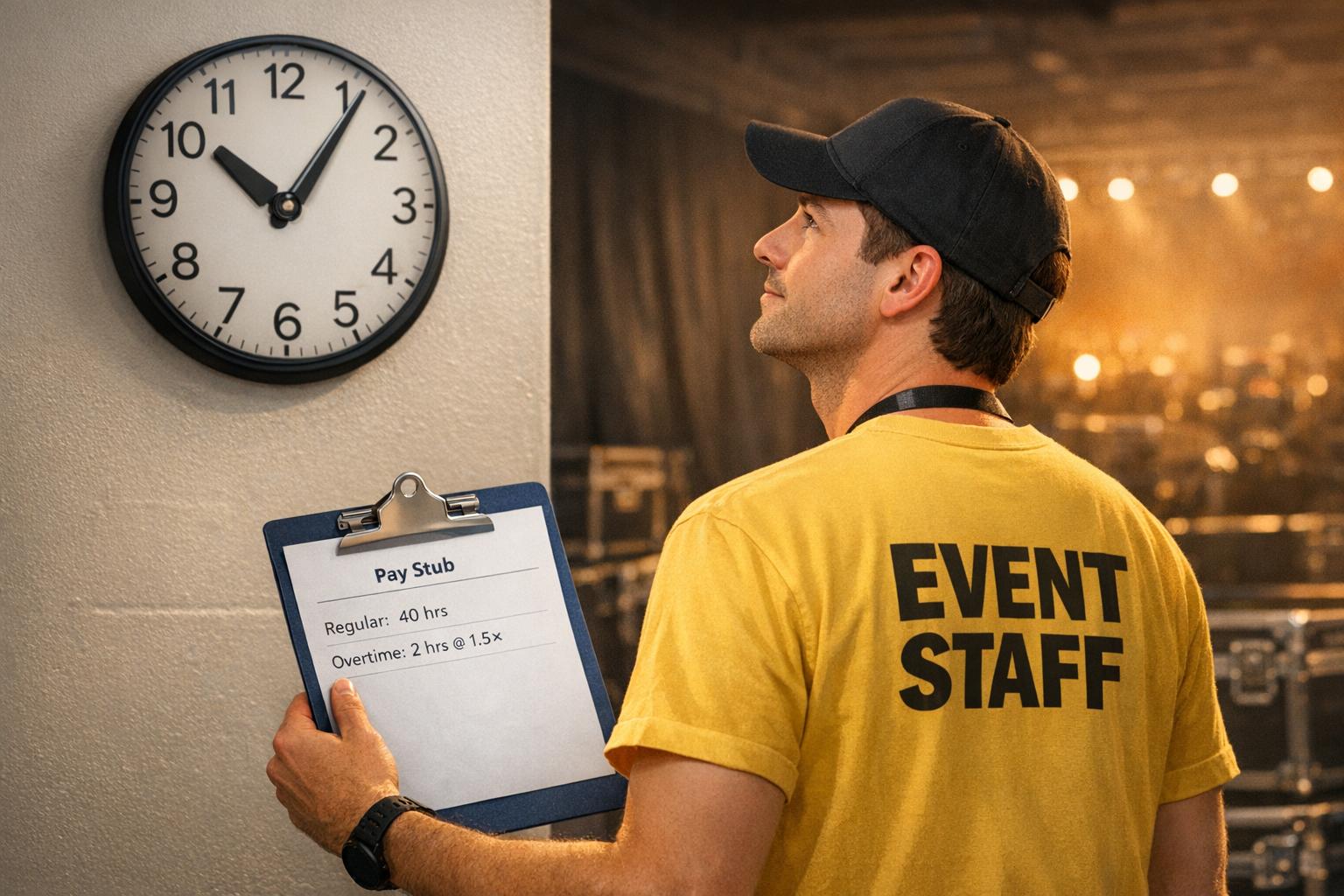
Yes, temporary event staff are generally entitled to overtime pay under federal law. According to the Fair Labor Standards Act (FLSA), most temporary event workers are classified as nonexempt employees, meaning they must receive overtime pay at 1.5 times their regular hourly rate for any hours worked over 40 in a single workweek.
Key points to know:
For accurate compliance, employers must track hours diligently, account for state-specific rules, and ensure proper classification of workers. Tools like Quickstaff can simplify time tracking and help avoid wage violations.
Temporary event staff are hired for specific, short-term roles tied to events. These roles can include catering assistants, ushers, registration coordinators, event assistants, security personnel, and setup or teardown crews. Unlike full-time or part-time employees, these workers are brought on for a fixed period or to work during designated events only.
The key distinction lies in control. If an employer dictates the schedule, provides uniforms, and assigns specific tasks, the worker is classified as an employee. This level of control plays a significant role in how temporary event staff are categorized under federal law.
According to the Fair Labor Standards Act (FLSA), most temporary event staff fall under the category of nonexempt employees. Their classification is determined using the "economic reality test", which assesses whether a worker is economically reliant on the employer or operates as an independent business. Factors such as who controls event staff scheduling, who supplies the tools and equipment, and whether the work is integral to the employer's business are part of this evaluation.
Roles in hospitality, event production, and support typically don’t qualify for executive, administrative, or professional exemptions. As a result, these workers are entitled to overtime pay at 1.5 times their regular rate for hours worked beyond 40 in a week. In fiscal year 2023, the Department of Labor conducted 1,190 investigations into misclassification - a 22% increase compared to the previous year. Additionally, when the IRS reviews classification disputes through Form SS-8, it finds the worker to be an employee in 81% of cases.
Even if contracts or 1099 forms are involved, the actual nature of the working relationship determines the worker's legal status. Misclassifying employees can lead to serious consequences for employers, including back wages, double liquidated damages, and civil penalties of $2,439 per willful violation.
The Fair Labor Standards Act (FLSA) lays out a straightforward rule: nonexempt employees must be paid overtime for any hours worked over 40 in a single workweek. The overtime rate is set at 1.5 times the employee's regular hourly pay. For instance, if someone works 50 hours in a week, they’re entitled to 10 hours of overtime pay.
Under the FLSA, a workweek is defined as 168 consecutive hours, or seven 24-hour periods. Employers cannot average hours across multiple weeks to avoid paying overtime. For example, if an employee works 50 hours one week and 30 the next, overtime pay is still required for the first week.
"The overtime requirement may not be waived by agreement between the employer and employees."
– U.S. Department of Labor
Even if an employer and employee agree otherwise, overtime pay cannot be waived. In 2024, the Department of Labor recovered $274 million in back wages for workers, with the hospitality sector - such as event staffing - ranking among the top five industries investigated.
Using budget-friendly staff scheduling tools can help track these hours automatically. Now, let’s break down how to calculate both regular and overtime pay.
Getting overtime pay right starts with accurately calculating the regular rate of pay. This is done by dividing the total weekly earnings by the total hours worked . Importantly, this goes beyond just the hourly wage and includes other forms of compensation.
Payments like shift premiums, nondiscretionary bonuses, and non-cash benefits (e.g., meals or lodging) must be factored into the regular rate . For example, if an event coordinator makes $20 per hour and receives a $100 nondiscretionary bonus during a 45-hour week, their total pay is $1,000. The regular rate would then be $22.22 ($1,000 ÷ 45 hours). Overtime pay is calculated as an additional 0.5 times this rate for each hour of overtime.
However, not all forms of pay are included in the regular rate. Discretionary bonuses, business expense reimbursements, gifts for special occasions, and payments for time not worked (such as vacation or sick leave) can be excluded . Here’s a breakdown:
| Payment Type | Included in Regular Rate? | Examples |
|---|---|---|
| Nondiscretionary Bonuses | Yes | Bonuses promised in advance to reward performance |
| Shift Premiums | Yes | Extra pay for night shifts or weekend work |
| Discretionary Bonuses | No | Year-end gifts determined solely by the employer |
| Business Expenses | No | Reimbursement for travel or tools |
| Gifts | No | Holiday bonuses not tied to hours worked |
"The regular rate of pay is based upon actual facts and cannot be circumvented by an agreement."
– U.S. Department of Labor
When employees perform multiple jobs at different pay rates during the same week, the regular rate is calculated as a weighted average. For example, if someone works 30 hours at $18/hour for setup tasks and 15 hours at $25/hour for bartending, their total pay is $915. The regular rate is then about $20.33 ($915 ÷ 45 hours).
Temporary event staff become eligible for overtime pay after working more than 40 hours in a single workweek. A workweek is a fixed, recurring period, and employers cannot average hours across multiple weeks to sidestep overtime obligations.
For example, if someone works 25 hours during setup and 20 hours serving at an event, their total of 45 hours includes 5 overtime hours. To highlight how common overtime violations can be, the Department of Labor recovered $130.7 million in back wages for such cases in fiscal year 2023. Additionally, a 2022 survey revealed that 24% of temporary workers reported wage theft, including unpaid overtime. Employers are required to compensate for all work that is "suffered or permitted" - this means if a supervisor is aware (or should reasonably be aware) that an employee is working beyond scheduled hours, those extra hours must be included in overtime calculations, even if the work wasn't formally approved.
This rule applies consistently, whether the employee is part-time or working in the public sector.
Part-time workers follow the same overtime rules as full-time staff. Once they exceed 40 hours in a workweek, they qualify for overtime pay at 1.5 times their regular hourly rate. Until they hit that 40-hour mark, all hours worked are paid at their standard rate.
For instance, if a part-time employee typically works 15 hours per week but takes on additional shifts, bringing their total to 35 hours, those 35 hours are paid at their regular rate. However, if they work 48 hours in a week, the first 40 hours are paid at the standard rate, while the remaining 8 hours must be compensated at the overtime rate. For workers with varying pay rates, the regular rate is calculated using a weighted average of total earnings divided by total hours worked.
Temporary staff working for public sector organizations - such as state universities or government agencies - are subject to different overtime guidelines. Unlike private sector employees, who must be paid overtime in cash, public sector employees can receive "compensatory time" (comp time) instead. This is accrued at a rate of 1.5 hours for every overtime hour worked. For example, a university staff member who works 45 hours in a week could earn 7.5 hours of compensatory time.
Another distinction is how paid leave is treated. For public sector employees, paid leave counts toward the 40-hour overtime threshold. In the private sector, however, paid leave typically does not count unless specified in an employment contract. Additionally, public sector employers can dock pay for partial-day absences under leave accrual systems, while private sector employers face stricter limits when docking pay for exempt employees. These differences highlight the need to understand how overtime rules vary depending on the employment sector.

Federal vs State Overtime Rules for Temporary Event Staff
Federal law sets a baseline for overtime, but state laws often add extra layers of protection for temporary event staff. When state and federal regulations differ, employers must follow the rule that benefits the employee most.
"When California law and federal FLSA rules differ, the standard that is more favorable to the employee applies." – California Overtime Laws Guide, RemoteLaws
One major difference lies in daily overtime thresholds. Under the federal Fair Labor Standards Act (FLSA), overtime pay (1.5× the regular rate) kicks in after 40 hours in a workweek. However, some states require overtime based on hours worked in a single day. For instance:
This means that an event staffer working a 12-hour wedding on a Saturday but clocking only 30 hours for the week wouldn’t qualify for overtime under federal law but would in California.
California also stands out with its double-time rules. Employees earn double their regular rate after 12 hours in a single day or after 8 hours on the seventh consecutive workday. For example, a catering staffer working a 14-hour event would receive:
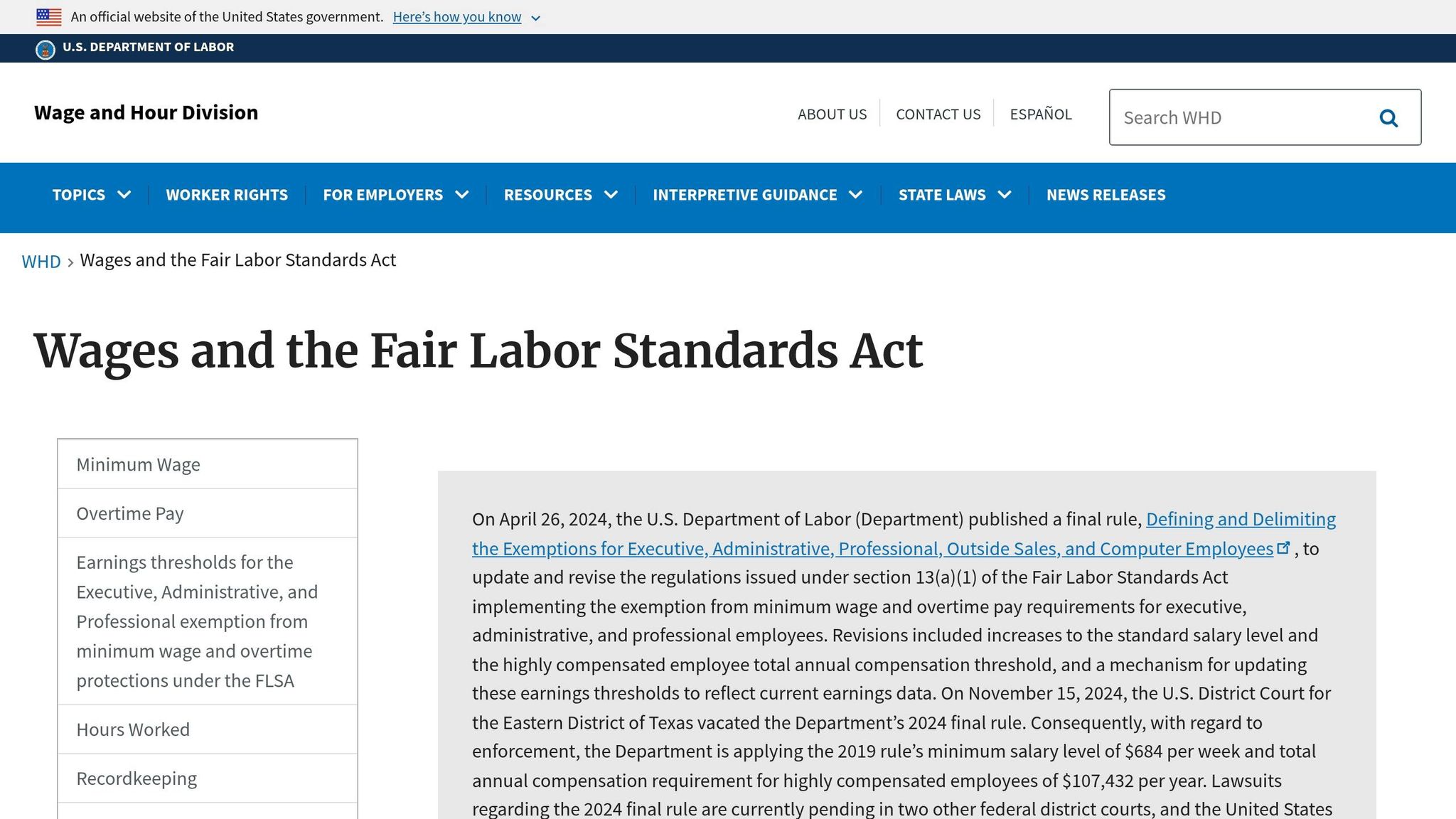
Salary thresholds for exempt employees also vary by state. The federal minimum is $684 per week ($35,568 annually), but some states set much higher standards:
For event companies classifying team leads or coordinators as exempt, it’s critical to meet the higher state thresholds, not just the federal one. These variations highlight the importance of accurate time tracking and wage calculations.
Navigating state-specific overtime rules requires solid compliance systems. Accurate time tracking is essential, especially in states with daily overtime requirements. Digital systems are often more reliable than manual logs, which can lead to errors and wage violations.
Employers must also ensure that any unscheduled hours worked are properly compensated, even if those hours weren’t pre-approved. If the employer knew - or should have known - that work was performed, they are obligated to pay overtime.
Timely payment of wages is another critical factor. Overtime must be paid no later than the payday for the next regular payroll period after it was earned. In California, failing to pay final wages on time can result in waiting-time penalties of up to 30 days’ worth of the employee’s daily wages. For temporary event staff, who often work sporadically, clear and consistent payment practices not only ensure compliance but also help build trust with employees.
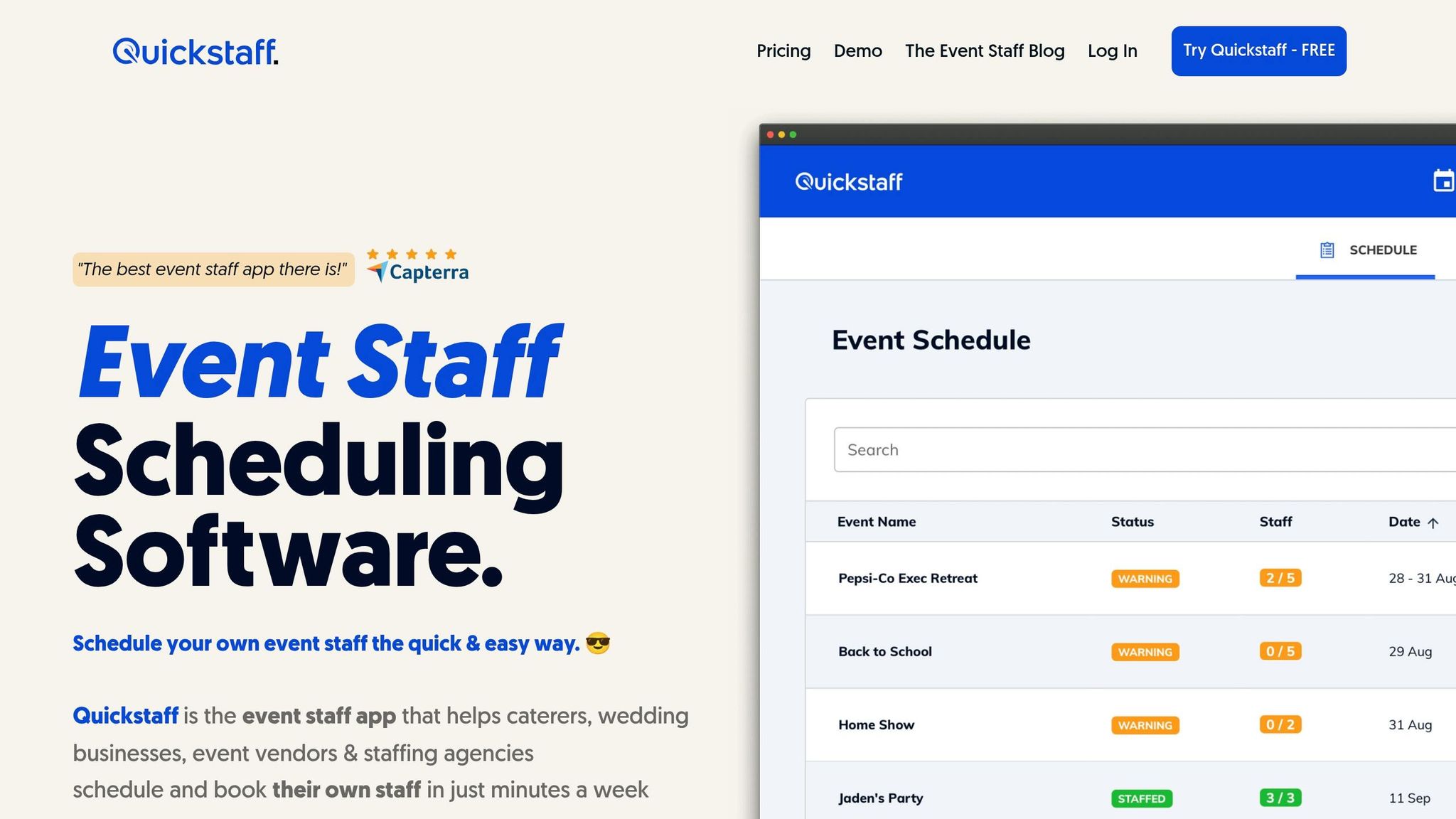
Keeping track of overtime compliance for temporary event staff can be a real challenge, especially with multi-day events, varying state regulations, and those inevitable last-minute changes. Quickstaff simplifies this process with a centralized platform that helps track hours, manage staff availability, and avoid wage violations.
With Quickstaff’s centralized scheduling, event managers can monitor hours across all phases of an event - setup, execution, and teardown - ensuring every minute contributing to overtime is accounted for. This comprehensive tracking helps prevent off-the-clock work and ensures all hours are properly recorded for overtime calculations. It also supports accurate and compliant overtime documentation.
Quickstaff also offers digital timekeeping to log all compensable time, including loading, setup, and teardown. This feature helps meet federal requirements under 29 CFR Part 516, which mandates proper recordkeeping. Without these records, courts may allow workers to estimate their hours, shifting the burden of proof to employers. Quickstaff’s system ensures you’re covered.
For businesses operating in multiple states, Quickstaff’s tools address the complexities of state-specific overtime rules. For example, in states like California, where the 8-hour daily overtime rule applies, Quickstaff helps manage staff schedules to avoid exceeding these thresholds. By centrally managing availability, event managers can reduce scheduling overlaps and maintain compliance with both federal and state regulations.
On top of these features, Quickstaff’s mobile interface enhances communication and keeps everyone on the same page. Real-time updates and automated reminders ensure staff and managers are aligned on schedules. This transparency not only improves operations but also builds trust with temporary workers by ensuring clear and consistent payment practices from day one.
Staying on top of overtime rules for temporary event staff isn’t just about avoiding penalties - it’s about protecting your business and earning the trust of your team. Remember, overtime violations are a major issue, with the Department of Labor recovering the largest portion of back wages from these infractions. Event organizers risk facing liquidated damages and federal penalties for noncompliance, making this a critical area to get right.
State-specific regulations, like California's rule that triggers overtime after eight hours in a single day, add another layer of complexity. Manual tracking systems often fall short, and under the joint employer doctrine, event organizers can still be held accountable for wage violations, even when staffing agencies are involved.
Getting overtime compliance right also helps maintain your reputation. Paying staff accurately for all hours worked - whether it’s during setup, teardown, or the event itself - creates a positive experience. This not only encourages workers to return but also boosts word-of-mouth recommendations for your business. The financial and reputational risks tied to wage disputes highlight the importance of having reliable systems in place.
Quickstaff offers a practical way to handle these challenges. By centralizing timekeeping, automating recordkeeping to meet federal standards, and managing state-specific rules across different locations, the platform takes the guesswork out of overtime compliance. Digital records also provide a strong defense against wage claims, especially in cases where courts allow workers to estimate hours due to missing employer documentation.
The IRS evaluates your work status based on how much control your employer has over your job. This is determined using a three-part test. If your employer dictates your schedule, assigns specific tasks, or even requires you to wear a uniform, you're likely classified as an employee. On the other hand, independent contractors usually enjoy more flexibility in how they complete their work and face less direct supervision.
When it comes to overtime pay, bonuses and shift premiums usually don’t alter the overtime rate directly. However, under the Fair Labor Standards Act (FLSA), all compensation for hours worked - including bonuses and premiums - must be included in the calculation of the regular rate of pay. This ensures that the overtime rate properly reflects the employee’s total earnings.
Under federal law, overtime kicks in after 40 hours of work in a single week. However, California has its own rule: employees are entitled to overtime pay after working more than 8 hours in a single day. No other states currently have daily overtime requirements specifically for event staff.