Ultimate Guide to Worker Classification for Events
May 4, 2026

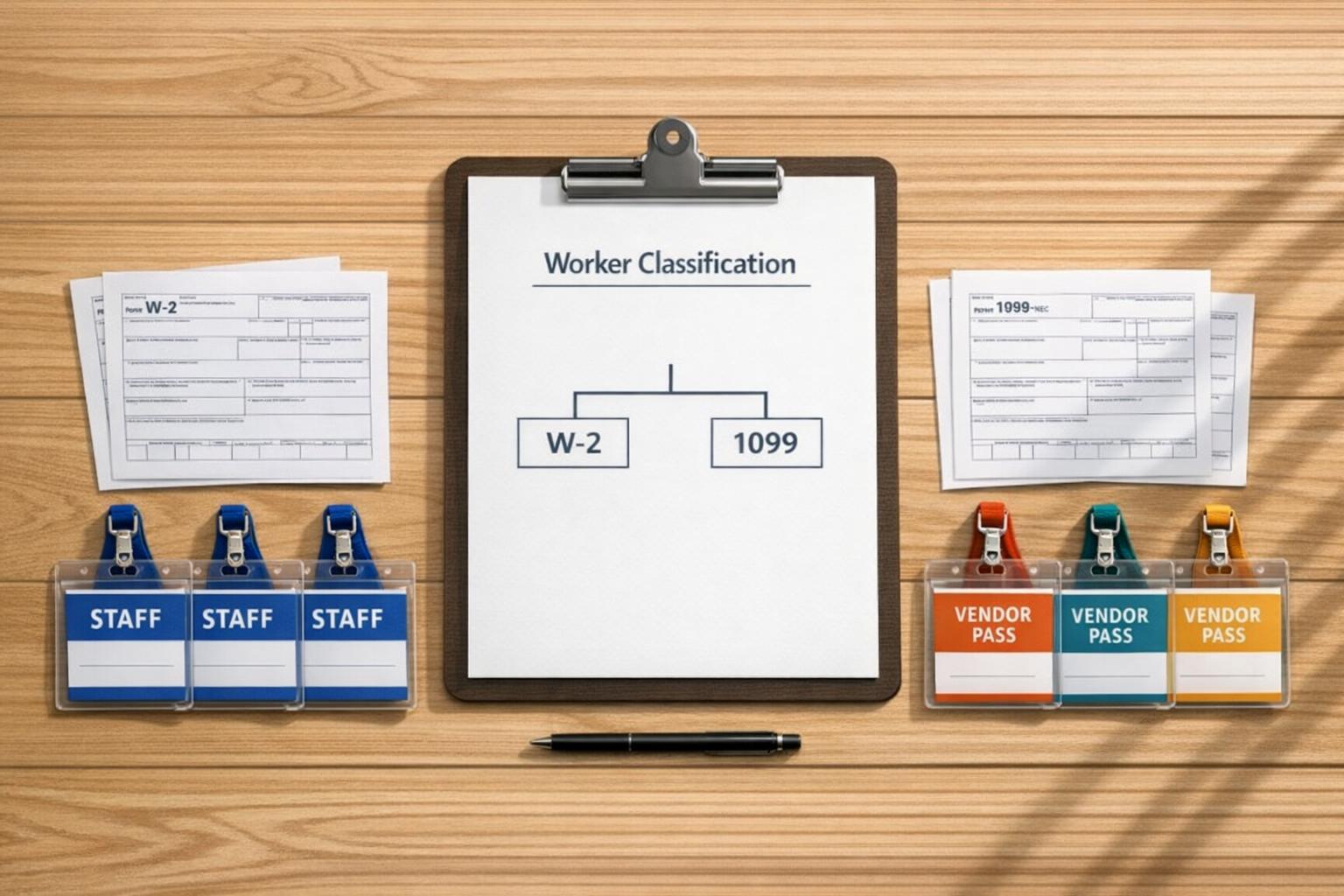
Worker classification for event staff is a critical decision that impacts taxes, wages, and legal compliance. Misclassifying workers as independent contractors instead of W-2 employees can lead to severe penalties - up to 41.5% of misclassified earnings - and expose your business to liabilities like unpaid wages and insurance gaps.
Key takeaways:
For event managers, proper classification ensures legal compliance, protects your business, and avoids costly mistakes. Tools like Quickstaff can simplify time tracking and documentation, helping you stay on track with labor laws.
Grasping the legal criteria that differentiate employees from independent contractors is crucial for effectively managing event staff. This isn't just about terminology - it’s about the nature of the working relationship as defined by standards set by the IRS and the Department of Labor (DOL). Importantly, a worker cannot simply choose to waive their employee status to be classified as an independent contractor.
Why does this matter? Because how workers are classified impacts taxes, overtime pay, and more. The Department of Labor uses a six-factor "economic reality" test to determine whether a worker is economically dependent on your business (making them an employee) or if they operate independently (making them a contractor). Similarly, the IRS applies Common Law rules, focusing on control and independence across three categories. Both agencies emphasize looking at the entire relationship rather than isolating any one factor. This comprehensive approach is essential for correctly classifying event staff.
To clarify the distinction, the Department of Labor’s 2024 economic reality test evaluates six factors to determine if a worker is running their own business or is economically reliant on an employer. One key factor is whether the work is integral to the company’s primary business. For example, in an event company, roles like bartenders and servers are central to delivering catering services, making their work integral rather than peripheral.
Another critical aspect is the worker’s opportunity for profit or loss based on managerial skill. If their earnings are tied solely to working more hours at a fixed rate, they are likely employees. Financial control also plays a role - if you supply all the tools, reimburse expenses, and pay by the hour instead of per job, it strongly suggests an employment relationship.
Permanency is another factor. Ongoing or indefinite engagements point toward employee status, whereas project-based or occasional work aligns more with contractor classification. Even seasonal workers - such as event staff hired for a busy season - can be deemed employees if you control their schedules and methods. Notably, 38 states have task forces that share data across tax, labor, and insurance agencies to identify misclassification.

The IRS evaluates worker classification through three main categories: Behavioral Control, Financial Control, and Type of Relationship.
Behavioral control looks at whether the employer directs how tasks are completed, not just the results. If you dictate arrival times, uniforms, tools, or task order, that indicates behavioral control. For roles like bartenders and servers, this often includes setting service protocols and timing.
Financial control examines who manages the economic aspects of the work. Key considerations include whether the worker invests in their own equipment, covers unreimbursed expenses, and is paid hourly or per project. Additionally, offering benefits such as Social Security contributions, unemployment insurance, health plans, or paid vacation further supports an employment relationship.
Type of relationship focuses on factors like written contracts, benefit offerings, the permanency of the arrangement, and whether the services are a core part of your business. The IRS emphasizes: "The keys are to look at the entire relationship and consider the extent of the right to direct and control the worker".
Bartenders, servers, and setup crews usually fall under the category of employees. If you dictate their schedules, attire, and duties, the IRS considers them employees under its guidelines. These workers also use tools and equipment provided by the venue, further solidifying their status as employees.
It's important to note that tip credits apply exclusively to W-2 employees. Misclassifying these workers could lead to wage violations, with hidden liabilities reaching up to $5.12 per hour. Additionally, most general liability insurance policies exclude independent contractors when it comes to alcohol service, which could leave your business exposed to uninsured risks.
According to industry experts, the key factor for the IRS is who controls the work, not what the contract says. Under state-specific tests like California's AB 5, if the work is part of your regular business operations, the worker must be classified as a W-2 employee. This also applies to temporary event staff, making proper classification critical to avoiding compliance issues.
Temporary and seasonal roles are not automatically considered independent contractor positions. Most roles in this category - like registration coordinators, event assistants, or setup crews - are legally classified as nonexempt employees because you control their schedules, provide their tools, and direct their work. When workers rely on your business for these factors, they are employees by definition.
In 2023, the Department of Labor (DOL) reported a 22% increase in investigations related to worker misclassification, recovering $274 million in back wages for over 163,000 employees. Workers classified as independent contractors must meet specific criteria: they must run their own business, serve multiple clients, set their own rates, and supply their own tools. For example, specialized roles like AV technicians or photographers may qualify. However, for most general event positions, W-2 classification is the safer and more compliant option.
Don’t overlook the requirement to compensate workers for all hours spent on loading, setup, and teardown, as these count toward overtime. States like California have stricter rules, requiring overtime pay after 8 hours in a day, as opposed to the federal standard of 40 hours per week. Proper classification is essential to stay compliant and shield your business from legal and financial risks.
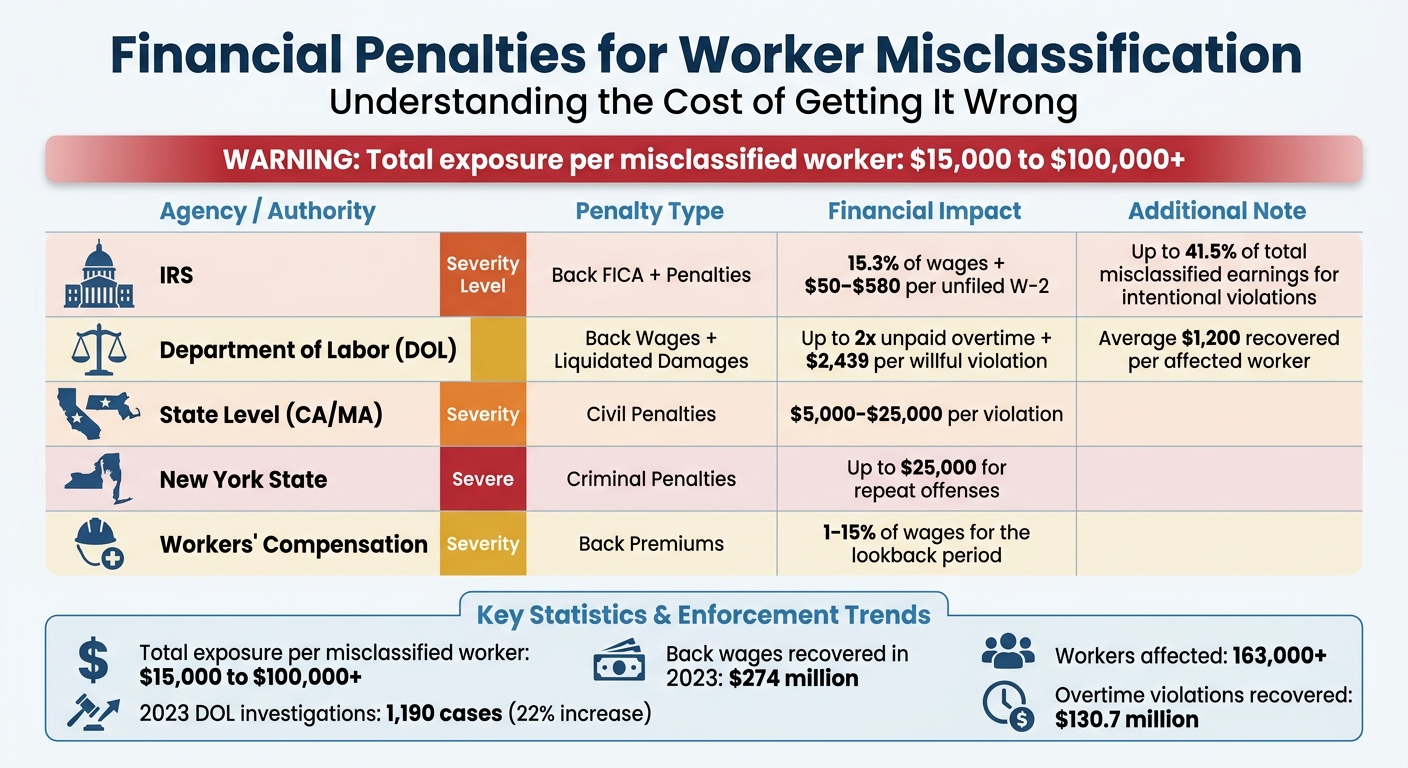
Worker Classification Penalties and Financial Impact by Agency
This section dives deeper into the tax, wage, and enforcement risks tied to worker misclassification, expanding on the legal and financial consequences mentioned earlier.
Misclassifying workers can lead to hefty financial penalties. Under IRC §3509, employers are required to pay at least 1.5% of wages for income tax withholding, along with 20% of the employee's FICA taxes. If the misclassification is found to be intentional, employers could owe 100% of unpaid taxes. Combined federal penalties can reach as high as 41.5% of the total misclassified earnings.
The Fair Labor Standards Act (FLSA) adds another layer of risk. Employers may be required to pay back wages plus liquidated damages, effectively doubling the amount owed. For example, in fiscal year 2023, overtime violations accounted for $130.7 million in recovered wages, making it the largest category of wage recovery. On average, a Department of Labor (DOL) investigation results in about $1,200 recovered per affected worker. Depending on the length of employment and state-specific laws, the total financial exposure for a single misclassified worker can range from $15,000 to over $100,000.
State-level penalties further compound these risks. For instance, California's AB 5 and Massachusetts impose civil penalties between $5,000 and $25,000 per violation. New York takes it a step further, with criminal penalties reaching up to $25,000 for repeat offenders. In Minnesota, fines can go up to $10,000 per misclassified worker. Employers may also face retroactive workers' compensation premiums (1–15% of wages over the lookback period) and unpaid unemployment insurance, adding even more to the financial burden.
| Agency/Authority | Penalty Type | Typical Financial Impact |
|---|---|---|
| IRS | Back FICA + Penalties | 15.3% of wages + $50–$580 per unfiled W-2 |
| DOL | Back Wages + Liquidated Damages | Up to 2x unpaid overtime + $2,439 per willful violation |
| State (CA/MA) | Civil Penalties | $5,000–$25,000 per violation |
| New York State | Criminal Penalties | Up to $25,000 for repeat offenses |
| Workers' Comp | Back Premiums | 1–15% of wages for the lookback period |
These financial risks are magnified by aggressive federal and state-level enforcement efforts.

The risks extend beyond monetary penalties, as regulatory enforcement has become increasingly stringent. In fiscal year 2023, the DOL's Wage and Hour Division conducted 1,190 misclassification investigations, reflecting a 22% increase from the previous year. These efforts resulted in the recovery of $274 million in back wages for over 163,000 workers. Additionally, when workers file IRS Form SS-8 to request a formal classification determination, the IRS identifies "employee status" in 81% of cases.
"Wage law isn't optional just because the event is temporary. Every hour worked at your event is a billable, reportable, auditable hour."
– Megan Hayward, Founder & CEO, TempGuru
The stakes are even higher with the rise of state-level task forces. Thirty-eight states now operate multi-agency task forces that share data across tax, labor, and insurance departments to detect misclassification. A single audit could trigger simultaneous investigations by the IRS, DOL, and state labor agencies. The DOL enforces a two-year statute of limitations for non-willful violations, which extends to three years for willful violations, with penalties for willful violations set at $2,439 per violation.
Joint employer liability adds another layer of complexity. If you exert control over a worker's schedule, tasks, or work conditions, which is why many businesses use scheduling software for catering to manage availability rather than direct control, you could be held "jointly and severally" liable alongside staffing agencies. This liability persists even when hiring through a third party. To make matters worse, most general liability insurance policies exclude coverage for independent contractors performing roles like alcohol service, leaving you exposed to uninsured risks during events.
Getting worker classification right is essential to keeping your event operations running smoothly and avoiding hefty penalties. While the risks are undeniable, staying compliant doesn’t have to be overwhelming. The secret lies in applying consistent standards, keeping thorough documentation, and using tools that simplify record-keeping. Most classification errors happen because of inconsistent practices, not ill intent.
Every hiring decision should start with a three-part evaluation:
For event managers, this often means that core roles - like registration staff, setup crews, servers, and bartenders - should be classified as employees. These roles are integral to your events, and you control their schedules and methods. On the other hand, specialists like photographers or caterers who bring their own equipment, set their prices, and work with other clients can usually be classified as independent contractors.
Proper documentation is key. For contractors, keep records like business tax IDs, invoices showing work for multiple clients, and proof they provide their own equipment. For employees, maintain accurate timekeeping records, overtime calculations, and signed confirmations of meal and rest breaks. Federal law requires these records to be kept for at least three years, serving as your first line of defense in audits by the IRS or Department of Labor.
If your events span multiple states, it’s safest to follow the strictest rules - like California’s daily overtime and meal break laws - across all locations. This approach ensures compliance no matter where the work takes place. Digital tools can help enforce these standards, automating much of the process.
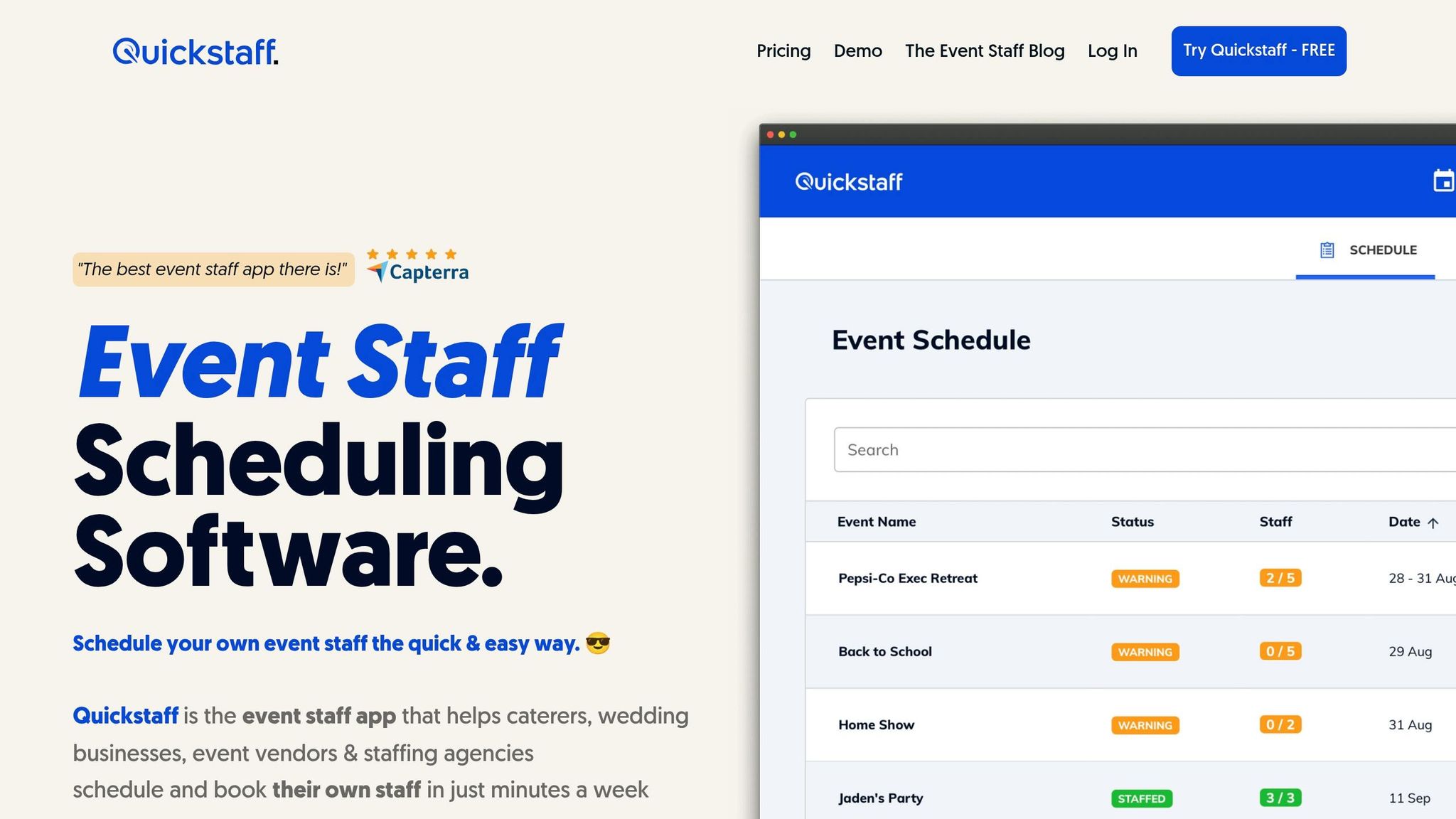
While manual recordkeeping is crucial, digital tools like Quickstaff can make compliance much easier. These platforms help reduce the risk of misclassification by automating rule application and maintaining detailed records. Quickstaff’s role-based scheduling feature ensures each position is assigned the correct employment status. When you assign roles like servers or setup crew, the system automatically creates an audit trail documenting who worked, when, and under what conditions.
Quickstaff also simplifies compliance with its built-in timekeeping and communication tools. Automated time tracking ensures accurate overtime calculations, especially for multi-day events like conferences or weddings. The system treats these as one continuous workweek, ensuring proper pay for workers nearing 40 hours.
Its availability tracking feature lets workers indicate when they’re free, giving you flexibility in scheduling while avoiding excessive control over their time. Plus, unlimited messaging and reminders create timestamped records of shift confirmations, break notifications, and policy updates. Workers can confirm receipt of these messages in real time, helping you address potential wage claims before they escalate.
For businesses managing anywhere from 35 to 175+ staff, Quickstaff’s pricing tiers ($49 to $249 per month) offer a cost-effective way to stay compliant. Considering that Department of Labor investigations recover an average of $1,200 per affected worker, and a single misclassification can cost $15,000 to over $100,000 in penalties, investing in a system that prevents even one error can save you significantly. With Quickstaff, you can focus on delivering exceptional events without the constant worry of compliance issues.
Getting worker classification right is essential for both legal compliance and financial security. Misclassifying workers can lead to hefty costs, with penalties reaching thousands of dollars per worker. As enforcement ramps up and millions in back wages are being recovered, the pressure to comply has never been greater.
At its core, proper worker classification boils down to one simple idea: control determines the relationship. If you're dictating schedules, requiring uniforms, and overseeing how tasks are performed - typical for bartenders, servers, and setup crews - those individuals are employees, not contractors. The main takeaway? The person controlling the work defines the classification.
You don’t need a team of lawyers to stay compliant. Use the three-part test - behavioral control, financial control, and the nature of the relationship - when making hiring decisions. Keep detailed records of your reasoning, store accurate time logs for at least three years, and when in doubt, classify workers as W-2 employees. For events spanning multiple states, follow the strictest regulations to avoid unintentional violations.
Digital solutions like Quickstaff can simplify this process. The platform streamlines classification, tracks time accurately, and generates comprehensive audit trails. Since a single misclassification can result in steep penalties, leveraging reliable digital tools is a smart way to protect your business.
It depends on whether the workers meet the IRS guidelines for control and employment status. Misclassifying employees as independent contractors can lead to hefty penalties. To avoid issues, assess factors like how much control you have over their work and their level of independence in completing tasks.
To establish a worker’s classification, it's crucial to maintain records that clearly illustrate the nature of the working relationship. Key documents to keep include those that demonstrate:
Additionally, ensure you have payroll records, signed contracts, and any correspondence (like schedules or agreements) that highlight the level of control and independence. These records not only help clarify the classification but also ensure compliance with IRS and Department of Labor regulations, minimizing the risk of misclassification issues.
Yes, businesses can still face liability for worker misclassification. The IRS and the Department of Labor assess various factors, such as the level of control a company has over the worker’s tasks and working conditions. This evaluation goes beyond simply identifying who employs the worker. Even when a staffing agency is part of the arrangement, companies may share the responsibility for correctly classifying workers.