10 Emergency Response Skills Every Event Staff Needs
April 30, 2026

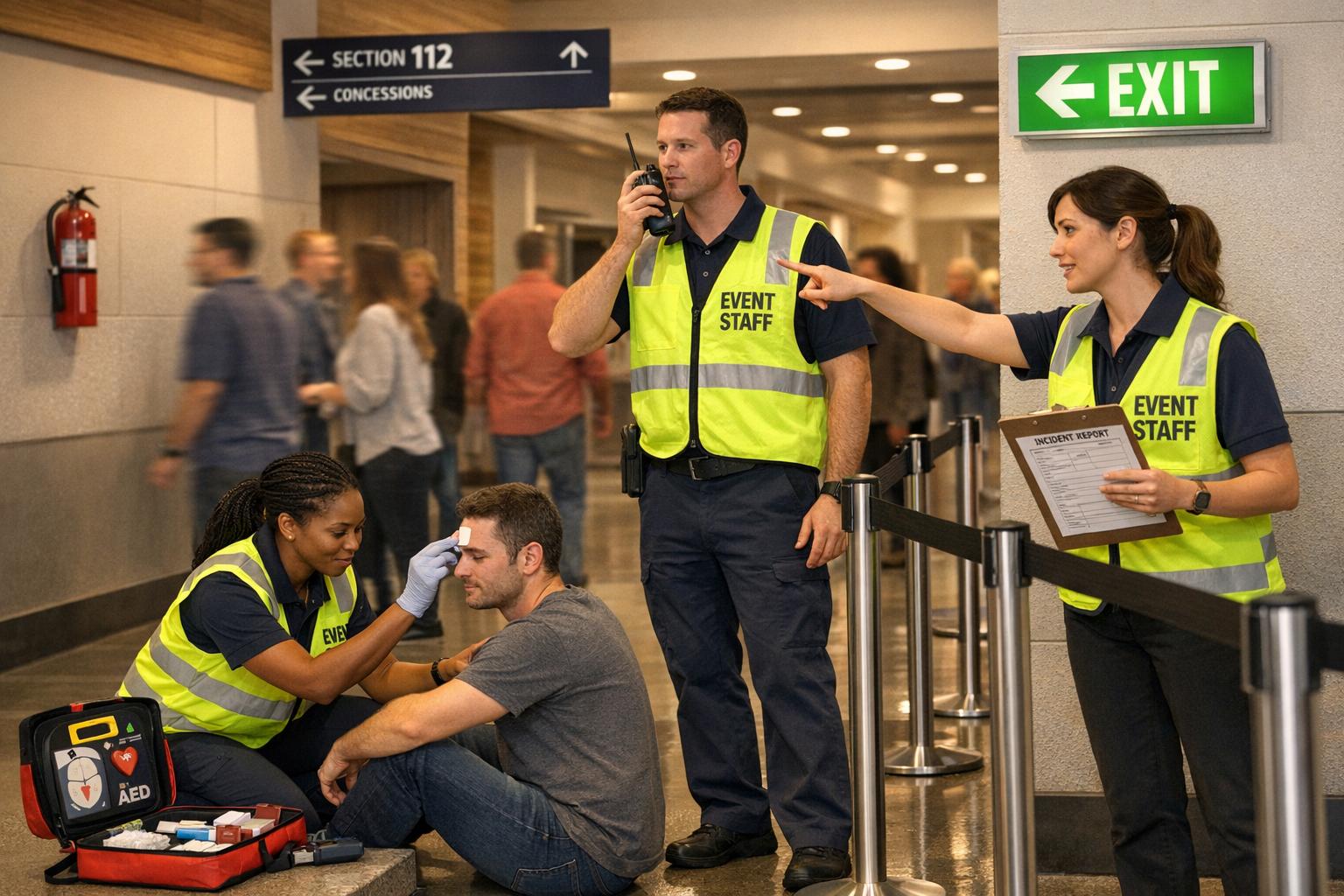
When emergencies strike at events - like medical incidents, crowd surges, or sudden weather changes - quick, effective action can prevent chaos. Event staff play a critical role in ensuring safety, minimizing risks, and maintaining order. Here's a breakdown of the essential skills every event staff member should have:
These skills not only protect attendees but also safeguard the event's reputation and reduce liability. Training, hands-on drills, and tools like Quickstaff can prepare teams to handle emergencies effectively, ensuring a safe and seamless experience for everyone.
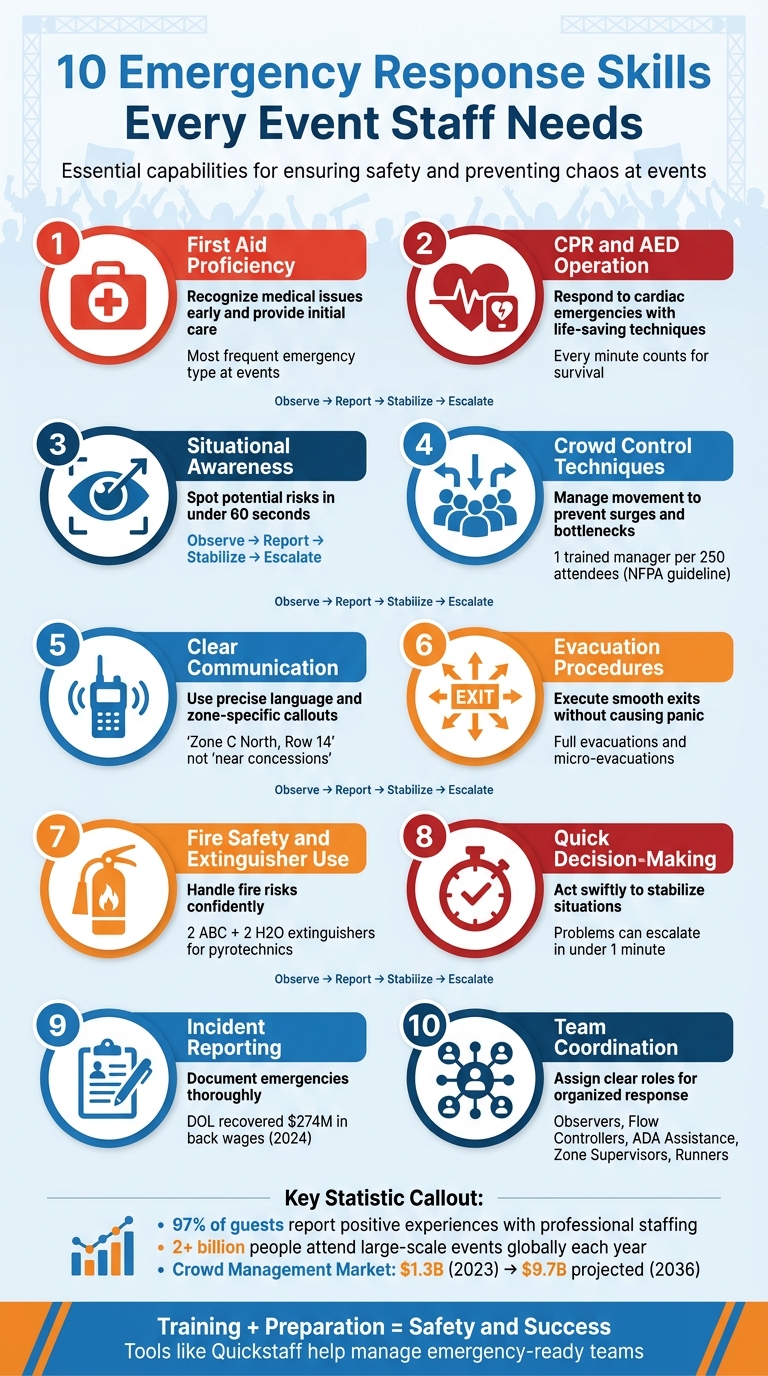
10 Essential Emergency Response Skills for Event Staff
Medical incidents are the most frequent type of emergency at events, and they often unfold without dramatic signs. For example, a guest leaning weakly against a barrier or showing signs like glassy eyes can signal the onset of a problem. Recognizing these subtle cues early is key, and trained staff are equipped to respond quickly.
Your team plays a crucial role in providing triage care, acting as the first line of response before professional help arrives. The process is straightforward: assess the guest's responsiveness, breathing, and any visible bleeding, then communicate the exact location to emergency responders via radio. While waiting for EMTs, staff ensure the guest's area is secured and create a clear path for responders. This prevents the common "crowd of onlookers" that can block access and increase stress levels.
This hands-on approach to first aid is essential for maintaining safety and control during events.
First aid preparedness is a cornerstone of any well-constructed Emergency Action Plan (EAP). OSHA advises all employers to have an EAP to mitigate the severity of injuries. But beyond regulatory compliance, first aid readiness ensures smooth operations, which can be further optimized using budget-friendly staff scheduling tools. Trained staff can identify warning signs before a situation escalates, and they keep access routes open to avoid delays when EMTs arrive.
This level of preparedness directly impacts how guests perceive safety. 97% of guests served by professional staffing agencies report positive experiences, often tied to the sense of security provided by capable event teams. When staff respond to medical incidents with calm, deliberate actions - like speaking in a steady, low voice to maintain control - it reassures guests and prevents panic from spreading.
Effective first aid training goes beyond reading manuals. Role-playing scenarios allow staff to build muscle memory for calm, confident responses. Venue walkthroughs before events help teams familiarize themselves with first-aid kit locations and emergency access points. As Lisa VanDyke Brown, a contributor to ZeroEyes, emphasizes:
"When it comes to event safety, never rely on manuals alone".
Cross-training is another valuable tool. Even non-security staff, such as servers or ticket checkers, benefit from basic first aid skills. This expands the number of people who can identify potential issues early. Additionally, using standardized communication protocols - like referring to specific zones and rows ("Zone C North, Row 14") instead of vague descriptions - reduces confusion and speeds up EMT response times.
Cardiac emergencies can strike without warning. Imagine a guest collapsing unexpectedly at a gala or festival. In such moments, every second counts - each minute without action drastically lowers the chances of survival.
When these emergencies happen, event staff spring into action by starting CPR and using the closest AED. The process begins with recognizing unresponsiveness and abnormal breathing, followed by immediate chest compressions. As Daniel Muersing, Founder of Event Staff, explains:
"Event emergency response staff are trained to spot problems in under 60 seconds, report them on a dedicated radio channel and stabilize guest flow while EMTs move in".
Keeping pathways clear for emergency responders is another critical step. This ensures professional teams can quickly access the scene and provide advanced care. Quick and efficient action like this forms the backbone of effective event safety.
CPR and AED skills do more than save lives - they also shield event organizers from potential liability. Just like first aid, rapid response builds trust among guests and helps meet legal and regulatory standards. Events with over 400 attendees are often labeled as "potentially hazardous", requiring safety assessments and trained personnel on-site. Without proper preparation, even minor medical issues could escalate, opening the door to negligence claims.
To enhance safety, AEDs should be strategically placed in high-traffic areas such as entrances, exits, and central gathering points. Clear signage ensures both staff and attendees can locate them quickly. This setup supports a triage approach where staff stabilize the situation until professional responders arrive, cutting down response times and improving outcomes.
Getting certified in CPR and AED use is straightforward, with plenty of training programs available. The real key lies in preparation - mock drills before events are essential. These practice sessions help staff learn the location of equipment, refine communication protocols, and understand their roles in emergencies , often utilizing scheduling tools for caterers to coordinate these drills. For example, teams might use specific zone callouts like "Zone C North" to direct attention and speed up responses.
Direct communication with local hospitals adds another layer of efficiency. In cases where a guest needs to be transported, this connection ensures a smooth handoff to medical professionals. With these measures in place, event staff move from being bystanders to becoming active participants in life-saving efforts.
Situational awareness is all about recognizing and interpreting environmental cues before they escalate into problems. Trained event staff can detect potential issues in under a minute by focusing on subtle signs, like a line suddenly stopping, clusters of people forming tightly, or individuals leaning into crowds. Instead of attempting to monitor the entire venue at once, they focus on specific areas in a systematic way. Their approach follows a clear sequence: Observe → Report → Stabilize → Escalate. Acting quickly and decisively ensures risks are managed before guests even notice something is amiss.
Beyond just responding to emergencies, situational awareness allows staff to prevent problems by identifying early warning signs. In crowded environments, issues typically unfold gradually through small, often overlooked changes rather than sudden events. Staff trained in this skill act as a "safety net", catching potential risks before they grow into dangerous or expensive situations. For example, they keep an eye on crowd movement patterns, weather shifts, and unattended items to flag concerns early. Bryan Huneycutt, Vice President of Operations at Halo Solutions, explains:
"Crowd crushes don't happen because people are panicking or running. They can happen when people move just a few inches."
Developing situational awareness starts with detailed pre-event walkthroughs of the venue. This preparation is often managed through event staff scheduling software to ensure the right personnel are present for these critical briefings. Working alongside local emergency personnel, like Fire Marshals and EMTs, helps identify problem areas such as poor signage, blocked access routes, or potential bottlenecks in crowd flow. Staff can also use "hot codes" - short, zone-specific radio callouts - to quickly communicate urgent information. Regular practice drills, including role-playing with simulated crowds, sharpen decision-making skills. Simple "if-then" protocols - like reducing gate inflow if a crowd cluster tightens - encourage a proactive reporting culture where even minor observations are flagged before they escalate. This systematic approach complements other emergency response techniques covered later.
Turning situational awareness into action, effective crowd control ensures swift and organized responses during emergencies.
Crowd control is distinct from crowd management. While management focuses on proactive planning to ensure smooth operations, crowd control is about reacting decisively when safety is at risk. In emergencies, quick action is crucial. Tools like stanchions and ropes help organize queues and prevent dangerous surges near critical areas. Trained staff can also prevent backward crowd movements, which often lead to falls and trampling. Additionally, lane-clearing techniques ensure emergency responders can reach the scene without delay.
One particularly useful tactic is the micro-evacuation. This involves clearing a specific section or row to address localized hazards, such as a spill or small fire, without causing widespread panic. Simple actions - like proper body positioning, clear hand signals, and concise instructions ("stay with me" or "hold here") - can be incredibly effective. These straightforward measures are essential building blocks for the more advanced training discussed later.
Large-scale events draw massive crowds, with over 2 billion people attending globally each year. The Crowd Management and Event Security Market reflects this demand, valued at $1.3 billion in 2023 and projected to surpass $9.7 billion by 2036. The National Fire Protection Association (NFPA) also provides critical guidelines, recommending at least one trained crowd manager for every 250 attendees at both indoor and outdoor venues. As venue occupancy nears 70–90%, closer supervision becomes necessary. When capacity exceeds 90%, physical barriers and controlled entry points are essential for maintaining safety.
Effective training begins with venue-specific risk mapping, identifying potential problem areas and backup routes. A clear response framework - Observe, Report, Stabilize, Escalate - gives staff a structured approach to emergencies. Training also emphasizes maintaining a calm tone, as a steady voice can help prevent panic and encourage orderly movement. Mastery of radio communication is another critical skill, including the use of precise map-based designations (e.g., "Zone C North, Row 14") and "hot codes" to signal urgency. Finally, ensuring that ADA-compliant pathways remain unobstructed is vital, as individuals with mobility challenges are particularly vulnerable during emergencies.
In emergencies, clear and concise communication can make all the difference. With radio channels often becoming overcrowded, teams follow a "lowest appropriate channel first" approach. They identify themselves by zone and use specific call signs and zone identifiers, ensuring supervisors immediately know where reports are coming from.
To maintain order and efficiency, staff rely on a structured communication framework. Instead of vague descriptions like "near concessions", responders use precise terms such as "Zone C North, Row 14 cross-aisle." This specificity speeds up response times. Additionally, shorthand "zone hot codes" are used to quickly alert supervisors about areas needing urgent attention.
The way information is delivered is just as important. A calm, steady tone during a crisis helps reduce panic, while concise instructions like "hold here" or "stay with me" ensure smooth crowd management. These practices align seamlessly with broader emergency response strategies.
Clear communication isn't just about efficiency - it also plays a role in meeting OSHA requirements. Emergency alarms must be both audible and visible (or otherwise perceivable) to everyone in the workplace. For areas with poor radio reception, backup methods like mobile apps or group texts should be ready. Pre-event briefings should also include a walkthrough to pinpoint potential communication challenges and review hazard maps.
Standardized protocols make training and implementation straightforward. Designating a communication lead ensures that devices are functioning properly and that critical updates reach the control center or local authorities without delay.
Encouraging staff to report even minor issues - like an unattended bag or a guest who seems unwell - helps build a proactive safety culture. Before each event, teams should verify radio coverage and ensure batteries are fully charged to avoid technical hiccups during emergencies .
When emergencies hit, the difference between a smooth exit and chaos often comes down to proper planning and execution. Trained event staff aren't just there to point people toward the exits - they manage crowd movement, secure pathways, and prevent dangerous backflows.
Evacuations don't always mean clearing an entire venue. Staff should be prepared to handle micro-evacuations for smaller, localized threats like a spill or a contained fire alarm. Instead of vague announcements, specific location details ensure faster responses and reduce confusion. This approach also keeps communication channels open for other critical updates.
For full evacuations, clearing hallways and ensuring steady guest flow are top priorities. Preventing reverse movement is critical, and assigning clear roles makes all the difference. For instance, one team member might assist ADA guests, another manages the flow of faster-moving crowds, and a third clears the next area. These roles work in tandem with established crowd control and communication systems, creating a safer environment for everyone.
Precise evacuation procedures aren't just about safety - they're also about meeting local regulations. Many municipalities require event organizers to align with their emergency response models and conduct documented drills, especially for large gatherings. Beyond regulatory compliance, having a well-trained team can shield organizers from legal risks and demonstrate a commitment to guest safety.
Bryan Huneycutt, Vice President of Operations at Halo Solutions, highlights the importance of tailoring plans to the audience:
"We're thinking about the stairs, the exits, the stages, and even how fast an audience can evacuate if needed. If it's a Neil Diamond concert, the audience will move at a very different pace than a crowd at a DJ-driven music festival".
Weather-related risks, like lightning or strong winds, add another layer of complexity. Staff must understand when to shelter in place versus initiating an evacuation, based on specific weather thresholds.
Effective evacuation procedures start with hands-on practice. Scenario-based drills, including "hot code" radio calls, help staff build the instincts they need for high-pressure situations. Partnering with local fire marshals and EMTs during drills ensures exit routes and assembly points are well-defined. It's also crucial for staff to physically walk through the venue, identifying key areas like assembly points and doors that need to remain locked or unlocked.
Cross-training staff adds flexibility during emergencies. While this might increase staffing costs, the added readiness protects both guests and the event's reputation. Hands-on preparation, combined with a clear plan, is the foundation of a safe evacuation process.
Fire extinguishers are only effective if staff know how to use them. In high-risk situations - like a pyrotechnic mishap - trained personnel can act quickly to control the situation, while untrained staff might hesitate or misuse the equipment, potentially worsening the problem.
Fire safety training is a critical part of overall emergency preparedness. Before any event, staff must ensure all fire extinguishers are properly tagged and fully charged. Missing or expired extinguishers can lead to event permits being revoked. For activities involving pyrotechnics, regulations mandate having at least two ABC dry chemical extinguishers and two water (H2O) extinguishers on hand. Additionally, open flames or grilling equipment should be positioned at least 10 feet away from buildings to minimize fire risks.
Assigning a dedicated "Fire Watch" is essential during pyrotechnic displays. According to the UCF Office of Risk and Safety:
"The fire watch personnel's only duty is to oversee the pyrotechnics display and watch for fire or other emergencies that could result in harm to persons or property damage".
This individual should maintain direct communication with event management via radio and have the authority to stop activities immediately if a hazard arises.
Pre-event inspections of electrical wiring and stage equipment can prevent small issues, like sparks, from turning into larger emergencies. Staff should also familiarize themselves with the locations of all fire extinguishers and fire alarm pull stations within the venue. Additionally, third-party vendors are responsible for providing their own fire extinguishers for specialized activities, as venues typically do not supply equipment for vendor use. It’s important to note that tampering with or moving permanent fire extinguishers without authorization is a felony.
Pre-event refresher courses and walkthroughs with local fire marshals help identify potential blind spots and ensure proper signage for fire safety equipment. Staff should also verify that all drapes, scenery, and temporary structures meet fire-retardant certification standards before installation. Clearly defining roles and responsibilities ensures a coordinated and effective response in case of a fire. These focused training efforts integrate seamlessly into broader emergency protocols, strengthening overall event safety.
In emergencies at events, every second counts. Crowd issues can spiral out of control in less than a minute, which is why staff are trained to spot and address problems swiftly using a structured decision-making process. This approach ensures that quick detection is followed by equally fast and effective action.
The decision-making process follows a clear sequence: Observe → Report → Stabilize → Escalate. This framework helps staff act quickly to prevent disruptions and ensure emergency responders can work without interference. For instance, if a staff member notices a crowd cluster forming or guests moving against the flow, they might temporarily hold access to a staircase or redirect a line. These small, immediate actions buy time for supervisors to evaluate the situation and prevent dangerous conditions like reverse crowd flow, which can lead to falls or trampling.
Acting decisively and maintaining a calm demeanor sends a message of control to attendees, reducing the risk of panic. On the other hand, hesitation or visible confusion among staff can heighten anxiety and worsen the situation. A trained team member who quickly opens a side lane or slows the flow at a gate creates an "operational buffer" that stops minor issues from escalating into major incidents. These actions align with established emergency protocols, ensuring consistency and enhancing safety measures. Additionally, this proactive approach helps event organizers by feeding into risk management plans and reducing liability.
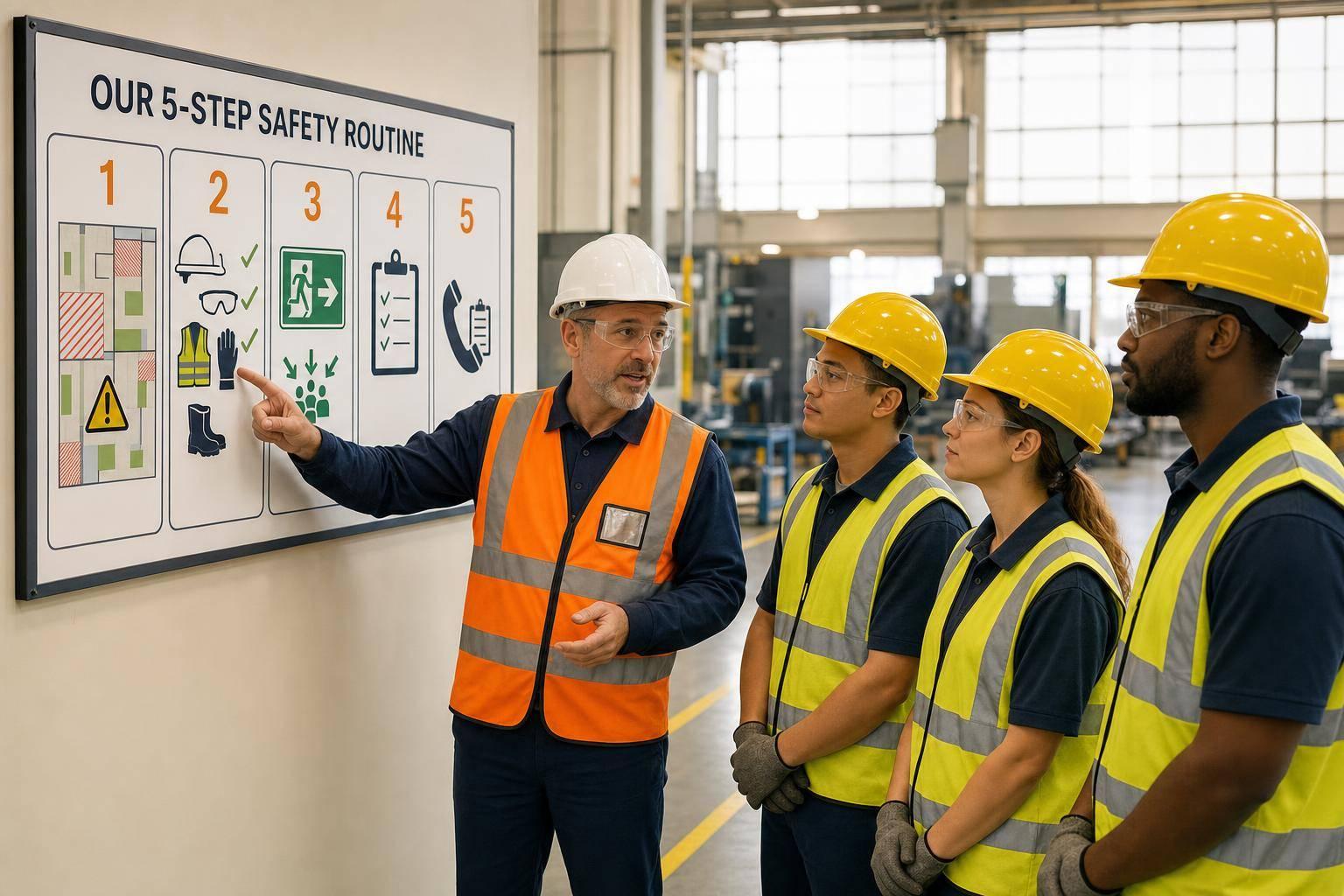
Training for quick decision-making goes beyond reading manuals - it requires hands-on practice. Scenario-based drills, such as handling lost-child cases or medical emergencies, help staff develop the reflexes needed for fast, effective responses. Lisa VanDyke Brown of ZeroEyes emphasizes this point:
"By normalizing adaptability and quick decision-making, your team can remain calm and effective even if/when the unexpected happens".
Cross-training staff for multiple roles also provides flexibility during high-pressure moments, ensuring that no area becomes overwhelmed. While adding emergency-ready skills and trained supervisors may slightly increase staffing costs, the benefits - such as reduced incident severity and stronger insurance defenses - far outweigh the investment.
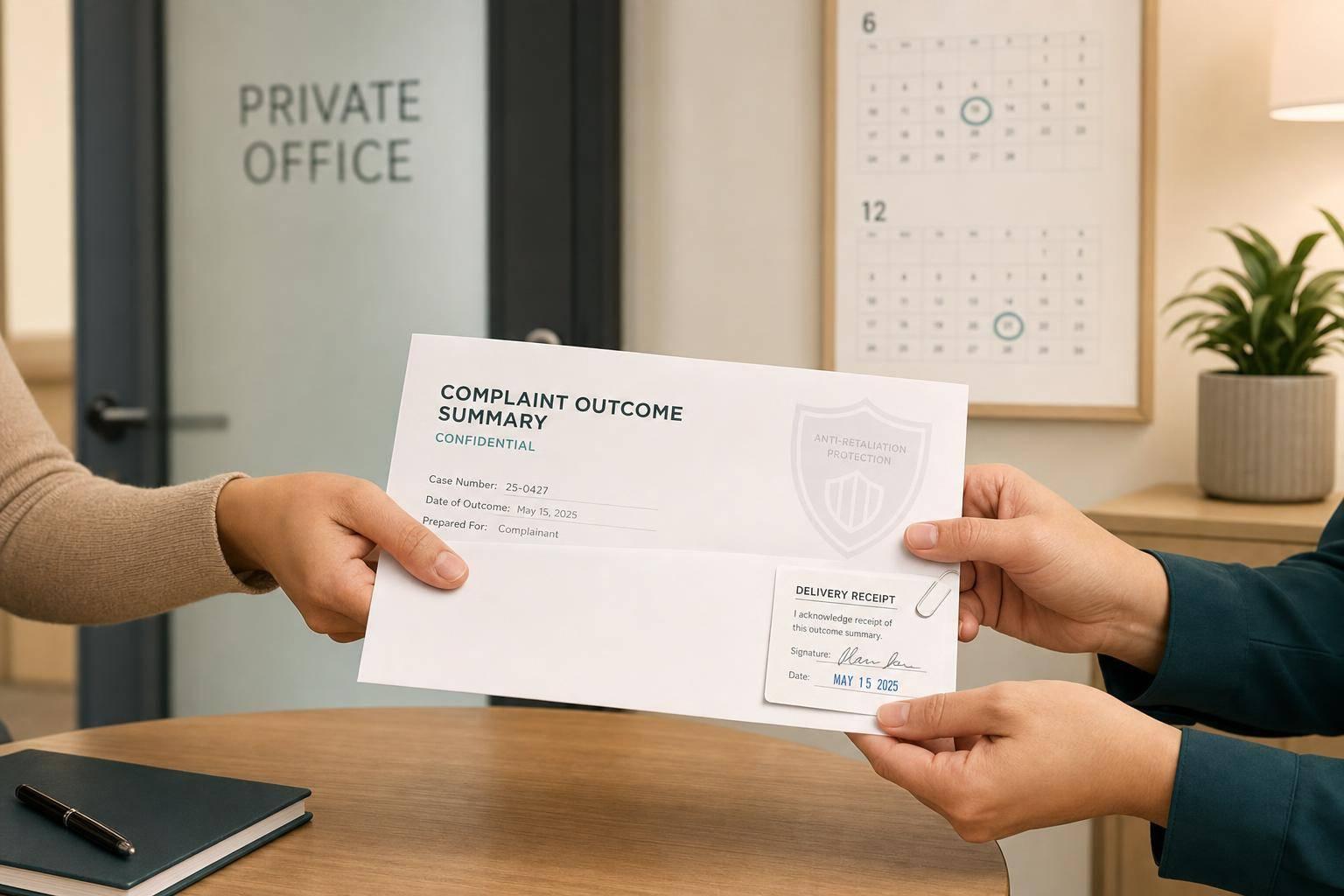
Once an emergency has been stabilized, accurate documentation becomes essential. It serves as a legal record, identifies safety vulnerabilities, and informs future planning. Skipping this step can turn small issues into big headaches. Megan Hayward, Founder & CEO of TempGuru, puts it plainly:
"Poor incident reporting - failing to document, losing critical information, not escalating appropriately - transforms minor issues into major problems".
A solid incident report captures all the key details. This includes the time, date, and specific location, noted with clear, venue-specific identifiers like "Zone C North, Row 14 cross-aisle". The report should classify the incident by type - whether it's medical, security-related, property damage, crowd safety, or a near-miss - and by severity:
Gathering witness statements is another critical step. These should be recorded word-for-word, avoiding any personal interpretations. Additionally, note environmental factors like lighting, weather conditions (for outdoor events), floor conditions, and crowd density.
This level of detail not only supports the immediate response but also lays the groundwork for improving safety in the long run.
Thorough documentation is a cornerstone of effective event management. It helps managers assess whether crowding was an issue, if poor lighting played a role, or whether response times were adequate. These insights directly influence future planning and risk management strategies.
Beyond operational improvements, proper reporting also safeguards your organization legally. It creates a clear record for insurance purposes and helps defend against exaggerated claims or lawsuits. For example, with the Department of Labor recovering $274 million in back wages in 2024 and penalties for worker misclassification ranging from $50 to $25,000 per violation, detailed records demonstrate compliance and professionalism to all stakeholders, from venues to municipal authorities.
Training staff to handle incident reporting doesn’t have to be complicated. Digital tools can streamline the process, making real-time, consistent record-keeping a breeze. This efficiency is one of the many benefits of using event staff scheduling software that includes integrated reporting features. However, it’s critical to emphasize that safety comes first. Staff should address immediate medical or security concerns before turning to documentation. Additionally, reporting near-misses is just as important, as it can reveal underlying hazards that might otherwise go unnoticed.
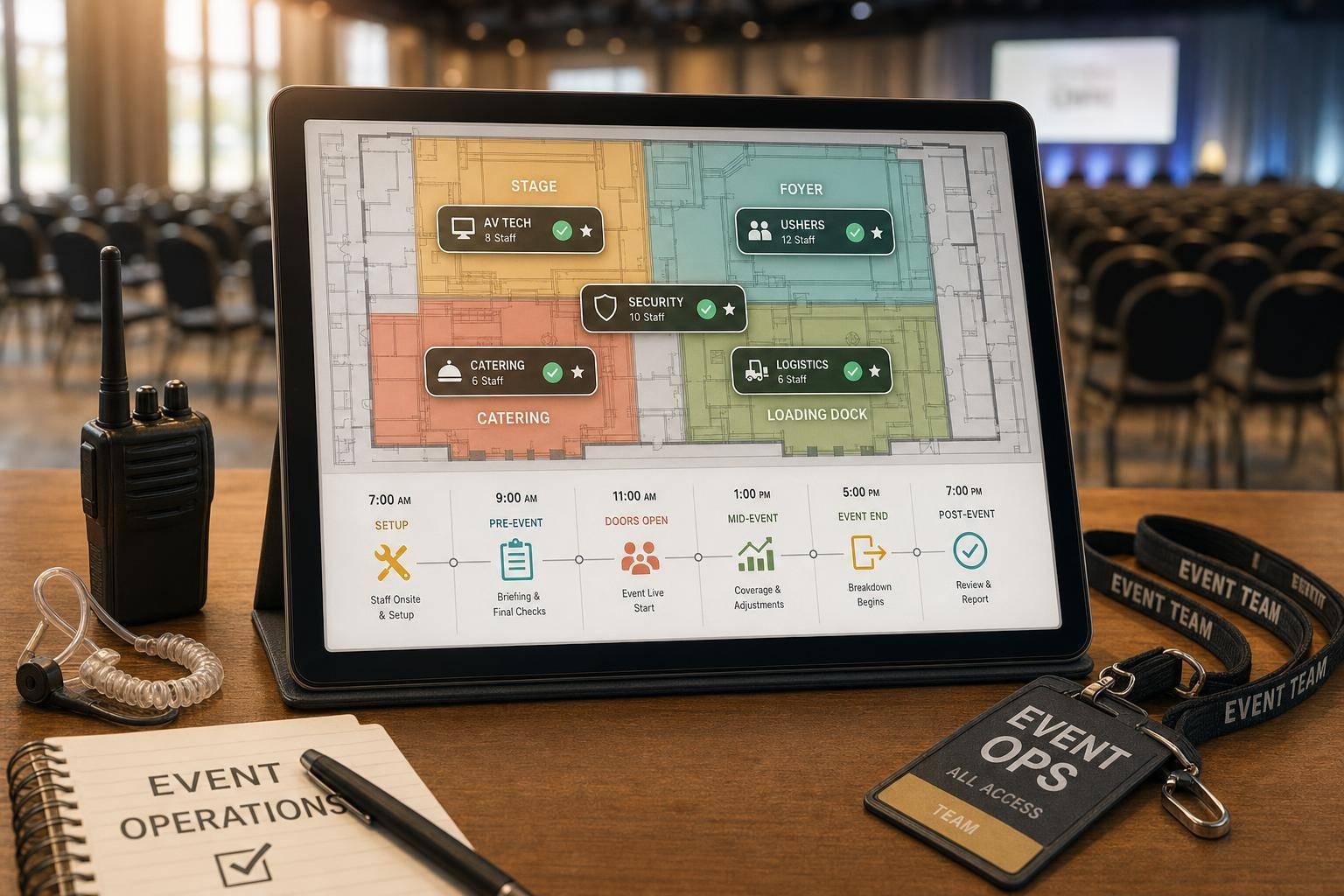
In the chaos of an emergency, confusion can grind response efforts to a halt. Without clearly defined roles, staff might end up duplicating tasks, issuing conflicting directions to guests, or leaving vital areas unattended. Assigning specific responsibilities ensures a unified response, building on the importance of communication and swift decision-making.
Smooth coordination begins with assigning specialized roles instead of relying on vague, general support, much like preparing an event day checklist to ensure nothing is overlooked. Here’s how roles can be divided:
A clear radio hierarchy is critical to maintaining order. Following a standardized approach - Observe, Report, Stabilize, Escalate - ensures predictable and efficient actions under pressure. This structured coordination ties seamlessly to other emergency skills, making sure every response is purposeful.
Defined roles minimize the risk of improvisation, which can lead to blocked exits or miscommunication with guests. Instead, staff can quickly detect and address issues - ideally within 60 seconds. These roles also allow for precise micro-evacuations, targeting specific areas or hazards without triggering unnecessary panic across the entire venue.
Matching roles to individual strengths and cross-training staff for multiple tasks boosts both confidence and flexibility during emergencies. Joint drills with emergency services can further improve coordination between teams. What’s more, integrating these roles and trained supervisors into existing protocols adds minimal extra cost to staffing. Together with established practices for first aid, communication, and evacuation, clear role assignments create a resilient and efficient event response system.
Creating a strong emergency response team involves more than just having a plan - it's about ensuring your team is trained, prepared, and organized. This process demands structured training sessions, clear safety protocols, and a reliable way to track staff readiness. That’s where Quickstaff steps in, offering tools that simplify the management of these essential tasks.
Quickstaff centralizes staff information, consolidating names, contact details, and role assignments into a single, easy-to-access roster. This eliminates the chaos of juggling multiple spreadsheets and ensures accountability during training. With everything in one place, it's simple to pinpoint who’s certified in CPR, trained to use an AED, or ready to lead an evacuation. This level of organization directly supports the critical emergency response skills mentioned earlier.
The platform also automates the distribution of essential safety documents, such as venue maps, event schedules, and emergency plans, sending them out 24 hours before an event. This ensures every team member has the necessary materials, from parking instructions to supervisor contact details, well in advance. By aligning everyone with the emergency protocols, Quickstaff helps create a unified and prepared team.
To confirm readiness, Quickstaff employs a straightforward text-based system. Team members must reply "YES" within 12–24 hours before an event, verifying their availability. This simple yet effective step ensures that trained responders are present when needed, minimizing last-minute staffing issues during emergencies.
The ten skills discussed are the backbone of ensuring safety and success at any event. Spotting issues early, addressing risks before they escalate, and managing clear evacuations allow attendees to fully enjoy the experience without worry. As Bryan Huneycutt, Vice President of Operations at Halo Solutions, explains:
"When safety is done right, it allows the event to be more successful because everyone can focus on the experience, knowing the risks are being managed".
This forward-thinking approach doesn’t just mitigate crises - it enhances the entire event planning process. Beyond preventing emergencies, these skills protect your organization’s reputation and reduce liability. Following established safety protocols also ensures detailed incident documentation, which can be critical for insurance claims and regulatory audits. Interestingly, building emergency-ready capabilities into your plan often adds only a small percentage to your overall staffing budget.
Post-event debriefs are another essential step. Gathering honest feedback and updating safety checklists after each event helps refine processes and promotes continuous improvement.
Having a well-coordinated team is just as important. Tools like Quickstaff simplify scheduling, streamline communication, and send timely reminders, ensuring every team member is prepared for emergencies. With proper training and efficient management, safety evolves from being just a compliance requirement to a competitive edge - one that fosters guest confidence and guarantees smooth event execution.
Event staff must have emergency response training to manage unexpected situations and ensure everyone's safety. Critical skills include:
These skills enable staff to quickly identify problems, maintain order, and take the right steps to safeguard attendees and the event itself.
The number of crowd managers you'll need hinges on the size and complexity of your event. For larger gatherings or events with dense crowds, you'll typically require more personnel to keep things running smoothly and maintain safety. Key factors to weigh include the venue's layout, the anticipated attendance, and the nature of the event itself.
Quickstaff provides tools to help track and manage staff certifications and training, particularly in emergency response skills such as first aid, crowd control, and incident management. By ensuring staff are properly trained and equipped for emergencies, event organizers can monitor readiness levels with ease, creating a safer environment for everyone involved.