Ultimate Guide to Event Staff Certifications
April 29, 2026


Event staff certifications are crucial for ensuring professionalism, compliance, and career growth in the event industry. They validate skills, simplify hiring, and boost earning potential. Key certifications include:
Certifications improve staff retention, simplify scheduling, and ensure compliance with legal standards. Tools like Quickstaff help manage credentials efficiently, making it easier to assign qualified staff to high-stakes events.

The event industry offers a variety of certifications tailored to different career stages and specialties. Knowing the requirements, costs, and potential career boosts of these credentials can help you decide which ones align with your goals or your team’s needs.

The CMP certification is widely regarded as a benchmark for meeting and event professionals. To qualify, you’ll need 36 months of full-time experience in the meetings industry and 25 hours of continuing education within five years. If you hold a degree in event management or hospitality, the experience requirement drops to 24 months.
Here’s a quick breakdown of the costs:
The exam itself includes 150 questions covering topics like site management, marketing, contracts, and stakeholder management. Currently, about 14,000 professionals globally hold this credential.

If your focus is on special events rather than corporate meetings, the CSEP certification may be a better fit. It requires three years of full-time experience in the special events industry, and the exam is offered quarterly. The total cost is approximately $700, split evenly between a $350 application fee and a $350 exam fee.
CSEP-certified professionals often see hourly pay increases of $10–$15, with the certification paying for itself in about 50 work hours. This credential highlights expertise in planning events like weddings, galas, and festivals.

With the virtual events industry projected to hit $404 billion by 2027, the DES certification has gained traction. Unlike CMP or CSEP, DES doesn’t require extensive prior experience. Instead, candidates complete an 8-module online course (about 10 hours of content), pass quizzes with at least 80%, and score 70% or higher on the final exam.
Cost breakdown:
DES-certified professionals tend to earn about $8,000 more annually than their non-certified peers, and those holding both CMP and DES credentials can see increases of up to $18,000.
"The DES course pointed me to look at the bright side, that is: digital events can increase our membership, which can be a new way of generating revenue."
– Carola Van Der Hoeff, Senior COO & Congress Director, International Pharmaceutical Federation
"In addition to learning from the course, you're going to gain a community that's awesome."
– Elyse Dawson, Manager of Corporate Events and Conference Center at Invesco
For event staff in hospitality roles, certifications focus on compliance and operational readiness. Many professionals build a "compliance stack" by combining a Food Handler certificate with an Alcohol Server credential.
As Daniel Muersing, CEO of Event Staff, puts it:
"When a staff member walks in with verified bartending or safety credentials, they remove liability from the equation, allowing us to book them on our most complex, high-budget activations."
This certification focuses on mastering event management software, which is crucial for tasks like registration, attendee tracking, venue sourcing, and marketing automation. While specific pricing isn’t detailed, the certification is known for its practical value in modern event coordination. Like many certifications, it typically requires renewal every three to five years through continuing education or re-examination.
Understanding certifications like these can streamline event planning and ensure you’re equipped to manage staff efficiently. Pairing these credentials with tools like Quickstaff can help organize certified teams across multiple events seamlessly.
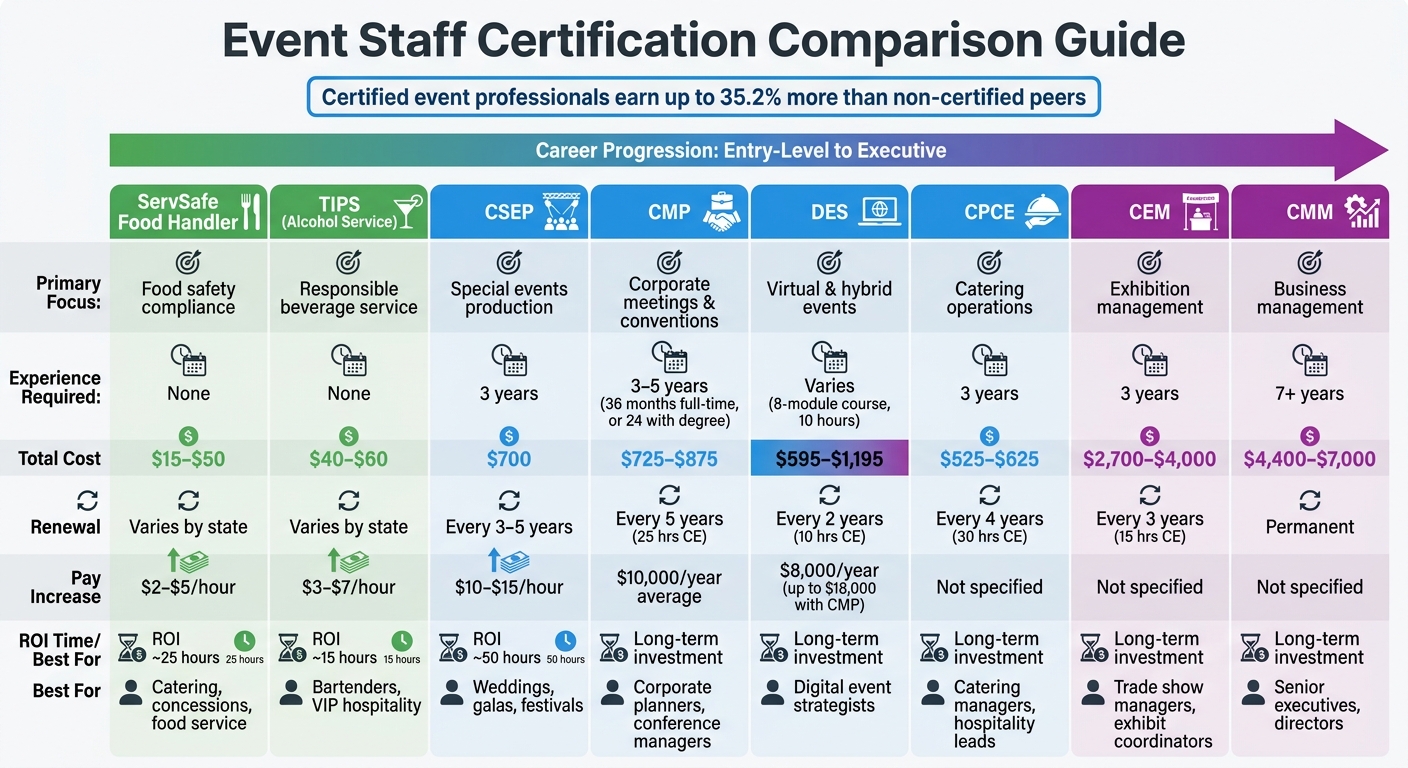
Event Staff Certification Comparison: Costs, Requirements & ROI
Selecting the right certifications for your event staff boils down to your business model, the types of events you handle, and your budget. Some certifications are essential for meeting legal requirements and securing immediate bookings, while others help your team qualify for higher-paying leadership positions. Knowing how these certifications compare can help you decide which ones provide the best return on investment.
| Certification | Primary Focus | Experience Required | Total Cost | Renewal Process | Best Use Case |
|---|---|---|---|---|---|
| ServSafe Food Handler | Food safety compliance | None | $15–$50 | Varies by state | Catering, concessions, food service |
| TIPS (Alcohol Service) | Responsible beverage service | None | $40–$60 | Varies by state | Bartenders, VIP hospitality |
| CSEP | Special events production | 3 years | $700 | Every 3–5 years | Weddings, galas, festivals |
| CMP | Corporate meetings & conventions | 3–5 years | $725–$875 | Every 5 years (25 hrs CE) | Corporate planners, conference managers |
| DES | Virtual & hybrid events | Varies | $595–$1,195 | Every 2 years (10 hrs CE) | Digital event strategists |
| CPCE | Catering operations | 3 years | $525–$625 | Every 4 years (30 hrs CE) | Catering managers, hospitality leads |
| CMM | Business management | 7+ years | $4,400–$7,000 | Permanent | Senior executives, directors |
| CEM | Exhibition management | 3 years | $2,700–$4,000 | Every 3 years (15 hrs CE) | Trade show managers, exhibit coordinators |
This table highlights the essential details to consider when weighing your options, focusing on compliance, cost, and leadership potential.
Compliance certifications like ServSafe and TIPS are must-haves for meeting legal regulations and quickly paying off their initial costs. For example, a $50 ServSafe course typically becomes profitable after 25 hours of work, while TIPS certification can add $3–$7 per hour to wages, covering its cost in about 15 hours.
On the other hand, professional designations such as CMP and CSEP signal advanced expertise and can lead to higher earnings. CMP-certified professionals, for instance, earn an average of $10,000 more annually. Additionally, planners with any certification often see salary boosts of up to 35.2%. For managers using Quickstaff, hiring certified staff reduces the need for close supervision and minimizes liability, especially in high-risk roles like food handling or alcohol service across multiple events using tools for last-minute catering staff scheduling.
Certifications can play a major role in elevating your event business, ensuring compliance, supporting career growth, and improving operations. Start with the basics - compliance. Before diving into advanced credentials, make sure your staff meet the legal requirements for food and alcohol service. Certifications like ServSafe Food Handler (costing $15–$50) and Responsible Beverage Service training ($40–$60) are often mandatory in many states. These certifications not only keep you compliant with the law but also allow your team to take on specific roles without restrictions. Think of these as the building blocks for a more structured certification program that benefits your team and your business.
Once the compliance groundwork is in place, you can create a certification plan that helps staff grow from entry-level roles to leadership positions. Start with the mandatory food and alcohol certifications, then encourage staff to pursue specialized credentials like bartending or wedding planning. For those aiming for supervisory roles, advanced certifications such as ServSafe Manager ($150–$200) or Certified Meeting Professional (CMP) ($875) are excellent options. This tiered system not only gives employees a clear career path but also ensures you have skilled leaders ready for high-pressure events.
Keeping track of certifications can be a hassle, but streamlining the process helps you overcome event staff scheduling challenges. Require your staff to upload digital copies of their certifications with clear, standardized filenames (e.g., "ServSafe_FoodHandler_2026.pdf"). This system speeds up verification and ensures schedulers can quickly confirm compliance.
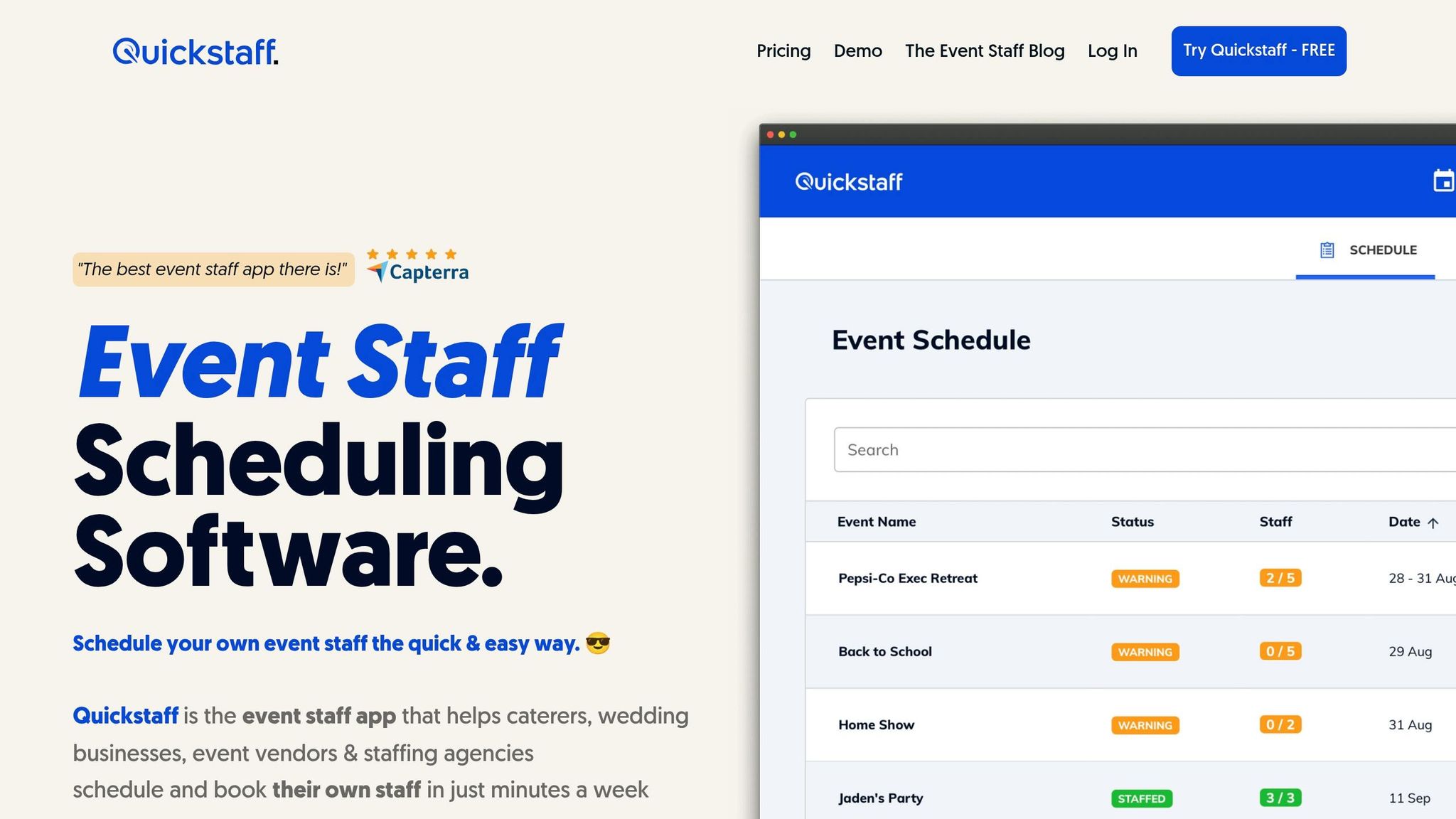
Tools like Quickstaff make certification tracking a breeze by organizing all staff credentials in one central location. You can add a dedicated "Certifications" section to each staff profile, listing certification names and expiration dates. This allows you to filter your team based on compliance when scheduling events. For example, Quickstaff enables you to instantly find and book staff who meet specific requirements. Its mobile-friendly interface also lets employees update their certification status on their own, saving you the trouble of constant follow-ups.
Certifications aren’t just about compliance - they’re a powerful retention tool. When staff see a clear path for growth, such as moving from standard catering roles to premium VIP assignments, they’re more likely to stick around. This is especially important as event management jobs are expected to grow by 11% through 2026. Retaining skilled employees not only stabilizes your team but also boosts your bottom line.
Certified staff can earn significantly more, with pay increases ranging from $2 to $20 per hour depending on their specialization. For instance, a Food Handler certification can add $2–$5 per hour, while a CMP credential can increase wages by $12–$18 per hour. By covering or reimbursing certification costs, you’re investing in employees who can handle complex tasks with minimal supervision. These verified credentials also enhance client trust and reduce liability risks.
Take it one step further by linking certifications to premium assignments. Use them as filters for high-profile events like corporate conferences or VIP hospitality gigs, where precision is non-negotiable. This strategy turns certifications into active tools that boost both employee satisfaction and your business’s performance.
Event staff certifications are a game-changer, enhancing skills, streamlining operations, and building client trust. They empower staff to grow from entry-level roles to specialized positions, such as craft cocktail preparation or food safety management. This career progression often comes with pay increases ranging from $2 to $20 per hour, depending on the expertise gained.
Operationally, certifications lighten the load for managers. They simplify scheduling by removing compliance hurdles and ensure that certified staff can be assigned to high-stakes tasks with confidence. This efficiency not only benefits internal processes but also reassures clients.
Certifications also act as a trust signal for clients, demonstrating that staff are equipped to handle high-pressure responsibilities and meet stringent standards. Daniel Muersing, CEO of Event Staff, highlights this point:
"In the premium event world, I don't pay extra for the certificate itself; I pay for the immediate trust it creates. When a staff member walks in with verified bartending or safety credentials, they remove liability from the equation".
With tools like Quickstaff, event managers can centralize and manage staff certifications effectively. The platform allows managers to log certification names and expiration dates for each team member and filter staff by compliance when scheduling. Its mobile-friendly design also enables employees to update their credentials independently, cutting down on follow-ups and ensuring only qualified staff are assigned to specific roles. This seamless system transforms certifications into a strategic asset, improving both staff retention and operational efficiency.
Start by pursuing certifications that emphasize safety, customer service, and specific job skills such as bartending or catering. These certifications not only help employees meet safety standards but also enhance their ability to serve customers effectively. Plus, they can open doors to higher earning opportunities. Focusing on these areas lays the groundwork for improved professionalism and overall job performance.
Choosing between CMP (Certified Meetings Professional), CSEP (Certified Special Events Professional), and DES (Digital Event Strategist) depends on what you do and where you want to go in your career:
Pick the certification that aligns with your current role and future aspirations.
The simplest way to stay on top of certification expirations is by using a centralized system that automates reminders and offers clear visibility. Automation not only cuts down on manual mistakes but also saves time and ensures certifications are renewed promptly. A centralized dashboard allows you to easily track expiration dates, reducing compliance risks and keeping your team’s credentials current without hassle.


