How Certification Boosts Event Staff Retention
January 28, 2026

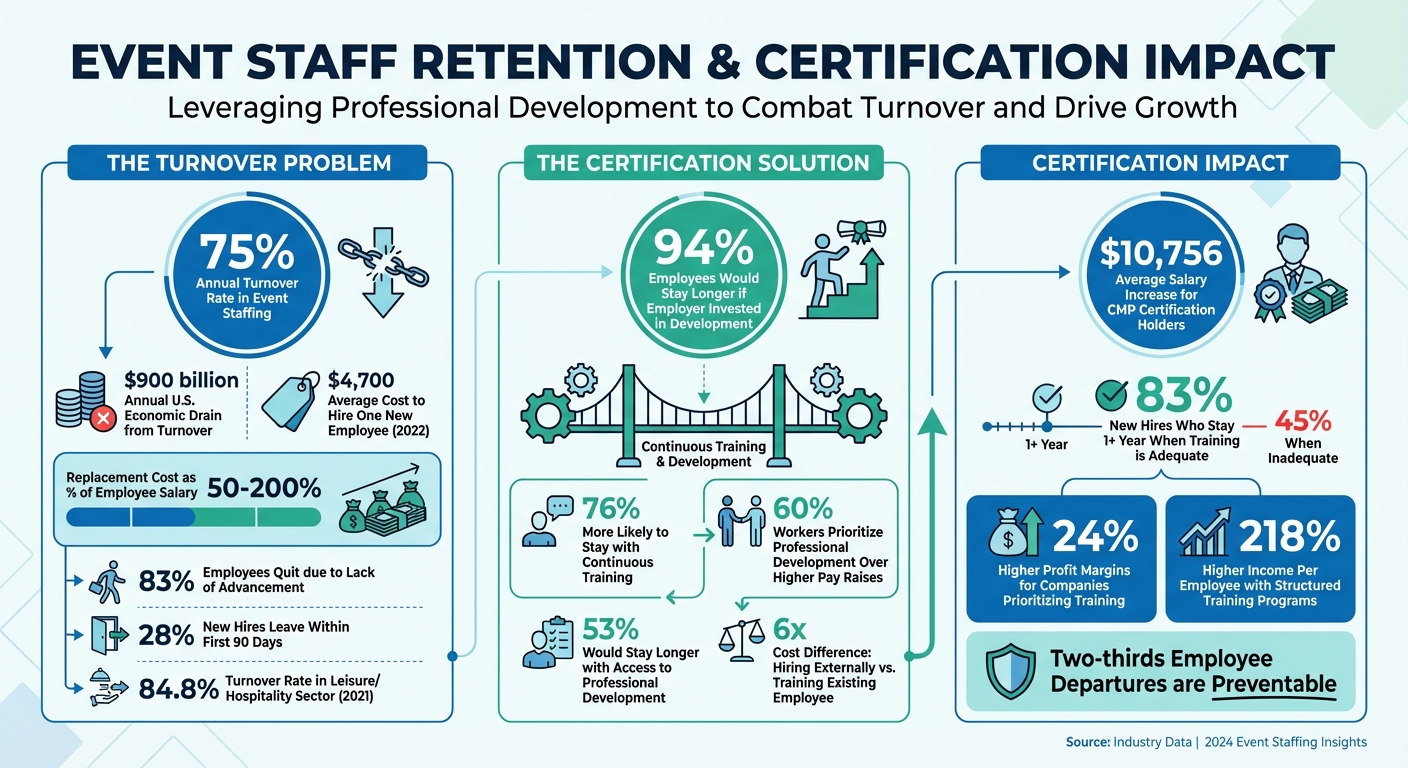
Event staffing struggles with high turnover - up to 75% annually. This churn is costly, with replacement expenses ranging from 50% to 200% of an employee’s salary. The main reasons staff leave? Stress, irregular schedules, and limited career growth. In fact, 83% of employees quit due to a lack of advancement opportunities.
Here’s the solution: certification programs. By offering professional development, businesses can reduce turnover, save money, and build a loyal, skilled team. Certifications like CMP (Certified Meeting Professional) and CSEP (Certified Special Events Professional) provide employees with clear career paths, recognition, and confidence in their roles.
Investing in certifications isn’t just about skills - it’s about showing employees they’re valued, which builds loyalty and drives long-term success.
Event Staff Retention Statistics: Impact of Certification Programs
The event industry is notorious for its grueling hours, high-pressure environment, and unpredictable schedules. Pair that with low pay and limited benefits, and it’s no wonder so many employees decide to leave. When workers are offered better opportunities elsewhere, these factors only make the decision to quit easier.
Another major driver of turnover is the lack of growth opportunities. Many employees feel stuck due to limited career advancement, inconsistent management, and a lack of recognition for their efforts. Micromanagement and poor leadership further erode employee satisfaction and loyalty. These issues are reflected in the numbers: 28% of new hires leave within their first 90 days, and the leisure and hospitality sector saw an 84.8% turnover rate in 2021. This constant churn doesn’t just hurt morale - it causes serious operational and financial strain.
High turnover isn’t just a headache for managers - it’s a major financial burden. In 2022, the average cost to hire a single new employee was nearly $4,700. But that’s just the tip of the iceberg. When you account for lost productivity, training time, and disruptions to workflows, replacing an employee can cost anywhere from 50% to 200% of their annual salary. Across the U.S., turnover drains nearly $900 billion from the economy each year.
The operational fallout is just as severe. Constant turnover leaves teams scrambling to fill gaps, leading to chaotic last-minute scheduling. Overworked staff are more likely to burn out, while new, inexperienced hires struggle to meet client expectations. This can hurt your company’s reputation and cost you repeat business.
"If skilled, veteran workers steeped in the nuances of hospitality are consistently leaving, and new, inexperienced workers are always scrambling to learn the ropes, the result can be a chaotic work environment where institutional knowledge is lost." - Lisa Schwarz, Senior Director of Global Product Marketing, NetSuite
Here’s the silver lining: up to two-thirds of employee departures are preventable. Tackling these root causes can help reduce turnover costs and create a more stable, effective workforce.
Certification programs help reduce staff turnover by offering recognition, opportunities for growth, and a clear path for career development. When companies invest in professional credentials for their employees, it sends a strong message about career advancement opportunities. The data supports this: 76% of employees are more likely to stay with employers who provide continuous training, and 60% of workers prioritize jobs with professional development over those with higher pay raises. These factors contribute to higher job satisfaction and a more defined career trajectory.
Certifications provide a roadmap for career progression. Instead of leaving employees uncertain about how to advance, certifications highlight the specific credentials needed for promotions and additional responsibilities. This is particularly valuable for employees in fields like event management, where formal degrees may not be common. A certification validates their expertise and positions them as professionals within their industry.
"If [employees] are confident in what they're doing and they can see a clear path for their career, they're more likely to stay with the company."
– Jennifer Buchanan, Senior Director of Field Learning and Development, Sam's Club
Sam's Club's "Manager in Training" program is a prime example of this approach. In 2021, nearly 350 employees earned eligibility for college credits, and 75% of Sam's Club managers began as hourly associates. This demonstrates how certifications can pave the way for upward mobility.
Employees with certifications tend to feel more confident in their abilities and take greater pride in their work. By meeting industry-recognized standards, they gain a clear understanding of their role, which improves their overall satisfaction. This confidence and clarity translate into tangible results for businesses. Companies that invest in staff training report a 24% higher profit margin. For instance, Bar Crawl USA has retained a core management team for over nine years, thanks to its intensive certification programs. These programs directly contribute to employee satisfaction and long-term loyalty.
Investing in certifications sends a strong message that employees are valued beyond their current roles. This fosters loyalty by showing that the company is committed to their long-term growth. Interestingly, making employees more "employable" through certifications often encourages them to stay, as they feel supported and see opportunities for advancement within the organization.
"Invest in your people and they really do feel like they're not just employed, but I call it employable... They don't feel stagnant, they don't feel stuck. It really does help in the broader ecosystem of retention."
– Tanya Moore, Chief People Officer, West Monroe
From a financial perspective, the benefits are clear. Hiring a new employee externally can cost up to six times more than training or reskilling an existing one. With 83% of workers leaving due to a lack of growth opportunities and 53% stating that access to professional development would make them stay longer, certifications are a smart investment for building a loyal and stable workforce.
Event staff in various roles have the opportunity to earn certifications that showcase their skills, boost earning potential, and open up career advancement opportunities. Two highly regarded certifications stand out for event professionals, each tailored to specific aspects of the industry.
The Certified Meeting Professional (CMP), offered by the Events Industry Council (EIC), is widely regarded as a benchmark for event planners and organizers. With over 11,000 certified professionals across 55 countries, it’s one of the most respected credentials in the field. The CMP highlights expertise in meeting management and has been shown to boost salaries by an average of $10,756 for those who achieve it.
To qualify, applicants need at least 36 months of full-time experience in events, hospitality, or tourism. Those with a relevant associate degree or higher can apply with 24 months of experience. Additionally, candidates must complete 25 clock hours of continuing education within the past five years. The certification process involves a $250 application fee and a $475 exam fee. The exam itself consists of 165 multiple-choice questions, covering areas such as Strategic Planning, Risk Management, and Financial Management.
While the CMP covers comprehensive meeting management, the next certification focuses on the creative side of event production.
The Certified Special Events Professional (CSEP), managed by the International Live Events Association (ILEA), centers on event design and production. This certification is ideal for professionals involved in weddings, galas, and corporate events. Like the CMP, it requires a similar level of experience and costs approximately $700 for the application and exam fees.
The CSEP emphasizes creative and live event production, offering a standardized approach to professional practices in this niche. For companies that specialize in weddings, high-profile galas, or corporate celebrations, encouraging staff to earn this certification signals a commitment to delivering exceptional event experiences and innovative designs.

Quickstaff’s mobile platform makes managing certifications like CMP or CSEP a breeze. From tracking progress to assigning roles strategically, it simplifies the process so you can focus on building a skilled, motivated team. Here’s how it works:
Keeping track of certification milestones is easier with Quickstaff’s automated reminders. These notifications ensure your team stays on top of deadlines and study checkpoints, whether they’re working an event or preparing from home. For example, you can set goals like completing 10 hours of continuing education by March 15, 2026, or finishing prerequisite coursework by the end of Q2. The platform’s centralized communication hub keeps everyone aligned and informed.
Investing in employee development pays off - 94% of employees say they’d stay longer at a company that prioritizes learning and growth. By maintaining consistent touchpoints, you show your team that their professional development is a priority.
Quickstaff also makes assigning roles based on certifications straightforward. The platform tags team members by their credentials (CMP, CSEP, FMP, etc.), allowing you to match them to roles that fit their qualifications. When setting up an event, you can filter your roster to ensure only the right people are assigned.
For instance, if a corporate gala requires CSEP-certified designers, you can quickly identify qualified candidates. Similarly, for catering events needing food safety credentials, the platform ensures only certified staff are considered. This approach not only highlights gaps in your team’s skill set but also ensures certified professionals are utilized where they’re most effective, saving time and reducing administrative effort.
Training programs have a direct impact on performance - 59% of employees report improved job performance due to workplace training. Assigning certified staff to roles that align with their expertise boosts their confidence and performance, creating a cycle of success that strengthens retention and team morale.
To understand the impact of certification programs, start by tracking turnover rates before and after implementation. This helps connect improved employee skills to reduced turnover costs. You can calculate retention rates using this formula:
(Ending headcount - Departures) / Starting headcount.
For example, if your team started with 50 employees in January 2026 and ended the year with 45 (after 5 departures), your retention rate would be 90%.
Break down this data by certification status to pinpoint which programs deliver the best results. Compare turnover rates among certified and non-certified employees, and dive deeper by job role. For instance, are your CSEP-certified designers staying longer than those without the certification? This approach helps identify which certifications provide the greatest return on investment.
Gathering feedback from employees is key to predicting turnover. Use short surveys and stay interviews to measure engagement. Questions like whether employees feel their roles allow them to use their skills or if they see a clear career path can offer early warnings of potential turnover.
Additionally, monitor employee satisfaction levels alongside retention metrics. Studies show that 83% of new hires who feel their training adequately prepared them are likely to stay for at least one year, compared to just 45% of those who felt their training fell short. Tools that track punctuality and attendance can also provide insights, as these often reflect job engagement. Together, these metrics offer a clearer picture of how certification programs influence retention and financial outcomes.
Retention data can also demonstrate the financial impact of certification programs. High turnover is expensive - replacement costs range from 50% to 200% of an employee’s annual salary. Even small reductions in turnover can lead to substantial savings. For example, replacing an event coordinator with a $60,000 salary might cost between $30,000 and $120,000.
If your certification program cuts turnover by just 20%, the savings can be significant. Imagine you lose 10 employees annually, with an average replacement cost of $38,700 each. That’s $387,000 in yearly turnover costs. Reducing turnover by 20% saves $77,400 - a clear justification for training investments ranging from $501 to $3,000 per employee. Companies with structured training programs also report 218% higher income per employee, along with 17% greater productivity and 21% higher profitability.
Certification programs address major causes of employee turnover - like lack of recognition, limited growth opportunities, and feeling undervalued - by turning skills training into a pathway for professional identity. This sends a powerful message: employees are seen as skilled professionals with meaningful career prospects. As go2HR explains, "By offering opportunities for certification, you're sending a message that you value your staff and view them as skilled professionals with long-term career goals".
The numbers back this up. 76% of employees are more likely to stay with companies that provide continuous training, and businesses that prioritize training see a 24% higher profit margin. These aren’t just statistics - they highlight tangible benefits like lower turnover costs and better team performance.
To make the most of certification programs, focus on aligning certifications with specific roles. Create a tiered system with clear milestones for advancement, and link certification achievements to rewards such as bonuses or leadership opportunities. Provide dedicated time for training, and use smart scheduling tools to maximize efficiency.
Platforms like Quickstaff make it easier to track certification progress and assign roles based on credentials. This ensures that certified staff are placed where they excel, leading to improved job satisfaction and overall team effectiveness.
In the fast-paced event industry, success depends on skilled, committed professionals. Certification programs not only enhance skills but also provide the recognition and career pathways that drive long-term dedication and operational success.
Certification programs play a key role in keeping event staff engaged and committed by building their skills, boosting their confidence, and increasing their professional worth. When employees earn certifications like CPR, First Aid, or event planning credentials, they not only feel more capable but also valued. This sense of appreciation often translates into higher job satisfaction and loyalty, making them less likely to look for opportunities elsewhere.
Providing certifications also reflects a company's commitment to its employees' growth. When staff see clear pathways for career development and recognition, they’re more inclined to stick around for the long haul. On top of that, certifications can lead to better performance and higher-quality events, creating a supportive and thriving workplace that naturally helps reduce turnover.
Investing in staff certifications can bring real financial benefits to event companies. Certified employees often deliver stronger performance, which translates into higher productivity, smoother event execution, and fewer expensive errors. These improvements naturally lead to better profitability.
Certifications also play a big role in keeping employees engaged and loyal. When team members see that their growth is supported, they’re more likely to stick around. This helps companies save on the costs of recruiting, onboarding, and training new hires while maintaining valuable institutional knowledge. By prioritizing certifications, event companies not only enhance service quality but also gain financially through improved efficiency and reduced turnover.
Certifications like the Certified Meeting Professional (CMP) and the Certified Event Planning Specialist (CEPS) can be game-changers for anyone aiming to grow in the event industry. The CMP is often considered the industry’s gold standard, highlighting a professional's expertise in event planning and management. Having this certification can boost your credibility, expand your career opportunities, and even increase your earning potential.
On the other hand, the CEPS certification zeroes in on the hands-on skills needed to plan and execute events successfully. From choosing the right venue to organizing entertainment, it’s perfect for those who want to stand out in a competitive job market. Earning these certifications not only strengthens your skill set but also shows your dedication to professional development, making you a stronger asset to any event team.