Labor Law Checklist for Temporary Staff
December 29, 2025

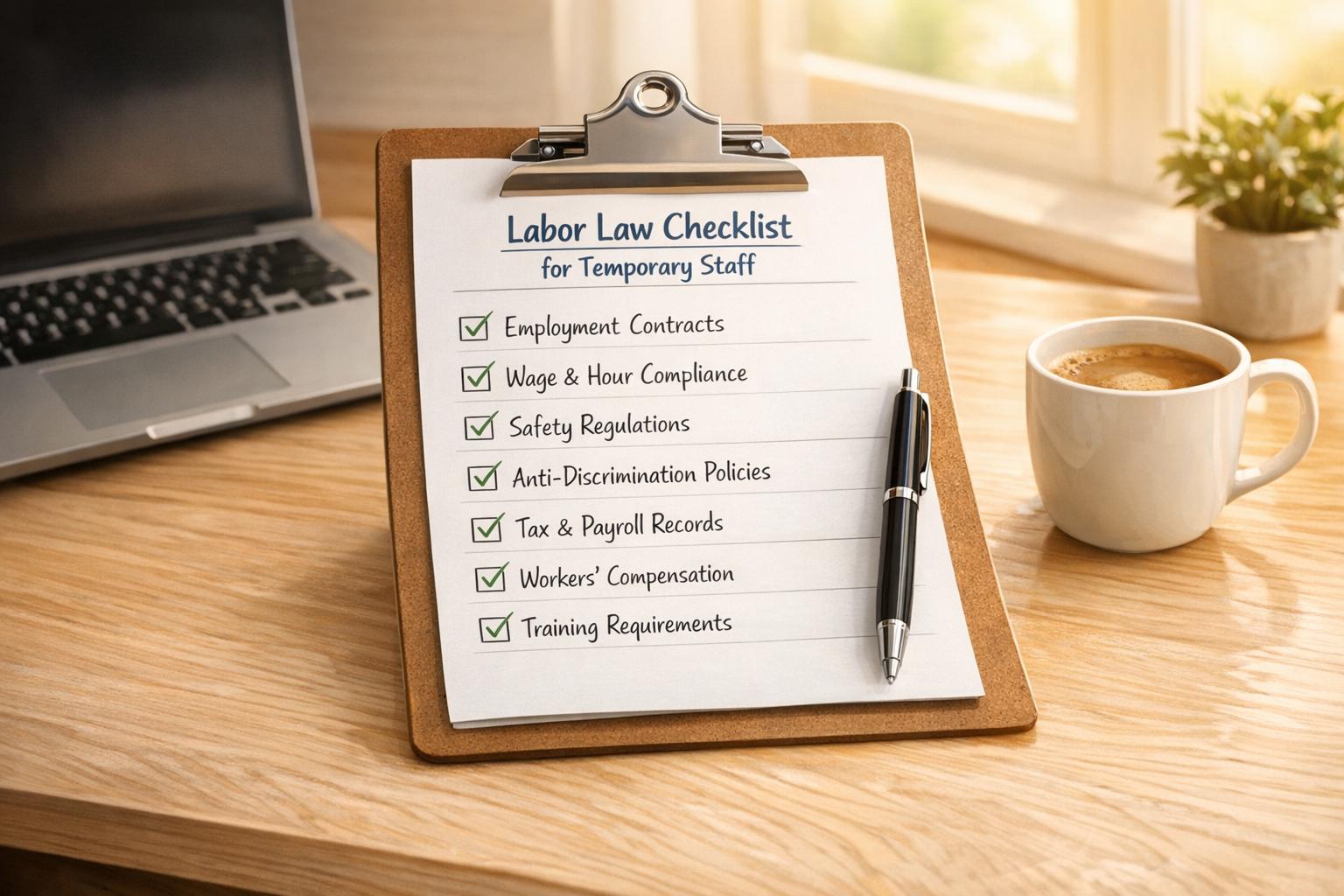
Managing temporary staff requires careful attention to labor laws to avoid penalties and ensure compliance. Here's what you need to know:
Key takeaway: Compliance isn't optional. Following proper classification, safety, wage, and documentation protocols protects your business and ensures fair treatment for temporary staff.
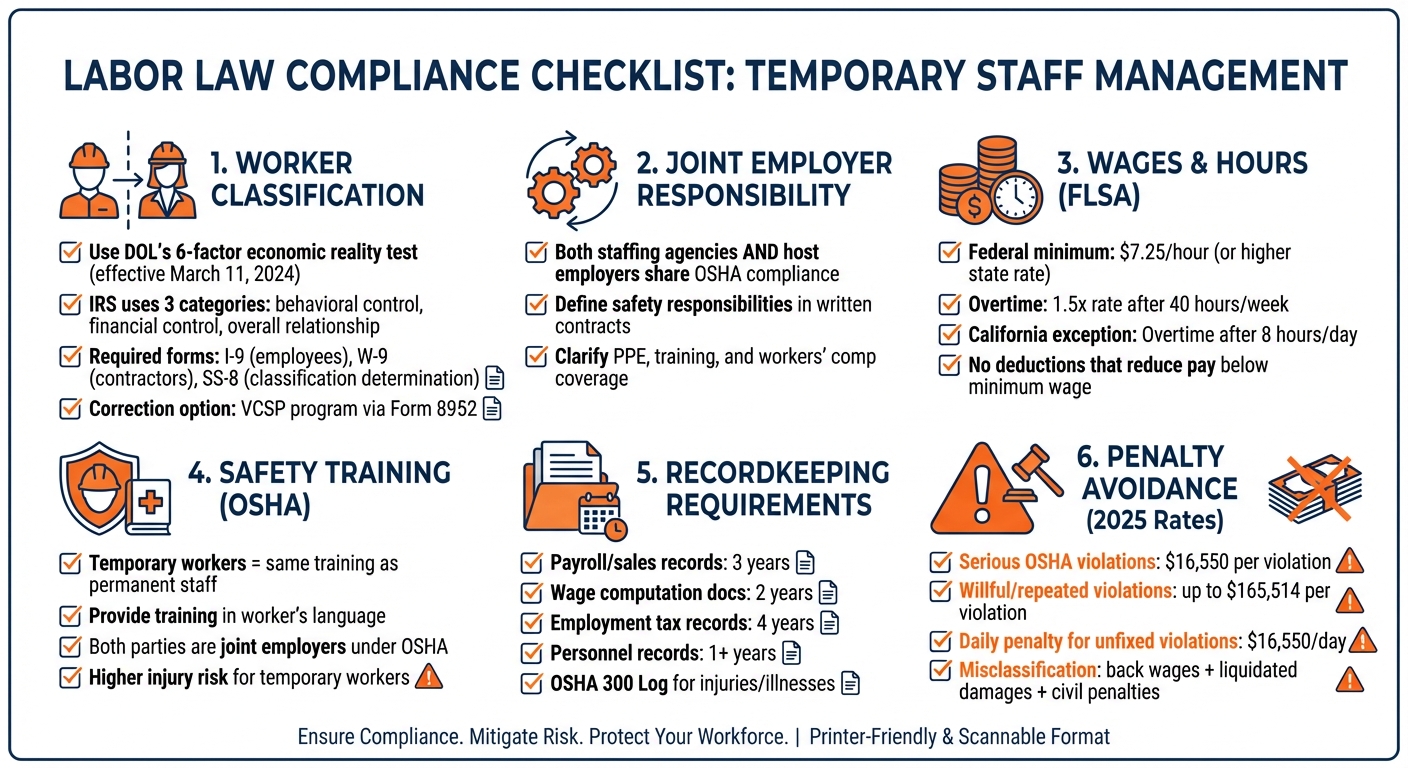
Labor Law Compliance Checklist for Temporary Staff Management
Starting March 11, 2024, the Department of Labor (DOL) will apply a "totality-of-the-circumstances" approach to decide whether a worker is classified as an employee or an independent contractor. This means no single factor determines the classification; instead, the entire working relationship is considered. The DOL examines six critical factors: profit opportunity, nature of investment, relationship permanence, degree of control, work integration, and worker initiative.
The IRS, on the other hand, uses a different method involving three categories: behavioral control, financial control, and the overall relationship. Under this framework, an employee is typically someone whose tasks and methods are directed by the business.
It’s important to note that labels like "independent contractor" don’t hold legal weight. If the economic reality indicates an employment relationship, workers are entitled to Fair Labor Standards Act (FLSA) protections, regardless of what the paperwork says. Make sure your documentation aligns with these classification principles.
For employees, you must complete Form I-9 to verify their identity and employment eligibility. For independent contractors, obtain Form W-9, which provides their Taxpayer Identification Number (TIN). If you're unsure about a worker's classification, you can file Form SS-8 with the IRS to get an official determination.
If you’ve misclassified workers in the past, the IRS offers a way to correct this through the Voluntary Classification Settlement Program (VCSP). By filing Form 8952, eligible employers can reclassify workers as employees for future tax periods while receiving partial relief from previous federal employment taxes. Workers who believe they’ve been misclassified can report uncollected Social Security and Medicare taxes by filing Form 8919.
Before a temporary worker starts their first shift, it's essential to have written policies in place. These should clearly define roles, responsibilities, job titles, start dates, and pay rates. Be sure to include a detailed outline of approved tasks to avoid any misunderstandings. Setting these expectations upfront ensures everyone is on the same page from day one.
Safety is a shared responsibility between the staffing agency and the host employer. To clarify these duties, create a contract that specifies who will handle PPE (personal protective equipment), safety training, and workers' compensation.
Temporary workers should receive the same safety training as permanent employees. This includes guidance on recognizing hazards, emergency protocols, and proper PPE usage. Make sure all training materials are provided in a language the worker understands. Studies show that temporary workers face higher risks of injury compared to permanent staff, making thorough safety onboarding a priority.
Once roles and safety procedures are established, promptly complete all hiring paperwork to formalize these standards.
Accurate and timely documentation is key to staying compliant and creating a smooth onboarding experience.
For every temporary worker, you must complete Form I-9. The worker needs to fill out Section 1 no later than their first day, and you must complete Section 2 within three business days by reviewing original, unexpired documents. If the assignment lasts fewer than three business days, both sections must be completed on the first day. Remember, workers can choose any acceptable documents from Lists A, B, or C - do not direct them on which to provide.
Collect Form W-4 immediately to ensure accurate federal tax withholding from the first paycheck. Additionally, most states require a separate state tax withholding form and a State New Hire Reporting Form, usually due within a few weeks of hiring. To meet EEOC reporting requirements, request voluntary self-identification information regarding race, sex, and veteran status.
Have temporary workers sign acknowledgments for key documents like the employee handbook, code of conduct, and workplace policies. They should also be informed of their whistleblower rights, which protect them from retaliation if they report safety concerns or injuries. Establish clear reporting procedures so temporary staff know exactly how to report injuries or safety incidents to both you and the staffing agency.
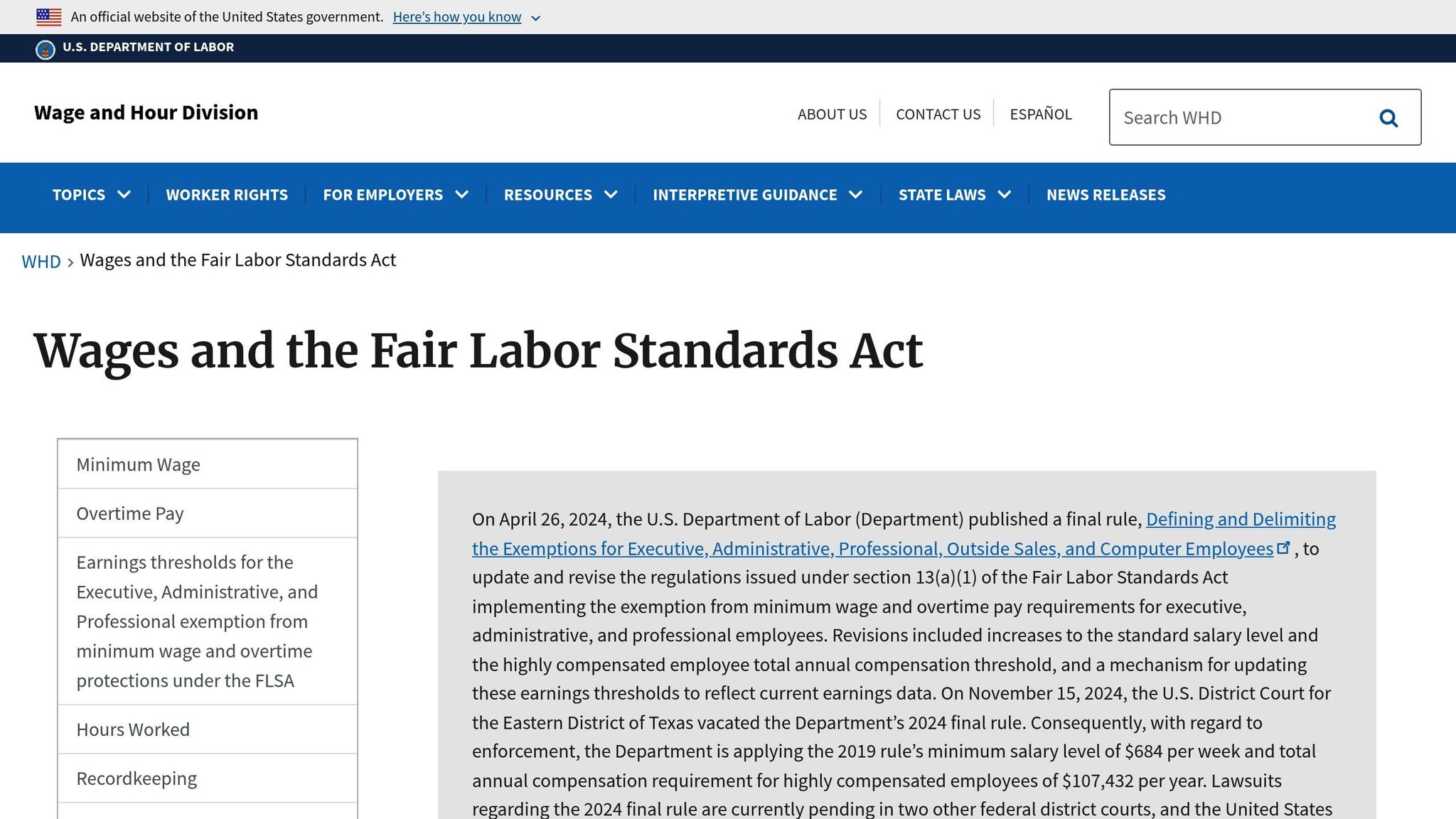
Temporary workers must be paid at least the federal minimum wage of $7.25 per hour, but if your state requires a higher rate, you need to pay that instead. For instance, in Washington, the minimum wage is $16.66, while California and New York set it at $16.50. Texas follows the federal rate of $7.25, and Florida requires $13.00 per hour.
Overtime rules apply after 40 hours in a workweek for nonexempt employees, and they must be paid at least 1.5 times their regular rate. A workweek is defined as 168 consecutive hours and cannot average hours across multiple weeks. California adds another layer, requiring overtime pay after an employee works more than 8 hours in a single day.
Keep detailed records of all hours worked, including training, travel between job sites, and any unexpected overtime. These records, along with pay rates and overtime documentation, should be maintained for at least two years. Deductions for uniforms or equipment are prohibited if they lower a worker's earnings below minimum wage or reduce their overtime pay.
In addition to wage compliance, ensuring proper workers' compensation coverage is critical.
In most states, workers' compensation insurance is mandatory for all employees, including temporary staff. Before work begins, clarify in writing which party - your company or a staffing agency - will provide this coverage.
If you're working with a staffing agency, they typically handle workers' compensation for the employees they place. However, if you hire temporary staff directly, you must add them to your own workers' compensation policy. Notify your insurance provider as soon as you bring on temporary workers to ensure their coverage starts from day one. Without proper coverage, you could face hefty fines and may be held personally responsible for medical expenses and lost wages if an injury occurs.
When it comes to temporary worker safety, both you and your staffing agency share responsibility. OSHA classifies both parties as joint employers, meaning you're both accountable for creating and maintaining a safe work environment.
To avoid any misunderstandings, ensure that safety responsibilities are clearly outlined in your written agreements. Typically, staffing agencies handle general safety training, while host employers take care of site-specific training related to equipment and workplace hazards. As the host employer, it’s crucial to provide temporary workers with the same level of safety protections, training, and hazard communication as your permanent employees.
OSHA’s Temporary Worker Initiative (TWI) offers detailed guidance on this topic through various bulletins. For instance, Bulletin No. 2 focuses on personal protective equipment, Bulletin No. 10 explains lockout/tagout procedures, and Bulletin No. 12 addresses heat-related risks. If temporary workers are placed in high-risk environments like construction sites or warehouses, consult Bulletins No. 15 and No. 14 for industry-specific protocols.
Once you’ve established a safe work environment, ensure compliance by keeping accurate records.
Accurate recordkeeping is essential for compliance. If you directly oversee temporary workers, you are responsible for recording their injuries and illnesses in your OSHA 300 Log. Work closely with staffing agencies to avoid duplicate entries.
Here’s a breakdown of the records you’ll need to maintain:
You can use any timekeeping method, as long as it ensures complete and accurate records. For temporary workers with fixed schedules, you only need to log exact hours when deviations from the schedule occur.
Keeping up with changes in labor law penalties is crucial. For instance, starting January 15, 2025, OSHA violations carry hefty fines: $16,550 per violation for serious offenses and up to $165,514 per violation for willful or repeated infractions. On top of that, there’s an extra penalty of $16,550 per day for failing to fix cited violations on time.
To stay informed, consider subscribing to the Wage and Hour Division's email updates. These updates provide official notifications about federal labor law changes. Additionally, you can request formal opinion letters from the WHD to clarify how specific laws apply to your temporary staffing needs. For more direct assistance, call the nearest WHD District Office at 1‑866‑487‑9243, available from 8 a.m. to 5 p.m. local time.
The Department of Labor also offers free compliance assistance toolkits. These cover key regulations like the FLSA and FMLA, along with industry-specific guidance for sectors like construction and healthcare. Regularly reviewing these resources can help you keep your practices in line with current rules and avoid costly mistakes, such as misclassifying workers.
Accurate worker classification is another critical step in avoiding penalties. The U.S. Department of Labor has emphasized the risks of misclassifying employees:
"Misclassifying employees as independent contractors is a serious problem because misclassified employees may not receive the minimum wage and overtime pay to which they are entitled under the FLSA".
Misclassifying temporary staff can result in serious consequences, including unpaid back wages, liquidated damages, civil penalties, and attorneys' fees. The recovery period for such violations is two years for standard cases and three years for willful violations.
It’s important to note that worker status is determined by the economic reality of their relationship with the employer - not by job titles or written contracts. To ensure compliance, conduct annual classification reviews using the DOL's economic reality test. This test evaluates factors like the worker’s opportunity for profit or loss, their investments, the permanence of the relationship, the level of control exercised, whether the work is integral to the business, and the worker's skill and initiative. Regular reviews can help you avoid penalties and maintain proper classification practices.

Staying compliant means keeping meticulous records, tracking time accurately, and managing documentation in one place. That’s where Quickstaff steps in, offering a digital scheduling solution designed to simplify these processes.
The Department of Labor (DOL) emphasizes the importance of accurate timekeeping, and Quickstaff takes this a step further. With mobile scheduling, availability tracking, and centralized event management, the platform minimizes human error while ensuring compliance with the Fair Labor Standards Act (FLSA). It automates recordkeeping, reducing the burden of manual administrative tasks.
When it comes to worker classification, Quickstaff helps document staffing decisions by recording scheduling details - information that aligns with the DOL's economic reality test. This ensures your staffing practices remain transparent and compliant.
Quickstaff also addresses joint employer safety responsibilities by organizing safety training records, communications, and compliance documentation in one centralized location, meeting OSHA requirements.
To avoid common compliance issues, like overscheduling or excessive overtime, Quickstaff flags potential problems before they arise. It also streamlines communication around schedule changes and safety protocols, keeping you aligned with FLSA wage and overtime rules. Plus, its unlimited messaging feature creates a reliable paper trail, which can be a lifesaver during audits or disputes.
Effectively managing temporary staff not only safeguards your business but also prioritizes worker safety. By adhering to a detailed labor law checklist, you stay compliant with federal and state regulations, avoid hefty penalties, and foster a workplace where temporary staff feel valued and secure.
It's important to remember that both staffing agencies and host employers share the legal responsibility for creating a safe work environment. This shared accountability means that either party - or both - can face consequences for violations, whether it's due to insufficient safety training or poor recordkeeping practices.
Failing to comply with labor laws can lead to fines, investigations, and even tarnish your reputation, making it harder to attract skilled temporary workers. Issues like worker misclassification, inadequate documentation, or neglecting safety protocols can result in significant penalties and scrutiny.
Having clear guidelines in place not only reduces legal risks but also improves operational efficiency. A well-structured checklist helps you avoid pitfalls while creating a transparent and organized workflow. When workers are properly classified, time records are accurate, required notices are displayed, and safety training is thorough, you set the stage for a smooth operation. Temporary staff know their rights, understand expectations, and can focus on performing their roles effectively.
Compliance doesn’t have to be complicated. By methodically addressing each checklist item - covering everything from worker classification to safety measures - you protect your business, your team, and your temporary staff. This approach builds trust, ensures clarity, and paves the way for a more efficient and reliable operation.
The Department of Labor (DOL) uses what’s called an economic reality test to figure out if a worker should be classified as an employee or an independent contractor under the Fair Labor Standards Act (FLSA). This test looks at key factors such as how much the worker relies on the employer for their livelihood, how permanent the working relationship is, and how much control the employer has over the work being done. Essentially, the goal is to determine if the worker is economically dependent on the employer or if they’re running their own independent business.
The IRS, however, takes a different approach with its common-law test, which is used for tax purposes. This test breaks things down into three main categories: behavioral control (how much direction the employer gives on how tasks are performed), financial control (who manages payments, expenses, and profits), and the relationship between the parties (as shown through contracts, benefits, and the nature of the work arrangement). Additionally, the IRS ties these classifications to tax forms - employees are issued W-2s, while independent contractors receive 1099-NECs.
While the DOL focuses on economic dependence, the IRS zeroes in on control and tax responsibilities.
To resolve previous worker misclassification issues, start by auditing your workforce. Take a close look at how independent contractors and exempt employees were categorized. This means reviewing contracts, job responsibilities, hours worked, and how much control your business exercised over these workers. If you uncover any mistakes, reclassify those individuals and determine any unpaid wages, overtime, or benefits owed under the Fair Labor Standards Act.
Once that’s done, address any tax reporting problems. This involves filing updated W-2 forms for the affected periods and covering the employer’s portion of Social Security, Medicare, and unemployment taxes. Proactively notifying the Department of Labor and creating a corrective plan - such as updating policies and offering training - can also help minimize penalties. Tools like Quickstaff can simplify record-keeping for worker schedules and hours, helping to avoid similar issues in the future.
Under OSHA’s Temporary Worker Initiative, both staffing agencies and host employers are classified as joint employers of temporary workers. This means they share the responsibility for maintaining workplace safety, addressing potential hazards, and ensuring that temporary workers receive the same health and safety protections as permanent employees. Together, they must evaluate the job site, provide essential personal protective equipment (PPE), and adhere to OSHA standards.
Temporary workers must also be given proper safety training before they begin their assignments. This training should cover topics such as hazard communication, equipment operation, and any other job-specific safety protocols. Importantly, it must be delivered in a language the workers understand. While host employers typically manage site-specific safety measures - like forklift operation or ergonomic practices - the staffing agency is responsible for broader employment needs, such as workers’ compensation and ensuring safety policies are communicated effectively. Collaboration between both parties is crucial to safeguard temporary workers and remain compliant with OSHA regulations.