Backup Staffing Tips for Busy Event Managers
December 22, 2025


Staffing issues can derail even the best-planned events. With 1.6 million job openings in the US leisure and hospitality industry, last-minute no-shows or cancellations are a constant challenge. But with the right preparation, you can avoid chaos and keep your events running smoothly.
Here’s how to tackle staffing gaps effectively:
Take a close look at where your staffing might fall short. Start by mapping out your event space and listing all the tasks that need to be handled. This will help you figure out how many people you need and where. Often, this process highlights gaps where no one is assigned or spots where responsibilities overlap.
Focus on roles that are crucial to safety and the guest experience. For example, not having enough check-in staff can lead to frustrating 30–45 minute lines. Gaps in security could create risks when dealing with large crowds or intoxicated attendees. And at tech-heavy events, not having an AV technician on hand can result in presentation issues or awkward "dead air."
Versatility is also important when assigning roles:
"Finding a person who can both use the Eventbrite Organizer app to check-in guests but also be personable, engaging, and professional is the true challenge - especially when you consider that this is the first person 1000 crawlers will see at our events." - Bar Crawl USA
To better understand your team's strengths, conduct a skills audit. Use questionnaires to document what each team member can actually do. This can reveal spots where only one person is trained to handle critical equipment or tasks - an issue that could derail your event if that person is unavailable.
Also, look at past event data, surveys, and feedback to identify recurring problem areas. This information will help you reallocate backup resources more effectively. These insights will be essential as you build stronger contingency plans in the sections ahead.
Once you've identified staffing gaps, cross-training your team can be a game-changer when unexpected absences arise. When multiple employees are equipped to handle the same responsibilities, last-minute scrambles for replacements become a thing of the past. Plus, it pays off - cross-training has been shown to improve profit margins by 24% and retain 94% of employees.
A great starting point is creating a skills matrix - a simple table that maps out who is trained to do what. This makes it easy to spot critical gaps, like roles where only one person is qualified to operate key equipment or manage essential tasks. Next, identify "floaters", employees trained to step into various roles during emergencies. For example, Bar Crawl USA has successfully maintained a strong management team for over nine years by using detailed playbooks and offering competitive pay.
Aim to develop "T-shaped" employees - team members who are experts in their primary role but also have the skills to handle related tasks. For instance, someone from your setup crew could assist with check-in during peak times. Techniques like shadowing and role-playing simulations can help staff build this versatility. You can even test these skills by running absence scenarios during slower events to see how well cross-trained employees manage additional responsibilities. This approach not only strengthens your team's flexibility but also lays a solid foundation for effective backup planning.
The financial benefits are hard to ignore: hiring a new employee costs approximately $30,000, whereas training an existing team member comes in at about $1,500. Structured cross-training can also cut down the time it takes for employees to reach full productivity by 25%. To make the process manageable, spread out training sessions and offer flexible options like digital modules or video tutorials that employees can access on their own schedule.
When employees understand the demands of different roles, they collaborate more effectively and approach challenges with fresh perspectives. Training doesn't just fill staffing gaps - it creates a more skilled, resilient team ready to tackle whatever surprises your events might bring. Employee training also leads to noticeable improvements in performance and time management, making it a win-win for everyone involved.
Having a dependable network of staffing partners can be a lifesaver when emergencies strike. Staffing agencies often maintain extensive rosters of pre-vetted professionals who can step in quickly to fill gaps. In fact, around 20% of event companies already rely on staffing agencies and platforms like LinkedIn for fast hiring solutions. The trick lies in selecting partners who truly understand your event's specific needs and can provide skilled staff on short notice. These partnerships also allow you to assess each source's reliability over time.
When choosing staffing sources, pay attention to their industry reputation. Platforms like Clutch, Yelp, and Google Maps can provide insights into how these agencies perform in actual scenarios. Look for partners with expertise in your type of event - whether it's corporate conferences, festivals, or weddings - and who can offer tailored advice on team size based on real-world experience. Ensure that the agencies handle critical administrative tasks like payroll, taxes, HR, and compliance with laws such as the Fair Labor Standards Act (FLSA) and the Occupational Safety and Health Act (OSHA).
"Having an event staffing agency with a large roster of employees helps make getting trained back-up staff super easy and (relatively) stress-free." - Social Tables
This capability is crucial for keeping operations running smoothly during events.
Before committing to a new agency for large-scale projects, test them out on smaller events. These trial runs will help you gauge their response time, staff quality, and ability to handle last-minute requests. Don’t hesitate to ask industry colleagues for recommendations - word-of-mouth referrals often highlight which agencies consistently deliver and which ones might fall short. When checking references, inquire specifically about punctuality, dependability, and how well their staff performs under pressure.
Freelancers and independent contractors can also be valuable resources. Build a database of vetted freelancers using referrals and skill assessments. Keep this database well-organized so you can quickly match the right person to your immediate needs. For events spanning multiple cities, work with agencies that have established networks nationwide. This ensures you’ll have reliable backup options no matter where your events take place.
Once you've reviewed your staffing needs, the next step is to develop solid backup plans for every essential role. Start by pinpointing the positions that are absolutely critical to your event's success - think keynote speakers, technical leads, venue liaisons, and security heads. Surprisingly, a 2017 survey revealed that 46% of meeting planners lack backup plans for natural disasters, while 43% are unprepared for bomb threats. Don’t fall into these gaps - address critical roles with a clear plan.
Begin by creating a task matrix that outlines every event task, from check-in to teardown, and assign a specific person to each responsibility. For critical roles, prepare a detailed playbook. This should include login credentials, step-by-step tool instructions, and contact lists for event leads and venue managers. A great example comes from Bar Crawl USA, which has been operating for over nine years. They provide managers with a comprehensive playbook a week before each event to prevent last-minute confusion.
It’s also important to establish a clear chain of command. Designate a primary contact for each role and ensure there’s a backup assigned as well. Consider hiring "floaters" - extra staff who can step in during breaks or unexpected absences. For speaker emergencies, have technology ready for virtual participation and include contract clauses that require reasonable cancellation notice.
When planning staffing levels, use attendance estimates - averaging projections for 25% and 75% capacity - to determine your baseline needs. On-demand staffing apps like JobStack or Instawork can also be lifesavers, providing pre-vetted temporary workers who can fill in at short notice, often within hours.
Centralize all backup contact information in one shareable document. This should include phone numbers for event leads, venue managers, security heads, and talent. Additionally, require vendors to give at least 48 hours' notice for any issues and maintain a list of secondary vendors who can step in if needed. Keeping everything organized and accessible ensures you're ready to handle surprises without chaos.
Trying to manage schedules with spreadsheets and phone calls can quickly spiral into chaos. Modern scheduling software simplifies this process, offering real-time updates on staff availability and cutting down on unnecessary back-and-forth.
Take Quickstaff, for example. Since 2013, it’s been used to schedule staff for over 20,000 events. Instead of relying on sticky notes or endless text threads, Quickstaff provides a centralized dashboard where everything is organized. Features like bottom-up scheduling let staff self-register or swap shifts, significantly reducing the administrative workload. This streamlined approach ensures you’re always prepared to handle staffing gaps.
When choosing scheduling software, look for tools that can automate key tasks like sending invitations, tracking confirmations, and syncing calendars. For instance, when you create an event, the system should automatically send invites to qualified staff - whether they’re servers, bartenders, or AV techs - and monitor responses in real time. Calendar syncing can prevent double-booking, while automated reminders sent 24–48 hours before the event help reduce no-shows.
"I used to be on the phone all the time to schedule staff. Now, within a few minutes, I can schedule all the staffing I need for my events." - Steven Townsend, Event Manager
In urgent situations, role-based messaging becomes a lifeline. For example, you can send a broadcast text to all available servers to quickly fill last-minute openings. With the event industry facing an annual turnover rate of 74%, having software that keeps your backup roster organized and ready to respond isn’t just helpful - it’s a game-changer.
Picture this: a staff member calls in sick just 30 minutes before opening. In moments like these, every second counts. How you handle communication can mean the difference between a smooth recovery and complete chaos. Quick, organized communication is the backbone of your staffing contingency plans.
Start by using collaboration tools like Slack or Microsoft Teams to share schedules and playbooks during the planning phase. But when it’s go-time, you need faster options. For live events, tools like WhatsApp groups or SMS are ideal for real-time updates. For larger events involving multiple departments, handheld radios are a game-changer - they provide instant, uninterrupted communication, even when networks slow down.
"The lines of communication should be set in advance with each staff member having their mode of communication at their fingertips at all times." - Lauren, RingCentral
Mass texting services, such as Text-Em-All, allow you to send emergency alerts to your entire team simultaneously. These tools are invaluable for filling last-minute gaps in staffing. To avoid confusion, stick to a single primary channel for all urgent updates.
Another essential step is distributing a digital playbook. This should include contact details, login credentials, and a clear chain of command to resolve issues quickly. For example, Bar Crawl USA has successfully managed staff leads for over nine years by sending out detailed playbooks a week in advance. This gives team members enough time to address questions before the high-pressure event day arrives.
Clear and reliable communication isn’t just helpful - it’s essential. It ties directly into your backup staffing strategy, ensuring every team member is reachable and prepared when it matters most.
Unexpected staffing costs can pop up out of nowhere - whether it’s last-minute sick calls, a sudden surge in attendance, or other emergencies. Without a financial cushion, these surprises can leave you scrambling to make ends meet or cutting corners to cover unplanned expenses.
Experts suggest allocating about 10–15% of your total event budget for a contingency fund. If your event carries more uncertainty - like highly variable attendance or greater risks - it’s wise to bump that up to 15–25%.
"Working some leeway into your budget gives you enough breathing room to absorb hidden costs... This helps minimize stress when unexpected costs arise." - Katie Sawyer, Writer, Eventbrite
This type of financial buffer doesn’t just cover surprise expenses - it also allows you to manage staffing more effectively and strategically.
When planning, keep in mind that event staff wages in the U.S. generally fall between $12 and $29 per hour. If overtime comes into play, expect to pay at least 1.5 times the regular hourly rate. Reviewing past events and comparing projected versus actual expenses can help you refine your contingency planning for future events.
With 53% of event planners identifying rising costs as their biggest challenge heading into 2024, having a dedicated emergency fund isn’t just a good idea - it’s a necessity to keep your event running smoothly when the unexpected happens.
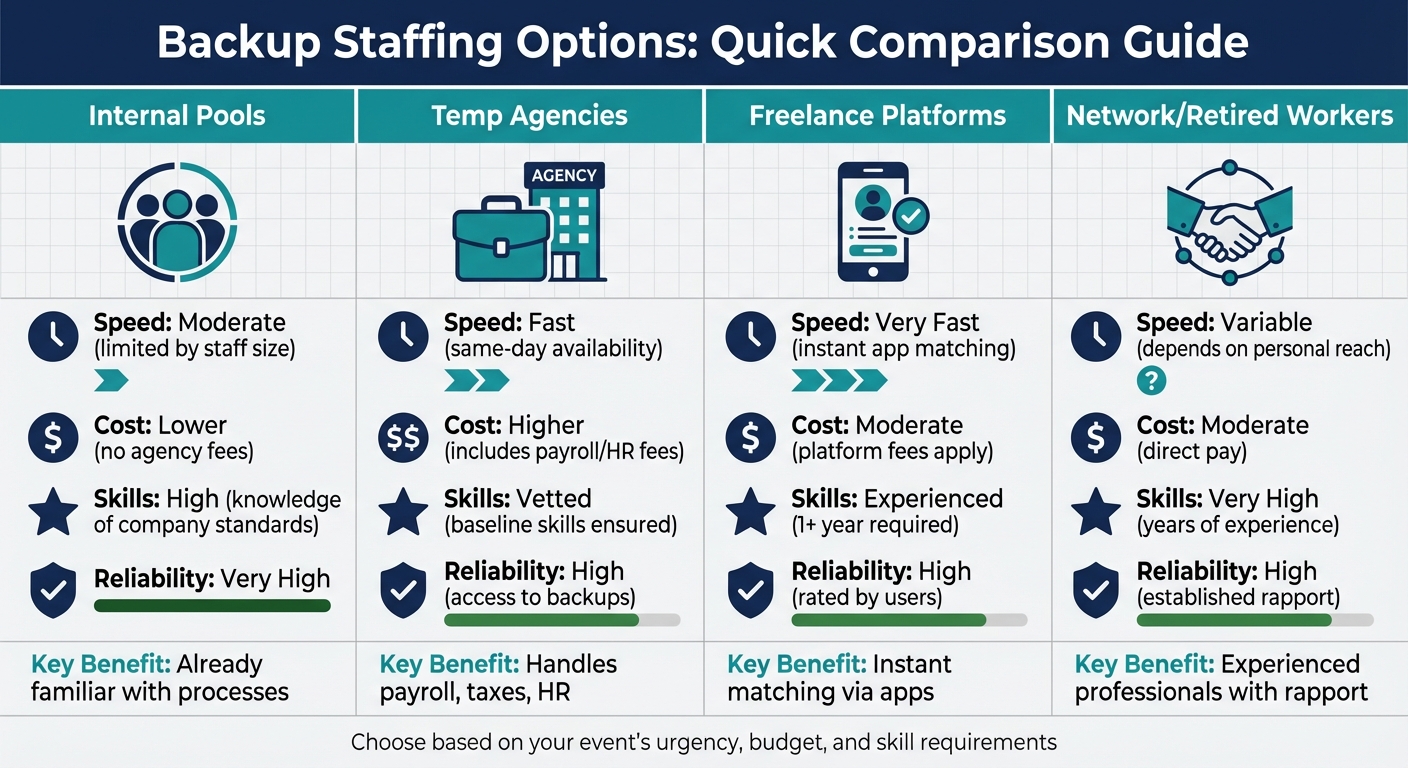
Backup Staffing Options Comparison: Speed, Cost, Skills & Reliability
Here’s a quick breakdown of your backup staffing options, focusing on the trade-offs in speed, cost, skills, and reliability. Use this table to weigh your choices and make informed decisions.
Internal Pools give you access to staff already familiar with your company’s processes, saving on agency fees. However, your options are limited by the size of your current team, which might not be sufficient for larger or more demanding events.
Temp Agencies are a reliable choice when you need roles filled quickly. They handle payroll, taxes, and HR paperwork for you. While convenient, this option comes with higher costs due to agency fees. On the plus side, you’ll have access to a vetted pool of backup staff whenever needed.
Freelance Platforms connect you with professionals almost instantly through mobile apps. These platforms typically require workers to have at least a year of experience for quality assurance. User ratings help you gauge reliability, and the costs are moderate since you’re paying platform fees instead of full agency markups.
Network and Retired Workers bring years of expertise and often a pre-existing rapport. Their availability depends on your personal connections, and they usually work for direct pay without agency fees. This makes them a strong option if you have the time to reach out and coordinate individually.
| Staffing Option | Speed | Cost | Skills | Reliability |
|---|---|---|---|---|
| Internal Pools | Moderate (limited by staff size) | Lower (no agency fees) | High (knowledge of company standards) | Very High |
| Temp Agencies | Fast (same-day availability) | Higher (includes payroll/HR fees) | Vetted (baseline skills ensured) | High (access to backups) |
| Freelance Platforms | Very Fast (instant app matching) | Moderate (platform fees apply) | Experienced (1+ year required) | High (rated by users) |
| Network/Retired | Variable (depends on personal reach) | Moderate (direct pay) | Very High (years of experience) | High (established rapport) |
If you’re looking to streamline scheduling alongside staffing, consider using specialized software. Tools like Quickstaff can cut communication time by 70%. With features like event creation, role-based staff scheduling, availability tracking, automated waitlists, and unlimited messaging, it’s built for efficiency. Pricing starts at $49/month for up to 35 staff members, scaling to $249/month for teams of up to 175. The platform is also mobile-friendly, making it easy to manage on the go.
Staffing shortages don’t have to throw your events into chaos. The difference between last-minute scrambling and smooth execution lies in preparation and adaptability. By pinpointing staffing vulnerabilities, cross-training your team, and establishing dependable staffing relationships, you can create safeguards that keep disruptions at bay.
Consider this: companies that prioritize training enjoy a 24% higher profit margin, and 59% of employees report better job performance as a result. These numbers make it clear - investing in your team isn’t just good for morale; it’s good for business.
Technology can also be a game-changer. Automated scheduling tools, for example, can slash communication time by 70%, giving you more bandwidth to focus on tasks that truly matter. Combining smart software, trusted partnerships, and an emergency fund helps you stay ahead of potential problems rather than reacting to them.
So, what’s next? Start building your backup staffing options now. Organize a cross-training session. Even setting aside a small emergency fund can make a big difference. As Anjali Mrig, a writer and event creator, wisely notes:
"Every event organizer who wants to scale eventually has to come to terms with the fact that event staff training is not optional".
With in-person event attendance on the rise and 86.4% of event teams planning to maintain or expand their in-person offerings by 2025, the demand for reliable staffing will only intensify.
The strategies outlined here - from identifying weak spots and cross-training staff to creating backup plans and improving communication - are designed to tackle the challenges you face head-on. By implementing these steps, you’ll be better equipped to prevent staffing crises before they happen.
To tackle staffing issues effectively, take a close look at past events to spot patterns where tasks were either understaffed or required overtime. Analyze peak periods to ensure you have enough team members equipped with the right skills to handle key responsibilities. It’s also helpful to gather input from your team about any missed or delayed tasks - they can often shed light on areas that need attention. Using this information, you’ll be better equipped to plan for upcoming events and minimize potential disruptions.
Cross-training your staff - teaching them to take on multiple roles - can be a game-changer for your event operations. Imagine a server calling out sick or a sudden surge of guests overwhelming the kitchen. With cross-trained employees, these challenges become manageable. They can step into different roles effortlessly, keeping the event running smoothly without the chaos of scrambling for last-minute replacements.
Beyond just keeping things operational, cross-training brings other perks. It boosts efficiency by keeping team members productive during slow times, as they can pick up new tasks instead of standing idle. This approach not only cuts down on downtime but also helps reduce overtime expenses. Plus, employees tend to feel more appreciated and engaged when they’re given opportunities to expand their skill set. This leads to stronger teamwork and better retention. Tools like Quickstaff can make it easier to schedule and manage these multi-role assignments, ensuring your team is always ready to adapt.
To tackle last-minute staffing needs efficiently, start by teaming up with a reliable staffing agency that keeps a roster of pre-screened, event-ready professionals. Choose agencies that handle certification checks, like food safety or alcohol service permits, so you’re not stuck chasing paperwork at the eleventh hour. When an urgent situation arises, provide the agency with clear and detailed information - such as how many staff you need, their roles, dress code, arrival time, and any specific instructions. This makes the process quicker and smoother.
Once you’ve nailed down a dependable agency, consider using a scheduling tool like Quickstaff to keep everything organized. Quickstaff helps you post shifts, track staff availability, and send out automated reminders in real time. By pairing a trustworthy staffing partner with a user-friendly scheduling platform, you can reduce chaos and keep your event on track, even when plans change at the last minute.