Employment Laws Every Event Vendor Should Know
February 16, 2026


Running an event business? Staying compliant with employment laws is not optional - it’s a must. Misclassifying workers, failing to meet wage requirements, or ignoring safety standards can lead to significant fines, lawsuits, and reputational damage. Here’s what you need to know:
Understanding these rules ensures smooth operations and avoids disruptions during events. Tools like Quickstaff can help with scheduling, tracking hours, and maintaining compliance records.
Event vendors need to understand the key aspects of the Fair Labor Standards Act (FLSA) to ensure compliance with federal wage and hour laws. The FLSA safeguards the rights of over 143 million American workers. For covered nonexempt employees, the minimum wage is set at $7.25 per hour, and all time spent on required duties - like event setup and teardown - counts as hours worked.
For tipped workers, such as servers and bartenders, employers can pay a direct wage of $2.13 per hour, as long as the combined total of wages and tips equals or exceeds the federal minimum wage. Employers cannot make deductions for things like uniforms or broken items if those deductions lower the employee's pay below the minimum wage or reduce overtime compensation.
Accurate recordkeeping and event staff scheduling are non-negotiable. Employers must maintain detailed records of employees' daily and weekly hours, straight-time earnings, and overtime pay for a minimum of three years. These records should also include personal details like name, address, occupation, and birth date for employees under 19. Additionally, the Department of Labor poster outlining workers' rights must be displayed in the workplace for temporary staff.
Classifying employees correctly is crucial for event vendors to meet their legal obligations. Most event staff - such as servers, bartenders, setup crews, and security personnel - are typically considered nonexempt. This means they are entitled to both the federal minimum wage and overtime pay. Titles like "Event Manager" or "Lead Server" do not automatically exempt an employee from these protections.
"Exemptions are generally narrowly defined under the FLSA; an employer should carefully check the exact terms and conditions for each." – Wage and Hour Division
To qualify as exempt, employees must meet specific criteria related to their job duties and salary level. Exemptions generally apply to executive, administrative, or professional roles. For example, a part-time server who occasionally supervises others would not qualify as exempt. Classification must always reflect the employee's actual responsibilities, not just their job title or how they are paid.
Distinguishing between independent contractors and employees is another critical area for event vendors. According to the Department of Labor's rule effective March 11, 2024, this classification hinges on the economic reality of the working relationship. A six-factor test helps determine whether a worker is an employee or an independent contractor.
"Whether a worker is an employee or an independent contractor under the FLSA is determined by looking at the economic realities of the worker's relationship with the employer." – U.S. Department of Labor
The test evaluates factors like economic dependency, focusing on whether the worker's role is central to the business's core services. For instance, a server who is essential to a catering business's operations is likely to be classified as an employee. Simply labeling someone as a contractor, issuing a 1099 form, or having them sign an agreement does not override the reality of their role. If the economic relationship suggests they function as an employee, that classification will prevail.
Federal vs State Employment Law Requirements for Event Vendors
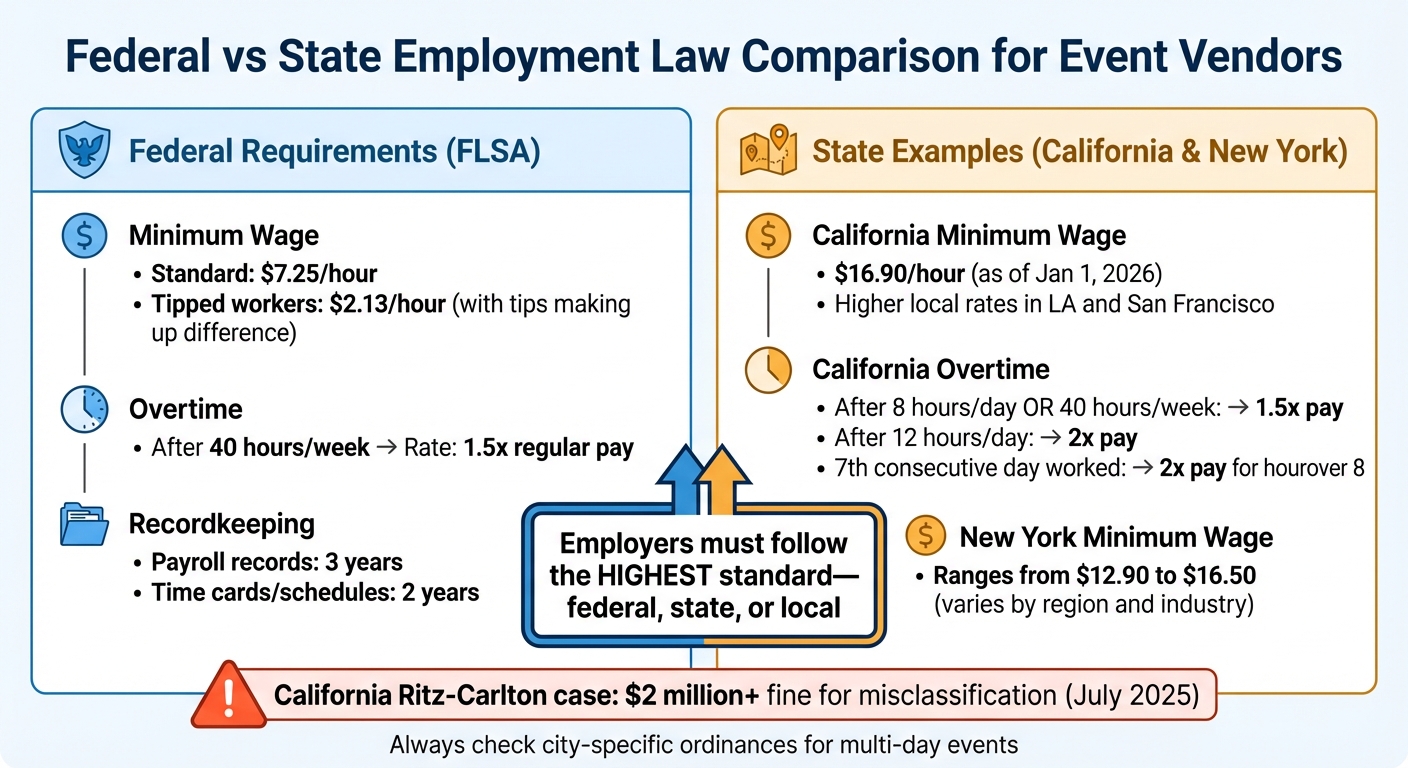
When it comes to wages, employers must follow the highest standard - whether that's federal, state, or local law. The federal minimum wage is set at $7.25 per hour, but many states mandate higher rates. For instance, starting January 1, 2026, California's minimum wage will be $16.90 per hour for all employers, regardless of their size. In New York, minimum wages vary by region and industry, ranging from $12.90 to $16.50.
Overtime rules also differ depending on the state. Federal law requires overtime pay after 40 hours in a workweek. However, California has stricter overtime policies. For example, employers in California must pay 1.5 times the regular rate for hours worked beyond 8 in a single day or 40 in a week, and double time for hours exceeding 12 in a day. Additionally, California enforces a "seventh-day rule", which means employees working seven consecutive days are entitled to double time for any hours over 8 on that seventh day.
Cities often have their own minimum wage ordinances that surpass state requirements. For example, Los Angeles and San Francisco have higher local minimum wages. For multi-day events, it's critical to check city-specific laws to ensure overtime is calculated correctly. Having an event day checklist can help you stay organized while managing these complex requirements.
Non-compliance can lead to severe financial penalties. In July 2025, the California Labor Commissioner fined the Ritz-Carlton and its subcontractors over $2 million for misclassifying workers. This underscores the importance of adhering to state classification and wage standards.
Understanding wage laws is closely tied to properly classifying workers, which brings us to the next set of regulations.
California relies on the ABC test to determine whether a worker is an employee or an independent contractor. This test assumes all workers are employees unless the hiring entity can prove three specific conditions. The "B" prong of the test is particularly challenging for event vendors because it requires the worker’s tasks to fall outside the hiring entity’s core business. For example, if a catering company hires temporary servers, it would likely fail the "B" prong since serving is central to its operations.
"The ABC test starts with an assumption that all workers are employees, and provides the test that a hiring entity must satisfy to prove that the workers are independent contractors." – California Labor Commissioner's Office
Failing any single prong of the ABC test means the worker must be classified as an employee. Employees are entitled to minimum wage, overtime, meal breaks, and workers' compensation. Employers who knowingly misclassify workers face civil penalties ranging from $5,000 to $25,000 per violation. Simply having a worker sign an independent contractor agreement or issuing a 1099 form does not exempt the employer from the ABC test.
Certain exceptions allow for the more flexible Borello test to apply. For example, under the "referral agency" exception, service providers must set their own rates, supply their own tools, and have the freedom to accept or reject clients without facing penalties. Another exception, the "Business-to-Business" rule, requires a written contract, a separate business location, and that the service provider holds their own business license.
Federal law requires employers to document 14 specific data points for each nonexempt worker. These include details like the employee's full name, Social Security number, address, date of birth (if under 19), gender, job title, start time of the workweek, daily and weekly hours worked, pay basis, hourly rate, straight-time and overtime earnings, deductions or additions, total wages, and payment dates. Employers must keep payroll records for three years and retain time cards and schedules for two years.
Paychecks must be issued on the designated payday. Employers cannot make deductions for required items, such as uniforms or tools, if doing so would lower an employee’s pay below the minimum wage or reduce overtime pay.
While the Fair Labor Standards Act (FLSA) doesn’t require a specific format for records, employers can use budget-friendly staff scheduling tools, time clocks, timekeepers, or even employee-written records, as long as they are accurate. To help track hours, the Department of Labor offers a free DOL-Timesheet App in both English and Spanish. Additionally, employers must display an official FLSA poster in the workplace to inform employees of their rights.
For tipped employees, federal law mandates a minimum direct wage of $2.13 per hour, with the employer ensuring that tips plus wages meet or exceed the minimum wage. Employers must also follow state labor laws if they offer greater protections or higher wages than federal standards.
Once wage compliance is established, maintaining a respectful and inclusive work environment becomes equally important.
Ensuring fair treatment in the workplace goes beyond wages. Employers must actively work to prevent harassment and discrimination, which are prohibited under Title VII of the Civil Rights Act, the Age Discrimination in Employment Act (ADEA), and the Americans with Disabilities Act (ADA). Event vendors and staffing agencies often share "joint employer" responsibilities, meaning both are accountable for creating a safe and equitable work environment.
"Prevention is the best tool to eliminate harassment in the workplace." - U.S. Equal Employment Opportunity Commission
A strong anti-harassment policy should clearly state that discrimination or harassment based on race, color, religion, sex (including pregnancy, sexual orientation, or transgender status), national origin, disability, age (40+), or genetic information is strictly prohibited. To ensure employees feel safe reporting issues, provide multiple reporting channels, including at least one option outside the worker’s direct chain of command. Make it clear that retaliation for reporting harassment or participating in investigations is not tolerated.
Employers are also responsible for addressing harassment by non-employees, such as customers, contractors, or event guests. If the employer knew - or should have known - about the harassment and failed to act, they could be held liable. All complaints should be investigated impartially, and appropriate corrective actions must be taken as needed. Offering anti-harassment training to managers and temporary staff can help clarify expectations and protect everyone involved.
Health and safety regulations are another critical area for compliance, especially when working with temporary staff. Both event vendors and staffing agencies are responsible for the safety of these workers, and OSHA can hold both parties accountable for violations. While staffing agencies typically handle general safety training, vendors must provide site-specific training that addresses the unique equipment, hazards, and tasks at the event location.
"Host employers must treat temporary workers like any other workers in terms of training and safety and health protections." - Occupational Safety and Health Administration
Under the General Duty Clause of the OSH Act, employers are required to maintain a workplace free from recognized hazards that could cause serious harm or death, even if no specific OSHA standard applies. Vendors must supply any necessary personal protective equipment (PPE) - like gloves, goggles, or hearing protection - at no cost to temporary staff. Additionally, they must ensure hazardous material containers are properly labeled and provide Safety Data Sheets (SDS) for these materials.
In the event of a workplace incident, employers must report fatalities to OSHA within 8 hours and any in-patient hospitalizations, amputations, or eye losses within 24 hours of becoming aware of the incident. To avoid confusion during audits, clearly outline the safety responsibilities of both the vendor and the staffing agency in written agreements.
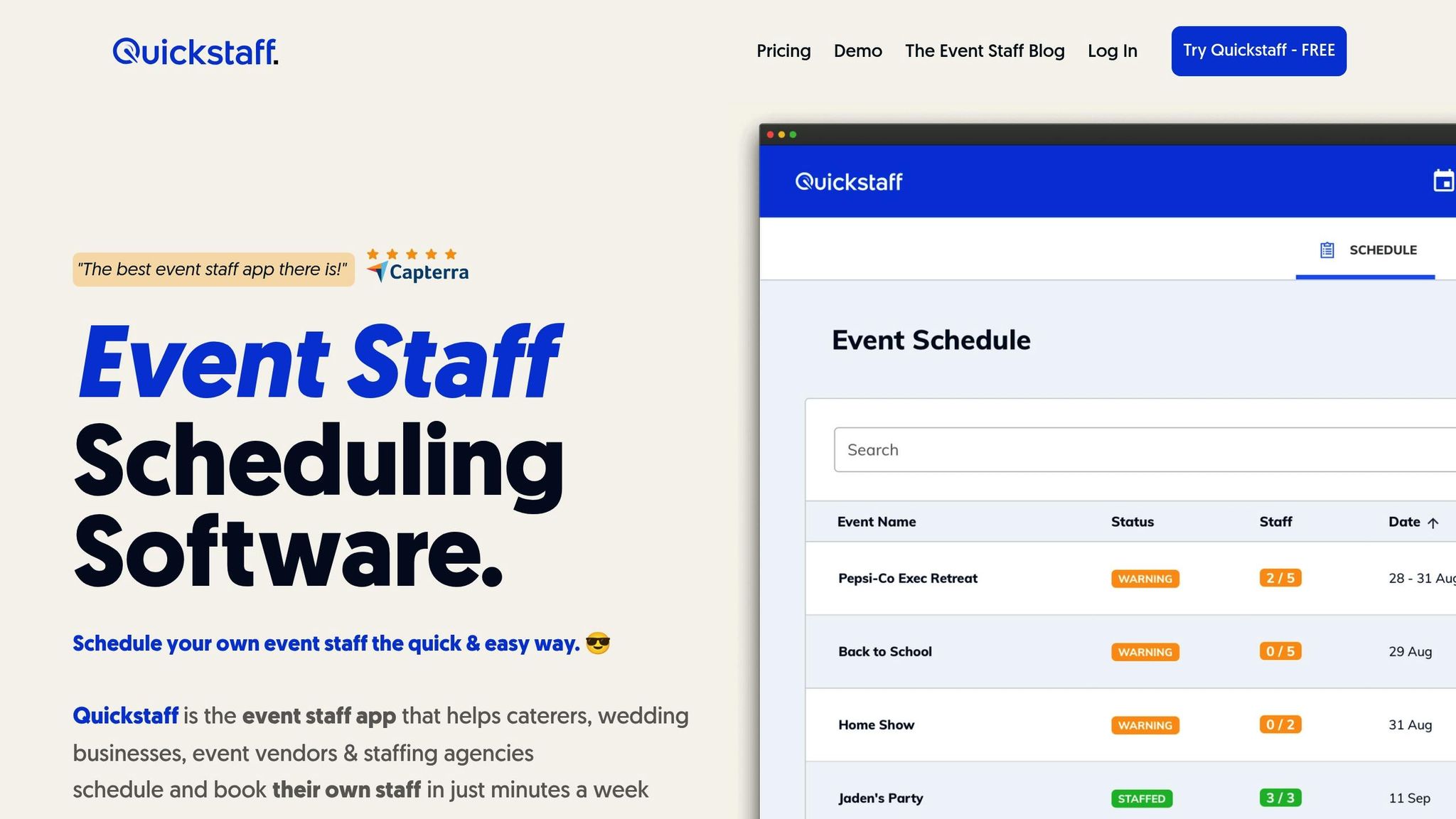
Quickstaff simplifies scheduling while also helping businesses stick to employment laws.
Tracking work hours accurately is a must for staying compliant with the Fair Labor Standards Act (FLSA). Quickstaff's availability tracking and automatically generated waitlists make it easier to avoid scheduling conflicts and unauthorized overtime. By knowing exactly when staff are available, you can steer clear of situations where employees exceed 40 hours a week without proper overtime pay.
The platform’s centralized scheduling system automatically logs daily and weekly work hours, ensuring that all necessary data is recorded. Since the FLSA defines a workweek as 168 consecutive hours, having a system that consistently tracks this period keeps you prepared for audits. This level of precision also makes recordkeeping a smoother process.
Federal law requires employers to keep payroll records for three years and time cards and schedules for two years. Quickstaff consolidates all this information in one place, making it easy to respond to audit requests quickly.
"The Act requires no particular form for the records, but does require that the records include certain identifying information about the employee and data about the hours worked and the wages earned. The law requires this information to be accurate." - U.S. Department of Labor
Quickstaff ensures compliance by storing essential details like employee identification, hours worked, wages, and payment records. If the Department of Labor (DOL) asks for "extensions, computations, or transcriptions" during an audit, you can access everything from one dashboard. This is especially helpful for event vendors who manage temporary staff across multiple locations. With all records in one place, you’re better prepared for any compliance checks.
Misunderstandings about roles or hours can lead to labor disputes, but Quickstaff’s messaging tools and reminders help prevent these issues. By clearly defining roles, responsibilities, and schedules - including break times and duties - you reduce the chances of "off-the-clock" work disputes that could result in wage claims.
The platform’s mobile-friendly design ensures that staff receive real-time updates about schedule changes or event instructions. This creates a digital trail that proves your oversight of workers - a crucial factor for proper classification during audits. Keeping a record of all communications not only protects your business but also fosters transparency with your staff.
Compliance with employment laws isn't just a legal obligation - it's the backbone of a successful and sustainable business. Misclassifying workers or failing to meet labor requirements can lead to serious consequences, including back wage payments, liquidated damages, and civil penalties. As the U.S. Department of Labor aptly states, "Following the law is good for business!"
For event vendors, the challenge lies in balancing these legal requirements while managing temporary staff across multiple venues and events. This means keeping track of work hours, properly classifying workers, maintaining detailed records for potential audits, and ensuring clear communication with your team - all while delivering top-notch service to clients. It's a lot to handle, but technology can help lighten the load.
Quickstaff offers a solution by centralizing key compliance tasks through scalable event scheduling, recordkeeping, and communication. The platform not only tracks hours worked but also keeps records audit-ready and maintains a secure digital trail of staff communications. By automating these administrative tasks, you can focus more on running successful events. Features like availability tracking help prevent unauthorized overtime, while the mobile-friendly design ensures your team stays informed with real-time updates about schedules and responsibilities.
Wage laws for multi-day events are determined by the specific state and city where the work occurs. In most cases, local laws take priority, but there can be exceptions based on certain conditions. It's crucial to carefully review the regulations for the event's location to make sure everything aligns with legal requirements.
To figure out whether your event workers should be classified as employees or independent contractors, you can apply the economic reality test set by the U.S. Department of Labor. This test evaluates several factors, including:
Getting this classification right is critical. It ensures you stay compliant with labor laws while also protecting both your business and your workers.
To get ready for a labor audit, keep detailed and organized records of employee hours worked, wages paid, personnel files, payroll documents, and employment practices. Federal regulations usually mandate holding onto these records for 2–3 years. Having everything in order not only helps you stay compliant but also makes the audit process much easier to handle.