Customizable Templates for Catering Staff Scheduling
February 11, 2026


Catering businesses often face challenges when scheduling staff for events, as each occasion has unique requirements. From weddings with 200 guests to corporate lunches for 50, staffing needs vary, and most catering workers have flexible, part-time availability. Manual vs digital scheduling methods like spreadsheets or emails struggle to keep up, leading to inefficiencies and last-minute issues.
Four scheduling options are explored:
| Method | Customization | Automation | Ease of Use | Scalability |
|---|---|---|---|---|
| Quickstaff | High (Event-specific) | High (Invites, reminders) | High (Centralized dashboard) | High (Tiered pricing) |
| Excel Templates | High (Manual flexibility) | None | Low (Time-intensive) | Low (Hard for large teams) |
| Calendar Tools | Medium (Basic details) | Medium (Basic alerts) | Medium (Simple interface) | Medium (Good for mid-size) |
| Shift Software | Medium (Fixed patterns) | High (AI, reminders) | Medium (Less event-focused) | High (Large teams, costly) |
Key Takeaway: Quickstaff is tailored for event-driven businesses, offering automation and role-based scheduling, making it ideal for catering teams managing temporary staff across multiple events.

Comparison of 4 Catering Staff Scheduling Methods: Features, Automation, and Pricing

Quickstaff allows managers to create unlimited custom roles tailored to each event. Instead of sticking to generic categories, you can define precise roles like server, bartender, kitchen assistant, setup crew, photographer, or any other position your business requires. This means a catering staff scheduling checklist for a 200-guest wedding can look entirely different from one for a corporate lunch.
Each template includes fields for details like location, client preferences, special instructions, and dress codes. Quickstaff also integrates with Google Calendar, Outlook, and other major calendar platforms, ensuring both managers and temporary staff can view upcoming shifts without needing to jump between apps. This integration simplifies scheduling and keeps everyone on the same page.
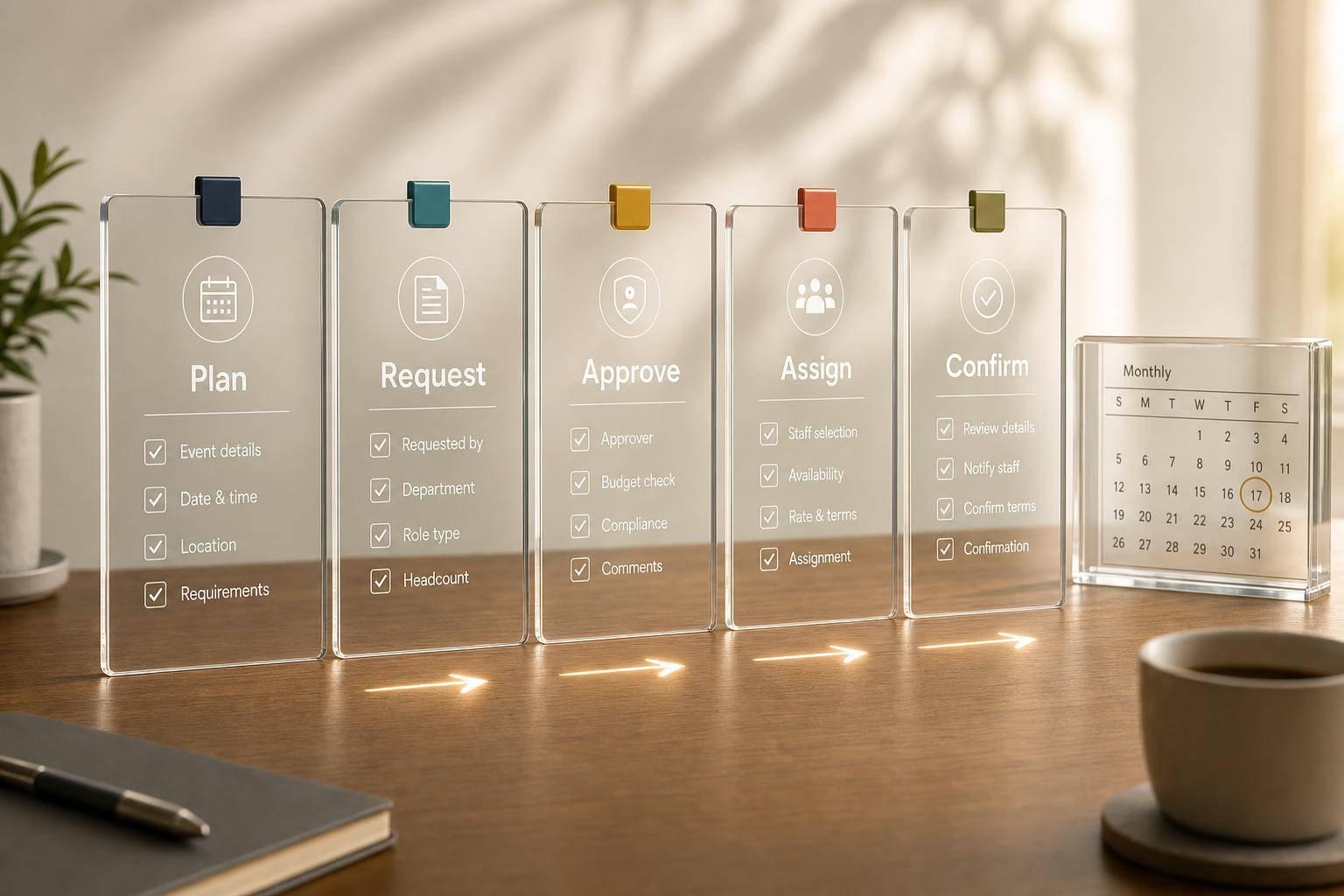
Scheduling with Quickstaff is straightforward. It involves three steps: creating the event, selecting staff, and sending automated invitations and confirmations. Staff members can accept or decline shifts directly via email, cutting down on manual follow-ups.
The system automatically filters out unavailable staff, showing only those who are free to work. If more staff accept than needed, Quickstaff creates a waitlist to handle any last-minute cancellations.
"I used to be on the phone all the time to schedule staff. Now, within a few minutes, I can schedule all the staffing I need for my events." - Steven Townsend, Event Manager
Quickstaff consolidates all scheduling tasks into a single dashboard. Staff can mark themselves as unavailable in advance, eliminating the need for endless phone calls to confirm availability.
Managers can also send targeted updates to specific groups. For instance, they can send dress code reminders exclusively to servers or share menu updates only with kitchen staff. Since its launch in 2013, Quickstaff has helped caterers and event vendors schedule staff for over 20,000 events.
Quickstaff offers plans designed to accommodate businesses of all sizes, with access to all customization features included in every tier. Pricing is based on the size of your staff roster. The Boutique plan costs $49/month for up to 35 staff, the Growing plan is $99/month for up to 70 staff, and the Large plan is $249/month for up to 175 staff. For businesses with over 175 staff, custom Enterprise quotes are available. All plans include unlimited events, unlimited managers, and assisted onboarding support - no per-user fees or hidden costs.
Generic Excel templates allow for manual adjustments, but they miss out on features that make dynamic event scheduling easier. You can tweak them by adding or removing rows for employees, setting shift start and end times, and assigning roles like server, bartender, kitchen assistant, or photographer. Tools like Excel's Merge and Center can help visually represent shift durations. However, all entries - like names, dates, and event instructions - must be input manually. You can add a "Special Events" row for things like location-specific instructions or dress codes, but Excel won't automatically catch scheduling conflicts or calculate overtime unless you dive into complex VBA coding. This manual process feels clunky compared to the streamlined features of automated scheduling tools.
Excel templates offer little to no automation. Unlike specialized scheduling software that can filter unavailable employees or send out automatic invites, spreadsheets only reflect what you manually input. Want to check someone’s availability? You’ll need to reach out via phone or text. This manual process takes significantly more time and effort. Plus, without automated reminders, keeping track of staff availability becomes even more of a headache.
Managing shifts in Excel is a one-way street - shifts are assigned, but staff can’t mark themselves as unavailable or request changes directly. Handling time-off requests, shift swaps, or availability updates means relying on calls, texts, or emails. And if someone misses a shift because they didn’t check the schedule, there’s no system in place to notify them. If your schedule is stored on a single office computer, accessing it remotely during events can be another hurdle.
Excel can handle small teams - think fewer than 10 employees - with simple shift patterns. But as your catering business grows, so does the workload of maintaining accurate schedules. You’ll spend more time cross-checking for issues like overtime, compliance, and conflicting assignments.
"Excel schedules can work well for small teams, but they lack the flexibility that larger businesses need."
– Connecteam
While there are plenty of free catering schedule templates online, premium options like those from Template.net provide more variety. However, remember to save files uniquely to meet labor regulations and keep a clear record in case of disputes.
Calendar-based scheduling tools offer visual flexibility that goes beyond what spreadsheets can handle. Managers can design schedules for unlimited staff roles - like servers, bartenders, kitchen assistants, or photographers - and include event-specific details. These might include the event location, client preferences, dress codes, or setup instructions, all directly attached to calendar entries. Staff can also mark their availability, blocking out dates and times they’re not free, which ensures they aren’t mistakenly scheduled. Plus, syncing with platforms like Google Calendar and Outlook helps avoid double-booking by keeping all schedules aligned across systems. This level of organization makes communication smoother and more efficient.
Automation takes much of the hassle out of managing staff communication. Instead of calling or texting individually, managers can select team members by role, and the system handles sending invitations and tracking responses in real time. automated reminders sent before events help cut down on no-shows, a feature common in top tools for last-minute catering staff scheduling. If more people accept an invitation than needed, the system creates a waitlist to address last-minute cancellations. Additionally, role-specific messaging ensures updates - like venue changes or dress code adjustments - reach only the relevant staff.
These tools offer a centralized dashboard that gives managers a clear view of all upcoming events, staffing levels, potential conflicts, and staff unavailability at a glance. Jennifer Manley, a Staffing Coordinator, shared her experience:
"The calendar clearly outlines my week, and its sorting function quickly isolates events."
This kind of transparency allows managers to confirm staff availability for specific dates before committing to new client bookings.
As your catering business grows, calendar-based tools can scale with you. Most offer tiered pricing plans, making it easier to budget as your team expands. For example, pricing might range from $49/month for up to 35 staff, $99/month for up to 70 staff, and $249/month for up to 175 staff, with all features included. This straightforward pricing structure helps businesses plan for growth without unexpected costs.
While calendar-based tools offer visual adaptability, standard shift scheduling software takes a more conventional route to managing work schedules.
With this type of software, managers can create scheduling templates from scratch or reuse templates from previous weeks. For example, you might use a "Scheduler Template" or copy a "Prior Week" schedule as a base, making adjustments as needed. The software also allows filtering by department or job, and managers can decide whether to include shift notes or unpublished shifts when applying a template. This setup works well for businesses with steady staffing patterns. However, catering operations often encounter a snag: standard scheduling tools are designed for businesses with fixed employees, assigning shifts directly instead of checking staff availability. This can be problematic for catering, where staff availability varies with each event. Despite this, the template system does help streamline scheduling, especially when paired with automation.
Automation is a key strength of standard scheduling software. It simplifies the process by sending out automated invitations and confirmations, drastically reducing the need for phone calls or texts. Notifications or emails are sent to staff based on their roles, allowing them to accept or decline shifts instantly. This efficiency is particularly helpful when onboarding new event staff who need to learn the system quickly. To further minimize no-shows, the software sends reminders before events.
"I used to be on the phone all the time to schedule staff. Now, within a few minutes, I can schedule all the staffing I need for my events." - Steven Townsend, Event Manager
These platforms often include centralized dashboards where managers can monitor upcoming shifts, staffing levels, and any scheduling conflicts and solutions. However, their design typically caters to businesses with fixed locations, making them less ideal for event-driven industries like catering. The main difference lies in how shifts are handled: standard tools assign shifts directly, while event-specific tools ask workers about their availability. For catering businesses juggling temporary staff across multiple venues, this difference can be a dealbreaker.
While standard scheduling software can handle large teams, the costs can add up quickly. Many platforms charge per user or per location, which can become expensive for businesses with a large pool of occasional workers. Additionally, systems designed for fixed schedules often lack the flexibility needed for catering, where staffing requirements are event-driven and unpredictable. This highlights the need for solutions tailored to on-demand scheduling.
This section breaks down the main trade-offs for different scheduling methods, offering a quick comparison of their strengths and weaknesses.
Each scheduling method has its own pros and cons. Excel templates are highly customizable - you can tweak fonts, colors, and layouts to match your style. However, they don’t support real-time updates or automation, which means you’ll spend a lot of time manually updating schedules and chasing follow-ups.
Calendar-based tools give you a clear visual of upcoming events, but they often miss key features like role-based assignments or automated waitlists.
Standard shift scheduling software excels in automation and can integrate with payroll systems. That said, it’s designed for more fixed schedules and can get pricey. For example, 7Shifts charges up to $76.99 per month per location, with extras like tip pooling costing an additional $24.99.
Quickstaff, built specifically for event-driven businesses, flips the script by asking staff about their availability first. Employees can accept or decline assignments via email, and the system handles waitlists and event reminders automatically. All features are included in every pricing tier, starting at $49/month for 35 staff, $99/month for 70 staff, and $249/month for 175 staff. This "invite-and-confirm" approach works well for catering businesses managing temporary workers across multiple venues, though it may not be ideal for companies needing advanced payroll or POS integrations.
Here’s a quick comparison of how these options stack up:
| Scheduling Approach | Template Customization | Automation Features | Staff Management Tools | Scalability |
|---|---|---|---|---|
| Quickstaff | High (Role-based, event-focused) | High (Availability requests, reminders, waitlists) | High (Availability tracking, event notes, role sorting) | High (Tiered pricing, all features included) |
| Generic Excel | Very High (Unlimited manual flexibility) | None | Low (Manual tracking only) | Low (Becomes unmanageable with large teams) |
| Calendar-Based Tools | Low | Low (Basic alerts/notifications) | Basic (Links to clients and inventory) | Medium (Requires manual setup) |
| Standard Shift Software | Medium (Shift-based templates) | Very High (AI scheduling, payroll integration, POS sync) | High (Compliance tools, HR features, geofencing) | High (Designed for large-scale use, but costly per user/location) |
Choosing the right scheduling system boils down to matching its features with the specific needs of your business or event.
The best scheduling method for your catering business hinges on the size and complexity of your team. Quickstaff offers tiered plans tailored to different needs, providing automation that eliminates the hassle of manual coordination. For smaller teams of up to 35 staff, the $49/month plan simplifies scheduling by letting employees confirm or decline shifts directly through email, reducing the uncertainty of unconfirmed schedules.
For mid-sized teams managing between 35 and 70 staff, benefits of event staff scheduling software become a game-changer. It eliminates the need for constant spreadsheet updates, allowing managers to dedicate more time to customer service and hiring efforts. Many business leaders who previously relied on manual tracking have seen significant efficiency gains after transitioning to automated systems. As teams grow larger, the importance of centralized dashboards and automated reminders only increases.
Large-scale event companies handling 70 or more staff benefit from Quickstaff's ability to streamline operations. Features like centralized dashboards and automated reminders help reduce no-show rates, even with high-volume rosters. Staffing coordinator Jennifer Manley shared her experience:
"My time spent scheduling has shrunk majorly, leaving me more time to focus on recruiting, on-boarding and training."
The key difference lies in automation versus manual flexibility. While manual templates allow for unlimited customization, they lack real-time updates. Event-specific software, on the other hand, actively gathers staff availability, making it more effective for temporary, on-demand workforces. Quickstaff combines customizable scheduling templates with automation, ensuring efficient, on-demand staffing for events of all sizes.
Creating reusable event templates for catering jobs can simplify planning and improve organization. Start with customizable templates designed for scheduling staff and managing event details. Choose a template that offers flexibility, then tweak it to include specifics like staff roles, event timelines, and unique requirements. By saving these tailored templates, you can streamline future planning while still accommodating the distinct needs of each event.
Quickstaff tackles the hassle of double-booking and no-shows with tools like real-time availability tracking, automated reminders, and centralized scheduling. These features keep your team updated on their shifts and ensure accurate management of availability, cutting down on scheduling conflicts and missed assignments.
To handle last-minute cancellations and manage waitlists efficiently, consider using scheduling software that offers real-time availability tracking and built-in waitlist features. These tools make it easier to spot open slots and assign staff quickly to cover shifts. Plus, automation plays a key role by sending notifications and reminders, which helps cut down on no-shows and scheduling conflicts. By keeping everything - scheduling and communication - in one centralized system, you can reduce disruptions and ensure events stay fully staffed.