Banquet Service Standards: What Managers Need to Know
February 11, 2026

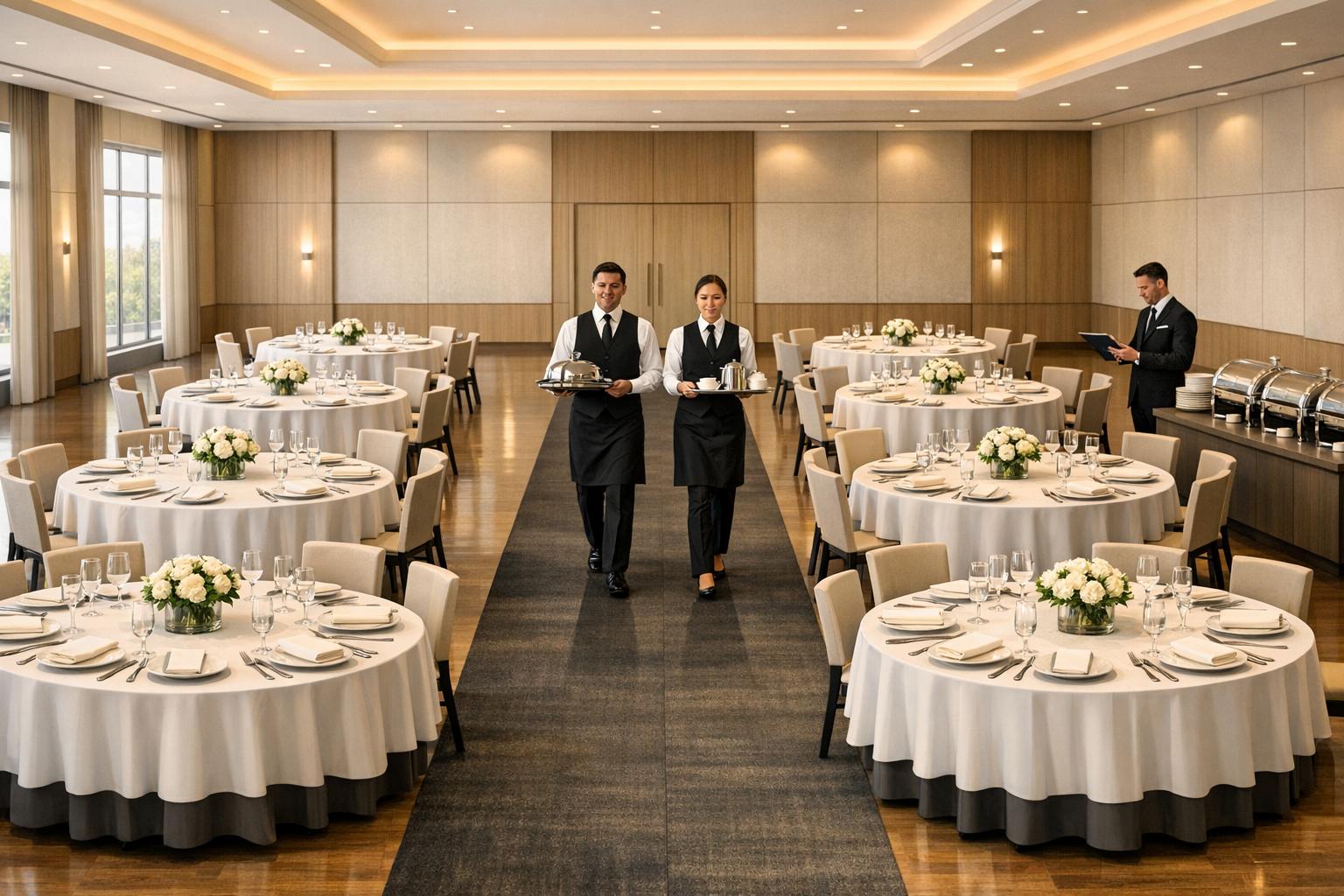
Banquet service standards are the backbone of delivering top-tier guest experiences. They cover staff behavior, service flow, and technical details like table setups and safety protocols. Here's what you need to know:
To excel, managers must enforce these standards, invest in staff training, and monitor performance for continuous improvement. Every detail, from table settings to guest interactions, shapes the event's success.
Banquet servers transform empty spaces into stunning dining areas through careful preparation and efficient cleanup.
When guests arrive, servers are the first point of contact, greeting them warmly, managing coats, and guiding them to their tables. They might also provide a brief overview of the event or venue. During the meal, servers deliver food to entire tables at once, adhering to the Banquet Event Order (BEO) and working closely with the kitchen team. Using event staff scheduling software can help managers coordinate these complex team movements. Professionalism is key - servers stand upright with hands behind their back when not serving, make eye contact with guests, and even refold napkins when necessary.
To ensure a seamless dining experience, servers must be well-versed in the menu, including ingredients and potential allergens. Between courses, they "pre-bus" by quickly clearing empty dishes and soiled linens. Proper etiquette is essential: plated food is served from the left, drinks and cleared plates from the right. The flow of service is deliberate, moving counterclockwise for food and clockwise for beverages to maintain order.
While guest interaction is a big part of the role, managing equipment and adhering to safety protocols are just as important.
Servers handle heavy equipment - up to 30 lbs - regularly to keep operations running smoothly. All tableware must be spotless, with no water spots, cracks, or chips. Silverware is handled by the handles, often with a napkin for added cleanliness, and water glasses are positioned precisely 1/4 inch from the tip of the entrée knife.
Safety is a top priority. Servers keep an eye out for spills or hazards that could pose risks to guests or staff. When serving alcohol, they follow strict federal, state, and company guidelines, including checking IDs to prevent serving minors or visibly intoxicated individuals. Physical demands include lifting at least 20 lbs and managing loads up to 100 lbs as needed. After events, servers are responsible for clearing leftover items, breaking down tables and chairs, and resetting the space for the next use.
These responsibilities highlight the precision and dedication required to ensure successful banquet events.
To assemble a team capable of delivering seamless service, it's essential to look for individuals who excel in both technical know-how and interpersonal abilities. While technical skills ensure operational efficiency, interpersonal skills are what truly elevate the guest experience. Managers should focus on finding candidates who can handle the demands of high-pressure events while maintaining professionalism and composure.
In the foodservice industry, certifications are often a baseline requirement. For instance, a Food Handler Card is mandatory in most areas for anyone involved in food preparation or service. This certification ensures staff understand basic sanitation and food safety practices. Supervisors or managers typically need the ServSafe Manager Certification, which is accredited by ANAB-CFP and valid for five years. This certification emphasizes identifying and preventing foodborne illnesses and ranges in cost from $69 to $99 for the exam alone or $119 to $189 if bundled with training materials.
For events involving alcohol, staff must have Alcohol Service Permits, which include training on ID checks and recognizing signs of intoxication. Most states require servers to be at least 18 years old to qualify. Additionally, while not always required, CPR and First Aid certifications are highly valued, especially for crowded or high-energy events where emergencies may arise.
Beyond certifications, hands-on skills are equally important. Candidates should be adept at:
These technical competencies ensure smooth operations, but they must be paired with strong interpersonal skills to create a well-rounded team.
Interpersonal skills are the cornerstone of delivering exceptional guest experiences. One of the most critical abilities is active listening - servers need to understand guest needs clearly, provide accurate solutions, and communicate effectively with both guests and kitchen staff to ensure orders are correct . Teamwork is equally important; staff should operate cohesively to ensure all guests are served simultaneously. A "no 'that is not my job'" mindset is encouraged, fostering collaboration during busy shifts .
"People are our most important asset. Involvement teamwork and commitment are the values that govern their work." – Hilton Corporate Mission
Stress management is another critical skill. The ability to stay composed and friendly under pressure - whether serving large crowds or managing demanding guests - can make or break the guest experience . Exceptional servers also practice anticipatory service, monitoring tables to refill drinks or clear items without being asked .
Problem-solving is the final piece of the puzzle. Staff should be trained to handle challenges like delayed service or unavailable menu items with professionalism. Instead of defaulting to "no", they should explore alternative solutions to accommodate guest needs .
To evaluate these skills during the hiring process, practical tests can be incredibly useful. For example, setting up a sample table allows managers to assess attention to detail, while role-playing high-pressure scenarios - like handling a delayed order or a difficult guest - provides insight into a candidate's composure and problem-solving abilities. These assessments help ensure that only the most capable individuals join the team, maintaining high standards of service.
How your team presents themselves and adheres to service protocols can make or break the success of an event. Every detail matters, and these professional standards are designed to ensure guests leave with a positive and lasting impression.
The way your staff looks is often the first thing guests notice. Standard banquet attire typically includes black dress shoes, black slacks, and a crisp, white button-up shirt. Uniforms should be spotless and perfectly pressed - anything less, like an off-white or wrinkled shirt, doesn't meet professional expectations.
"All employees must maintain a neat, clean, and well-groomed appearance".
Personal grooming is just as important. Hair should be styled neatly and kept away from the face, nails trimmed short, and any facial hair should be well-maintained. Avoid strong scents like cologne or perfume, and jewelry should generally be removed during service.
When interacting with guests, body language matters. Servers should stand upright, hands positioned behind their back, and avoid slouching, crossing arms, or putting hands in their pockets. Eating, drinking, chewing gum, or touching hair and uniforms while visible to guests is strictly off-limits. To maintain these high standards, managers should perform roll call inspections during pre-event meetings to ensure everyone is presentation-ready before stepping onto the floor.
While appearance creates the first impression, consistent service protocols ensure a smooth and professional event. Food is always served from the left and cleared from the right, while beverages are both served and removed from the right. For efficiency, follow a counter-clockwise flow when serving food and a clockwise flow when serving beverages or clearing plates.
Table settings are another area where precision counts. Silverware should be placed exactly 1/2 inch from the table's edge at a perfect 90-degree angle. The water glass should sit 1/4 inch from the tip of the entrée knife, with the knife's cutting edge facing left.
The Banquet Event Order (BEO) is your go-to guide for every event. It outlines all the details, from guest counts and menu items to linen colors, napkin folds, and glassware requirements. To ensure uniformity, managers should set up a "Sample Table" with the complete place setting, centerpieces, and linens. All other tables must match this sample exactly. A pre-event briefing, held 30–45 minutes before service, should cover the timeline, roles, dietary restrictions, and backup plans for any unexpected situations.
"The 'moment of service' is when the food and beverage items are actually placed in front of a guest and is probably the most memorable aspect of our guest's dining experience".
These meticulous standards not only elevate the guest experience but also reflect a commitment to quality and professionalism throughout the event.
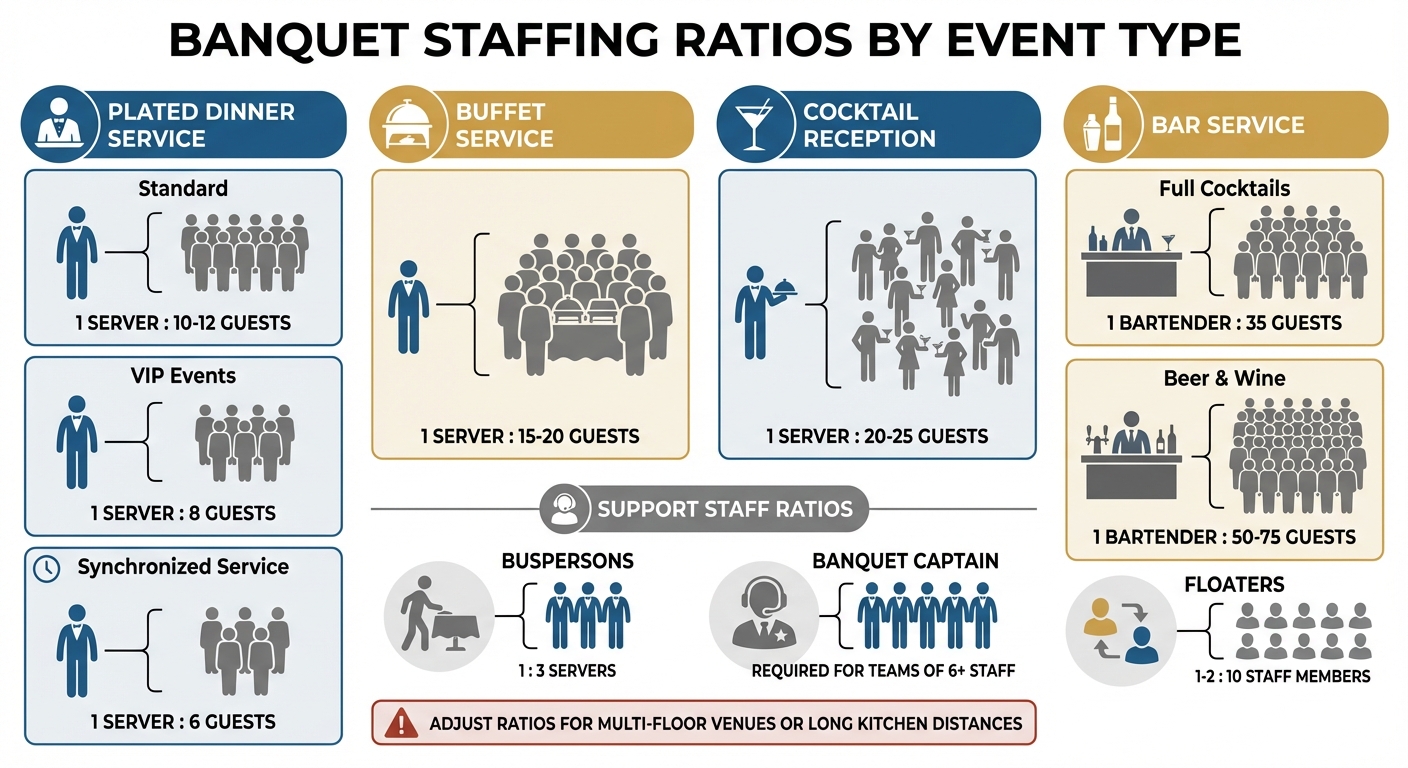
Banquet Staffing Ratios by Event Type Guide
Maintaining the right staffing ratios is essential for delivering top-notch service and ensuring a smooth guest experience. Proper staffing not only protects your event's reputation but also guarantees that guests leave with a positive impression.
The type of event and service style dictate how many staff members you'll need. For example, plated dinners typically require 1 server for every 10 to 12 guests. In a buffet setup, you can manage with 1 server for every 15 to 20 guests. However, VIP or high-end events demand a closer ratio, with 1 server for every 8 guests to provide more personalized service.
"Understaffed meal service is not compatible with successful events; regardless of the quality of a catered function's food and beverage... poor service reduces significantly the attendees' appreciation."
– Patti Shock, Author
For synchronized plated service, where all guests at a table are served simultaneously, you'll need 1 server for every 6 guests to maintain the proper temperature of the food. At cocktail receptions, 1 server for every 20 to 25 guests is sufficient. When it comes to bar service, the ratios vary based on the type of drinks offered. For full cocktails, plan for 1 bartender per 35 guests, while beer and wine service can stretch to 1 bartender per 50 to 75 guests.
| Event/Service Type | Server-to-Guest Ratio |
|---|---|
| Plated Dinner (Standard) | 1:10 to 1:12 |
| Plated Dinner (VIP) | 1:8 |
| Synchronized Service | 1:6 |
| Buffet Service | 1:15 to 1:20 |
| Cocktail Reception | 1:20 to 1:25 |
| Bar (Full Cocktails) | 1:35 |
| Bar (Beer & Wine) | 1:50 to 1:75 |
To support your servers, include 1 busperson for every 3 servers. For events with a larger team (6 or more staff members), appoint a banquet captain to oversee operations and maintain quality. Additionally, having 1–2 unassigned floaters per 10 staff members can help handle unexpected challenges or bottlenecks. Keep in mind that venues with multiple floors or long distances from the kitchen may require extra staff to keep things running smoothly.
Traditional scheduling methods can be time-consuming and prone to errors. Modern scheduling software simplifies the process by automating staffing calculations based on guest numbers, ensuring you have the right team in place without over- or under-staffing. These tools can monitor staff availability, quickly find replacements when someone calls out, and send instant notifications to keep everyone updated.
"It has made a huge difference to our scheduling process, resulting in our schedules being completed in 5% of the time and no longer requiring admin staff to call out to employees."
– Terry Selaices, Director of Food & Beverage, The Sands Expo and Convention Center
Platforms like Quickstaff offer user-friendly solutions for event managers. With features like mobile access, automated reminders, and centralized dashboards, you can efficiently manage staff roles, track availability, and even reduce no-shows. For longer events (5 to 6 hours or more), the software can help you schedule additional staff to cover mandatory breaks and rotations. Plus, by analyzing historical data from past events, you can fine-tune your staffing strategies for future occasions.
Delivering top-notch banquet service hinges on prioritizing customer satisfaction, maintaining consistency, and aiming for continuous improvement. Hilton’s Corporate Mission sums it up perfectly:
"Quality comes first. The quality of our product and service creates guest satisfaction, our No. 1 priority".
To achieve this, managers must actively refine service delivery processes.
A solid strategy includes combining pre-event checks with real-time oversight. Before guests arrive, a formal roll call ensures staff uniforms and grooming are on point.
Once the event begins, the focus shifts to the "moment of service" - that critical point when food is presented to guests. Managers should assess the server’s demeanor, noting their attitude, smile, and whether the main dish is positioned correctly for the guest. It’s also essential to monitor adherence to the service sequence, such as the timing of wine service, clearing plates, and table upkeep. Team captains can use prearranged signals to ensure smooth transitions between these steps.
These measures not only enhance guest satisfaction but also provide a framework for targeted training and measurable performance improvements.
Maintaining consistent service quality starts with effective training programs and reliable performance tracking. A comprehensive training manual is key - it sets clear expectations for both technical and interpersonal skills. On the technical side, staff should master tasks like carrying trays weighing up to 30 lbs, skillfully handling serving utensils, and confidently reciting menu details. Interpersonal skills are equally critical, with a focus on guest attention, efficiency, rapport-building, and clear communication.
To ensure these standards are consistently met, implement a digital rating system to evaluate staff performance after every event. With the hospitality industry facing an average turnover rate of 74% - and each lost employee costing approximately $6,000 - tracking performance is an essential tool for reducing turnover and improving reliability. Tools like BANQSERV, a 33-item survey that evaluates areas such as Services & Facilities, Guest Experience, Guest Needs, and Venue, can help identify specific areas needing improvement.
For further efficiency, platforms like Quickstaff can centralize data by tracking shift ratings and staff accountability across events. Analyzing this historical data allows managers to identify top performers, address skill gaps, and make smarter staffing decisions for future events. These systems not only streamline operations but also ensure that quality remains a constant, no matter the scale of the event.
Running a successful banquet operation hinges on maintaining high standards, fostering capable teams, and staying well-organized.
Start with the basics: hygiene and safety are non-negotiable. Stick to established service ratios tailored to your event type, as these ensure smooth operations and prevent service disruptions.
Consistency in presentation is equally important. Use pre-event meetings to check uniforms and brief your staff on menu specifics. Set up a sample table with perfectly arranged linens, silverware, and glassware to give your team a clear standard to follow. Additionally, invest in training your staff - not just in technical skills but also in building strong guest connections.
Relying on manual processes can be cumbersome. Tools like Quickstaff simplify event coordination, automate staff notifications, and track performance metrics. Considering the hospitality industry's 74% turnover rate and the $6,000 cost of replacing an employee, having accurate data on staff attendance and performance can save time and money.
Ultimately, your focus on standards and guest satisfaction reflects the core of hospitality. As Danny Meyer wisely said:
"Business, like life, is all about how you make people feel. It's that simple and it's that hard".
Every system and standard you implement should serve one purpose: creating memorable experiences that turn first-time guests into loyal, returning customers.
A pre-event briefing is your team’s roadmap to success. It should detail the event schedule, room layout, guest count, menu specifics, service timing, and any special requests. Use this time to go over table arrangements, VIP preferences, hygiene protocols, uniform expectations, and service guidelines. For larger gatherings, assign responsibilities and rehearse key roles to ensure everyone is on the same page. This level of preparation sets the stage for a smooth and polished banquet experience.
When hosting a banquet where the kitchen is far from the dining area, it's smart to adjust the number of servers to keep service running smoothly. Generally, staffing ratios can vary - anywhere from one server for every 8 guests (for high-touch service) to one server for every 32 guests (for more basic setups). If the kitchen is a long walk away, consider adding extra servers to compensate for the distance.
Equally important is ensuring that staff communication and coordination are seamless. A well-organized team can make all the difference in delivering efficient, high-quality service, even when logistics are challenging.
To keep tabs on server performance after events, blend direct observation, guest feedback, and data analysis. Guest surveys are a great way to gauge service quality, while metrics like upselling rates and guest satisfaction scores can offer deeper insights. Scheduling software can also play a role by analyzing factors such as schedule adherence and no-show rates, helping you measure staff efficiency. This combination helps pinpoint standout performers, spot areas needing attention, and maintain steady service standards.