NY Temp Staff Compliance Checklist for Events
August 5, 2026

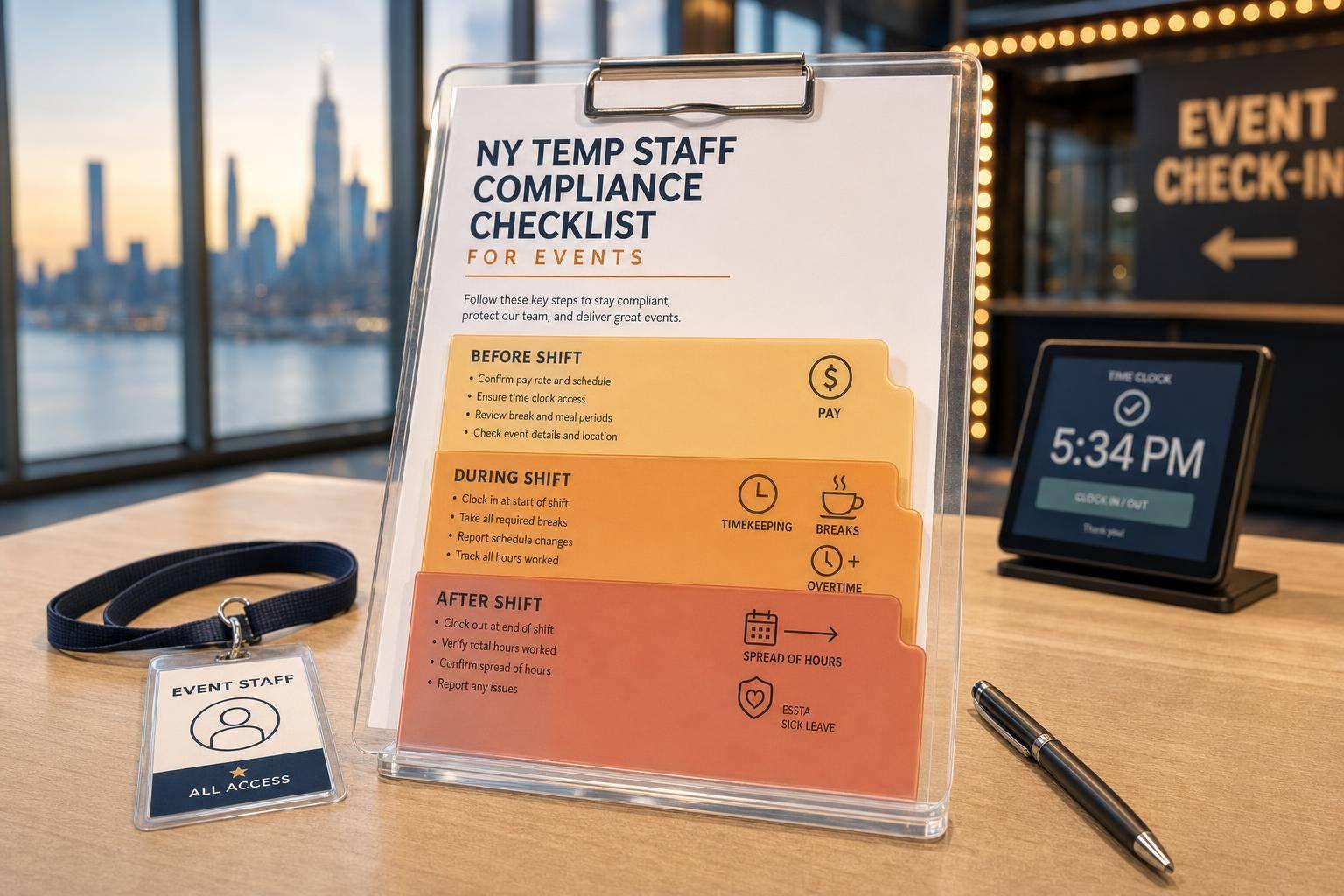
If you use temp staff at New York events, the main job is simple: set pay terms before the shift, track hours and breaks during the shift, and check payroll and records after the shift.
I’d boil this checklist down to three parts:
A few numbers matter right away:
If the event is in New York City, there’s more to track. That includes ESSTA leave records, pay-stub leave balances, and some schedule-change requests. If staff come from a temp firm, the agency may handle some of those tasks, but I’d still confirm who does what in writing.
This article is a plain-English shift checklist for caterers, venues, staffing teams, and event vendors that use hourly temp workers.
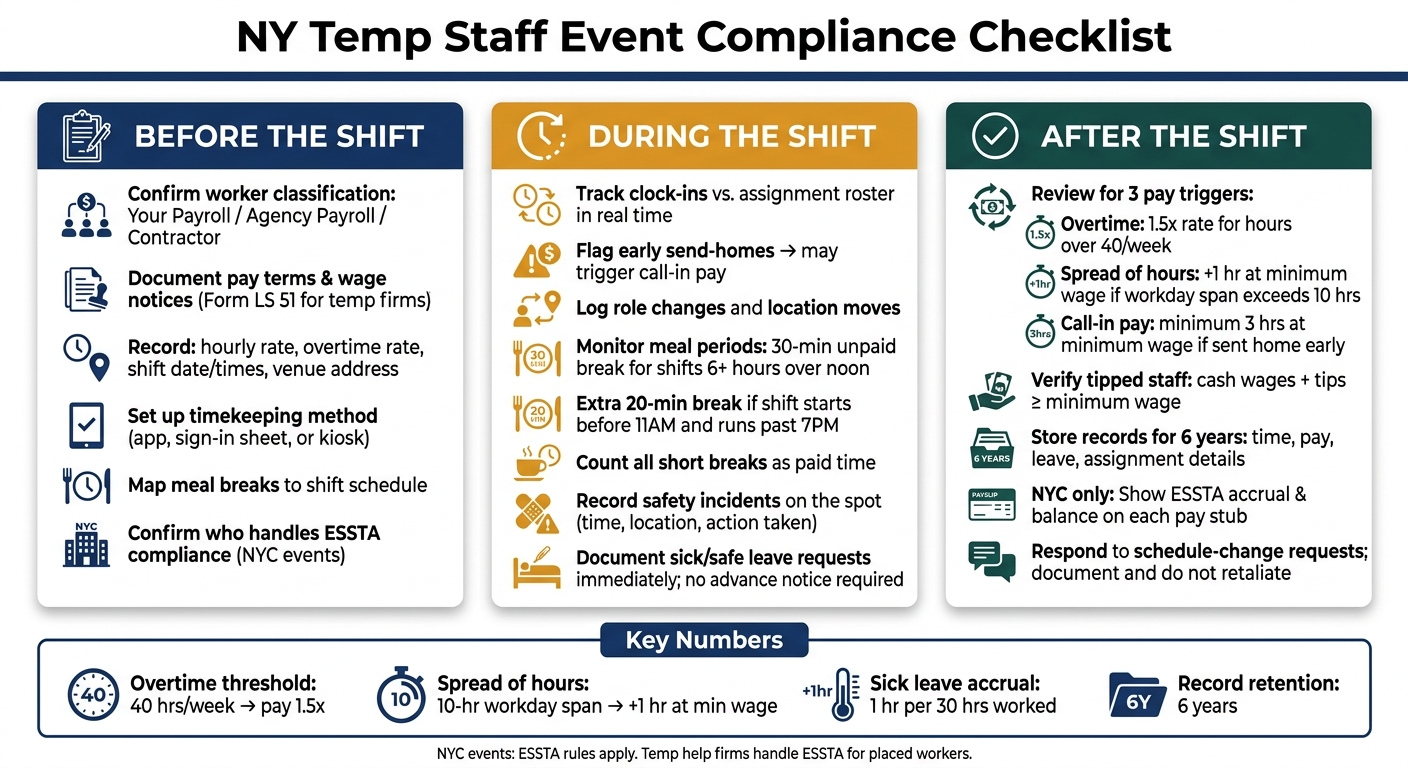
NY Temp Staff Event Compliance: Before, During & After Shift Checklist
Before staff arrive, lock in classification, pay, and timekeeping. Start with classification first, because it decides who handles pay, notices, and leave tracking.
For each role, confirm the worker's status: your employee, a temp help firm employee, or an independent contractor. In New York, temporary help firms employ workers and place them with other organizations, and they stay the legal employer for wage notices and some recordkeeping duties.
For NYC events, a temporary help firm is solely responsible for Earned Safe and Sick Time Act compliance for the temporary employees it places, including accrual, use, and recordkeeping. Before the shift starts, get it in writing which party handles New York Labor Law notices, payroll taxes, sick leave tracking, and unemployment insurance notices.
Add a classification field to each event record and keep it simple:
Set payroll and compliance duties before the shift begins.
Once classification is set, document pay and assignment terms. New York's Wage Theft Prevention Act requires written wage notices at hire that state the rate or rates of pay, the basis of pay, the regular payday, the employer's legal or DBA name and contact information, and any tip, meal, or lodging allowances. For temporary help firms, the New York Department of Labor provides Form LS 51, a notice and acknowledgement for employees of temporary help firms that is used to document the pay-rate and payday information needed for each assignment.
For each worker and each event, the assignment record should include:
At or before each assignment, temp help firms must also tell workers the actual hourly rate of pay, the designated payday, and the overtime rate, or explain why overtime does not apply. Spread-of-hours pay means one extra hour at the basic minimum wage when the total span of the workday goes past 10 hours. Hospitality call-in pay usually means at least 3 hours at minimum wage when a worker reports for a scheduled shift but is sent home or works fewer hours.
Wage notices must be given in English and in the employee's primary language when the NY DOL offers a translation, and signed acknowledgments must be kept for six years.
After pay terms are documented, set up timekeeping and break coverage. Confirm the clock-in method before the shift starts, whether that's an app, sign-in sheet, or kiosk. New York requires contemporaneous time records, and each record must show the date (MM/DD/YYYY), time in, time out, total hours worked, and the start and end times of any unpaid meal periods.
Then map breaks to the shift schedule and coverage plan. New York Labor Law Section 162 requires meal periods for most employees, including at least 30 minutes unpaid for shifts of more than six hours that extend over the noon period, plus extra meal periods for some long shifts.
Plan break windows, assign coverage, and record whether staff bring meals or get one. When a required meal period applies, hospitality employers must either let employees bring their own food or provide a meal at a cost no greater than the meal credit amount, and meal credits cannot be used to offset spread-of-hours or call-in pay.
During the event, compare scheduled labor against actual work as it happens. That lets you catch pay and break problems before the shift is over, not days later when payroll is already in motion.
Set up one check-in point where every worker clocks in before guest load-in. Check each clock-in against the assignment roster so the worker's name, role, and location all line up. Then keep a live roster that shows scheduled hours next to actual hours worked.
Flag any mismatch right away. If someone is sent home early, that can trigger call-in pay under New York's hospitality wage order. The same goes for any shift change that creates overtime, spread-of-hours pay, or call-in pay.
Log split shifts as separate work blocks and clearly mark unpaid gaps. As the shift moves along, use the live roster to compare scheduled time with actual time in real time. If a worker changes roles or moves to another location, note that too.
Once attendance is locked in, shift to break tracking and fatigue checks.
New York requires most non-exempt workers to get an uninterrupted, unpaid meal period of at least 30 minutes on shifts longer than six hours that extend over the noon period. And if a long shift starts before 11:00 a.m. and runs past 7:00 p.m., the worker must also get an extra 20-minute meal period between 5:00 p.m. and 7:00 p.m. At long weddings or galas, those time windows can disappear fast.
Assign a lead or break captain to keep a break roster. That person should record when each worker starts and ends a break and confirm the worker is fully off duty.
A few points matter here:
If someone leaves early or reports a problem, record it right away under safety and leave tracking.
When a safety incident happens, document it on the spot. That includes a slip, a burn, or even a near-miss with equipment. Record the time, location, staff involved, what happened, whether there was an injury, and what corrective action was taken right then and there.
Also note whether the worker got first aid, was sent home, or was taken for medical evaluation. If the worker came through a temp agency, notify the agency promptly and share the incident record so both sides can meet their obligations. Save that report with the shift record.
If a worker asks for sick leave, record when the request came in and whether the worker stayed or left. Note whether the worker asked to use sick leave or safe leave. In New York City, workers covered by the Earned Safe and Sick Time Act (ESSTA) can use accrued time for illness and for safety-related needs tied to domestic violence, stalking, sexual assault, or human trafficking.
Don't require advance notice for unexpected sick leave. Record the request, send it to HR or payroll, and avoid asking for medical details you don't need.
After the event, line up each worker’s scheduled hours with their actual clock-in and clock-out times. This is where payroll review starts. It’s also where missed overtime, unpaid spread-of-hours pay, and call-in pay often show up.
Before you close payroll, check for three extra-pay triggers:
If you have tipped staff, make sure cash wages plus tips meet the applicable minimum wage. Also confirm that any tip credit is backed by written notice and records.
Once payroll is right, file the source records right away. Keep payroll and time records for six years. For each temp worker, retain:
In New York City, employers must also keep records showing sick time accrued and used and give a summary to any employee who asks for one within three business days. Update these records after each shift so nothing slips through the cracks.
To make these files easy to search across events, keep them in one system. Quickstaff can centralize event creation, scheduling, availability, and attendance data, which makes payroll review and record retrieval faster.
Store records as PDF or CSV, and index them by worker, event date, and client.
In New York City, temp event staff may also fall under ESSTA and schedule-change rules. Start with the New York State checklist, then add these NYC steps only if the event takes place in the city.
The main NYC add-on is ESSTA: the NYC Earned Safe and Sick Time Act. Each pay period, show ESSTA accrual, use, and remaining balance on the pay stub or in an accessible electronic record.
Workers can also ask for a temporary schedule change for qualifying personal events. When that happens, respond promptly, document both the request and your response, and do not retaliate.
For this checklist, the NYC items that matter most are pretty simple:
A few rules deserve extra attention:
Use this final pass to catch NYC-only items before payroll closes. Run the same routine for every event so nothing slips through the cracks.
Before the shift: Confirm who is handling ESSTA compliance and wage notices. Give workers ESSTA accrual and leave details in writing. Also flag any shift that could trigger spread-of-hours pay.
During the shift: If a worker leaves early for an ESSTA-qualifying reason, record it right away. Note whether the time counts as paid ESSTA or unpaid protected time. If there’s a schedule-change request, document the request, your response, and how you covered the shift.
After the shift: Review the shift for overtime, spread-of-hours pay, call-in pay, and any ESSTA hours used. Then store time records, pay records, and any leave or schedule-change documents for the required retention period.
Keep assignment and attendance history organized. That makes future staffing plans easier, and centralized scheduling plus attendance records can make payroll review and audit retrieval much faster.
Running this routine the same way each time - classify, track, reconcile, file - can help stop a small miss from turning into a wage claim or an ESSTA violation.
For temp event staff, the staffing agency and the host employer are often joint employers under OSHA guidelines. In plain English, both sides may share responsibility for job site safety and hazards.
Tax and wage status works the same way. The law looks at the actual working relationship, not just what the contract says. If your business controls schedules, tools, or day-to-day tasks, those workers are generally employees, and you may share compliance and payroll responsibility.
In New York, spread-of-hours pay kicks in when the time from the start of an employee’s workday to the end goes past 10 hours.
When that happens, the employee must be paid one extra hour of pay at the basic minimum hourly rate, no matter how many hours they actually worked.
Keep key compliance records after each shift. This isn’t busywork. It’s how you back up payroll, staffing, safety, and contractor decisions if someone asks questions later.
Hold on to these records for the right amount of time:
A simple rule of thumb: if a record helps explain who worked, what they were paid, or how they were classified, keep it organized and easy to find.