Live Event Safety Standards: Cal/OSHA Guide
September 16, 2026

If I staff live events in California, I have to treat safety checks and training as a scheduling rule, not a last-minute task, following a scalable event scheduling framework. This guide makes one point clear: high-risk work must go to workers with the right training, the right supervisor, and the right records before the shift starts.
Here’s the short version:
What I take from this is simple: safe staffing starts before call time. I need to sort workers by training, limit rigging and electrical work to cleared crew, assign supervisors with stronger safety training, and keep day-of inspection and incident records in order.
The article then walks through the same process from start to finish: who needs training, which tasks carry the most risk, what supervisors should inspect, and which records need to be on file.
Frontline crew need training tied to the hazards of the job, along with task training for staging, teardown, and support work. OSHA-10 can work as a starting point, but it does not show that someone is qualified for specialty work. Before you book a crew member, match the assignment to documented training. For technical roles, the standard is higher.
That also means general labor and specialty calls shouldn't get treated the same way. A person helping with basic event support is not the same as someone working a rigging point or handling temporary power.
For crew chiefs, department heads, stage supervisors, and production leads, the standard goes up again. These roles should have OSHA-30-level supervisor training before they direct hazardous work. Supervisors need to be treated as their own staffing pool because their job is different: they review hazards, brief crews, and stop unsafe work, not just carry out instructions.
Require OSHA-30 for anyone who approves rigging crew assignments or signs off on a daily safety briefing. In practice, supervisor roles should be a distinct category, not just a promotion from general labor.
For technical calls, keep proof of competency on file, not just proof of general safety training. The Entertainment Technician Certification Program (ETCP) offers certifications for Rigger – Arena, Rigger – Theatre, Entertainment Electrician, and Portable Power Distribution Technician. ETCP certification is strong proof of competency for rigging and entertainment electrical assignments.
You should also verify training for:
Update training when equipment, hazards, or procedures change. If the work changes, the training record has to keep up.
Staffing rule: split your worker pool into at least two groups - general event labor and workers cleared for specialty technical work. That way, coordinators can spot who is allowed on a rigging call, electrical run, or elevated installation right away, without guesswork.
Quickstaff can store certification dates, qualification notes, and role status in each worker profile, then show only workers cleared for the task. That helps keep substitutions compliant if a qualified worker drops out. It also turns the schedule itself into part of the compliance record.
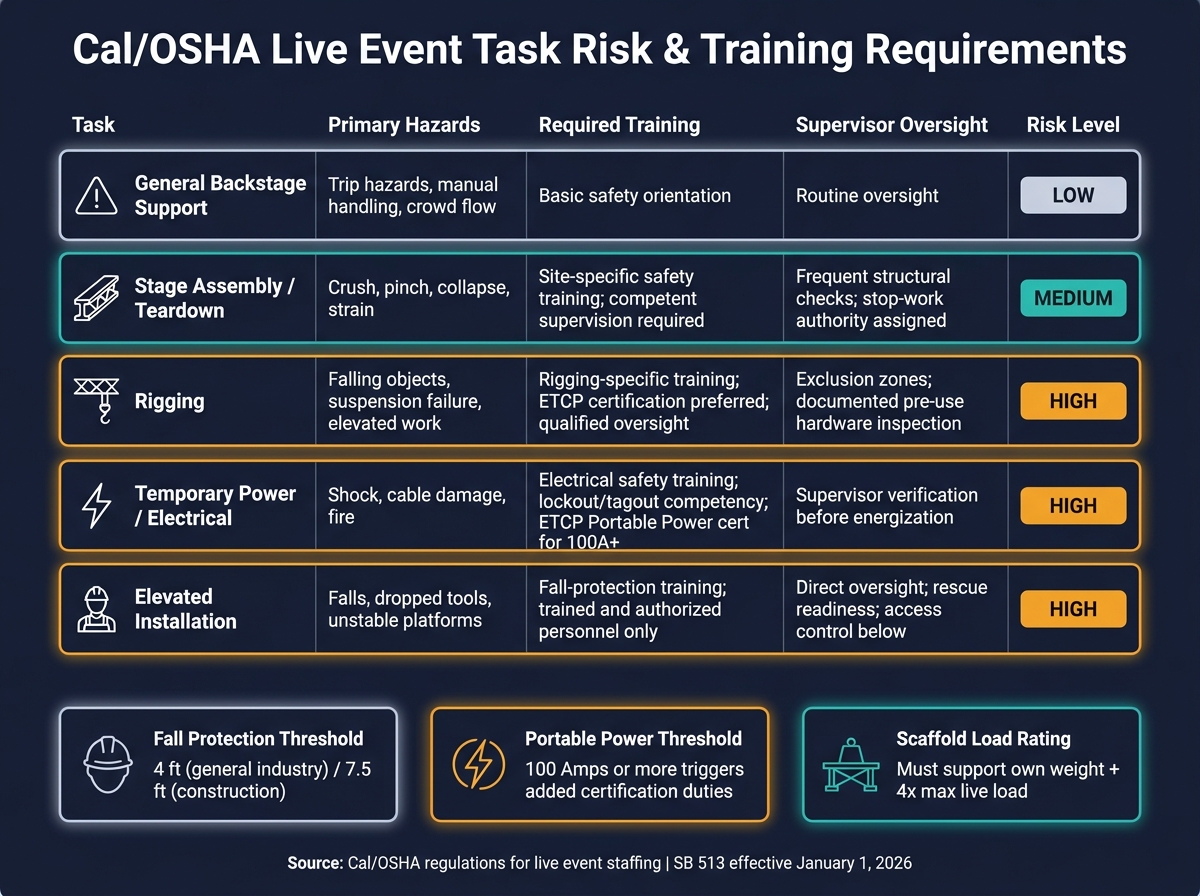
Cal/OSHA Live Event Safety: Task Risk & Training Requirements at a Glance
Once crews are assigned using budget-friendly staff scheduling tools, the next step is simple: make sure the work is built, lifted, powered, and watched the right way.
Before anyone starts assembly, confirm the design, load rating, anchoring, bracing sequence, manufacturer instructions, and floor capacity. The floor or ground has to carry the load. If it can’t, the structure is unsafe.
Cal/OSHA does not allow any temporary structure to be loaded past its design capacity. A qualified engineer must decide whether the structure can safely carry the intended load. Scaffolds and elevated platforms must support their own weight plus at least four times the maximum intended live load.
For crew leads, the message needs to be plain:
If a deck, truss, or platform shifts, sags, or starts acting oddly, work stops until a qualified person inspects it.
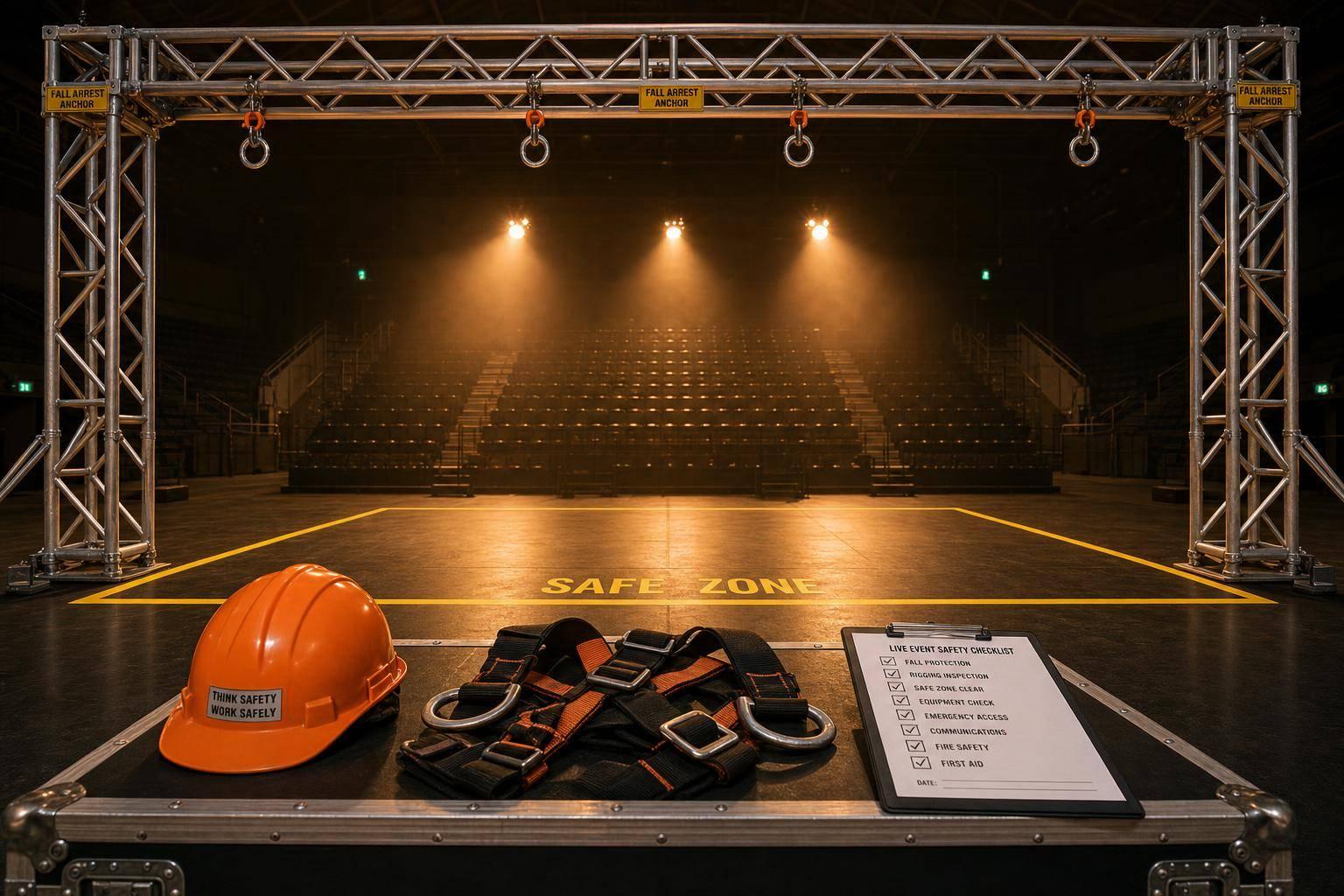
Before any lift, set up a barricaded exclusion zone with cones, tape, or barricades. No one should be under a suspended load unless the load is fully controlled and the area is clear.
Elevated work has a split rule in California. Construction rules require fall protection at 7.5 feet, while general industry rules set it at 4 feet. Either rule may apply to live event work, depending on the task. Workers in aerial lifts must use a safety belt or full-body harness and lanyard attached to a designated anchor point in the lift.
Temporary power also needs close attention. It requires grounding, cable protection, and a pre-use inspection. Portable power distribution at 100 amps or more brings added training and certification duties under California guidance. Lockout/tagout applies to temporary electrical systems too. Equipment must be de-energized and locked out before anyone works on it.
A supervisor should check a few things before energizing anything: cables are secured, connectors are intact, and damaged equipment has been pulled from service. That’s the kind of check that can stop a bad day before it starts.
Use task risk to decide who can work with limited supervision and who needs direct oversight.
| Task | Primary Hazards | Required Training | Supervisor Oversight Needs |
|---|---|---|---|
| General backstage support | Trip hazards, manual handling, crowd flow | Basic safety orientation | Routine oversight |
| Stage assembly / teardown | Crush, pinch, collapse, strain | Site-specific safety training; competent supervision required | Frequent structural checks; stop-work authority assigned |
| Rigging | Falling objects, suspension failure, elevated work | Rigging-specific training; qualified oversight | Exclusion zones; documented pre-use hardware inspection |
| Temporary power / electrical | Shock, cable damage, fire | Electrical safety training; lockout/tagout competency | Supervisor verification before energization |
| Elevated installation | Falls, dropped tools, unstable platforms | Fall-protection training; trained and authorized personnel only | Direct oversight; rescue readiness; access control below |
That same assignment logic should carry into the daily briefing and the supervisor checks that come next.
Once crew assignments are locked in, supervisors need a same-day routine for briefings, inspections, and paperwork. This is the day-of system that keeps the job moving and helps catch problems before they turn into injuries, delays, or shutdowns.
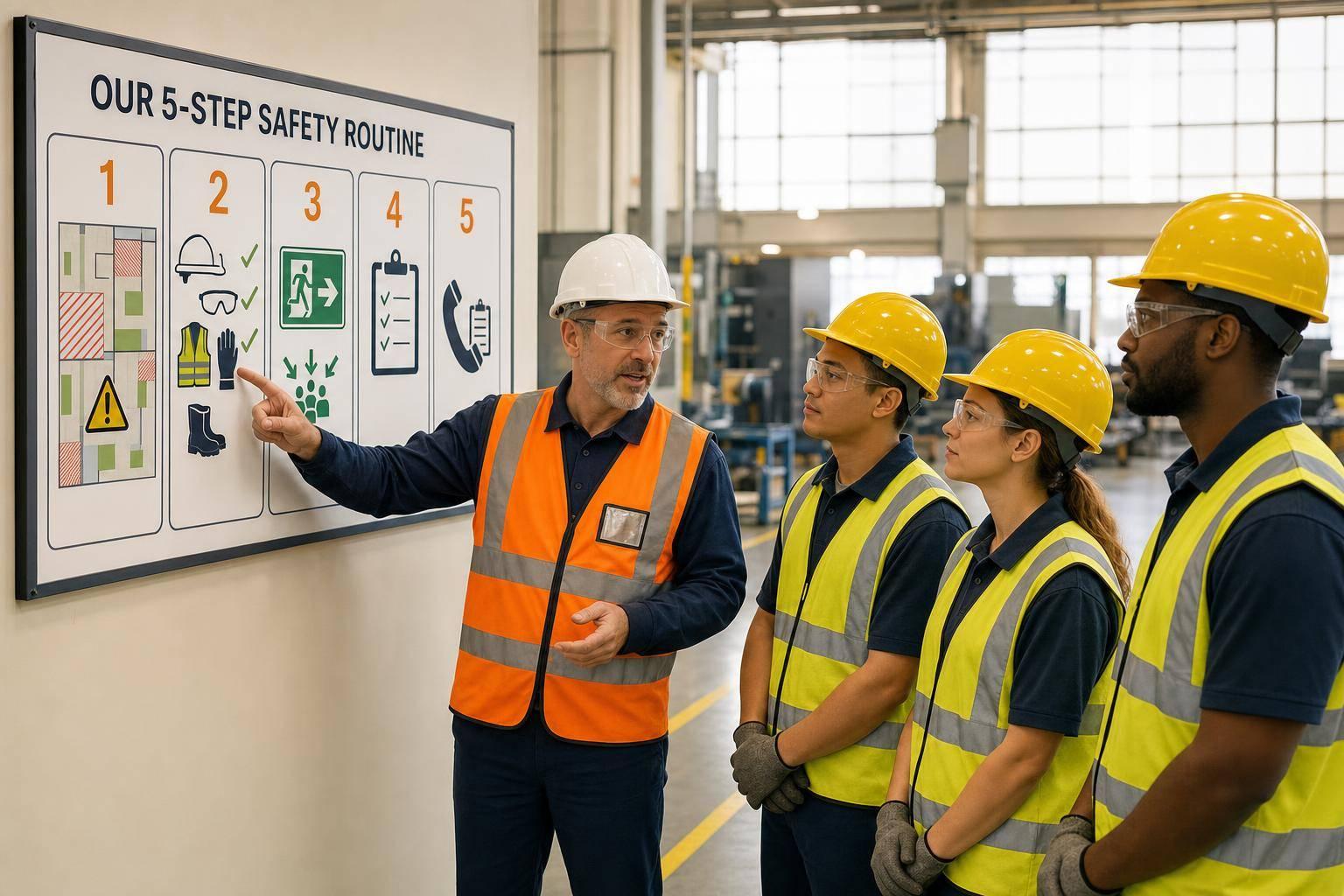
Before doors open, supervisors should run a toolbox talk that covers site hazards, PPE, safe work methods, and stop-work authority. If anything changed since the last shift, that needs to be called out clearly. A new truck path, a wet deck, a swapped rigging plan, a weather shift - small changes can create big risks fast.
Supervisors should also walk audience and crew circulation routes before opening. The goal is simple: make sure people can get in, move around, and get out safely if something goes wrong. Check that exits are unlocked, clear, and marked. Make sure gear isn't blocking egress. Fire extinguishers need to be in place, easy to reach, and inspected. Emergency lighting and exit signs should work. Radios and emergency contact numbers should be checked too. For outdoor events, weather matters a lot. Wind, heat, and rain all need to be factored into staging, rigging, and temporary power decisions.
Before the public comes in, the supervisor should sign off that stage structures, rigging points, and temporary power systems were inspected, that hazards were fixed, and that the work area is safe to use. That sign-off should show who did the inspection, what they found, and what action they took. Use a daily checklist tied to the IIPP.
Cal/OSHA's IIPP requires records showing who was trained, what they were trained on, and when the training happened. That includes both general orientation and task-specific training, such as fall protection, rigging, temporary power, ladder use, and equipment operation. California's SB 513, which takes effect January 1, 2026, adds more detailed training record rules. It also makes those records personnel records that must be kept for at least three years after employment ends.
Incident logs should cover more than injuries. Near misses and hazards matter too. If a truss shifts, someone spots a trip hazard, or a small electrical issue pops up, that should trigger a written report. Include the date, location, description, immediate response, root cause, and corrective action. Cal/OSHA Form 300, Form 301, and the yearly Form 300A summary must be kept for five years. Form 300A also has to be posted from February 1 through April 30 each year.
For subcontracted crews, gather each subcontractor's qualification documents before work starts and file them with the worker or vendor record. Don't release the crew until that file is complete.
Use this checklist to keep pre-show, show-time, and post-show duties in one place.
| Event Phase | Supervisor Task | Required Documentation |
|---|---|---|
| Pre-show | Conduct toolbox talk on day-specific hazards | Attendance sign-in sheet |
| Pre-show | Inspect stage, rigging, and temporary power | Daily inspection checklist with sign-off |
| Pre-show | Verify egress routes, fire extinguishers, emergency lighting, and communications | Site check form |
| Pre-show | Confirm training status for all assigned crew | Training verification log |
| During show | Monitor work areas and crowd movement for changing hazards | Supervisor log notes |
| During show | Respond to incidents and near misses | Incident report form |
| During show | Enforce PPE use and safe work practices | Supervisor log notes |
| Post-show | Oversee safe strike and load-out; confirm lockout of temporary power | Load-out checklist |
| Post-show | Conduct debrief safety meeting with crew | Debrief meeting notes |
| Post-show | File incident reports and update training records | Updated IIPP action items, corrective action log |
Use the timeline as the standard supervisor checklist for every event.
Once training and supervision are in place, the schedule has to match the risk level of each phase. This is where compliance starts. High-risk event windows need the right depth of training, not just enough hands on site.
For a multi-day festival, that could mean extra ETCP-certified riggers and OSHA-30-trained supervisors on Day 1 during the truss hang, a smaller but still qualified team for daily checks on show days, and a larger, well-rested crew for the final overnight teardown. The point is simple: high-risk windows need the most qualified coverage, not just more people. Weak planning and unqualified supervision create avoidable risk.
Fatigue matters too. Build in rest periods, breaks, and task rotation to help limit fatigue.
That same risk-based approach should shape how coordinators filter and book crews. Use Quickstaff to filter workers by qualification, track availability, and fill open shifts with workers who already meet the task requirements.
Use the checklist below to keep staffing decisions tied to compliance.
| Step | What it means in practice |
|---|---|
| Confirm training before assignment | Verify OSHA-10 or equivalent general entertainment safety training for workers assigned to setup, operation, or teardown tasks before they are scheduled |
| Verify supervisor qualifications | Schedule OSHA-30-trained department heads and leads, with ETCP or equivalent certification where applicable, for shifts that include rigging or elevated work |
| Limit high-risk tasks to trained personnel | Restrict rigging, aerial lift work, and high-capacity portable power to trained and certified personnel |
| Build a recorded safety checkpoint into each event phase | Pre-build, show, and strike should each include a recorded safety talk and site check |
| Keep training and site-check records current | Maintain documentation of safety and health training, plus inspection and safety meeting records |
Risk-based scheduling is the clearest sign that safety is built into staffing, not added later. In live events, compliant staffing starts with assigning the right workers to the right moments.
Tasks that need trained workers include setup and strike work, heavy equipment operation, and technical jobs in high-risk areas.
That covers ladder safety, lifting, equipment handling, electrical panel access or maintenance, forklift use, hazardous materials handling, and job-specific needs like bartending permits.
Quickstaff helps managers assign the right roles, track certifications, and schedule only qualified staff for high-risk positions.
The source material here does not say when California uses the 4-foot rule versus the 7.5-foot rule for fall protection.
So if you want to answer that FAQ with confidence, you'll need a source that directly spells out those California height thresholds.
Before an event, keep records of site-specific safety training, equipment and hazard communication, emergency procedures, staff certifications, personnel forms, and run sheets that list safety roles, emergency contacts, and briefing attendance.
After an event, document attendance, hours worked, wage records, any injuries or illnesses in the OSHA 300 Log, corrective actions, and post-event debrief notes on near misses, safety concerns, or equipment issues.