Best Practices for Temporary Worker Safety
June 24, 2026

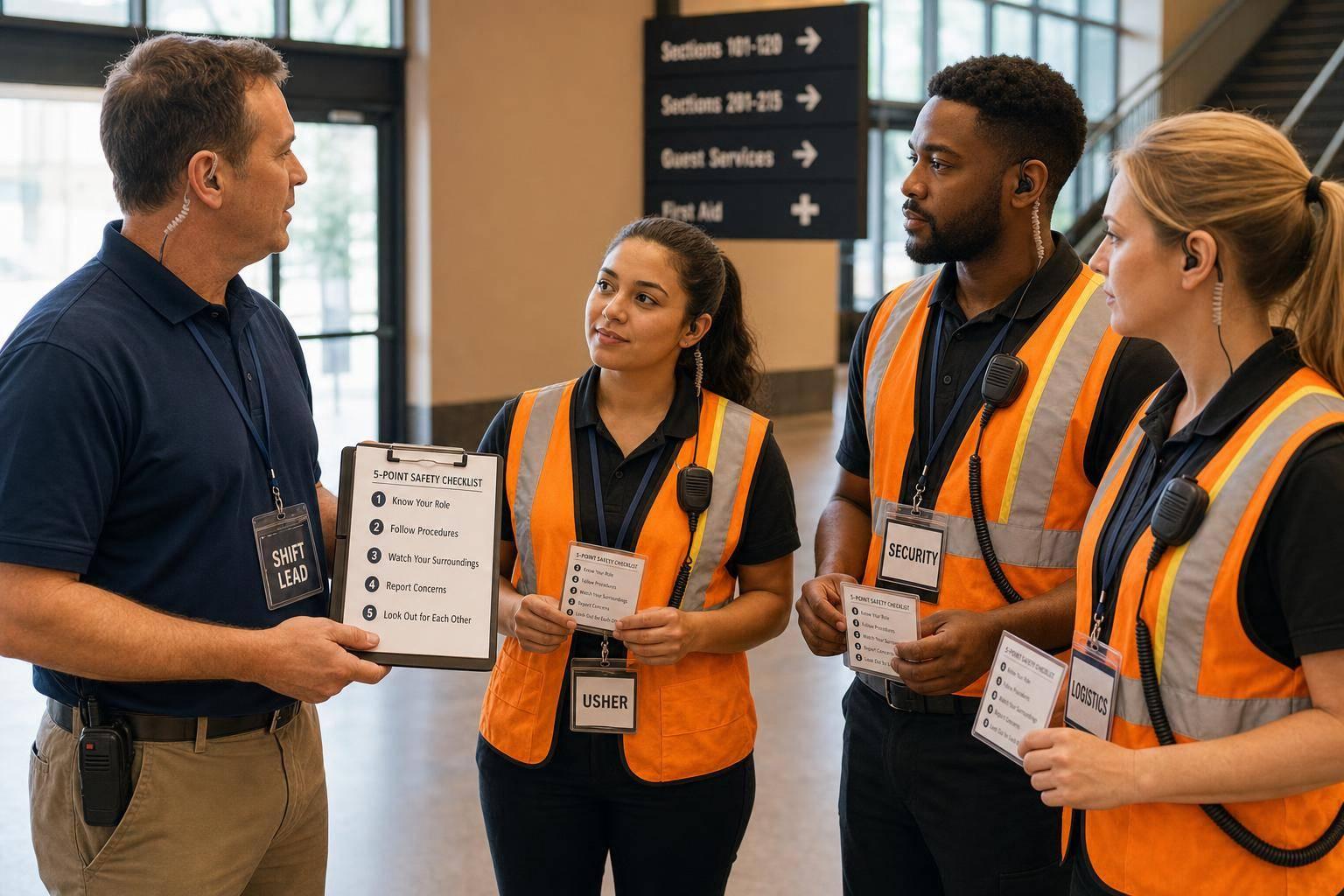
Temporary event workers face more risk when jobs, supervisors, and site hazards change by the hour. My main takeaway is simple: if you want safer event shifts in the U.S., you need clear shared duties, job-specific training, one reporting path that includes compliance checks, and short checklists for setup, live event hours, and teardown.
Here’s the short version:
A few facts from the article stand out:
If I had to boil the whole article down to one checklist, it would look like this:
| Area | What to do |
|---|---|
| Safety duties | Put training, PPE, supervision, and incident reporting in writing |
| Training | Give pre-assignment info and site walk-throughs before work starts |
| Supervision | Assign one lead and one reporting chain for every temp worker |
| Hazard control | Flag trip risks, crowd issues, weather exposure, noise, and lifting limits |
| Follow-up | Use stage-based checklists and short post-event debriefs |
Bottom line: temporary worker safety at events is less about long manuals and more about clear instructions, clear ownership, and clear follow-through.
Once the risks are clear, put safety responsibility in writing.
Under the OSH Act of 1970, temporary workers have the same right to a safe workplace as permanent employees. OSHA treats staffing agencies and host employers as shared safety decision-makers for temporary workers.
"The staffing agency and the staffing agency's client (the host employer) are joint employers of temporary workers and, therefore, both are responsible for providing and maintaining a safe work environment for those workers." - Occupational Safety and Health Administration
That shared role has a plain meaning: both parties can be cited if OSHA rules aren't followed. In most cases, the employer handling day-to-day supervision keeps the injury log.
A written agreement between the staffing agency and the host employer helps stop compliance gaps before a worker even gets to the venue. OSHA recommends spelling out each employer's duties in the contract:
"To ensure that there is clear understanding of each employer's role in protecting employees, OSHA recommends that the temporary staffing agency and the host employer set out their respective responsibilities for compliance with applicable OSHA standards in their contract." - Thomas Galassi, Director of Enforcement Programs, OSHA
At a basic level, the agreement should make clear who trains workers, who supervises them, how you manage event staff scheduling, and who reports incidents. If that isn't written down, it's easy for one side to assume the other handled it.
At minimum, the contract should address:
Staffing agencies should also verify site conditions before assigning workers.
With responsibility set, move to role-based training.
Once the staffing agency and host employer have split up duties, the next job is simple: make sure workers know what to do before the shift begins. When that prep is done well, you get fewer setup mistakes, faster hazard reporting, and safer shifts. The best approach starts before arrival and ends with a site check on day one.
Training tends to work best in two parts.
Before workers arrive, cover the basics they need to show up ready to work. That includes event dates and times, shift length, physical demands, dress code, uniform rules, parking details, staff entrance locations, and basic safety points like proper lifting technique, heat exposure prevention, and required PPE.
Then, on site, walk the venue or review a venue map together. Show workers where to find emergency exits, fire extinguishers, bathrooms, muster points, restricted back-of-house areas, evacuation routes, severe weather plans, first-aid contacts, the chain of command, radio channels, and a current contact list.
Sending the pre-assignment training in digital form before event day helps keep back-of-house areas from getting clogged when gates open. This process is easier when using budget-friendly staff scheduling tools to centralize communication.
Once workers know the venue layout, shift the briefing toward the work they'll actually handle.
After the general orientation, narrow the training to each worker's actual tasks. A broad safety talk isn't enough. People need instructions that fit the job in front of them.
For example:
Instead of giving every worker the same all-purpose manual, use one-page role sheets for each position. It's a small shift, but it cuts confusion and helps people work more safely from the start.
Wrap up training by checking that each worker can repeat the key instructions in plain language. This matters even more with large crews and mixed backgrounds. If some workers need bilingual materials, give key safety instructions in plain English or in multilingual formats.
Before anyone starts working on their own, confirm they understood the briefing. That can be as simple as a short verbal review, a digital sign-off, or a supervisor watching the first few tasks. Supervisor checklists that confirm PPE and zone compliance during the event also help keep these checks from slipping into the background once things get busy.
Once workers know the job, communication keeps that training in place during the shift. It cuts mistakes by getting the right details to the right people at the right time.
Send a one-page shift brief before work starts. It should spell out role duties, hazards, PPE requirements, and the on-site contact. Add role-based lifting limits too, and make team lifts or dollies mandatory for heavy items.
PPE requirements should live in that same brief. For most event roles, closed-toe shoes with traction are the starting point. Rigging and electrical work need hard hats. Food prep staff need nitrile gloves. High-visibility vests apply to anyone working near vehicle traffic or loading docks. If a worker doesn’t have the required PPE, they shouldn’t start.
Name site hazards in plain language. Call out uneven flooring, low ceilings, obstacles in walkways, or weather exposure. Saying “be careful on site” sounds nice, but it doesn’t tell anyone what to do.
Temporary staff need one clear supervisor and one reporting path. When people get mixed instructions, response slows down and risk goes up.
A clear reporting chain helps small issues get handled fast. Before the event starts, assign team leads for each department, such as security, catering, setup, and crowd management. Then give each worker a printed card or a digital reference with their direct supervisor and the main contacts for hazards, injuries, or schedule changes. One visible reporting chain helps stop people from acting on conflicting directions during an emergency.
"Clear, reliable communication is essential for sharing updates, asking for help, and addressing issues quickly to keep the event running smoothly." - Erin Helms, LaborMax Staffing
Unclear assignments lead to avoidable confusion on site. Tools like Quickstaff keep shift details, reminders, and role assignments in one place, which cuts down the last-minute scramble that can push people into unsafe reassignments. Use one system to keep assignments, reminders, and contacts together.
Clear communication works best when the site itself stays under control.
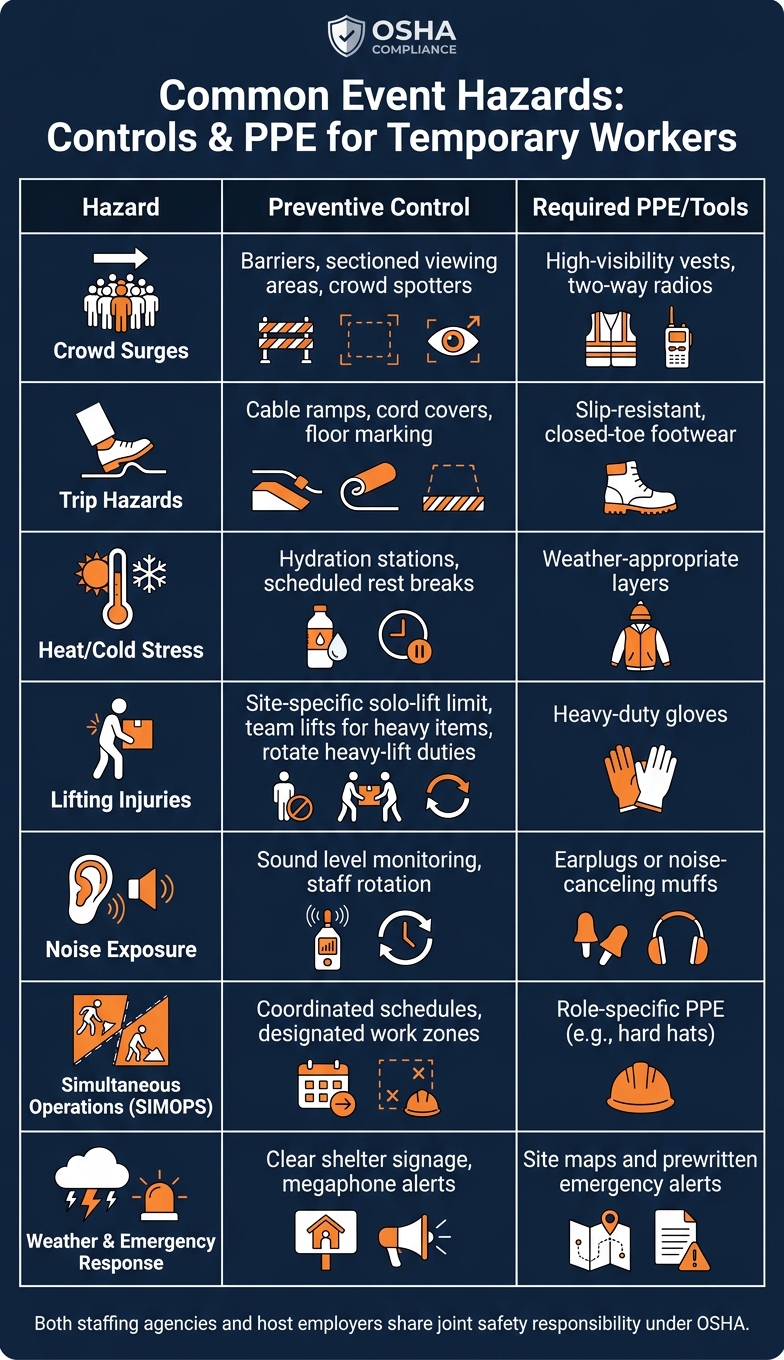
Common Event Hazards: Controls & PPE for Temporary Workers
Once roles and reporting lines are clear, the next step is simple: deal with the physical hazards on site.
Temporary event staff run into the same kinds of risks again and again at U.S. events. Crowd surges are one of the biggest. They can turn deadly fast, which is why crowd spotters should have direct authority to escalate problems the moment they see them. Barriers and sectioned viewing areas also help manage movement before things get out of hand.
Other risks need the same no-nonsense approach. Trip hazards, weather exposure, noise, and lifting injuries are best controlled with the right barriers, scheduling, PPE, and tools.
The table below links the most common event hazards to practical controls and PPE:
| Event Hazard | Preventive Control | Required PPE/Tools |
|---|---|---|
| Crowd Surges | Barriers, sectioned viewing areas, crowd spotters | High-visibility vests, two-way radios |
| Trip Hazards | Cable ramps, cord covers, floor marking | Slip-resistant, closed-toe footwear |
| Heat/Cold Stress | Hydration stations, scheduled rest breaks | Weather-appropriate layers |
| Lifting Injuries | Set a site-specific solo-lift limit, require team lifts for heavier items, rotate heavy-lift duties throughout the shift | Heavy-duty gloves |
| Noise Exposure | Sound level monitoring, staff rotation | Earplugs or noise-canceling muffs |
| Multiple crews working in the same area at once (SIMOPS) | Coordinated schedules, designated work zones | Role-specific PPE (e.g., hard hats) |
| Weather and emergency response | Clear shelter signage, megaphone alerts | Site maps and prewritten emergency alerts |
One risk that often gets missed is simultaneous operations, where setup crews, catering staff, and security all work in the same space at the same time. It sounds routine, but that overlap can create new hazards fast. Written zone assignments and coordinated schedules and event staff scheduling software help stop one team’s work from putting another team at risk.
The goal is to make these controls repeatable, not ad hoc. That’s where stage-based checklists come in.
Simple checklists make safety easier to repeat from one shift to the next. Build short checklists for arrival, setup, live operations, and teardown so supervisors can focus on the hazards most likely to show up at each stage. That turns pre-shift orientation and role-based training into active on-site supervision instead of a box-checking exercise.
Before the crew arrives, supervisors should walk the site and look for problems early: uneven flooring, blocked exits, unsecured cables, or missing signage. It’s a small step, but it can prevent a messy shift later.
After the event, run a short debrief. Log near misses and any hazards that came up without warning. Those notes should feed right back into the next checklist and the next shift plan.
The safest event teams stick to the same core habits every time: clear roles, role-based training, plain communication, and hazard checks. Define shared responsibilities before the contract is signed. Send shift briefs before work starts, with hazard details and PPE requirements. Then use checklists and post-event reviews to track what worked and what didn’t.
Safety works best when these steps are routine, not improvised.
In the United States, temporary staffing agencies and host employers both share responsibility for keeping temp workers safe at events.
In most cases, the staffing agency covers general safety training. The host employer handles site-specific training and steps to prevent hazards on the job site. Those roles should be spelled out in a written contract so there’s less confusion about who does what.
That said, a contract doesn't let either side off the hook. Both the staffing agency and the host employer still have to follow OSHA standards.
A temp worker safety briefing should explain how to do the job safely and how to spot hazards before they turn into problems.
It should cover:
Event teams can cut on-site hazards by making roles clear from the start. The host employer and staffing agency should agree on who handles what, so nothing slips through the cracks.
Start with a joint risk assessment. That helps both sides spot likely hazards and match each task with the right controls.
Before the first shift, give temporary staff the same site- and task-specific safety training that permanent employees receive. No shortcuts. If a job has risks, every worker should get the same level of prep.
A mentor or buddy system helps too. It gives new workers someone they can check with in the moment, which makes it easier to build safe habits and ask questions on the spot.