Common Onboarding Mistakes with Temporary Staff
March 25, 2026

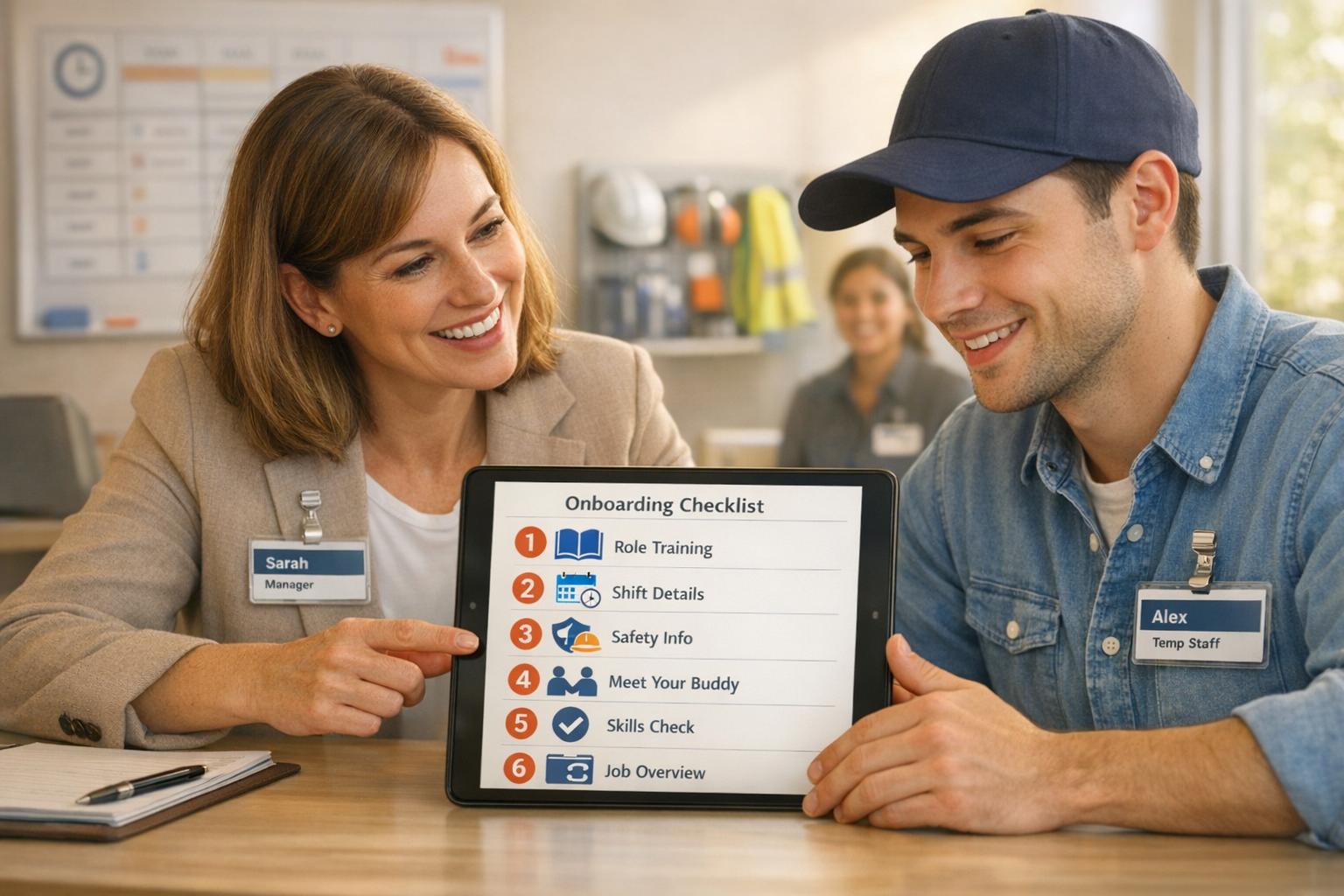
Onboarding temporary staff poorly can lead to confusion, mistakes, and high turnover. Here's how to avoid common pitfalls:
Why it matters: Proper onboarding boosts satisfaction, productivity, and retention while reducing costly errors. Tools like Quickstaff can simplify this process, ensuring smooth events and a reliable workforce.
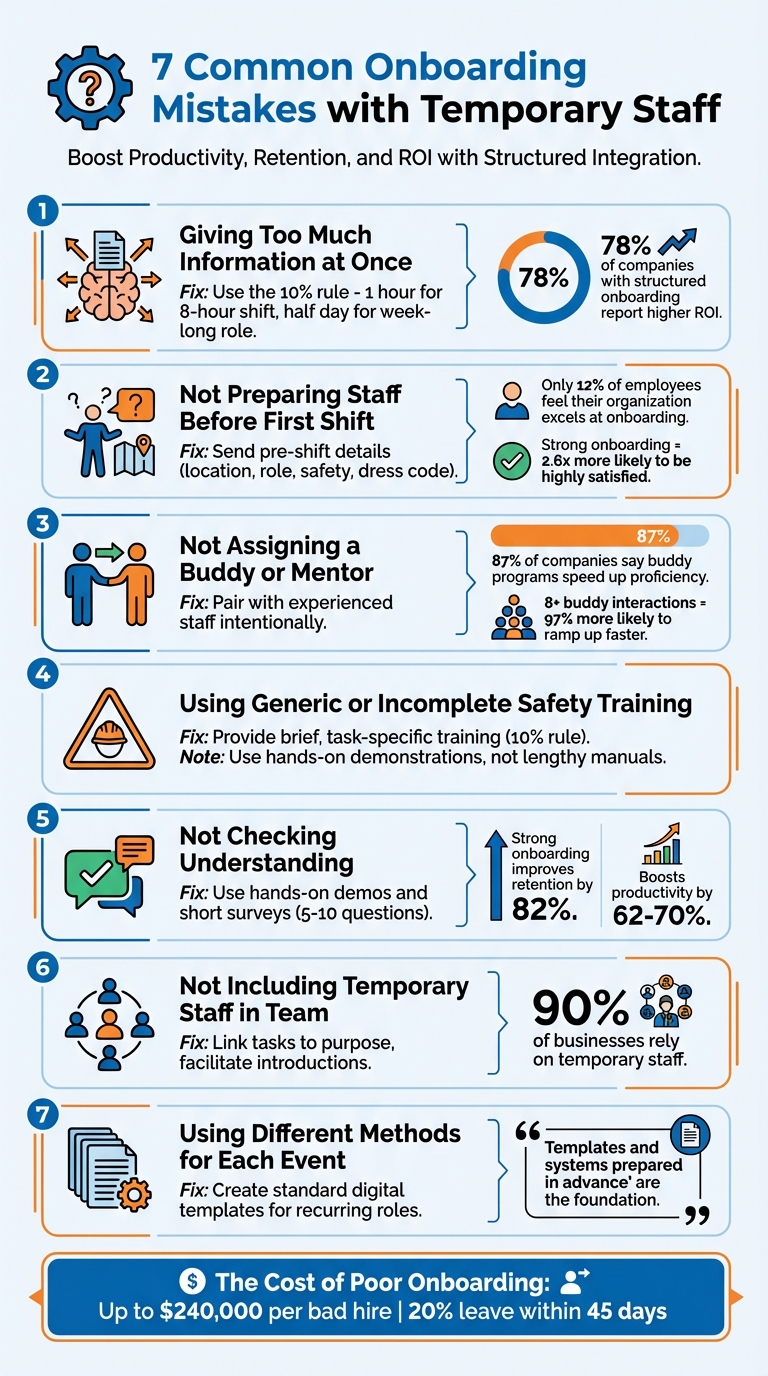
7 Common Onboarding Mistakes with Temporary Staff and How to Fix Them
One of the biggest missteps in onboarding temporary staff is bombarding them with too much information. Imagine handing a short-term worker a hefty manual meant for a permanent role - it’s a recipe for disaster. Overloading staff with details not only hinders their ability to retain key points but also sets them up for failure. In fact, information overload can be just as damaging as providing no training at all, as it negatively impacts both memory and job performance. The result? Temporary staff often feel overwhelmed, anxious, and may even consider quitting before they fully begin.
The root of the problem lies in using onboarding materials designed for full-time employees. These materials typically cover company culture, policies, and procedures in depth - things full-time workers have weeks or months to absorb. When there’s no separate process tailored for temporary hires, or when time is tight, it’s tempting to hand over the same comprehensive packet. But temporary workers don’t need all that. They require concise, role-specific guidance to hit the ground running.
The fix is simple: streamline the onboarding process. A good rule of thumb is the 10% rule - spend 1 hour onboarding for an 8-hour shift, half a day for a week-long role, and up to 3 days for a month-long assignment. Focus exclusively on what temporary staff need to succeed in their role: tools, processes, and safety protocols. Skip the deep dive into company history or long-term goals.
Create role-specific checklists that include the essentials, such as required tools, links to system training, and supervisor contact details. To make things even easier, build a digital knowledge base that workers can access anytime. Platforms like Quickstaff can centralize this information, making it mobile-friendly and easy to use.
Here’s why this approach works: 78% of companies that implement structured onboarding report higher ROI. It’s proof that keeping things simple and focused isn’t just effective - it’s smart business.
Skipping preparation for temporary staff can lead to immediate headaches. The fallout? No-shows, operational slip-ups, and confusion - all of which could be avoided with a simple pre-shift message. As the Zelos Team Management aptly explains:
"Skipping preparation is like embarking on a journey without directions. Even for seemingly uncomplicated roles, onboarding is the GPS that ensures temp staff know exactly where they're headed".
When temp staff show up unprepared, the cracks start to show right away. They’re unsure of the tools you use, the small but important details that make your operation tick, or even basic safety protocols. This lack of direction frustrates workers and introduces costly operational risks. Miscommunication leads to mistakes, and mistakes can derail the success of your event. Unclear instructions leave workers feeling disconnected, which drains their motivation.
The stats are telling: only 12% of employees feel their organization excels at onboarding. Poor onboarding doesn’t just confuse - it chips away at confidence and morale. Workers who don’t see how their tasks fit into the bigger picture often end up completing work that’s off-target. Fixing those errors later isn’t just inefficient - it’s downright discouraging.
The solution? Send clear, straightforward pre-shift details before staff arrive. Cover the essentials: where to go (address, parking info, start time), what their role entails, who they’ll report to, and any safety protocols or dress code requirements. If there’s a special event, a busy schedule, or specific tools they’ll need, give them a heads-up. Keep it short and focused - just the key details they need to start strong.
Automated tools can make this process a breeze. Platforms like Quickstaff let you send automated reminders and event details directly to your team. Workers can check their assignments on their phones before arriving. And the benefits are clear: employees who go through a strong onboarding process are 2.6 times more likely to feel highly satisfied with their workplace. A little preparation goes a long way in boosting performance and morale.
Skipping the step of assigning a buddy can leave temporary staff feeling isolated and struggling to keep up. Without someone experienced to guide them, new hires often work in silos and miss out on learning opportunities that naturally happen when observing seasoned colleagues. This lack of connection can slow down their learning curve, make them hesitant to ask questions, and lead to wasted time on assignments that miss the mark. Over time, this disconnect can result in slower performance, mounting frustration, and a feeling of being an outsider rather than part of the team. It’s clear: support systems are essential.
Pairing temporary staff with experienced team members can dramatically improve their onboarding experience. A whopping 87% of companies say that buddy programs help new hires become proficient more quickly. In fact, temporary staff who connect with their buddy eight or more times during their first 90 days are 97% more likely to ramp up productivity faster. On top of that, these employees report being 23% more satisfied after their first week and 36% happier after 90 days compared to those without buddy support.
"New hire buddy programs are often effective as the employees are more comfortable asking questions to a peer rather than a mentor." – Disprz
Buddies play a critical role by sharing the unspoken rules of the workplace, explaining daily routines, and answering those awkward questions new hires might hesitate to bring up with a supervisor. They also help temporary staff feel included by introducing them to other team members. On the flip side, being a buddy offers experienced employees a chance to sharpen their coaching and leadership skills.
To maximize the benefits of buddy systems, intentional pairing is key. Avoid random matches - pair temporary staff with experienced employees who work in similar roles and are familiar with the tools and tasks required. Matching personalities and work styles can further improve compatibility.
A good rule of thumb is the "10% rule": allocate about 10% of a temporary worker’s shift to onboarding activities with their buddy. For an 8-hour shift, this means dedicating roughly one hour to shadowing and hands-on guidance. Start the day strong by having the buddy greet the new hire when they arrive - this helps ease first-day nerves. Encourage informal check-ins throughout the shift to tackle any lingering questions.
Tools like Quickstaff can simplify this process. The platform allows you to schedule buddies and temporary staff for the same shifts, track availability, and assign roles. This ensures that experienced team members can support new hires without being stretched too thin. A structured approach like this ensures temporary staff feel supported from day one while keeping buddies from feeling overwhelmed.
Generic or incomplete safety training isn’t just ineffective - it can lead to serious accidents and legal trouble. In the U.S., OSHA places joint responsibility on both staffing agencies and host employers to ensure the safety of temporary workers. This means that if training falls short, both parties could face penalties. Beyond the legal risks, temporary workers who don’t receive role-specific training may fail to recognize site hazards or operate equipment safely, putting themselves and others in danger.
Throwing a massive manual at temporary workers or forcing them to sit through irrelevant presentations is a recipe for disaster. When training doesn’t relate to their specific tasks, workers quickly lose interest. It’s like showing up for a cooking class and being taught how to fix a car - it’s confusing and disengaging. This kind of overload causes workers to miss critical safety details, increasing the likelihood of accidents, costly errors, and compliance violations.
"Imagine trying to dive into a thrilling computer game, only to be handed a dictionary-sized instruction manual... It's a surefire way to send [temps] running." – Zelos Team Management
The key is to make safety training short, specific, and hands-on. A good rule of thumb is the 10% rule - limit training time to about 10% of the assignment duration. For instance, if the shift is eight hours, training should take no more than an hour. Focus on the essentials: the tools they’ll use, the hazards they might encounter, and the procedures they need to follow.
Interactive methods like simulations and hands-on demonstrations are far more effective than long lectures or dense manuals. You can also place quick-reference guides or "cheatsheets" near equipment, such as cash registers or machinery, to provide on-the-spot reminders. For a diverse workforce, visuals like infographics and materials in multiple languages can ensure everyone understands the safety protocols.
Tools like Quickstaff make it easier to standardize this approach by offering customizable training templates. These templates ensure every temporary worker gets the right safety information for their role - concise, relevant, and easy to follow - without overwhelming them or skipping crucial details.
Giving instructions without ensuring they’re understood can lead to costly errors. It’s easy to assume that everyone fully grasps the details, knows what success looks like, and feels comfortable asking questions. But for temporary staff adjusting to a new environment, this assumption can lead to mistakes, safety hazards, and wasted time on rework.
Skipping this step is like sending someone on a road trip without confirming they know the destination. Without regular check-ins, errors and miscommunications can go unnoticed until it’s too late, impacting productivity and morale. When safety is involved, the consequences are even more serious - misunderstandings can result in accidents or legal issues.
To avoid these risks, it’s essential to provide immediate feedback and conduct regular check-ins.
Just as a catering staff scheduling checklist and pre-shift details set the stage for success, verifying comprehension ensures smooth operations and safety. The approach is straightforward: don’t just explain - confirm. Use hands-on demonstrations where temporary staff perform tasks under supervision instead of relying solely on verbal instructions. Schedule early check-ins to identify and resolve issues like equipment access or procedural confusion before they escalate.
Feedback tools like short surveys can also help. Conduct surveys at key points - after the first day, at the end of the first week to assess role clarity, and at 30 days for long-term integration. Keep these surveys brief, with 5 to 10 targeted questions, and ensure anonymity to encourage honest responses. Studies show that strong onboarding processes can improve new hire retention by 82% and boost productivity by 62% to 70%.
Tools like Quickstaff make this process easier. Their platform includes built-in communication features for pre-shift reminders, post-shift surveys, and quick check-ins - all in one place. Centralizing these touchpoints helps catch misunderstandings early and keeps your onboarding process running smoothly.
Overlooking temporary staff during onboarding can disrupt the flow of teamwork. When temporary workers are excluded, they miss out on understanding how their efforts contribute to the team's success. This can lead to disengagement, lower morale, and reduced work quality. Considering that about 90% of businesses across the country rely on temporary staff, ensuring they feel included is more important than ever.
When temporary workers aren’t shown how their tasks align with the organization's goals, they often feel disconnected. This lack of purpose can lead to wasted time and effort. As Zelos Team Management puts it:
"Not understanding why you're doing a task at work can lead to hours of effort down the drain and a hit on employee motivation."
Without a clear understanding of their role, temporary staff may struggle to align their work with team objectives. This can leave them feeling undervalued and unsure of their place within the team.
Start by linking each task to its broader purpose during orientation. Highlight how temporary staff contribute to department goals and share success metrics to create a sense of shared achievement.
Facilitate introductions with supervisors and team members early on, and establish clear communication channels from day one. Don’t wait for temporary staff to ask questions - proactively provide them with the resources they need. Regular check-ins from supervisors can also help prevent feelings of isolation and ensure temporary workers know who to turn to for guidance.
Tools like Quickstaff can simplify team integration. Its centralized event management and messaging features keep everyone - both permanent and temporary staff - aligned on schedules and expectations. Managers can use the platform to share updates and respond to questions, helping temporary workers feel like essential members of the team rather than just short-term help. By fostering connection and open communication, temporary staff can quickly become key contributors.
Keeping your onboarding process consistent is key to reducing errors and boosting confidence among your temporary staff. When each event comes with a different onboarding method, it leaves workers guessing about what to expect. This lack of predictability leads to confusion, disrupts consistency, and ultimately impacts productivity. The result? More mistakes and a slower workflow.
A scattered approach to onboarding leaves temporary workers without a clear framework for success. Those who’ve worked prior events can’t carry over their experience because the process keeps changing. This not only slows down their ability to adapt but also makes scaling your operations during busy seasons a nightmare. Reinventing the onboarding process for every event wastes time and increases the chances of errors, creating headaches for both managers and staff.
Standardizing your onboarding process can eliminate confusion and set your staff up for success. One way to do this is by creating digital templates for recurring roles like registration staff, setup crew, or ushers. These templates should cover all the essentials - job expectations, event logistics (like parking and entrance details), dress code, emergency procedures, and payment details. Megan Hayward from TempGuru emphasizes this point:
"The foundation of rapid onboarding is having templates and systems prepared in advance."
Platforms like Quickstaff make this process even easier. With features that allow you to duplicate event setups, you can reuse onboarding materials from previous events and simply update the venue-specific details. This ensures every worker gets the same critical information, whether they’re new or experienced. By using standard templates, you enable your staff to focus on their responsibilities instead of wasting time deciphering new instructions.
Onboarding is more than just a checklist - getting it wrong can be costly. A single bad hire could set you back up to $240,000, and nearly 20% of new hires leave within their first 45 days.
But the payoff for doing it right is huge. By improving how you deliver information, prepping staff ahead of time, assigning mentors, customizing safety training, ensuring understanding, fostering team connections, and creating a standardized onboarding process, you can see impressive results: job satisfaction increases 2.5 times, performance improves by 25%, retention jumps by 50%, and productivity climbs by 62%. Yet, despite these benefits, 88% of organizations acknowledge their onboarding needs work, with poor processes sometimes increasing manager fatigue by 42%.
This is where tools like Quickstaff come in. Quickstaff simplifies onboarding by automating repetitive tasks and maintaining consistency event after event. Features like event duplication, role-specific scheduling, centralized communication, and mobile-friendly access allow you to create reliable onboarding templates. This means less time spent on logistics and more time focusing on running smooth, successful events.
When temporary staff are clear on their roles, feel supported from the start, and see how they fit into the bigger picture, everything runs more smoothly - and they’re much more likely to return for future events.
To help a temporary staff member succeed, give them well-defined tasks and necessary training. A short but focused onboarding session can make a big difference in how well they perform and how long they stay. Prioritize the key information they need to hit the ground running with confidence.
The responsibility of providing safety training to temporary staff usually falls on the organization or employer. This training should cover both the specific tasks they’ll be performing and the safety procedures they need to follow. The goal is to ensure they can carry out their responsibilities safely and efficiently.
Quickstaff simplifies onboarding by creating a consistent, repeatable process for training and role-specific instructions. With its centralized management tools, you can design templates and checklists customized for different event types, ensuring every team member gets the same clear guidance. Plus, automated communication and reminders help keep everything on track, cutting down on inconsistencies and boosting efficiency for all your events.