Event Staff Onboarding Timeline Guide
January 29, 2026

Want your event staff to perform better and stick around longer? A structured onboarding process is key. Research shows that effective onboarding boosts new hire retention by 82%, and companies that invest in training see a 24% higher profit margin. This guide breaks down the onboarding process into actionable steps, from pre-hire preparation to long-term staff development.
A well-planned onboarding process reduces turnover, improves performance, and ensures smooth event execution. Tools like Quickstaff can simplify scheduling and communication, helping your team stay organized and efficient.
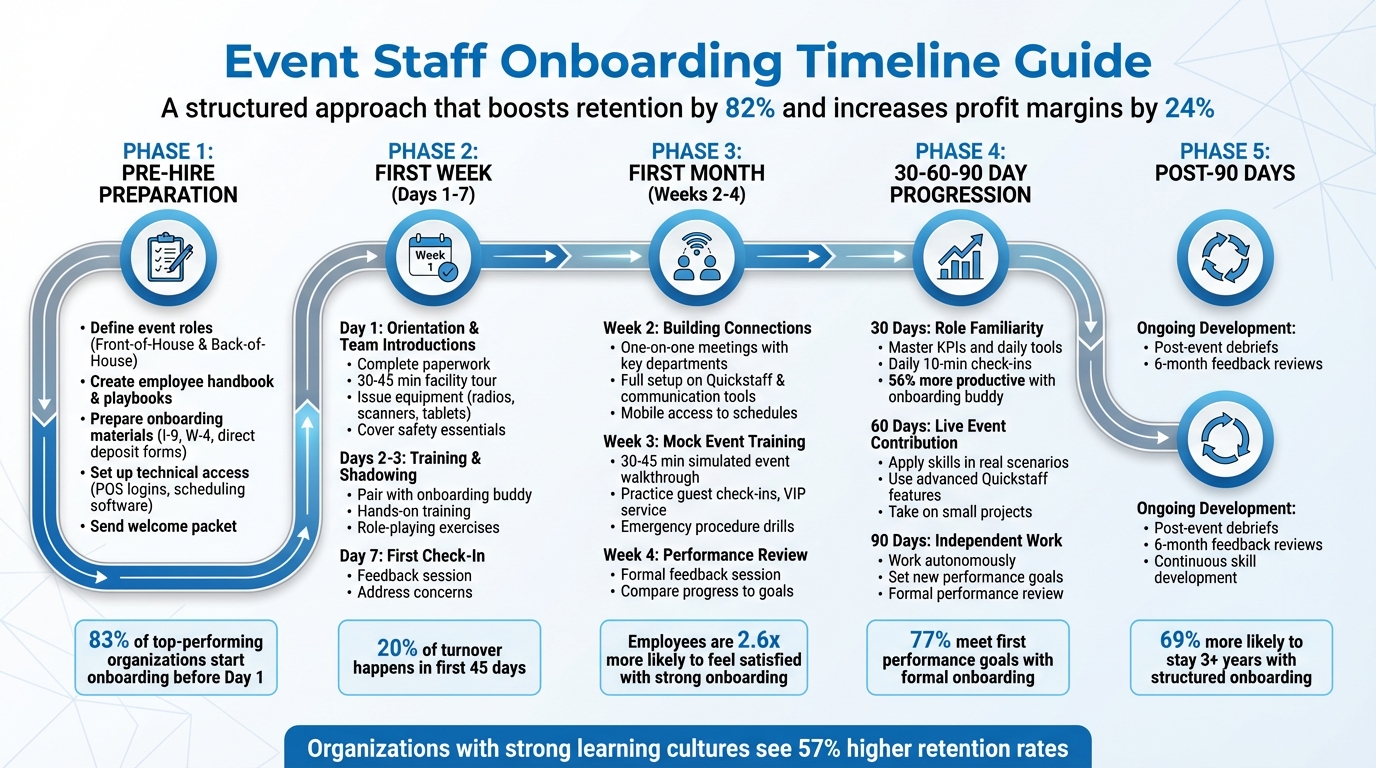
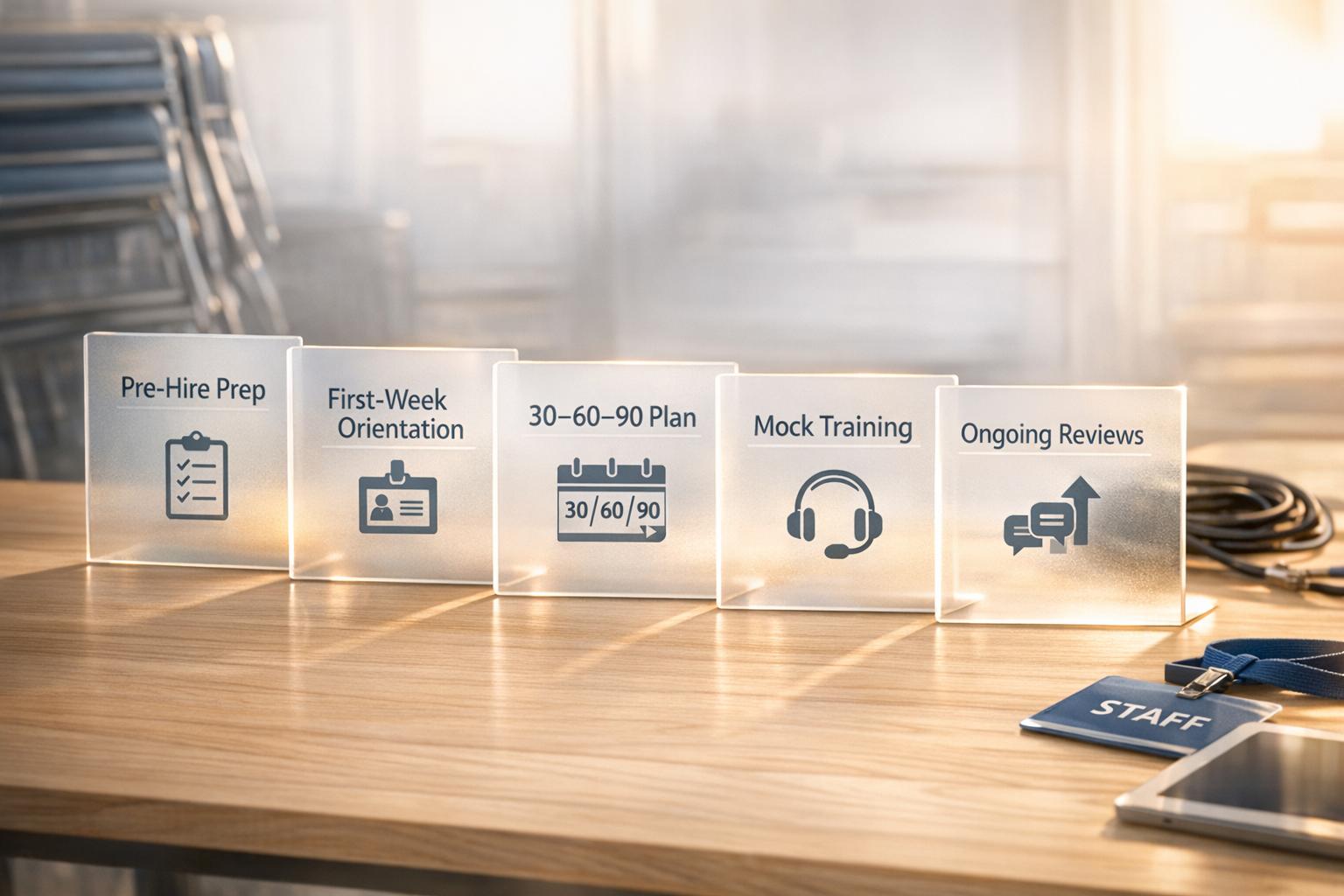
Event Staff Onboarding Timeline: Pre-Hire to 90 Days
Laying the groundwork before your team steps in ensures a smoother start and sets the tone for success.
Start by evaluating your venue's layout and the specific needs of your guests. This helps you figure out how many staff members you’ll need and what tasks they’ll handle during the event.
Break down roles into Front-of-House and Back-of-House categories. Front-of-House roles often cover reception, ticketing, guest services, and VIP hosting. Meanwhile, Back-of-House takes care of tasks like setup and teardown, AV support, inventory management, and maintenance.
Next, prioritize tasks. Some, like scanning tickets or handling cash, are non-negotiable. Others, like managing event tech, might be helpful but not crucial. This prioritization helps you zero in on the must-haves during hiring.
Take a page from Bar Crawl USA’s playbook. They’ve retained managers since 2016 by hiring staff who blend technical skills with the right attitude. To attract and retain top talent, they offer competitive pay, including 10% of event profits or $50–$100 per hour for larger events.
Before you begin hiring, establish a clear team structure. Define reporting lines so every staff member knows exactly who to approach for specific issues. Don’t forget to include backup staff or "floaters" who can step in during breaks or emergencies. To help everyone stay on the same page, outline common event scenarios and clarify responsibilities.
Once roles are outlined, focus on creating materials that support this structured approach.
With roles defined, gather all the documents and tools new hires will need. Standardize the onboarding process with a checklist that includes essentials like I-9 and W-4 forms, direct deposit setup, and emergency contact information.
Create an employee handbook to introduce your company’s values, codes of conduct, dress codes, and benefits. Adding an FAQ section can save time by answering common questions upfront.
Develop playbooks that detail shift times, tasks, and performance standards. Send these out at least a week before the event so staff can familiarize themselves with schedules and logistics. Venue maps and parking instructions are also helpful for easing first-day jitters.
Technical prep is another key step. Set up POS logins, payroll accounts, and scheduling software access ahead of time. Organize physical items like radios, uniforms, safety gear, and security badges so they’re ready to go on day one.
Keep it simple. Too much information can overwhelm new hires. Use tools like color-coded task lists and labeled maps to make details easier to digest.
As soon as a new hire accepts your offer, send them a welcome packet. This should include your handbook, dress code, parking layouts, check-in procedures, and a warm welcome letter. Preboarding helps new hires feel connected and prepared before their first day.
Bar Crawl USA emphasizes this approach:
"We create and send out a playbook for each event that details everything that will happen in the week of the event in advance. This allows staff to ask questions before the event rather than having to guess or call them on the day".
Be specific about what you expect. For instance, if "on time" means arriving 15 minutes early to settle in, spell that out - and explain how lateness impacts the event. Setting clear expectations helps avoid confusion.
Studies show that employees who have a positive onboarding experience are 69% more likely to stay with a company for at least three years. Additionally, companies that invest in training their on-ground staff see a 24% higher profit margin. By setting clear expectations and preparing thoroughly, you’re not just organizing your team - you’re also building a stronger foundation for long-term success.
The first week is crucial for setting the stage for a new hire’s success. Research indicates that 20% of employee turnover happens within the first 45 days, making these early days particularly important. The goal is to ensure new employees feel welcomed, prepared, and confident as they step into their roles.
Building on any pre-hire preparation, the first day should focus on a practical and welcoming orientation. Overloading new hires with too much information can be counterproductive, so keep things straightforward and actionable.
Start with the basics: handle administrative paperwork like Form I-9, Form W-4, direct deposit setup, emergency contact forms, and signed acknowledgments of the employee handbook and company policies. Follow this with a short (30–45 minutes) tour of key areas like restrooms, break rooms, supply stations, parking areas, and service points. This helps new hires familiarize themselves with the space before they’re in a live-event setting.
Introduce the new hire to their manager, supervisor, and team members. A casual team lunch or meet-and-greet can go a long way in making them feel part of the group. Make sure they’re equipped with the tools they’ll need - like radios, scanners, tablets, or logins for POS systems and scheduling apps. Don’t forget to cover safety essentials, including fire extinguishers, first-aid kits, emergency exits, and health protocols.
Keep the orientation session to about three hours to avoid information fatigue. Use the "5 C's of Onboarding" framework to structure the day: Compliance (paperwork), Clarification (job duties), Culture (mission and values), Connection (team introductions), and Check-back (end-of-day questions).
Pairing new hires with a mentor or "onboarding buddy" during their first shifts can make a big difference. This approach creates a supportive environment where new employees feel more at ease asking questions.
A great example of this method comes from Bar Crawl USA, where owners personally train new leads during their first event. As one team member explained:
"We are usually there assisting, training, and helping with the set-up and check-in process at least for their first event. They want to see how we do it - and we want to show them how we do it and want it to be done."
– Bar Crawl USA
Shadowing helps new staff develop "event logic", or the ability to anticipate needs and identify important details without constant direction. Incorporate brief simulations or role-playing exercises to prepare them for common scenarios, like handling difficult guests or troubleshooting tech issues. Quick-reference materials - such as labeled maps or color-coded task lists - can reduce the need for frequent verbal reminders.
Investing in training pays off. Companies that prioritize training for on-the-ground staff see a 24% higher profit margin, and 59% of employees report improved performance as a result of workplace training programs.
By the end of the first week, it’s time for a focused feedback session. This check-in helps gauge whether the role feels like a good fit for the new hire and provides an opportunity to address any concerns early. Even brief daily check-ins throughout the week - just five minutes - can uncover technical or process-related issues before they grow.
During the Day 7 review, prioritize active listening and empathy. Bar Crawl USA highlights the importance of this approach:
"Showing empathy, listening, and offering assistance/guidance can go a long way to making a staff member feel comfortable and excited about running events for you."
– Bar Crawl USA
Use this session to explore five key areas: organizational values, individual strengths, role clarity, teamwork, and future growth. Pay close attention to how well they’ve adapted to tools like POS systems or scheduling software, as addressing these challenges early can prevent long-term mistakes. Revisit the expectations and responsibilities outlined earlier to ensure alignment and set the stage for their continued growth.
Currently, only 29% of new employees feel adequately prepared to succeed in their roles. A well-planned Day 7 check-in can significantly improve that number, setting your team up for long-term success.
Once the first week wraps up, it’s time to move beyond the basics and focus on deeper integration. This phase is all about helping new hires strengthen connections and build the skills they’ll need to thrive. Research backs this up: employees who go through a strong onboarding process are 2.6 times more likely to feel extremely satisfied at work.
During this first month, it’s also essential to introduce staff to tools and systems that simplify their work. A great example is Quickstaff, which centralizes schedules, reminders, and event details. This tool ensures everyone stays on the same page while reducing the back-and-forth calls often needed to confirm coverage. Plus, it’s mobile-friendly, so staff can access everything they need on the go. These steps set the stage for growth and seamless team integration.
The second week is all about showing new hires how their roles contribute to the bigger picture. Organize brief one-on-one meetings or casual lunches with key team members from other departments - like catering, venue management, or AV teams. These introductions answer the critical question: “Who are my go-to people?”. Knowing who to contact for help builds confidence and streamlines teamwork.
This is also the time to get everyone fully set up on your scheduling and communication tools. Pre-configure accounts and logins to avoid technical hiccups. For event staff constantly on the move, mobile-friendly tools are a must. Quickstaff’s app lets them view event details, accept or decline shifts, and block out unavailable dates - all from their phones. You can even assign roles (like servers or photographers) and send targeted messages to specific groups, avoiding unnecessary mass texts. Automatic shift reminders, sent a day or two in advance, help reduce no-shows and ensure everyone knows where they need to be.
As Inês Pinto from Oneteam explains:
"Onboarding is as much about social integration as it is about skills. Employees who feel a sense of belonging from the start are more motivated and engaged."
With connections built and tools in place, your team will be ready to dive into hands-on training in week three.
By the third week, it’s time for hands-on practice in a low-pressure, simulated event setting. Mock events teach staff to anticipate needs, prioritize tasks, and develop “event logic”. Dedicate 30 to 45 minutes for a walkthrough at the venue. Assign roles and run through common scenarios like guest check-ins, VIP service, or answering frequently asked questions.
Bar Crawl USA has been using this approach since 2016. They simulate real challenges, like a check-in scenario where a staff member is given incorrect login details. Afterward, they hold feedback sessions to discuss problem-solving and decision-making. These simulations not only test technical skills but also help staff practice staying calm under pressure. Emergency procedures should also be part of this training - review responses for fire alarms, medical issues, or security incidents. Show staff where to find fire extinguishers and first-aid kits for quick access. Additionally, role-playing guest interactions helps staff stay personable, even when things get hectic. Companies that prioritize this kind of training see a 24% higher profit margin.
The fourth week is the perfect time for a formal review. This isn’t just about evaluating performance - it’s also an opportunity to make new hires feel valued. Compare their progress against the role-specific goals set at the start of the month and address any challenges they’ve encountered.
Keep the review conversational. Ask questions like, “What’s been the toughest part of your first month?” or “Are there tools or resources that would make your job easier?” Regular check-ins with an onboarding buddy can significantly boost productivity. A structured and positive onboarding process can make a real difference - employees who go through one are 69% more likely to stay with the company for at least three years. This review not only highlights progress but also reinforces the sense of belonging and growth established from day one.
Once the first month of onboarding wraps up, it’s time to focus on measurable growth. The 30-60-90 day framework breaks staff development into three phases: foundation, momentum, and independence. These checkpoints ensure progress continues beyond the initial integration phase. Research highlights that 77% of employees who go through a formal onboarding program successfully meet their first performance goals.
By the end of the first 30 days, staff should have a solid grasp of key performance indicators (KPIs) and the tools they’ll use daily, such as Quickstaff for managing schedules, accepting shifts, and blocking off unavailable dates.
Daily 10-minute check-ins are a great way to address any lingering questions or barriers. For example, you could ask, “How would you handle a last-minute schedule change?” or “Is there any part of the tool that still feels unclear?” Pairing new hires with an onboarding buddy during this phase can significantly boost productivity - staff are 56% more likely to feel productive, and that jumps to 97% if they meet with their buddy more than eight times. With these foundational skills in place, they’ll be ready to start contributing to live events.
At the 60-day mark, staff move from training to applying their skills in real-world scenarios. This phase involves taking on live events and tackling small projects using the "Plan, Develop, Implement" model to address routine tasks. They should also begin using advanced features in Quickstaff, such as automated waitlists to fill open shifts when cancellations occur.
Encourage team members to identify repetitive tasks - like manual shift confirmations - and suggest ways to streamline them. For instance, they might research a solution, test it internally, and then implement it during a live event. Publicly celebrating their first major achievements, whether it’s managing a check-in shift or resolving a guest complaint, can boost confidence and reinforce their value to the team. Companies that prioritize hands-on training like this often see a 24% higher profit margin.
By 90 days, staff should be working independently and setting new performance goals. As Keith MacKenzie from Workable puts it:
"At the 90-day mark, that employee is equipped with the knowledge – and experience – to independently make decisions to move the project forward. They no longer will need to 'check in' with their manager or seek approval or validation before moving forward."
This is also the ideal time for a formal performance review. Discuss their progress, identify areas for improvement, and outline goals for the next six months. Ask for reverse feedback as well - what could be improved in the onboarding process for future hires?. Employees who experience a structured onboarding process are 69% more likely to stay with the company for at least three years. Setting clear goals now not only keeps the momentum going but also shows your commitment to their long-term growth.
Onboarding doesn’t stop after the first 90 days. Research highlights that organizations offering continuous feedback experience a 14.9% lower turnover rate, while those with a strong learning culture see a 57% higher retention rate. Extending onboarding efforts to six months or even a year ensures deeper integration and supports long-term talent growth. As Jordan Worthington, Training Manager at Ziggy's Home Improvement, puts it:
"The days of 'tie your boots and get to work' are long gone. Potential hires and new employees are expecting to receive a certain level of care, attention, and structure as they start their employment with businesses".
Here’s how ongoing reviews can drive staff development well beyond the initial onboarding phase.
Formal post-event debriefs are essential for evaluating successes and identifying areas for improvement. Gathering feedback from coworkers, managers, and even customers provides a well-rounded perspective on performance. These debriefs are an opportunity to strengthen "event logic" - the ability to foresee and address potential issues during live operations. For instance, you might ask questions like, “What adjustments would you make if a vendor arrived late?” or “How can we improve the guest check-in process next time?” These discussions also offer a chance to refine processes for recruitment, hiring, and onboarding, making them more effective for future hires.
In addition to immediate reflections, periodic reviews play a key role in fostering ongoing staff development.
At the six-month mark, the focus shifts from initial onboarding to long-term growth. Building on earlier check-ins, this review deepens engagement and helps align employees with their career goals. It’s a great time to assess strengths, address any skill gaps, and discuss future aspirations. Employees who go through exceptional onboarding are 2.6 times more likely to feel extremely satisfied with their workplace. Use this review to conduct a skills assessment and suggest opportunities for additional training or upskilling. Make the session a two-way conversation, encouraging employees to share ideas or concerns about event processes.

Quickstaff simplifies long-term staff management by centralizing key processes. The platform tracks staff availability, schedules shifts, and assigns tasks, which minimizes confusion during live events. Instead of juggling spreadsheets, Quickstaff automates communication about schedules and event details, ensuring everyone - new or experienced - stays informed. Before feedback sessions, you can review a staff member’s reliability, task completion history, and performance notes to provide actionable insights. As one industry expert explains:
"Event scheduling software will provide your employees with their schedules, assigned tasks, complete information about the event, and consistent and streamlined communication".
Having a structured onboarding timeline is crucial for managing event staff effectively. By breaking the process into stages - from pre-hire planning to 90 days and beyond - you allow new team members to integrate smoothly without overwhelming them with too much information at once.
Training your staff pays off in more ways than one. It can increase profit margins by 24% and boost overall performance. In fact, 83% of top-performing organizations start onboarding even before a new hire’s first day. This method not only promotes consistency and lowers turnover but also sets clear expectations and accountability, ensuring everyone stays on the same page. These benefits highlight the importance of tools that can simplify the entire process.
That’s where technology comes in. Platforms like Quickstaff make onboarding and event management easier by centralizing event details, automating schedules and reminders, and tracking staff availability - all in a mobile-friendly format. Forget the hassle of juggling spreadsheets and phone calls; these tools let you focus on building a dependable team that delivers outstanding service at every event.
Onboarding isn’t a one-and-done effort. Continuous improvement through regular check-ins, post-event reviews, and six-month evaluations helps refine your process and supports long-term staff growth. A well-planned onboarding timeline, paired with the right tools, sets the stage for a stronger team and consistently successful events.
Quickstaff makes event staff scheduling and communication easier by offering a central hub to manage schedules, check availability, and organize events. With features like automated reminders and integrated communication tools, it keeps everyone aligned and informed.
The platform's intuitive design, including real-time updates and mobile access, helps minimize scheduling mishaps and improves team coordination. Whether you're managing a small gathering or a large-scale event, Quickstaff streamlines the process for handling temporary staff.
A 30-60-90 day onboarding plan offers a step-by-step framework to help new event staff settle in, gain confidence, and perform well in their roles. By dividing the onboarding process into distinct phases, it ensures steady progress and establishes clear, achievable goals.
This approach boosts productivity, lowers employee turnover, and enhances staff engagement. It also enables organizations to spot and resolve potential issues early, paving the way for long-term success for both the staff and the company.
Getting everything in order before hiring is key to a seamless onboarding experience. When you take the time to organize tasks like defining roles, preparing training materials, and setting up schedules in advance, you help new hires feel confident and ready to hit the ground running.
This proactive approach minimizes miscommunication, boosts team performance during the event, and leaves a strong first impression - one that can encourage long-term retention. Simply put, solid preparation ensures your team is ready to deliver when it counts.