Common Onboarding Mistakes for Event Staff
December 26, 2025

Onboarding event staff is often rushed, disorganized, or incomplete - and it shows. Poor preparation leads to confused teams, mistakes during events, and higher turnover. Here’s what you need to know:
The Fix? Focus on clear, repeatable systems: use checklists, break training into manageable parts, and leverage tools like Quickstaff to keep everyone aligned. A little preparation goes a long way in avoiding chaos and boosting team performance.
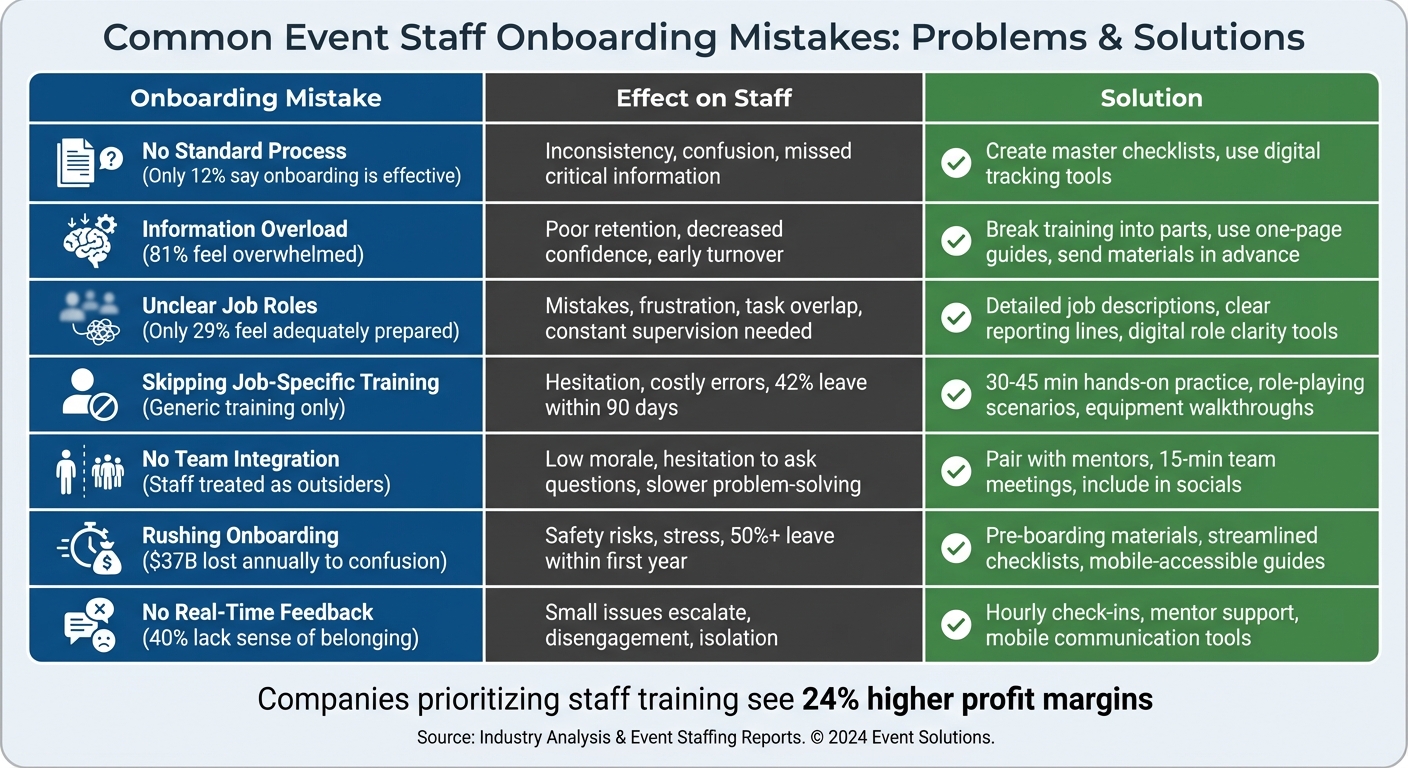
7 Common Event Staff Onboarding Mistakes and Solutions
Inconsistent onboarding creates confusion, and the numbers back this up: only 12% of employees strongly agree that their organization does a great job onboarding new hires. The issue becomes even more challenging with temporary event staff, who need to adapt quickly to their roles.
Without a clear and repeatable onboarding process, managers are left scrambling to remember what they’ve already covered. This leads to critical information gaps that surface during events, with staff making mistakes or skipping essential steps. The result? Repeated questions about basic tasks and costly errors during high-pressure moments.
The problem goes deeper than just confusion. 32% of employees describe their onboarding experience as confusing, while 22% find it outright disorganized. Beyond the frustration, there’s a financial impact: companies that prioritize training for on-ground staff see a 24% higher profit margin. When staff lack clear guidance, tasks are delayed, and precious time is wasted on unnecessary clarifications. As ACS Professional Staffing puts it:
"When companies fail to properly communicate job expectations and performance standards, they leave temporary workers guessing about priorities and deliverables. This creates unnecessary confusion and anxiety".
A structured system can eliminate these inefficiencies and set staff up for success.
The key to fixing this issue is creating a master checklist. This should include everything from paperwork and health protocols to venue logistics, role responsibilities, and brand standards. A comprehensive checklist ensures that every staff member gets the same essential information, no matter who leads the onboarding. As Quickstaff highlights:
"With a checklist, your onboarding will be consistent and complete for each employee, and you can stop the guessing game of what you've covered with each team member".
Another essential tool is a living FAQ document. Cover practical concerns like parking, dress codes, handling guest complaints, and emergency contacts. This centralized resource prevents conflicting instructions and reduces repetitive questions. To make training even more effective, incorporate visual aids like labeled maps and color-coded task lists, which can help staff retain information more easily.
Finally, leverage technology. Digital checklists on mobile-friendly platforms allow real-time tracking of progress, ensuring both managers and temporary staff stay accountable. By putting these systems in place, you’ll create a smoother onboarding process that benefits everyone involved.
Trying to cram everything into a single briefing session can overwhelm temporary event staff - 81% of new hires experience information overload during onboarding. This issue is even more pronounced with temporary staff, who often arrive just days - or even hours - before an event. Covering venue layouts, safety protocols, brand standards, and role-specific tasks all at once can leave them struggling to keep up.
The rush to prepare staff quickly is often the root cause. Managers tend to pack everything into one session, but this approach can overwhelm workers, making it hard for them to focus on what’s important. As Paychex notes:
"Some businesses use the occasion to deliver excessive data on the new hire, without recognizing that it's impossible for anyone to assimilate all this data and retain it".
This strategy doesn’t just overwhelm - it undermines. Only 29% of new employees feel adequately prepared and supported in their roles. Worse, nearly 30% of those dissatisfied with onboarding start looking for a new job within just three months. For temporary staff, a chaotic first experience might discourage them from working with your organization again.
The solution? Simplify and prioritize. Start with the basics - role details, schedule, location, reporting structure, and key brand standards. Save the rest for later. As StaffConnect puts it:
"Give your team only what they need to do the job right, nothing extra, nothing missing. When you keep it focused, they retain the essentials, feel more confident, and hit the ground running".
Swap out lengthy manuals for one-page quick-reference guides that are easy to scan during the event. Use labeled maps for venue layouts and color-coded task lists to make information easier to digest. Sending detailed event playbooks a week in advance can also help; this gives staff time to review and ask questions before the event. For example, Bar Crawl USA has used advance playbooks since 2016 to ensure their staff is well-prepared.
Lastly, ditch the jargon. Avoid internal acronyms and insider terms that might confuse temporary staff. If technical terms are unavoidable, include a simple glossary. The goal is to make staff feel equipped and confident - not alienated. By keeping things simple and clear, you set the stage for better role understanding and smoother hands-on training down the line.
When temporary staff show up at an event without a clear understanding of their responsibilities, it often leads to operational hiccups, mistakes, and frustration. Vague job descriptions trigger a chain reaction where critical tasks are missed, and roles overlap unnecessarily. As StaffConnect puts it:
"A slip in communication can sink your event without you even noticing".
Unclear or unrealistic expectations don’t just create chaos - they also lead to higher stress levels, burnout, and reduced productivity among temporary staff. This often results in an overreliance on supervision. Alarmingly, only 29% of new employees feel they are adequately prepared and supported to excel in their roles.
To avoid these pitfalls, it’s crucial to define roles clearly from the outset. Start by outlining specific duties and required skills for each position well before the event begins. Whether it’s bartenders, registration staff, or the setup crew, ensure that tasks align with their expertise. Mismatched roles not only lead to errors but also diminish overall performance.
Detailed job descriptions are key. These should go beyond listing tasks - they should include reporting lines and clear success criteria. For instance, Bar Crawl USA has successfully retained a core team of leads for over nine years by providing them with comprehensive playbooks. These playbooks outline every action required during the event week. To further incentivize their leads, they offer high rewards, such as 10% of event profits or hourly wages ranging from $25 to $100. This approach motivates the team to execute their responsibilities with the same dedication as the event owners.
Once roles are defined, digital tools can help reinforce this clarity by centralizing all relevant information. Relying on paper schedules or juggling multiple communication channels often leads to confusion. Event scheduling software can streamline the process by consolidating tasks, schedules, briefing materials, and FAQs in one easily accessible platform. Staff can quickly check their responsibilities on their mobile devices, ensuring they’re always in the loop.
These tools can also establish a clear chain of command. For example, an organizational chart can indicate who is responsible for security, logistics, or technical issues, making it easy for staff to know exactly whom to contact when challenges arise.
Generic training might work for some industries, but when it comes to events, it’s a recipe for disaster. Think about it: bartenders need to master POS systems, check-in staff must handle scanners and manage guest flow, and setup crews require hands-on experience with staging and AV equipment. A one-size-fits-all training approach leaves teams unprepared and overwhelmed.
Tailored training isn't just a nice-to-have - it’s a game-changer. It can increase profit margins by 24% and improve performance for 59% of employees. Without it, staff are more likely to hesitate, make costly mistakes, and constantly seek guidance, which slows everything down.
Take Bar Crawl USA, for example. They’ve learned that finding staff who are both tech-savvy and personable is no easy task. To address this, they provide new leads with hands-on support during their first event, demonstrating exactly how to handle setup and check-in. This approach pays off - some of their managers have stayed with the company for over nine years. Hands-on, practical training like this cements skills and builds confidence.
Job-specific training develops what some call "event logic" - the ability to notice details and make smart decisions on the fly. When training is tailored to the actual tasks at hand, employees gain the confidence to work more efficiently and accurately. This is critical because 81% of new hires report feeling overwhelmed during onboarding. By focusing on what each role truly requires, you help staff retain the most important information and avoid overload.
Skipping this kind of training has serious consequences. The sink-or-swim approach often leads to mistakes, unhappy customers, and frustrated teams. According to Access Group, 42% of staff in the hospitality and event sector leave their jobs within the first 90 days, often due to poor onboarding experiences or lack of support. And replacing those employees? It can cost 30% to 150% of their annual salary. In short, neglecting job-specific training doesn’t just hurt operations - it hits your bottom line, too.
Reading manuals and watching presentations can only take your team so far. Real learning happens when they roll up their sleeves and practice. Dedicate 30–45 minutes before the event for a live walk-through where each team member gets hands-on experience with their role. Let check-in staff try out ticket scanners. Have setup crews go through the equipment checklist. Walk guest services staff through the venue, pointing out key areas like restrooms, VIP sections, and potential bottlenecks.
Anjali Mrig, a writer and event creator, emphasizes the importance of this approach:
"When your staff feels more equipped to do their job, they do it quicker and better. Naturally, this results in higher productivity and increased earnings".
This kind of hands-on preparation builds muscle memory and helps uncover potential issues before guests arrive - like a login problem with the check-in app or a missing cable for the sound system.
Role-playing takes this a step further. Simulate real-world scenarios to test readiness: What happens if a guest’s ticket doesn’t scan? How should staff respond to someone asking for the nearest exit? Bar Crawl USA even throws in curveballs, like providing incorrect login details during training, to see how quickly staff can troubleshoot. These practical exercises ensure your team isn’t just prepared in theory - they’re ready to handle challenges in real time. And it pays off: 41% of employees say training programs improve their time management skills, a crucial advantage when every second counts at a live event.
Successful onboarding isn’t just about teaching technical skills - it’s about creating a sense of belonging and fostering teamwork. Event managers often prioritize training on logistics and tools while overlooking the human element. When permanent staff treat temporary workers as outsiders, it can lead to low morale and strained teamwork, especially during high-pressure moments.
This disconnect creates an environment where new hires feel hesitant to ask questions or seek assistance. That hesitation can result in unnecessary mistakes, slower problem-solving, and inconsistent service. Only 12% of employees strongly agree their organization excels at onboarding new hires, and the social aspect of onboarding is often what’s missing. This is where mentorship and team integration become game-changers.
Building a sense of belonging isn’t just about being friendly - it directly impacts performance and retention. Employees with exceptional onboarding experiences are 2.6 times more likely to report high satisfaction with their workplace. A cohesive team isn’t just nice to have; it’s essential for smooth operations.
Team integration also helps new hires develop "event logic", the ability to anticipate needs and prioritize tasks without constant guidance. This skill is often learned by observing seasoned team members handle challenges under pressure. Something as simple as a 15-minute team meeting at the start of a shift - where everyone is introduced, and key roles are clarified - can significantly improve collaboration. Including temporary workers in team socials and informal gatherings can also strengthen relationships and boost morale.
Mentorship can transform the onboarding process. New hires often feel more comfortable asking basic questions to peers rather than managers, which speeds up their learning curve and reduces the burden on event managers. This peer dynamic allows managers to focus on broader responsibilities instead of fielding routine inquiries.
Bar Crawl USA exemplifies how mentorship can lead to long-term success. Since 2016, they’ve kept turnover low by treating event leads as true partners. Leads are physically present to guide new hires during their first event, ensuring they learn the "Bar Crawl USA way" through hands-on experience. By offering leads $25 to $100 per hour or 10% of event profits, the company incentivizes senior staff to invest in mentoring. The result? Some leads have stayed with the company for over nine years. Similarly, Netflix’s "buddy system" has contributed to 90% of employees reporting a positive onboarding experience and 52% receiving helpful feedback weekly.
To make mentorship effective, choose mentors who are experienced, reliable, and aligned with your brand values. Provide them with tools like shift schedules, FAQs, and escalation protocols, and brief them on their mentee’s background. When mentors feel trusted and valued, they model the professionalism and attention to detail that new hires need to thrive.
When time is tight, temporary staff often get thrown into roles with barely any preparation. This "shortcut" can lead to serious operational headaches. Ann Geier, Chief Nursing Officer at Surgical Information Systems, puts it bluntly:
"When they do hire people, they need them right away, so they cut corners... their orientation is very sketchy, and it doesn't meet the criteria for orientation. It's a mess".
The fallout from rushed onboarding isn't minor. In fact, businesses in the U.S. and U.K. lose $37 billion annually because employees don't fully understand their jobs. When temporary staff are left to figure things out on the fly, it wastes time, increases the likelihood of mistakes, and can even jeopardize safety. For example, only 20% of new workers recall receiving safety training, often because it was delivered too quickly or ineffectively. This lack of preparation not only risks accidents but also creates liability issues when staff are unprepared or unwilling to handle unsafe situations.
The impact isn't just operational - it’s psychological, too. Rushed onboarding often leaves temporary workers feeling confused, stressed, and overwhelmed. This can lead to burnout, making them less likely to return for future assignments and increasing the need for constant recruitment. Over 50% of new employees leave their jobs within the first year, and poor onboarding is a key reason why.
Clearly, balancing speed with thorough preparation is critical to avoiding these problems.
To sidestep the risks of rushed onboarding, it’s important to find a balanced, efficient approach. Start by sending out essential training materials - think handbooks, videos, and checklists - before the first day. This "pre-boarding" strategy helps temporary staff show up ready to hit the ground running.
For short-term staff, focus on the essentials. Use a streamlined checklist that covers the most critical aspects of the role, such as safety protocols, reporting lines, and brand standards. Pair this with an FAQ document so staff can quickly find answers on their own without constant oversight. A quick 30- to 45-minute walkthrough of the venue can also make a big difference, helping staff familiarize themselves with guest flow, emergency exits, and key locations. Visual aids like labeled maps or one-page guides can be far more effective than lengthy manuals, especially when time is limited.
When onboarding temporary workers, less is often more. Strip down training to the essentials specific to their role. For example, a server doesn’t need a deep dive into event planning - they need to know table assignments, menu details, and how to manage common guest requests.
Make training materials easy to access on smartphones so staff can quickly reference them during an event. Even for one-day assignments, schedule brief check-ins during the shift to address any concerns before they grow into bigger problems. Setting clear expectations for what success looks like during the shift can also help reduce stress and ensure alignment. After all, employees who go through an outstanding onboarding experience are 2.6 times more likely to feel highly satisfied with their workplace. Happy, well-prepared temporary staff are not only more likely to perform well but also more inclined to return for future events.
Once temporary staff hit the floor, many managers assume the hardest part is behind them. But without regular check-ins during the event, small problems can quickly spiral into bigger ones, affecting both performance and morale. Raya Cohen, an onboarding and engagement expert at Newployee, points out that neglecting early feedback allows "small frustrations [to] snowball into bigger issues". Without timely input, staff are left wondering if they’re meeting expectations, which can lead to uncertainty and disengagement. Consistent support during events is essential to keep both performance and morale on track.
The statistics paint a clear picture: only 29% of new employees feel adequately prepared and supported to succeed in their roles. Furthermore, 40% say effective onboarding helped them feel a sense of belonging. Skipping real-time feedback means missing out on quick adjustments - those small but impactful changes that can immediately boost confidence and service quality. When feedback is delayed, issues linger, and staff may feel undervalued, which can hurt their overall experience.
Real-time feedback goes beyond correcting mistakes; it’s about fostering engagement and connection. When managers fail to check in, temporary staff can feel disconnected and isolated, which is a common reason why they may leave before their contract ends. In fact, 46% of employees report that a positive onboarding experience, including regular feedback, significantly increases their productivity.
The solution? Shift from a "set-it-and-forget-it" mindset to one focused on coaching. Build in specific moments for feedback - such as quick check-ins after the first hour or midway through a shift - to address issues before they escalate. Pairing new hires with experienced mentors can also provide immediate support and answers to questions as they arise. Publicly recognizing great work during the event not only motivates individual staff members but also allows the entire team to learn from standout performers, boosting morale.
Technology can make real-time communication easier and more effective. Event management software centralizes schedules, briefings, and contact lists, cutting through the clutter of spreadsheets and group chats. These platforms allow managers to send instant updates, corrections, and reminders during live events. Research shows that "fast feedback" can increase employee engagement nearly fourfold, and companies using scheduling software for onboarding report 28% higher knowledge retention among new hires.
Mobile tools also empower staff by giving them instant access to FAQs, maps, and task lists, so they can find answers quickly. Digital checklists on phones or tablets help track progress and ensure accountability throughout the event. Automating tasks like shift reminders frees up managers to focus on coaching and making real-time adjustments that enhance service quality. This combination of human interaction and smart technology ensures smoother operations and a better experience for everyone involved.

The onboarding challenges mentioned earlier all share a common cause: fragmented communication, inconsistent workflows, and an overload of scattered information. Quickstaff tackles these issues by consolidating everything event staff need into a single, mobile-friendly platform. Instead of juggling multiple tools prone to errors, managers can handle task assignments, share event details, and track staff availability all in one place. This eliminates the uncertainty of whether everyone has the same information and ensures every team member works from a consistent schedule with clear expectations. By unifying these processes, Quickstaff directly addresses the disjointed workflows that lead to onboarding mistakes.
Quickstaff is built to simplify and standardize the onboarding process, offering features that clarify roles and make scheduling a breeze. For example, its task assignment and scheduling tools eliminate role confusion by allowing managers to assign specific responsibilities to team members. Staff can indicate their availability directly in the platform, cutting down on endless email threads and text messages. Automated reminders keep everyone updated in real time, giving managers more bandwidth for meaningful, one-on-one interactions.
The platform also organizes information into digestible pieces. New hires can access schedules, tasks, and event details whenever they need them, avoiding the overwhelming nature of lengthy briefings. This approach helps reduce information overload.
Quickstaff’s features are designed to counteract common onboarding pitfalls, providing practical solutions for standardization, role clarity, and communication. Here's a breakdown of how it addresses these issues:
| Common Onboarding Mistake | Effect on Staff | Quickstaff Solution |
|---|---|---|
| No Standard Process | Leads to inconsistency and missed details | Centralized tools ensure uniform schedules and information sharing. |
| Unclear Job Roles | Causes confusion and poor performance | Task assignments clearly outline each team member’s responsibilities. |
| Information Overload | Overwhelms staff and hinders retention | Breaks down details into easily accessible, event-specific tasks. |
| Poor Communication | Results in missed updates and scheduling errors | Streamlined communication tools keep everyone aligned. |
Quickstaff is intuitive and easy to learn, which is especially important for temporary staff who need to get up to speed quickly. It offers a 14-day free trial with no credit card required, making it simple to test its fit within your workflow. By replacing outdated, manual processes with a repeatable system, Quickstaff empowers event managers to provide the clear, consistent onboarding experience that 88% of new hires report is often missing.
Onboarding mistakes aren’t just small missteps - they can have a direct impact on your company’s financial performance and reputation. Businesses that prioritize thorough training for their on-ground staff see a 24% increase in profit margins. On the flip side, employees who endure a poor onboarding experience are twice as likely to start job hunting right away. When your event staff represent your brand, inconsistent or rushed onboarding can lead to confusion, frustrated guests, and missed opportunities.
The challenges mentioned earlier - like fragmented systems and overwhelming information - are often interconnected. These issues don’t just affect your staff; they ripple out to hurt your event’s overall success. The solution? Creating repeatable processes that equip temporary staff with exactly what they need, exactly when they need it. This means defining roles clearly, offering short and focused training, providing mentorship opportunities, and maintaining consistent communication. These steps help build a confident and prepared team.
Streamlining your systems is essential, and technology plays a big role here. Tools like Quickstaff simplify everything by integrating scheduling, task management, and communication into a single, mobile-friendly platform. With features tailored for event businesses - like tracking staff availability and sending automated reminders - it takes the guesswork out of coordination. The result? Fewer errors and better-prepared teams. You can even try Quickstaff free for 14 days to see the difference it makes.
To ensure onboarding event staff goes smoothly, focus on making the process clear and consistent. Start by creating a master checklist that covers every step new hires need to complete, such as filling out paperwork, attending safety briefings, and receiving their uniforms. This helps prevent any details from slipping through the cracks and keeps the experience consistent for everyone.
Ahead of the event, share essential information like the schedule, venue details, dress code, and confirm each team member’s availability. On their first day, offer a brief orientation to introduce them to the team, go over expectations, and make sure they have everything they need to hit the ground running. Using a centralized tool like Quickstaff can simplify communication, send timely reminders, and handle updates efficiently, keeping the process smooth and stress-free for everyone.
When onboarding new staff, it's important to avoid overwhelming them with too much information at once. Instead, introduce details about policies, procedures, and events in smaller, digestible chunks spread over the first few days or weeks. Start each session by focusing on the most pressing tasks for that day, leaving less urgent information for later.
To stay organized, consider using a visual checklist. This simple tool helps ensure that nothing important is overlooked. Complement it with easy-to-access resources like short training videos or quick reference guides that employees can review whenever needed.
Keep training sessions short and to the point, concentrating on one or two key objectives at a time. Create opportunities for questions and hands-on practice to help solidify what they’ve learned. You can also leverage digital tools like Quickstaff to simplify the process. These platforms can track progress, deliver updates, and allow staff to learn at their own pace, making the onboarding experience smoother and more effective.
Defining roles clearly for temporary event staff is key to making sure everyone knows their tasks and responsibilities. This clarity helps cut down on confusion, boosts efficiency, and keeps the event running smoothly. When team members understand what’s expected, they can dive into their tasks without wasting time or dealing with miscommunication.
Spelling out role descriptions also encourages accountability and gives your team the confidence to perform well. It creates a more organized and professional atmosphere. Investing time upfront to outline these roles can save you headaches and reduce stress when the event is in full swing.