How to Train Event Staff for Crowd Management
June 17, 2026

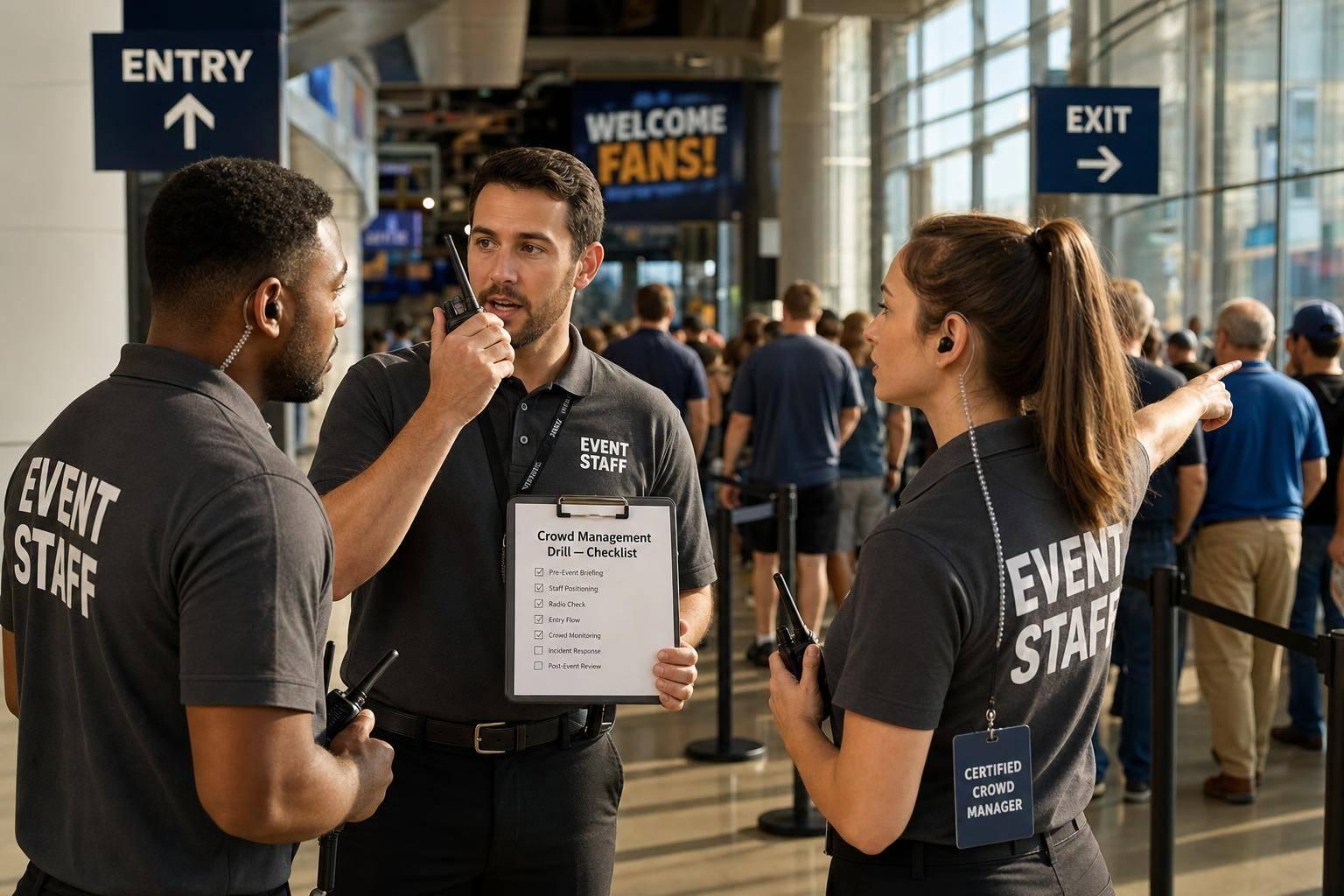
Most crowd problems start small, then grow fast. In this guide, I show that staff training should focus on early warning signs, clear communication, zone coverage, and simple drills before event day starts.
If I had to sum up the full article in a few points, it would be this:
A few numbers stand out:
This means crowd staff should not just know where to stand. They should know what to watch, what to say, when to report, and when to escalate.
The rest of the article breaks that into a simple training system I can repeat from one event to the next.
Start with the event profile: attendance, layout, program, and risk factors.
Crowd density is one of the clearest risk signals. Plan for about 5 square feet per person in standing areas, and safety concerns climb fast once space falls below 7 square feet per person. Run that math zone by zone - entry gates, stage areas, vendor corridors - not just across the venue as a whole.
Density isn't the only thing to watch. Some risk factors show up again and again. Alcohol service can increase intoxication-related incidents and aggressive behavior. Outdoor events need written weather protocols for lightning, high winds, and extreme heat, along with show-stop and heat-mitigation plans. And in packed areas, audience mood can change fast.
Set capacity alert thresholds before training starts:
Then review local rules. NFPA 101 requires at least one trained crowd manager per 250 attendees, and events with more than 1,000 people need at least four exits. Some states add stricter rules. In New York, events with 500 or more attendees need at least two trained crowd managers, plus one more manager per 250 attendees after that. Bring in your fire marshal and venue management early - ideally 4 to 6 months ahead for large-scale productions.
Use these risk factors to figure out which roles need more training time.
Not every staff member needs the same training. A gate controller does a different job than a zone supervisor or a security manager. If you lump them together, you waste time and miss the spots that matter.
A simple competency matrix makes this easier. Match each role to the skills it needs, then build training around what that person will do on the ground.
| Role | Primary Focus | Key Skills |
|---|---|---|
| Crowd Marshal / Usher | Flow and Direction | Guest communication, wayfinding, situational awareness |
| Access Control Staff | Entry and Perimeter | Ticket validation, credential checks, screening handoffs |
| Zone Supervisor | Real-time Management | Decision-making, radio discipline, staff reassignment |
| Security Manager | Oversight and Risk | Risk assessment, multi-agency coordination, EAP execution |
| Event Medical Lead | Health Escalation and Crowd Coordination | Identifying heatstroke/dehydration, coordination with ground staff |
The main difference between roles is depth. A zone supervisor needs to make real-time calls across an entire area. A marshal needs to guide guests, keep lines moving, and stay calm when pressure builds.
Once roles are set, train each person on the skills they'll use on the floor.
Knowing who completed training doesn't help much if the wrong people end up on shift. On event day, scheduling is part of safety, not just staffing.
Use Quickstaff to match cleared staff to the right roles, confirm availability, and spot coverage gaps before the event.
After assignments are set, move into the core crowd management skills each staff member needs.
Start with the basics: how crowds move. Then train staff to shape that movement before bottlenecks turn into a problem.
Staff need to understand how crowds move in practice. Not just where guests are meant to go, but where they tend to drift, bunch up, and slow down. Train them to watch the front of any queue for early warning signs like tighter spacing, guests leaning forward, or movement that stops and starts in pulses. Those are often the first signs of crowd compression building.
Each staff member should also know the venue layout cold. That means being able to find all exits, name at least one alternate route from their assigned zone, and point out accessible lanes and emergency access routes, even when the area is packed.
Once staff can read crowd flow, the next step is teaching them how to stop pressure from building in the first place with positioning, barriers, and signs.
Put staff at pinch points like entry gates, stairways, corridor intersections, and any spot where two streams of foot traffic cross. In those areas, one person can slow or release movement as needed and help stop gridlock before it starts. If a ticket or bag check problem holds up a lane, move that guest to a separate resolution table right away so the main line keeps moving.
Use stanchions to split entry and exit paths. Add directional signs, maps, and color-coded or numbered zone markers at every choice point so guests can find their way without needing constant staff help.
After that, staff should practice clear verbal directions and tight radio communication so everyone responds the same way in the moment.
Train staff to use short, plain directions such as "Hold here", "Follow me," and "This lane is closed - please move right." Clear, repeatable phrasing cuts confusion and helps keep traffic moving.
The same idea applies on the radio. Keep calls brief and specific. Say "Zone C North, Row 14" instead of something vague, and keep each transmission short. A simple response sequence helps here: Observe → Report → Stabilize → Escalate.
When guests get frustrated by long lines, access problems, or heat, tension can spread fast. Handling those moments calmly, and without calling someone out in front of everyone, helps stop "crowd contagion", where one person's agitation spreads to the people nearby. Staff should also look for quieter signs of distress, like a guest slumping against a barrier, sitting on the floor in a busy walkway, or waving for help.
"True expertise isn't found in a manual; it's forged on the job, where our teams translate theoretical flow patterns into real-time guest experiences." - Daniel Meursing, CEO, Premier Staff
| Skill | Real-World Application | Risk Mitigated |
|---|---|---|
| Situational Awareness | Monitoring zone headcounts and repositioning at choke points | Prevents surprise compression and delayed response |
| Communication | Using brief radio calls and clear, calm phrasing for redirection | Eliminates mixed signals and guest confusion |
| Conflict Resolution | De-escalating line tension without public shaming | Prevents flashpoints and "crowd contagion" aggression |
| Emergency Support | Maintaining accessible route availability and keeping access lanes clear | Ensures safe egress and medical access |

Event Staff Training Formats: Time, Scope & Realism Compared
Once staff know the flow of the room, where to stand, and how to talk to each other, drills help those actions become second nature. Then written procedures make sure everyone responds the same way when pressure hits.
A tabletop exercise brings department heads and supervisors into one room to work through scenarios on paper before the venue opens. Focus on situations tied to the event itself, like weather holds, show-stops, and moments that need several teams to coordinate at once. You should also include higher-risk cases, such as narrow-corridor compression, medical triage, and shelter-in-place calls.
After each tabletop, move straight into an on-site walk-through. Have field staff go through the venue in person to test communication systems, confirm exit routes, and check response times. This is where small problems tend to show up.
Pay close attention to trouble spots like:
Don’t practice only on the main aisles. Staff should rehearse clearing those smaller paths too. Use exact location names, and drill the sequence Observe → Report → Stabilize → Escalate. Work in small-area evacuations and reverse-flow prevention so teams can handle a limited hazard without setting off mass panic.
Drills fall apart fast if staff don’t have one written playbook for both day-to-day operations and emergencies. SOPs should be short enough to review before a shift and clear enough to use under stress.
Normal operations SOPs should cover opening procedures, peak ingress and egress, queue and line management, capacity monitoring, zone-based positioning, radio discipline, and guest redirection. Emergency SOPs should address medical incidents, lost children, fights, fire, severe weather, structural failure, evacuation, lockdown, and shelter-in-place.
Build emergency SOPs around a three-tier response system: Tier 1 for local incidents that one team can handle, Tier 2 for situations that need several departments, and Tier 3 for full emergencies that bring in outside services and unified command. Each tier needs to spell out who can call a hold, approve a reroute, or escalate to venue command. Staff should use the lowest reporting channel first, then move up only when the issue is beyond what their zone can manage.
Keep the wording brief and easy to repeat. In tense moments, long instructions don’t stick. After every drill or live incident, run a hot wash and update the SOPs.
| Training Format | Objectives | Time Required | Staff Roles Involved | Advantage | Limitation |
|---|---|---|---|---|---|
| Classroom Briefing | Crowd-management basics, safety standards, and role definitions | 1 hour | All staff and volunteers | Efficient for large groups | Low retention; lacks physical context |
| Tabletop Exercise | Decision-making, command hierarchy, and communication gaps | 2–4 hours | Department heads, supervisors, and security leads | Low cost; tests "what-if" scenarios | No physical movement or stress |
| Venue Walk-Through | Route familiarity, checkpoints, and zone boundaries | 2 hours | Field staff, ushers, and zone leads | Builds spatial awareness; verifies checkpoints | Hard to simulate high-density crowd pressure |
| Full Drill | Unified command and multi-agency coordination | 4+ hours | All operational staff and external partners | Highest realism; builds instinctive reactions | Resource-intensive |
For most events, a classroom briefing plus a venue walk-through handles the basics. For larger or higher-risk events, add a tabletop exercise. Full drills make more sense for venues or repeat events where multi-agency coordination is a real chance. Use that mix to check who’s ready before you track completion and simplify event staff scheduling for the next event.
Once your team has finished training and drills, the next job is simple: know exactly who is cleared to work each role on event day.
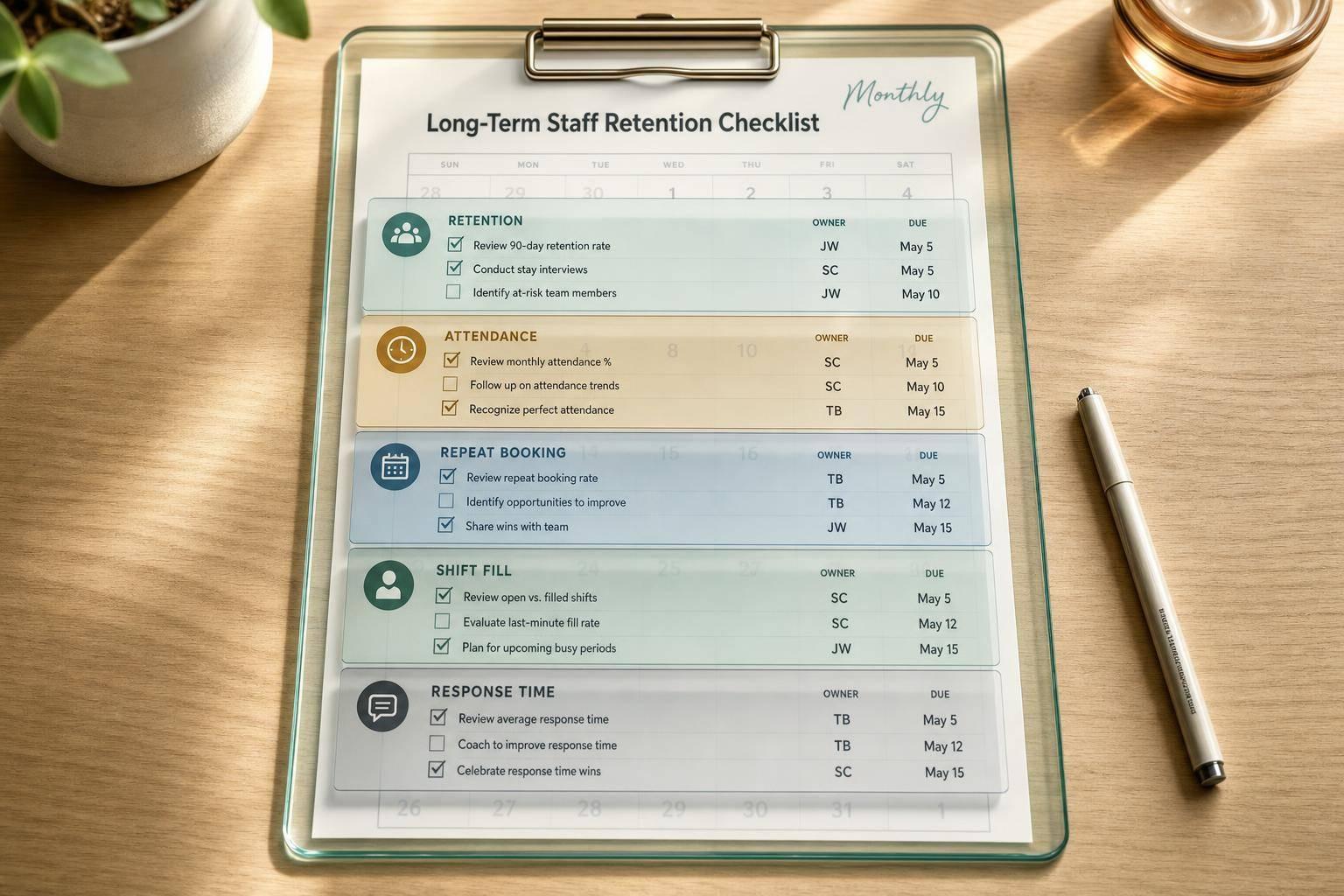
Track readiness with the same care you give training. Keep one central log that shows each staff member's completed modules, drill participation, crowd-management training, and any code-based qualifications tied to NFPA 101 and the IFC. That way, you can see at a glance who can work high-risk zones and who still needs more prep.
This matters for compliance too. The NFPA Life Safety Code requires at least one trained crowd manager per 250 attendees. If your records are messy or out of date, that can turn into a compliance issue fast.
Staff also shouldn't be placed in high-risk areas until they've finished the required number of shadowing shifts or supervised rehearsals. Use Quickstaff to track training completion, role eligibility, and reminders in one place.
Your readiness log should feed straight into the briefing. Every event needs a short, focused pre-shift briefing. A good one covers:
Keep it to one page. Supervisors should stick to the same script so the message stays the same across all zones.
After the event, close the loop with a quick debrief. Ask each zone lead:
What was the first sign of a crowd issue? Which response worked? What needs to change in the lanes, signage, or staffing?
Pull those answers into a short after-action note, then update your SOPs before the next event.
Effective crowd management training is not a one-and-done task. It works best as a repeatable loop: train, brief, rehearse, execute, and review. Centralized tracking keeps that loop moving by showing who is ready for high-risk roles and where refreshers are needed.
And this isn't paperwork for paperwork's sake. 80% of incident-related risks at events come from lapses in communication, poor awareness of conditions, or delayed reporting. That's why clean records and steady briefings matter just as much as what happens on the ground.
When each debrief feeds into the next round of training, the whole system gets better - not just the files.
Track readiness, brief every shift, and update procedures after each event.
Refresh crowd management training every year or before each new event season. All new staff should get training during initial orientation too.
After every event, review what worked and make changes where needed. That can include focused training for issues like medical emergencies or severe weather. Quickstaff can help organize training and keep schedules clearly documented.
Before they work in high-risk zones, new staff need training that fits the exact area they'll cover. That means learning their zone, how it links to nearby zones, and the right escalation paths - when they should handle something themselves and when it's time to call a supervisor.
They also need to understand emergency procedures, including exit routes and medical protocols. On top of that, they should be trained in crowd dynamics, radio communication, and zone handoffs so coverage stays safe and smooth.
Adjust training with venue-specific crowd analysis based on attendee profiles, seating layouts, and the way crowds usually move and react at each event.
Shape that training around your site’s setup and limits, including weather, schedules, and congestion points. Use Quickstaff to organize roles by zone or task, then run pre-event walkthroughs and tabletop exercises to test emergency response and communication plans.