Police, Fire, EMS: Coordinating Large Event Safety
June 15, 2026

If police, fire, EMS, hospitals, and venue staff are not working from one written plan, your event is harder to protect.
I’d boil the article down to this: start planning 3 to 12 months ahead, name agency contacts early, put roles and costs in writing, use one command post, split the site into clear zones, and confirm radio and evacuation rules before gates open. The article also stresses a few hard numbers and actions, like using 1 crowd manager per 250 attendees and making sure staff know who calls 911 and where responders should enter.
Here’s the full takeaway in plain terms:
A few points stand out most: crowding and access control matter, mixed radio language causes delays, and even small misses - like not assigning a person to meet incoming responders - can slow help when minutes count. That’s why the article keeps coming back to one theme: clear roles, clear maps, and clear communication.
Below is a quick snapshot of the article’s main points.
| Area | What the article says to do |
|---|---|
| Planning timeline | Start 3 to 12 months before the event |
| Staffing | Use 1 crowd manager per 250 attendees |
| Command | Put police, fire, EMS, and event leaders in one command structure |
| Site control | Split the venue into labeled zones with shared maps |
| Communications | Set primary and backup channels, and use plain language |
| Incident planning | Write response steps for EMS, fire, police, and weather |
| Event day | Hold one pre-opening briefing and check routes, posts, and triggers |
| After the event | Record lessons learned and update SOPs |
If I were reading this to get one answer fast, it would be this: large event safety works best when agencies plan together early, write down who does what, and run the event from one shared playbook.
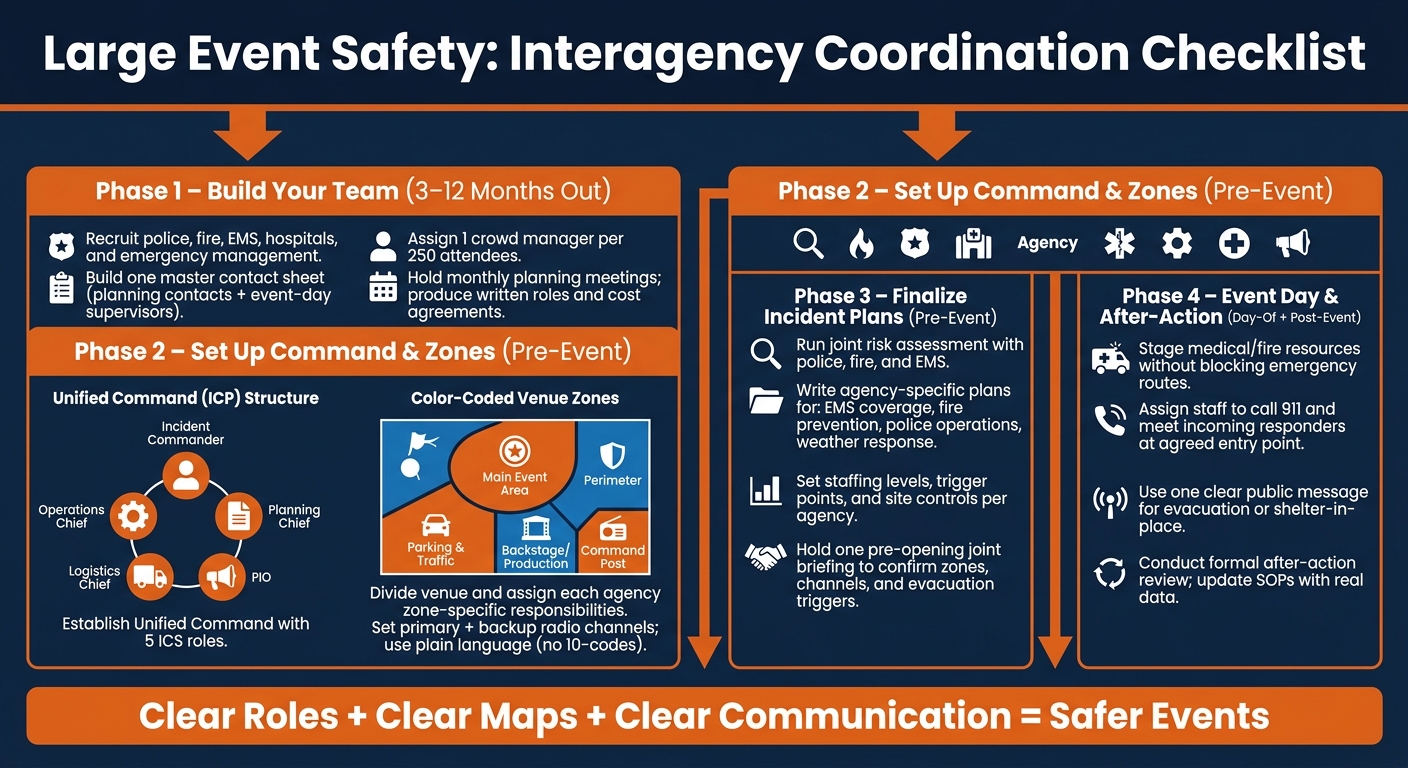
Large Event Safety: Interagency Coordination Checklist
Start interagency planning months before the event so police, fire, EMS, and hospitals can line up staffing, triggers, and response roles. You need the right people in place for planning, escalation, and event-day command. And that first meeting should do more than gather names - it should assign clear planning owners.
Build one master contact sheet that includes every agency you may need. That usually means local, state, and federal law enforcement when needed, the city or venue fire marshal, EMS providers, nearby hospitals, and your local emergency management office. For larger events, add regional intelligence-sharing contacts.
For each person, collect:
That last part matters. Planning contacts are the agency leaders who join pre-event meetings. Event-day supervisors are the people who handle live escalation when something happens.
Your venue team also has a job here. Staff must support agency response by keeping access points clear and crowd levels under control. On the venue side, assign trained crowd managers at a ratio of 1 per 250 attendees to keep aisles clear, capacity within limits, and exits open and marked.
Once the contact sheet is done, shift to meeting cadence and decision authority.
Set the kickoff meeting 3 to 12 months before the event, then meet monthly as the date gets closer. Use those meetings for tabletop exercises, threat reviews, and decisions that can't wait until event week.
The point isn't just to talk. Those meetings should produce written roles and staffing commitments that feed straight into the safety plan.
Every agency's role, staffing commitment, and cost arrangement should appear in a written safety plan. That plan should name the lead for medical, fire, and security incidents and spell out each partner's event-day duties.
At a minimum, document each agency's:
If it's not written down, it can get muddy fast on event day.
Once your contacts and written agreements are in place, the next step is making sure everyone knows who’s in charge, which part of the site they own, and how they talk to each other. Without that structure, even an event with efficient staff scheduling can come apart fast when something goes wrong.
Written agreements now become the live command structure for event day.
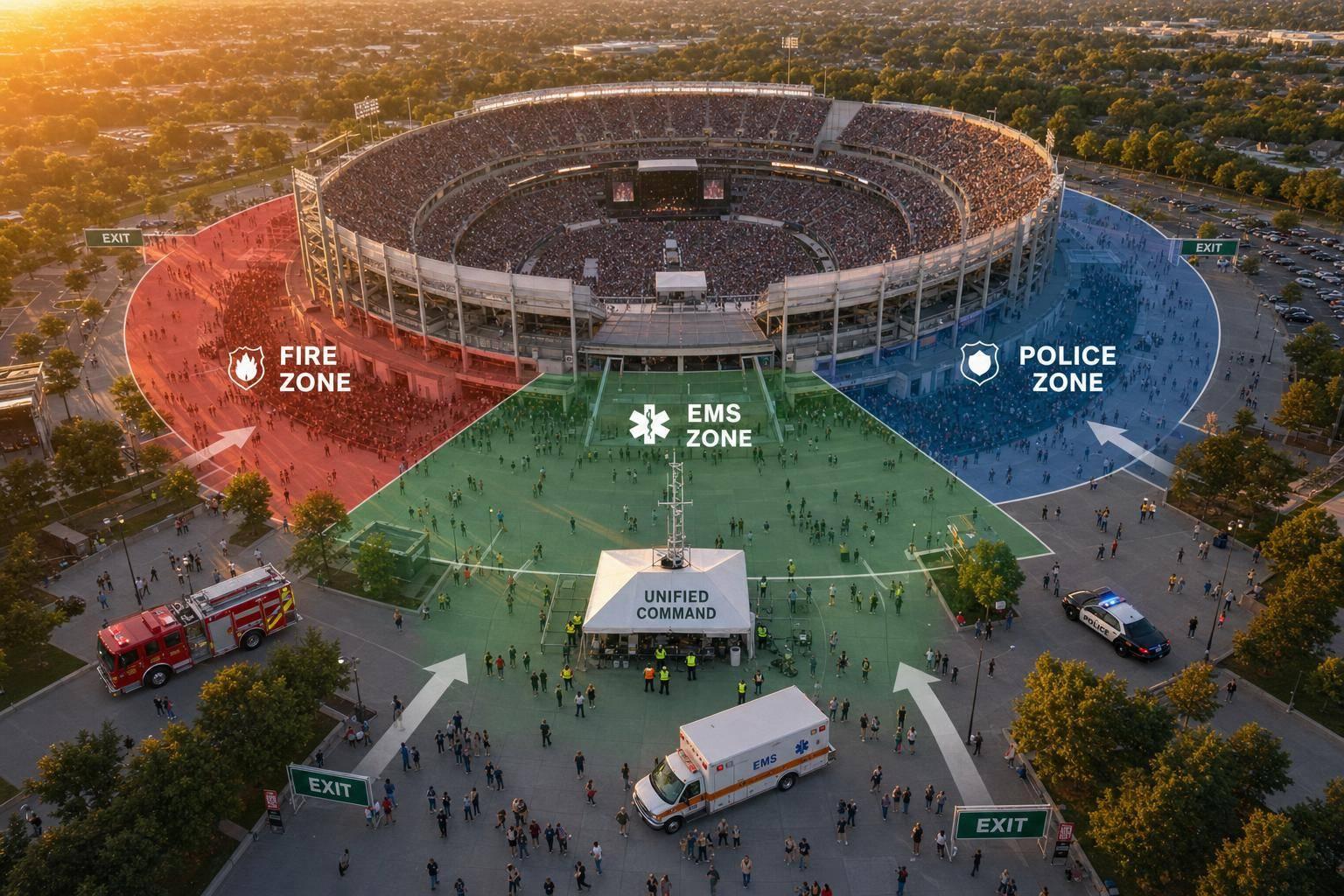
Unified command means police, fire, EMS, and event operations work from one Incident Command Post and make major safety decisions together.
Each agency still keeps its own chain of command. But each one sends a representative to the ICP so they can agree on priorities and major tactics in one place. Big calls - like stopping a performance, closing a road, or ordering an evacuation - should be made jointly at the ICP, not by one agency acting on its own.
For most events, set five core ICS roles before event day:
Assign each role to a named person before event day. That way, nobody is guessing when pressure hits.
Divide the site into clearly labeled zones before event day. Every agency should get a color-coded site map that shows zone boundaries. Radio traffic should use those same zone names every time, such as “Unit 4 moving from Perimeter Zone 2 to Main Event Area Zone 1.”
| Zone | Police | Fire | EMS | Event Staff |
|---|---|---|---|---|
| Main Event Area | Crowd safety, law enforcement, support evacuations | Clear exits and fire lanes, inspect structures, respond to fires | Staff medical tents and roving teams, triage and treat patients | Manage entry points, crowd flow, report hazards immediately |
| Perimeter | Traffic and pedestrian control, secure access, manage protests | Keep fire access routes open | Maintain ambulance access points, respond to nearby calls | Credential checks at gates, line management, wayfinding |
| Parking & Traffic Corridors | Manage intersections and vehicle flow, support towing | Maintain fire lane access through lots | Standby at ambulance access lanes, respond to medical calls in lots | Direct parking, monitor hazards, report to command |
| Backstage / Production | Access control, respond to high-risk incidents | Inspect cooking areas, fuel storage, pyrotechnics, back-of-house egress | Quick access to performers and crew, respond to work injuries | Credential checks, equipment safety, keep emergency paths clear |
| Command Post | All agencies: staff the ICP, share incoming resource status, and coordinate demobilization. | Support logistics, supplies, and media access via the PIO |
Once zones are set, your radio traffic and dispatch paths need to match them exactly. If the map says one thing and the radios say another, confusion spreads fast.
Every agency needs to know which channel to use and when. Set a primary tactical channel shared by police, fire, EMS, and your event operations team. Then set a backup channel in case the first one fails. Use plain language - no 10-codes - so everyone hears the same message the same way.
Your escalation path should stay simple. Field units report incidents through dispatch or the event operations channel. Supervisors pass major incidents to Operations at the ICP. Operations then updates the Incident Commander when there’s a life-safety issue or a threat to event continuity.
If CAD is used in your area, confirm ahead of time how 9-1-1 calls and on-scene reports from private security will be routed to the right agency and flagged at the command post. That small detail can save a lot of scrambling later.
Confirm all of these rules in a pre-opening operations briefing. Hold it before public entry so you can verify radio channels, zone assignments, staging locations, and the exact triggers for an evacuation or shelter-in-place order. It’s your last shot to catch gaps before attendees arrive.
Once your command structure and communication rules are set, the next move is simple: turn general safety ideas into written, agency-specific plans for the risks most likely to affect your event. Under stress, specific plans work better than generic ones.
Meet with police, fire, and EMS before the plan is finalized. Walk through the venue layout, expected crowd density, transit effects, and the hazards most likely to show up. The point is to build the plan around the event’s actual risk profile instead of dropping in a boilerplate template.
When agencies share one live view of the incident, they can move faster together and avoid missed handoffs or blind spots.
Use that assessment to set:
Each agency needs its own written section that spells out responsibilities and escalation triggers.
For EMS, document how medical coverage will be staffed and what conditions call for more support. For fire, list pre-event inspection requirements and how fire lanes will be kept clear. For police, cover crowd management, traffic control, and the trigger points for added support or a security escalation.
High-profile events need extra attention up front. Add early threat monitoring and prevention steps, then leave room to adjust based on the event’s actual risk profile instead of forcing a one-size-fits-all plan.
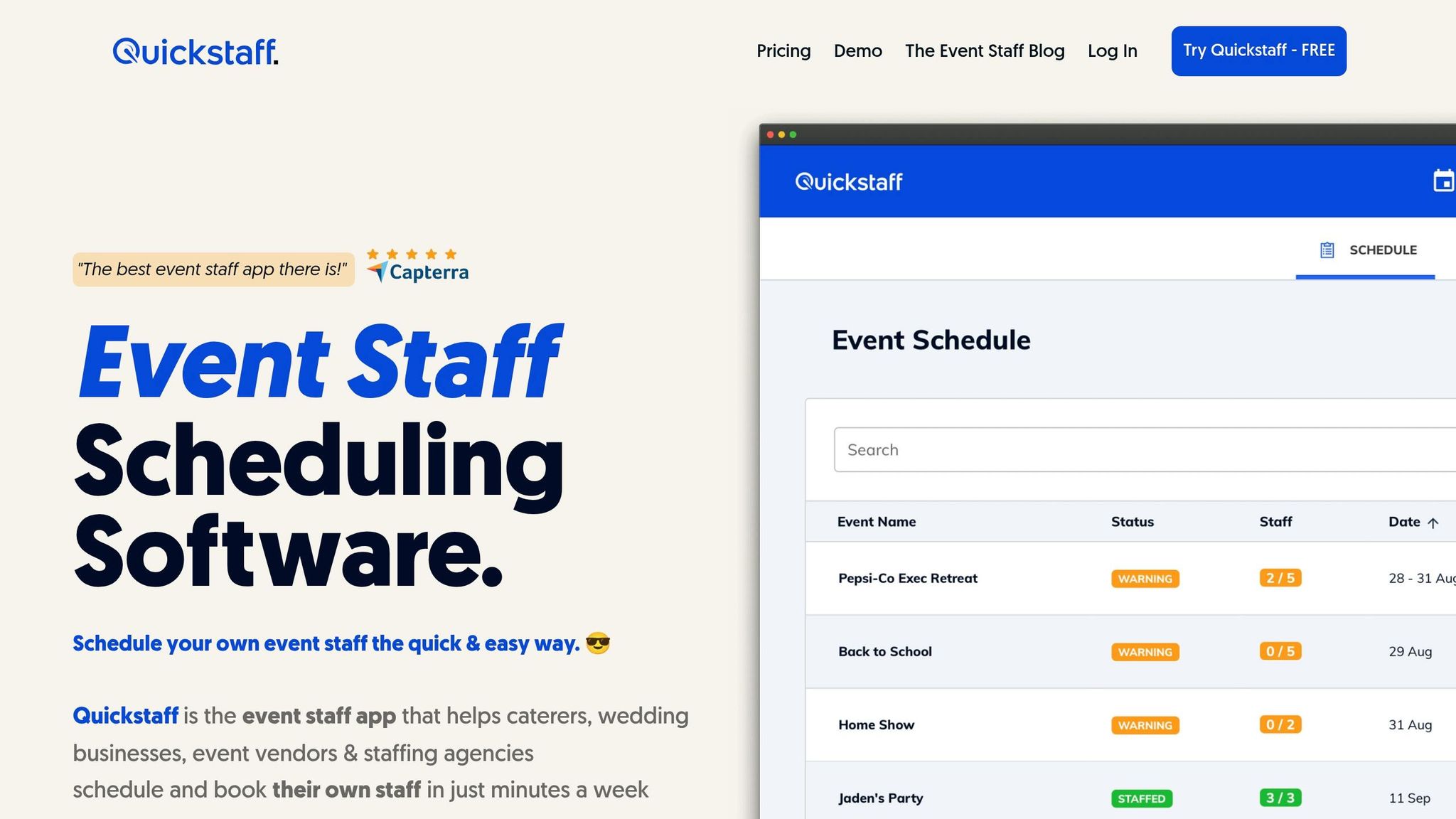
After agencies lock in the plan, assign the non-public-safety staff who need to carry it out. Use Quickstaff to place entry workers, crowd monitors, parking attendants, and production support in the right shifts and zones.
When plans shift - and they often do - centralized messaging and reminders help you send updates to the right people without a scramble. That keeps staff working from the latest instructions, not yesterday’s version.
Briefed staff cut confusion and help teams respond faster.
On event day, follow the plan as written. Start with one joint briefing for agency supervisors and department leads. Reconfirm zone assignments, radio channels, and aid-station locations so everyone is working from the same playbook.
Place medical and fire resources where they can respond fast without blocking emergency routes or crowd movement. In packed areas, bikes, small utility vehicles, and roving responders often move through the site better than standard ambulances or patrol units. Double-check that crowd managers, aid stations, and responder points are staffed. Assign fire watch personnel to look for smoke, fire, and other hazards while keeping exits and emergency vehicle routes open.
Also, assign specific staff to call 911 and meet incoming responders at the agreed entrance point. That one step can cut confusion and avoid delays when seconds matter.
If conditions change, switch from normal operations to protective action right away. When evacuation or shelter-in-place is needed, police, fire, EMS, and event leadership need to stay aligned on the exact action being used.
Then give the crowd one clear instruction through the assigned gate and usher teams. Mixed messages can slow movement and make a tense situation worse.
After demobilization, document lessons while the details are still fresh. Bring police, fire, EMS, and event leadership together for a formal after-action review. Walk through what worked, what slowed response times, and where communication broke down. Then update your SOPs with real data before the next event.
Document those lessons and use them to adjust your site plan, staffing approach, and procedures. Refine Quickstaff shift templates and staff assignments for the next event.
Event safety planning should be led by a designated lead agency. In most cases, that’s the community’s emergency management agency or the local law enforcement agency that has operational control.
That agency acts as the point person for the full safety effort. It brings together a multidisciplinary planning team, names a safety coordinator, and gives the group clear direction so law enforcement, fire, EMS, medical, and transportation planning stay aligned and work together.
Agencies share command through a structured system that keeps law enforcement, fire, EMS, security, and other teams working in sync. Each group keeps its own role, but they connect through a multi-agency command center, such as a MACC or JOC, so everyone can stay on the same page, share information, and make decisions together.
Clear communication channels, like radios and phone lines, connect command staff, operations, and field personnel. That link helps teams send coordinated instructions, move resources where they’re needed, and respond during the event without confusion.
A large event safety plan should spell out who does what, how police, fire, EMS, and event organizers will work together, and when planning meetings will happen. It also needs to cover inspections, permits, occupancy limits, electrical safety, and clear routes for emergency access.
Just as important, the plan should deal with traffic control, crowd management, medical support, sanitation, food safety, communication protocols, and post-event review so the next event runs better.