ICS Planning for Large-Scale Events
June 14, 2026

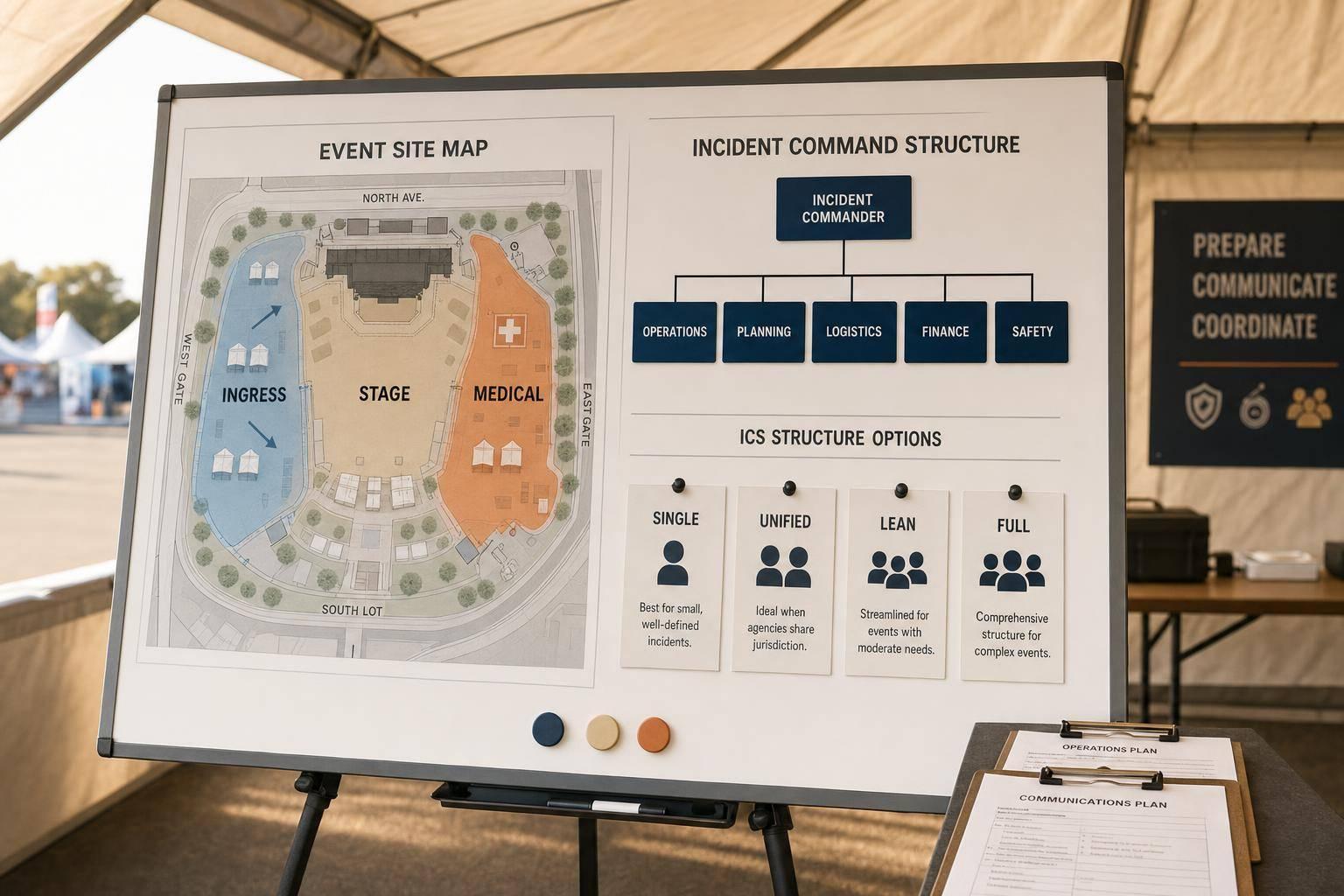
The right ICS model should be picked before event day, not during a crisis. From what I see in this article, the choice comes down to four things: who has authority, how many people are needed (and how to handle event staff scheduling), how many groups must work together, and how much strain the event could put on local response systems.
If I had to sum it up fast, here’s the core point:
The article also keeps coming back to one hard rule: keep span of control at about 3 to 7 direct reports per lead. Once that starts to break down, the structure needs to expand.
What this means for you: if your event has more agencies, more sites, more crowd risk, more media attention, or more pressure on police, fire, and EMS, you likely need more ICS depth from the start.

ICS Models for Large-Scale Events: Quick Comparison Guide
| Model | Who leads | Staffing depth | Coordination load | Best fit |
|---|---|---|---|---|
| Single Command | One Incident Commander | Low | Low | Simple, single-agency events |
| Unified Command | Shared command by multiple agencies | Medium to high | High | Multiagency events with split authority |
| Lean Staffing | One Event Lead or Ops lead, sometimes with shared roles | Low | Medium | Lower-risk events, about 50 to 500 people |
| Full Sectioned | IC plus Command Staff and Section Chiefs | High | High | Large, multi-site, higher-risk, or long-duration events |
A few points stand out from the article:
So in plain English: small event, light structure; bigger risk, more structure; shared authority, use Unified Command. That is the article’s main message, and it applies whether you are planning a street fair, sports event, festival, or large public gathering.
Single Command is the simplest ICS model. It works as the baseline for low-complexity events.
Under Single Command ICS, one Incident Commander is in charge. That creates one clear path for decisions, which helps teams move fast without mixed direction.
Keep span of control within 3-to-7 direct reports per lead. That helps protect accountability and keeps the response moving without clogging up communication.
Standard terminology and set roles help police, fire, EMS, and venue staff work together without clashing instructions. Everyone knows who does what, and that cuts down on confusion.
ICS tracks personnel and equipment in real time. So if a team needs to shift people or replace gear, that can happen faster without disrupting command.
Use this model when one agency owns the response and the incident stays operationally simple. If authority needs to be shared, move to Unified Command.
When one agency can’t handle an event on its own, Unified Command keeps separate authorities working from one event plan. If responsibility is split across venue security, police, fire, and EMS, this setup keeps everyone aligned without folding those groups into a single chain of authority.
Unified Command allows organizations with different legal and operational duties to work inside one framework. Venue leaders, public safety officials, and medical partners still keep their own roles. But before the event begins, they agree on shared objectives and a common plan. That cuts down on delays when decisions need to happen fast.
"Based on the core criteria of unity of command and management by objective, the Incident Command Structure delineates specific roles and reporting responsibilities and can be expanded to fit the incident at hand." - Lucian A. Mirra, Mass Gathering Medicine
Pick a multidisciplinary planning team early, then hold recurring safety meetings before event day. Those meetings give organizers, public safety agencies, and vendors a place to line up priorities, sort out friction points, and settle disagreements before the crowd shows up.
Unified Command gives agencies one process for resource requests, allocation, and oversight. It also creates a shared view of how event needs may affect local resources and surrounding communities.
Use the event’s risk assessment to decide how much of ICS to activate. A smaller event may need a lean setup. A higher-risk event may call for more structure, more staffing, and tighter coordination.
As FEMA puts it:
"Using ICS for every incident or planned event provides the practice that will help to maintain and improve skills needed to effectively coordinate larger or more complex efforts."
After the event, bring all agencies back together for a review. That post-event check helps spot coordination gaps and shows how lean future staffing can be without losing control.
For lower-risk events, ICS can stay lean without giving up control. The Lean Staffing ICS Model works for low- to moderate-complexity events with about 50 to 500 attendees. It’s the smallest workable ICS setup in this comparison.
In this model, authority sits with a single Event Lead or Operations Manager. That person handles scheduling, vendor coordination, and issue escalation. In some cases, one person may cover more than one ICS role, like Command and Planning. Even so, the roles still need to stay clear.
Each lead should manage 3 to 7 direct reports. As the event gets closer to 500 attendees, add zone leads to keep that ratio in place and avoid overloading the Event Lead.
Even with a lean setup, outside agencies like police, fire, and EMS need one clear point of contact. A designated Liaison handles that link and uses standard ICS terminology so contractors, volunteers, and agency teams are all speaking the same language.
Before the event, run a short tabletop with all stakeholders. It’s a simple way to spot gaps before event day.
Lean models depend on cross-trained staff and mobile tools, like push-to-talk communication and shared digital checklists, to track resources. For example, training registration staff to help with room turns or basic AV support gives the team some breathing room when things get hectic.
It also helps to assign a dedicated logkeeper. That person records every major decision and resource deployment, which keeps the team accountable and leaves a clear record for post-event review.
Once an event goes past 500 attendees or gets more complex, the structure starts to stretch too thin. That can happen with multiple venues, heavy media coverage, or more public safety risk. At that point, command functions need their own leads, which is where the Full Sectioned ICS Model comes in.
When the lean model can’t keep span of control in check, it’s time to move to a full sectioned structure. That’s the point where shared roles stop making sense and the event needs dedicated leads for logistics, finance, and interagency coordination.
Once a single leader can’t manage every function, command splits into specialized sections. At the top is the Incident Commander (IC), backed by Command Staff - a Public Information Officer, Safety Officer, and Liaison Officer - plus General Staff made up of four Section Chiefs: Operations, Planning, Logistics, and Finance/Administration.
Only the IC is required. The other sections are turned on as the event becomes more complex. As the operation grows, sections and subordinate units help keep reporting lines under control instead of letting everything funnel through one person.
For large multiagency events, this model supports Unified Command under one Incident Action Plan while still preserving each agency’s authority. That matters in practice. Everyone works from the same plan, but no agency gives up its own legal or operational role.
The Liaison Officer helps coordinate with outside agencies, and standard terminology keeps teams on the same page.
This structure also makes accountability much cleaner. Planning tracks resource status, Logistics provides support, and Finance/Administration tracks costs from setup through demobilization.
The Full Sectioned Model is built to grow. As complexity increases, more organizational levels - such as Branches, Divisions, Groups, and Units - can be activated to keep span of control manageable.
Demobilization planning should start early to help with cost control, safety, and an orderly closeout. The tradeoff is pretty simple: more structure means more staff, more coordination, and more overhead.
That added structure also increases staffing and coordination demands.
Each model handles decision speed, staffing depth, and coordination in its own way. So the best fit comes down to one thing: how complex the event is.
Single Command is the fastest option because one person is making the calls and keeping communication in one place. That makes it a strong match for routine operations. The downside is pretty clear, though: if conditions change fast, that one lead can get stretched thin.
Unified Command gives up some speed for better coordination. It works especially well when police, fire, and medical services need to operate under one structure with shared objectives. There’s more coordination work involved, but for multi-agency events, that extra effort often pays off.
Lean Staffing keeps the team light by turning on only the functions that are needed. That can work well for smaller events or the early phase of an incident. The catch is span of control can get harder to manage if one person is wearing too many hats.
Full Sectioned ICS needs more people and more coordination, but it brings stronger documentation, accountability, and resource management. With dedicated sections, teams can handle documentation, resource control, and Incident Action Plans with more consistency.
The table below sums up the main differences at a glance.
| Model | Decision Speed | Span of Control | Communication Load | Best Use Case |
|---|---|---|---|---|
| Single Command | High | Strict | Low/Centralized | Routine operations; single-agency response |
| Unified Command | Moderate | Strict | High (Multi-agency) | Complex incidents involving police, fire, and medical |
| Lean Staffing | High | Variable | Moderate | Small-scale events or early incident phases |
| Full Sectioned | Moderate | Strict | High | Large, complex, long-duration events |
The four models all lead to the same basic rule: match your ICS depth to the level of risk, the mix of agencies involved, your staffing depth, and how hard the event will be to coordinate.
Make those calls during planning, not in the middle of the event. Use a pre-event threat assessment to pick the right ICS model, then follow up with a post-event review to check whether staffing depth and documentation matched what the event actually required.
In day-to-day use, Unified Command works best for multiagency events. Lean Staffing fits smaller, lower-risk events. And Full Sectioned ICS makes sense for larger operations with more moving parts.
For large temporary workforces spread across roles and sites, Quickstaff can help keep scheduling, availability, reminders, and communication in one place.
Choose Single Command when one agency or jurisdiction has main responsibility for the incident. It gives you clear leadership and a simpler path for decisions.
Use Unified Command when more than one agency or jurisdiction is involved. It allows them to set shared incident goals and coordinate in one structure while each keeps its own authority.
A lean ICS setup should grow into full sections when an event gets big or complex enough to need clear ownership, fast calls, and tight coordination across teams, such as with 500+ attendees.
That shift should happen as the event’s needs increase.
Warning signs show up fast: more tactical confusion, missed critical information, fuzzy assignments, and more accidents or misuse of resources.
This tends to happen most often when someone is managing more than 7 direct reports. At that point, things can start to slip. Messages get lost, handoffs get messy, and small mistakes can turn into bigger problems.