Ultimate Guide to High-Security Event Staffing
May 20, 2026

High-security events - like government summits, corporate conferences, and celebrity galas - demand more than just basic staffing. These events require personnel who can handle strict confidentiality, manage risks, and respond effectively to emergencies. Here's what you need to know:
Effective planning, qualified staff, and seamless coordination are key to ensuring safety and success at high-security events.
High-Security Event Staffing: Risk Levels, Ratios & Key Protocols
Match your staffing plan to the specific risks tied to your event.
To determine how many staff members you need and their roles, focus on the event's context - not just the number of attendees. Several factors influence the risk level, including VIP attendance, crowd density, venue layout, local crime rates, and the presence of alcohol.
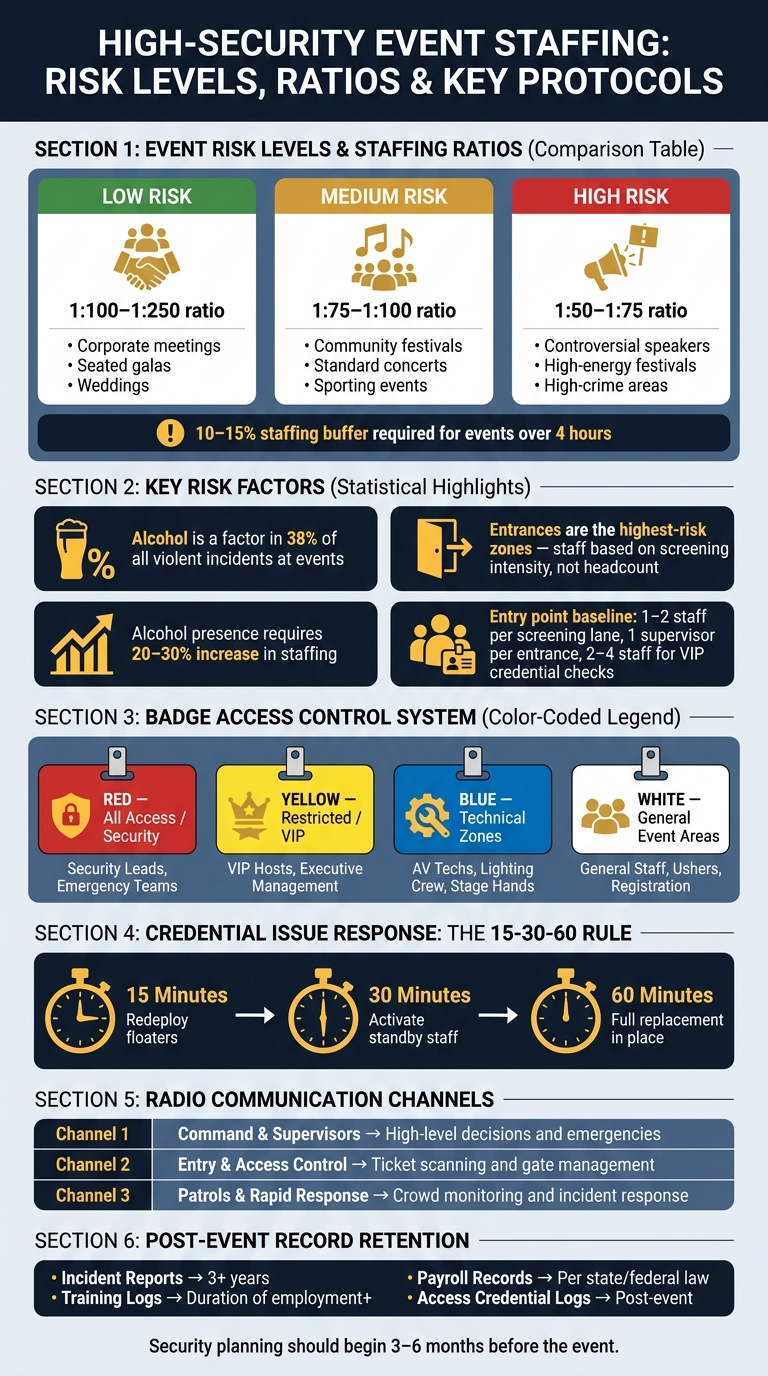
Alcohol plays a major role in increasing risk. It accounts for 38% of all violent incidents at events and typically requires a 20–30% increase in staffing to manage behavioral changes and de-escalate conflicts.
The venue layout is equally critical. Entrances, often the riskiest areas, require staffing levels based on screening intensity rather than just attendance numbers. As Daniel Muersing, CEO of Event Staff, explains:
"Planners ask 'how many staff for 1,000 guests' but they're asking the wrong question. It's not one number. The real number is a formula based on entrances, alcohol, and venue risk."
To guide your planning, use an event staffing needs analyzer or refer to the table below that connects event risk levels with recommended staffing ratios:
| Event Risk Level | Recommended Staffing Ratio | Typical Event Types |
|---|---|---|
| Low Risk | 1:100 to 1:250 | Corporate meetings, seated galas, weddings |
| Medium Risk | 1:75 to 1:100 | Community festivals, standard concerts, sporting events |
| High Risk | 1:50 to 1:75 | Controversial speakers, high-energy festivals, high-crime areas |
For events lasting more than four hours, plan for a 10–15% staffing buffer to accommodate rotations and maintain alertness.
These ratios help you integrate vendor staffing seamlessly into your overall security plan.
After assessing risks, ensure vendor roles align with the event’s security framework. Most security plans use a "rings of protection" model, ranging from outer perimeter control to close protection for VIPs. Vendor teams - whether catering, AV, or logistics - must understand their role within this structure.
To maintain control, issue zone-specific credentials (like RFID or digital badges) to vendor staff, restricting them to their assigned areas. High-risk zones like loading docks and staging areas require strict protocols and supervision. Vendor contracts should include clear security requirements, covering staff behavior, confidentiality, and adherence to the event’s security plan.
Pre-event walkthroughs with security are vital for spotting vulnerabilities. For instance, Nic Moretto of Tactful Elite Security Solutions highlighted this in 2026 when a plainclothes agent accessed a corporate keynote venue through an unmonitored rear entrance. They bypassed production staging and photographed a backstage credential without being stopped. In response, the venue implemented new protocols, added a gate system, and increased security personnel in high-traffic zones.
This structured approach ensures vendor contributions enhance overall security.
Different vendors come with unique risks, requiring tailored staffing approaches.
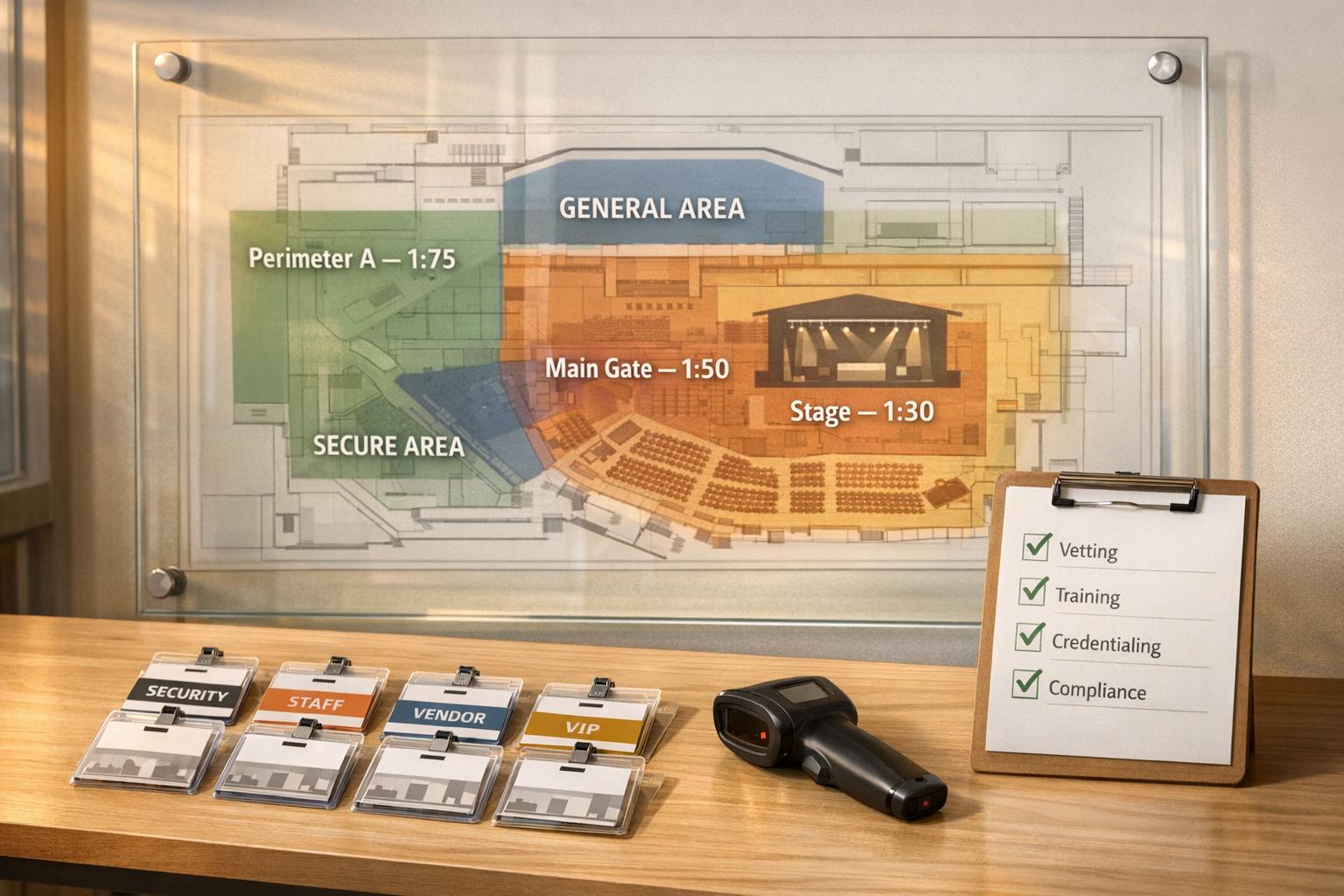
Entry points demand careful staffing: assign 1–2 staff per screening lane, one supervisor per entrance, and 2–4 staff for VIP credential checks. These aren’t optional - they’re the baseline for maintaining effective access control.
Once you've nailed down your staffing ratios and zone assignments, the next step is finding the right people to fill those roles. This process requires careful planning and attention to detail.
Traditional job boards usually aren't the best place to find candidates with experience in high-security environments. Instead, it’s better to turn to specialized agencies or trusted professional networks. Referrals are another strong option - research shows that candidates recommended through reliable connections tend to perform better and stay longer.
When creating job descriptions, focus on detailed role requirements rather than just job titles. The best candidates combine technical qualifications with the right personality traits. For example, roles might require a valid Class D Security License (if applicable), along with current CPR and First Aid certifications. For armed roles or leadership positions, you'll need candidates with documented use-of-force training, proper state firearm credentials, and a strong command presence. As Daniel Meursing, CEO of Premier Staff, puts it:
"I tell clients that a Team Lead isn't an extra expense; they are an insurance policy for your timeline. If you have twenty staff and no conductor, you don't have a team, you have a crowd."
Physical stamina is another key factor. Staff may need to stand for up to four hours at a time and lift at least 15 pounds. For VIP-facing roles, prioritize candidates trained to handle sensitive information discreetly. These individuals play a critical role in maintaining the security structure across all zones.
Once you've recruited potential candidates, the next step is to ensure they meet the specific demands of your event through thorough vetting.
The level of vetting required will depend on the role and the level of access involved. For general floor staff, a basic identity verification and a criminal history check covering the past 7–10 years are usually sufficient. However, for positions involving VIP areas, cash handling, or back-of-house zones, a more intensive screening process is necessary. This might include reviewing up to 15 years of criminal history, verifying employment for the last 7–10 years, and checking at least two professional references.
In addition to background checks, use scenario-based interview questions to evaluate a candidate's judgment. For instance, ask how they would handle situations like a guest refusing to comply or a credential issue during peak traffic. As the U.S. Office of Personnel Management explains:
"Background evaluations... are used to review an applicant's employment, criminal, and personal history to gauge behavioral reliability, integrity, and personal adjustment, and to identify any historical facts that could interfere with job performance."
Before making any final offers, ensure you have written proof of licensing, drug-screen results, and insurance bonding. Start these checks early to avoid last-minute complications.
Once the vetting process is complete, the focus shifts to equipping your team with the necessary training.
Having a vetted and qualified team is just the beginning. Proper training ensures they can perform effectively in high-security situations. Training should cover four key areas: situational awareness, access control, emergency response, and communication protocols.
Situational awareness training helps staff identify unusual behaviors - like awkward posture, facial flushing, or vacant stares - that might indicate a potential threat. For access control, hands-on certification with any equipment they’ll use, such as magnetometers, is essential. As Nic Moretto, Founder & CEO of Tactful Elite Security Solutions, explains:
"A magnetometer operated by someone who isn't certified is just expensive furniture."
Emergency response training should be tailored to specific scenarios, such as bomb threats, medical evacuations, severe weather, or crowd surges. Use tabletop exercises and full-scale rehearsals to ensure the team is prepared before the event. On event day, pre-shift briefings should include details like floor plans, communication protocols, post assignments, and non-negotiable rules (e.g., no-photo policies near VIPs).
For effective oversight, aim for a staffing ratio of one lead for every 6–12 team members. This structure ensures smooth operations and prevents gaps in coverage during breaks.
Once your team is trained and ready, the spotlight shifts to execution. How you handle schedules, credentials, and communication on the big day can make or break all your hard work.
Effective scheduling is the backbone of a smooth event day. It’s not just about planning for calm moments but preparing for those chaotic bursts when everything seems to happen at once. As Daniel Meursing, CEO of Event Staff, explains:
"I don't build staffing plans for the easy hours. I build them for the 15 minutes where check-in backs up, the client's asking questions, and everyone's looking at us to fix it."
Deploy your team 1–2 hours before the event opens to allow time for setup, equipment checks, and a quick operational briefing. These briefings, lasting 30–60 minutes, should cover floor layouts, assignments, and emergency protocols - focusing on real-time updates rather than rehashing pre-event training. For longer events (over 5–6 hours), rotate staff regularly to prevent fatigue, which can lead to mistakes, especially in security roles.
Spread experienced team members across all shifts instead of concentrating them at the beginning. A balanced skill distribution ensures no shift becomes a weak link. Scheduling tools like Quickstaff can streamline this process by centralizing availability, sending reminders, and ensuring prompt confirmations. Stagger shift overlaps so outgoing staff can directly brief their replacements, reducing any chance of miscommunication.
Don’t forget to schedule post-event tasks, such as collecting access passes, checking the venue for sensitive materials, and conducting a staff debrief. These steps are just as important as the event itself.
Managing access and credentials is just as crucial as scheduling. A color-coded badge system can simplify access control, providing immediate clarity for security teams. Here's an example of how this system might look:
| Badge Color | Access Level | Typical Personnel |
|---|---|---|
| Red | All Access / Security | Security Leads, Emergency Teams |
| Yellow | Restricted / VIP | VIP Hosts, Executive Management |
| Blue | Technical Zones | AV Techs, Lighting Crew, Stage Hands |
| White | General Event Areas | General Staff, Ushers, Registration |
Set up a centralized credentialing desk where staff must present a government-issued photo ID and sign in or out to maintain accountability. Number badges sequentially to track who has access and prevent misuse.
Prepare badges well in advance, and print an extra 10–15% to cover unexpected needs like last-minute hires or replacements. For any credential issues, follow the 15-30-60 Rule: redeploy floaters within 15 minutes, activate standby staff within 30 minutes, and have a full replacement in place within 60 minutes.
"Credentialing is stricter, labor is leaner, and guest patience is thinner, so staffing execution has less margin for error." - Premier Staff
Before the event begins, ensure every gatekeeper understands the badge system and their role in enforcing it. A well-designed system is only effective if those using it know how it works.
Clear leadership and communication are essential for keeping everything on track. Assign leadership roles and designate an Event Security Officer (ESO) to act as the main point of contact for security and vendor teams. This person should have the final say on security-related decisions. Additionally, assign zone-specific leads for areas like registration, VIP sections, and breakout rooms to maintain oversight throughout the event.
Use dedicated radio channels to keep communication focused and prevent unnecessary chatter. A simple three-channel setup can work for most events:
| Radio Channel | Assigned Team | Purpose |
|---|---|---|
| Channel 1 | Command & Supervisors | High-level decisions and emergencies |
| Channel 2 | Entry & Access Control | Ticket scanning and gate management |
| Channel 3 | Patrols & Rapid Response | Crowd monitoring and incident response |
Standardize call signs (e.g., "Control", "Post 1") and use discreet code words for sensitive situations. For instance, "Code 10" might signal a medical issue, while "Code 20" could indicate a disturbance . Test all radios and technology before guests arrive to identify and address any dead zones or equipment issues .
After an event, your follow-up actions play a key role in minimizing legal risks, improving team performance, and refining future operations. Taking the right steps within 24–48 hours ensures compliance, enhances your team's efficiency, and sets the foundation for smoother events down the road. These processes are essential to maintaining a secure and legally sound approach to event management.
Pay close attention to wage accuracy and proper worker classification. All compensable work - like writing incident reports, returning equipment, or completing post-event tasks - must be accounted for. As Security Force USA explains:
"If report writing is required for your job, it is commonly treated as compensable work time."
Misclassifying employees as independent contractors (1099) instead of W-2 workers can lead to penalties for unpaid payroll taxes, unemployment insurance, and workers' compensation violations.
Data privacy is another critical area. Protect sensitive information, such as attendee and staff data, by using encrypted systems with limited access. This is especially important if regulations like the California Consumer Privacy Act (CCPA) apply to your operations. Mistakes in compliance can be costly. For instance, in 2024, a Tennessee company faced fines of nearly $300,000 for labor law violations, while its staffing agency paid over $121,000 and was placed under a third-party compliance monitor for three years.
Accurate records are your best defense in case of disputes. Incident reports, in particular, should be kept for at least three years to meet standard documentation requirements and support potential legal proceedings. As Big Guys Agency notes:
"Incident reports document events and support legal cases and show proper project management."
Here’s a quick guide to essential records and their retention:
| Record Type | Retention Period | Key Details to Include |
|---|---|---|
| Incident Reports | 3+ years | Time, location, involved parties, injuries, response timeline |
| Training Logs | Duration of employment+ | Certifications, de-escalation training, use-of-force policy |
| Payroll Records | Per state/federal law | Total hours, overtime, compensable administrative time |
| Access Credential Logs | Post-event | Badge retrieval, deactivation records, chain of custody |
For efficiency, store records digitally to avoid loss and simplify audits. Tools like Quickstaff can centralize staff rosters, scheduling history, and communication logs, making it easier to maintain a clear and accessible paper trail.
With your records in order, the next step is to review the event and identify areas for improvement.
Analyzing event performance is the final piece of the post-event process. Start with a leadership debrief within 24 hours, followed by a full team review within 48 hours to gather timely feedback. Begin discussions by acknowledging what went well, then transition to areas that need improvement. Open-ended questions like "What would have made your job easier?" often yield more actionable insights than simple yes/no questions.
When assessing performance, focus on measurable outcomes such as response times to security alerts, incident resolution rates, and how quickly credential issues were handled. Use a straightforward rating system to evaluate staff - categories like "Excellent - invite back" or "Issues - do not hire" work well for documenting individual performance. Share this feedback with your staffing agency within two business days to ensure timely adjustments for future events.
Staffing for high-security events demands careful and deliberate planning. Every choice, from conducting risk assessments to classifying payroll, carries meaningful consequences. As Knighthood highlights:
"A single security incident can result in legal liability, financial losses, and permanent damage to your organization's reputation."
When it comes to security, quality beats quantity. A team of 30 highly trained and vetted professionals will always outperform 50 untrained individuals. Ideally, security planning should start 3 to 6 months before the event. This timeframe allows for finalizing critical details like staffing ratios, access control zones, and communication protocols. These foundational elements shape everything from pre-event preparations to post-event evaluations.
Effective communication and a well-defined chain of command are non-negotiable. Without them, even the best plans can falter under pressure. Additionally, using efficient scheduling tools can significantly improve operations on event day and streamline post-event reviews.
As covered throughout this guide, tools like Quickstaff simplify the staffing process. By centralizing scheduling, tracking availability, managing shifts, and improving communication, it ensures no detail slips through the cracks. Beyond the event itself, reviewing incident reports, gathering performance feedback, and refining procedures are essential steps. These practices elevate a competent team into an exceptional one, reinforcing the strategic approach required to keep high-security events running smoothly from beginning to end.
To gauge your event's security risk, start with a detailed threat evaluation. Look at critical elements like attendee demographics, event size, venue design, alcohol presence, and whether high-profile guests will attend. Pinpoint weak spots in assets such as attendees, equipment, and confidential information. Examine the venue for areas like entry points and blind spots that could pose challenges. Additionally, review data from similar past events to predict potential risks and fine-tune your security strategy accordingly.
Roles in security, particularly those requiring armed guards, demand thorough background checks to ensure public safety and minimize risks. These checks often include a detailed review of criminal records, local court documents, and employment history spanning the past 7–15 years. In environments with heightened security needs, it's crucial that all staff undergo rigorous screening and receive proper training in confidentiality to safeguard sensitive information. Tools like Quickstaff can streamline the process by managing credentials and efficiently scheduling pre-screened, qualified personnel.
Quickstaff tackles the headache of last-minute staffing issues by streamlining scheduling and automating communication. With its centralized system, managers can monitor staff availability in real time and rely on automated waitlists to alert backup team members when necessary. The platform’s mobile-friendly push notifications ensure updates reach staff immediately, while delivery and read receipts provide confirmation that assignments have been acknowledged. This reduces miscommunication, minimizes delays, and keeps events running smoothly.