Do Staffing Agencies Have to Offer Health Insurance?
October 30, 2026


Staffing agencies don’t automatically have to offer health insurance. I’d start by checking last year’s average workforce: 50 or more full-time employees plus full-time equivalents generally makes your agency subject to ACA employer coverage rules.
Next, check which employees qualify as full time based on hours across assignments - not their “temporary” job label. My checklist:
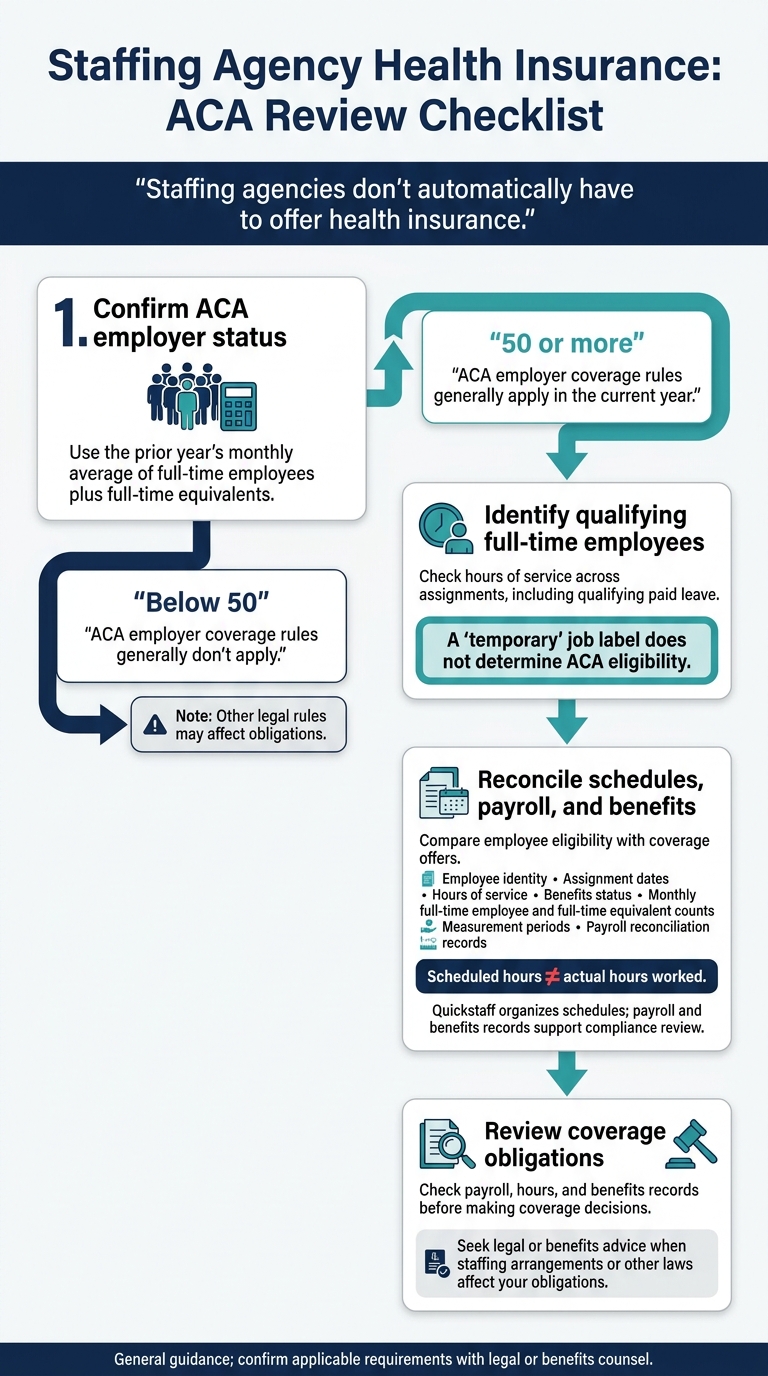
Staffing Agency Health Insurance: ACA Review Checklist
A staffing agency determines its ACA applicable large employer (ALE) status using the prior year’s monthly average of full-time employees plus full-time equivalents.
If that average is 50 or more, ACA employer coverage rules apply in the current year. Below 50, those rules generally don’t apply.
Once a staffing agency crosses the ACA size threshold, hours worked and full-time status determine coverage requirements. Calling a worker “temporary” doesn’t change their eligibility under the ACA.
When coverage rules may apply, the agency needs records that document employee counts, hours, and eligibility.
Keep a file for each employee with their identity, assignment dates, hours of service, and benefits status. Track monthly full-time employee and full-time equivalent counts, along with the measurement periods used to assess coverage eligibility. These records show whether the agency met ACA coverage rules and which workers counted as full time.
Keep scheduled hours separate from actual hours worked. Retain payroll reconciliation records, including paid leave that counts as hours of service. This makes later schedule-to-payroll checks faster.
Quickstaff helps organize event staffing schedules, but compliance depends on matching those schedules to payroll and benefits records.
Once you’ve confirmed your agency’s ALE status and tracked hours across assignments, compare those records with your coverage offers. Staffing agencies don’t automatically have to offer health insurance. ACA duties depend on whether the agency is an applicable large employer and which workers qualify as full-time employees.
Check payroll, hours, and benefits records before making coverage decisions. If your staffing model is complex, seek legal or benefits advice to assess employee counts, hours of service, and the ACA rules that apply to your agency.
Under the Affordable Care Act, part-time workers count as full-time equivalents toward the 50-employee threshold that determines Applicable Large Employer status.
To calculate their full-time equivalent value each month, add the hours worked by all part-time employees - those working fewer than 30 hours per week - and divide the total by 120.
Under the Affordable Care Act (ACA), temporary workers count as full-time employees if they are employees - not independent contractors - and average 30 hours per week or 130 hours per month. Temporary status alone doesn't determine eligibility.
Applicable Large Employers must offer health insurance to these employees. To assess their hours, employers can track them monthly or use a look-back measurement method, which measures hours over a longer period.
The staffing agency usually acts as the employer of record, but it may share compliance duties with the client as joint employers. Who handles those duties often depends on who controls scheduling, day-to-day tasks, and working conditions [3][4].
Under the ACA, Applicable Large Employers must offer health insurance to temporary workers classified as employees who average 30 hours per week or 130 hours per month.