PPE Policies for Event Staff
August 28, 2026

If your event team does not know what to wear, when to wear it, and who hands it out, your PPE policy is not doing its job.
I’d sum the article up like this: a PPE policy for event staff should tie gear to hazards, not just job titles, and it should spell out five things with no room for guessing:
The article also makes three points that matter right away:
A few examples from the article make that plain:
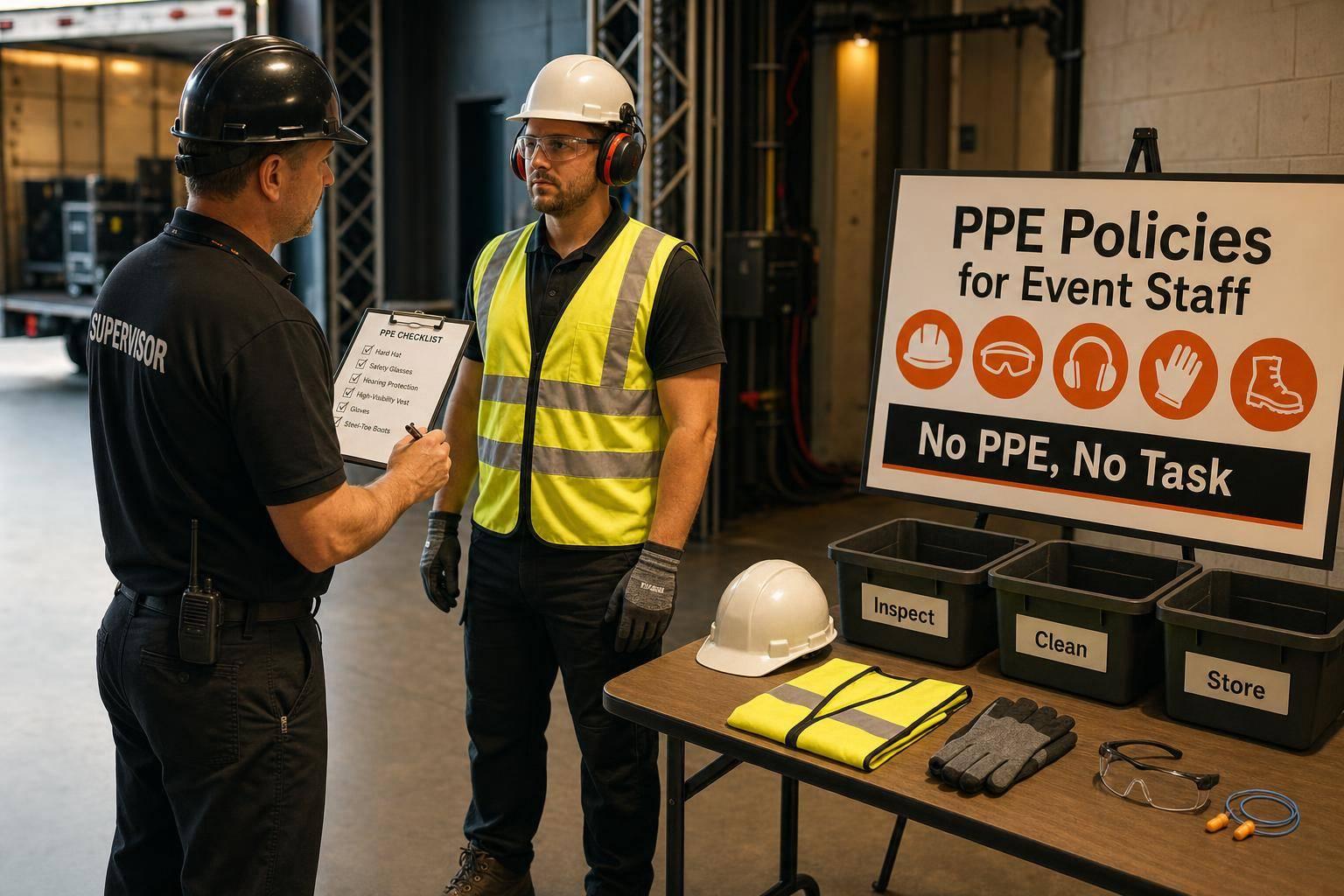
The article also lays out the basic enforcement rule: no PPE, no task. If gear is missing, broken, dirty, or does not fit, the job should not start.
Just as important, the policy should cover the full cycle of PPE use, not just issue rules. That includes:
In short, I’d say the article is about turning safety from a loose reminder into a written system people can follow on a busy event day.
After you define the PPE your team may need, the next job is figuring out when it has to be worn.
PPE is required when a task, venue condition, or event setting creates a hazard you can reasonably see coming, and that hazard can't be controlled in another way. Under OSHA's general PPE standard, 29 CFR 1910.132, employers must require PPE when injury or illness is likely and other controls don't do enough.
Event work can get messy fast. Setup, kitchen, cleaning, and traffic-control jobs often put staff around sharp edges, hot surfaces, chemicals, slick floors, vehicles, and moving crowds.
That means the PPE has to fit the hazard. Heat-resistant gloves are for hot items and surfaces. Cut-resistant gloves are for slicing, trimming, or other cutting work. A good policy links each task to the hazard behind it, so staff understand why they're wearing certain gear, not just that they have to.
The event setting changes the risk. The same job may call for different PPE depending on where it's done and what's happening around it.
| Event Type | Common Hazards | Affected Roles | Typical PPE |
|---|---|---|---|
| Banquet / Wedding | Wet floors, hot items | Servers, bussers, kitchen support | Slip-resistant shoes, heat-resistant gloves |
| Outdoor Festival | Sun, dust, uneven ground, vehicle traffic | Setup crews, crowd staff, parking attendants | Hi-vis vests, sturdy footwear, rain gear, sun protection, or insulated layers |
| Warehouse Load-In | Forklifts, carts, sharp packaging, heavy equipment | Production staff, runners, stagehands | Hi-vis gear, gloves, safety footwear |
| Sporting Event | Crowd movement, restricted access zones, weather | Ushers, security support, gate staff | Hi-vis vests, weather-appropriate footwear |
| Concert / DJ Event | High noise levels | Stage crew, production staff near speakers | Hearing protection (earplugs or earmuffs) |
| Cleaning and Breakdown | Chemical splashes, sharp debris | Cleaning crews, restroom attendants | Chemical-resistant gloves, eye protection, aprons |
Exceptions should be rare. Only allow them when there's a documented risk assessment or a specific rule that supports the change.
Personal preference is not a reason to skip required PPE. A valid exception could apply if a venue already has a controlled setting with guarded equipment, or if a task no longer includes the original hazard once setup is done. In those cases, require supervisor approval and a written record that explains the exception. That exception still needs to be assigned and tracked by role as part of your compliance checks.
PPE Requirements by Event Staff Role
Your policy should spell out who provides, who pays for, and who replaces each PPE item. There are a few narrow exceptions, like everyday clothing or safety-toe shoes staff can wear off the job. Use the hazard assessment to decide which roles need which gear.
One simple way to frame it is with three levels of accountability:
Once those lines are clear, the next step is to turn them into role-based rules.
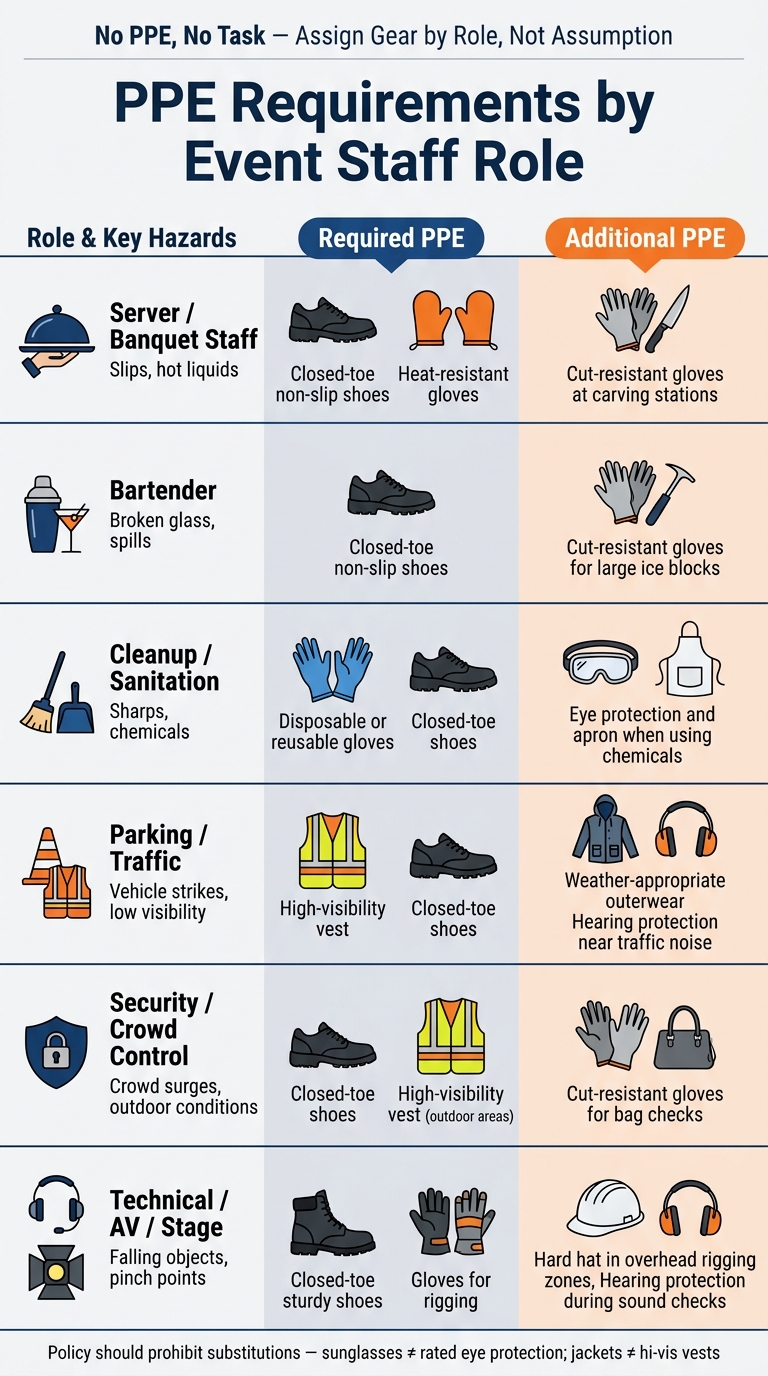
Not every role needs the same gear. Your policy should say that plainly. When you define required and extra PPE by role, you cut down on guesswork and stop common scheduling problems and unsafe workarounds on event day. It also makes check-in faster.
The table below maps common event roles to their hazards and PPE needs:
| Role | Key Hazards | Required PPE | Additional PPE |
|---|---|---|---|
| Server / Banquet Staff | Slips, hot liquids | Closed-toe, non-slip shoes | Cut-resistant gloves at carving stations |
| Bartender | Broken glass, spills | Closed-toe, non-slip shoes | Cut-resistant gloves for large ice blocks |
| Cleanup / Sanitation | Sharps, chemicals | Disposable or reusable gloves; closed-toe shoes | Eye protection and apron when using chemicals |
| Parking / Traffic | Vehicle strikes, low visibility | High-visibility vest; closed-toe shoes | Weather-appropriate outerwear; hearing protection near traffic noise |
| Security / Crowd Control | Crowd surges, outdoor conditions | Closed-toe shoes; high-visibility vest in outdoor areas | Cut-resistant gloves for bag checks |
| Technical / AV / Stage | Falling objects, pinch points | Closed-toe sturdy shoes; gloves for rigging | Hard hat in overhead rigging zones; hearing protection during sound checks |
Your policy should also name prohibited substitutions. This part matters more than people think. Sunglasses do not replace rated eye protection. Jackets do not replace hi-vis vests in traffic zones. Flip-flops are not acceptable where foot protection is required.
After you write the role rules, build them into the shift assignment process. Attach role-based PPE notes to each shift in your scheduling tool. Quickstaff can send reminders, flag what staff need to bring, and track what was issued at check-in.
Once PPE is issued, you need a clear system for storage, cleaning, and return to service. Reusable PPE should go in clean, dry, labeled bins or on shelves kept away from food, chemicals, and direct sunlight. Sort gear by type and size so staff can grab the right item fast during a rushed setup.
Your policy should spell out storage limits too. Rubber gloves and harnesses can break down in high heat, so leaving gear in a hot vehicle during the summer is not okay. Cleaning duties also need to be assigned with zero confusion: the employer or a designated supervisor handles cleaning and sanitation, and staff clean and return gear after use. Reusable aprons should be bagged, labeled, and laundered within 24 hours after each event. Eye protection should be wiped with manufacturer-recommended wipes and air-dried before it goes back on the shelf.
Every item should be checked before every shift for wear, damage, contamination, and fit. In plain terms, that means looking for wear, damage, leaks, cracks, contamination, and poor fit. If gear fails any of those checks, pull it from service right away. Failed gear needs to be removed and replaced before the shift starts.
The employer should replace normal wear items without delay. Worn or damaged PPE must be replaced before the shift, while lost or intentionally damaged gear should be handled under a separate company policy.
A simple way for supervisors to confirm checks happened is to add a PPE check-complete line to the event sign-in sheet. If you're tracking stock across multiple venues using event staff apps and busy seasons, attach PPE kit counts to each event and run a weekly count during heavy periods. That helps catch shortages before event day instead of scrambling at the last minute.
Inspection rules fall apart if staff don't know how to use PPE or if supervisors let issues slide.
Train staff on when PPE is required, how to wear it, its limits, and how to care for it. For event teams, that should happen at onboarding and then be reinforced in short pre-shift huddles before large events.
Supervisors should enforce compliance with a clear step-by-step response:
No PPE, no task. Supervisors should have written authority to stop work or reassign staff when PPE rules are ignored.
Use the wording below to turn the role and hazard rules above into staff handbook language.
This policy applies to all individuals working an event on behalf of the company, including W-2 employees, 1099 contractors, and temporary or on-call staff, no matter how they are paid. PPE means required protective gear such as safety footwear, high-visibility vests, gloves, eye protection, hearing protection, and hard hats.
The handbook assigns PPE by role and task. Any event-specific requirements listed in call sheets or scheduling notes are mandatory.
The company provides all required PPE for employees at no cost. For contractors and temporary staff, the company issues or reimburses required PPE when it is mandatory. Staff may use their own PPE only if it meets company safety standards and a supervisor approves it. Staff must report damaged, worn, or poorly fitting PPE right away. Replacement gear must be available before work starts. This is a critical part of being prepared for anything on event day.
Use this shorter version in the staff-facing part of the handbook.
All event staff must wear assigned PPE, follow training and supervisor instructions, and comply with event-specific safety rules. Staff may not remove or alter required PPE without supervisor approval. Refusing issued PPE is a safety violation. Supervisors can stop work and reassign or remove staff from the event when PPE rules are not met. Employees are subject to progressive discipline. Contractors and temporary staff may be removed from the assignment and blocked from future bookings.
These are the site rules staff cannot override.
There are no self-directed exceptions. Staff must wear required PPE whenever the role, task, or event conditions call for it. They cannot opt out just because they do not want to wear the gear. The company provides, maintains, and replaces required PPE, and staff must use it exactly as directed. Supervisors enforce PPE rules, and staff may not work without the required gear.
Start by reviewing the tasks for each role and the conditions at the venue. Look for hazards like slips and falls, extreme heat or cold, heavy lifting, loud noise, and hazardous materials.
Then match each risk to the right PPE, such as gloves, goggles, or hearing protection. Document the assessment and include it in site-specific safety training so staff know when to use their gear and how to wear it the right way.
Supervisors should keep clear records to support safety compliance and day-to-day accountability. That means logging staff injuries and illnesses in the OSHA 300 Log and keeping documentation for issued gear, including item IDs, quantity, condition, and the staff member responsible.
It also helps to store these records in a digital, well-organized system. That makes it easier to verify compliance, track equipment, and review what was needed after the event.
No. Employers must provide the needed personal protective equipment to temporary staff at no cost.
Under OSHA rules, staffing agencies and host employers share responsibility for a safe workplace. That includes making sure workers have the required gear. Temporary staff should not have to bring or buy their own PPE.