OSHA Training Frequency Guide For Event Staff
October 10, 2026

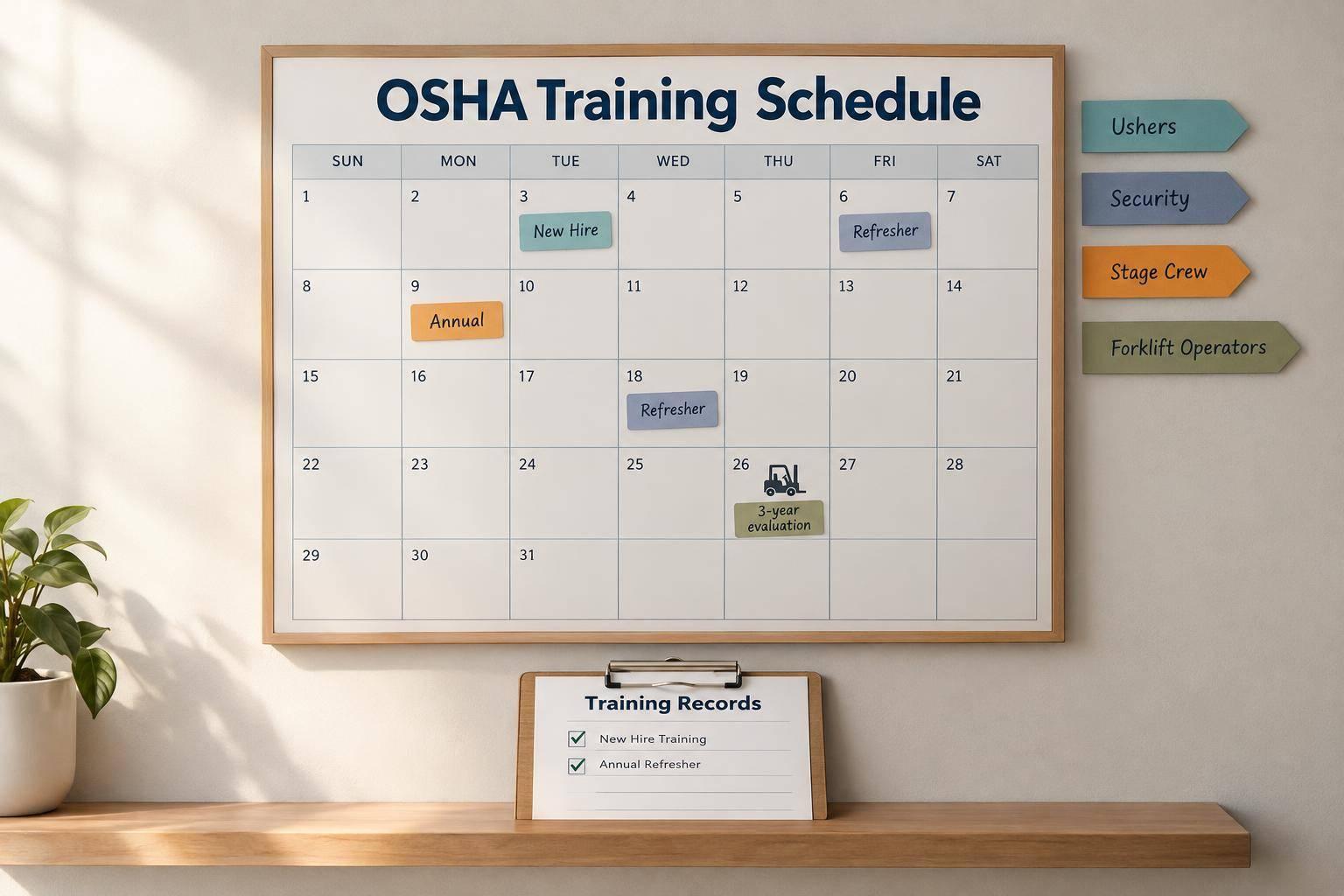
OSHA does not require annual training for all event staff. I schedule training before covered work begins, based on each worker’s duties, hazards, and the rules that apply - not one deadline for everyone.
Here’s the checklist I use:
Match training to what each person does. Use a job hazard analysis to identify exposures, then separate OSHA-required training from company rules, licensing, and transportation requirements.
| Role | Training Before Assignment | Refresher or Retraining Triggers | Manager’s Documentation |
|---|---|---|---|
| Temporary staff | Site orientation, evacuation, basic hazard awareness, and PPE. | Changes to duties, hazards, or equipment; unsafe performance; an incident or near miss. | Duties, briefing date, topics, trainer, acknowledgment, and PPE instruction. |
| Leads | Hazard recognition, crew communication, and emergency duties. | Changes to duties, hazards, or equipment; unsafe performance; an incident or near miss. | Emergency-duty designation, escalation contacts, site-plan review, and training date. |
| Drivers | Vehicle-specific onboarding, inspections, backing, loading, and securement. | Changes to duties, hazards, or equipment; unsafe performance; an incident or near miss. | Vehicle-training record, license verification and expiration, and transportation records. |
| Warehouse crews | Material handling, pedestrian routes, PPE, and equipment hazards. | Changes to duties, hazards, or equipment; unsafe performance; an incident or near miss. | Equipment qualifications, chemical-training date, SDS access, program location, and PPE records. |
| Setup teams | Loading, staging, teardown hazards, PPE, and fall risks. | Changes to duties, hazards, or equipment; unsafe performance; an incident or near miss. | Briefing date, attendees, layout version, equipment sign-off, weather controls, and corrective actions. |
Use this role-by-role map to schedule training before assignment and retraining when duties change.
Finish onboarding before the shift starts. Train leads to handle their assigned emergency duties and stop or escalate unsafe work. OSHA does not require a universal event lead credential. Train before the first shift, then retrain after any site, plan, or duty change.
For drivers and warehouse crews, training timing depends most on the equipment they use and the hazards they face. Schedule role-based refreshers for drivers, and retrain them before they use unfamiliar vehicles or equipment. OSHA training does not replace licensing or DOT requirements. Check applicable DOT, FMCSA, and state rules for licensing, medical qualification, hours-of-service, inspections, and cargo securement.
For warehouse crews exposed to hazardous chemicals, OSHA requires hazard communication training at initial assignment and whenever a new chemical hazard not covered by earlier training enters the work area. Explain labels, controls, and how to access safety data sheets and the written program. Handing over an SDS is not enough. Keep SDSs accessible during every shift.
Forklift operators need truck- and workplace-specific training and evaluation - not just warehouse orientation. Train before first use and retrain after equipment, cargo, or hazard changes.
Retrain setup and teardown teams whenever the event layout or work sequence changes. Provide equipment-specific instruction before use and required fall-hazard training before exposure.
Classify the work before choosing the training: general industry rules cover most event work, while Part 1926 applies to construction, alteration, or repair. Train before setup begins, then retrain when the layout, weather, or sequence changes.

OSHA Training Frequency: Deadlines and Retraining Triggers
Once you’ve mapped training by role, set a due date for each required topic.
Keep OSHA-required deadlines separate from internal refresher schedules. Start with the federal minimums below, then check the state-plan rules for each worksite.
Use this table to match each topic to its initial training date, recurring requirements, and retraining triggers.
| Training Topic | Initial Training Timing | Required Recurring Interval | Retraining Trigger | Applicability |
|---|---|---|---|---|
| Hazard communication | Before the first assignment involving hazardous chemicals and when a new chemical hazard is introduced | No universal annual deadline | New chemical hazard, changes to labels or SDS information, changed procedures, or a knowledge gap | Staff exposed to hazardous chemicals |
| PPE | Before work requiring PPE begins | No universal annual deadline | New PPE, changed hazards or tasks, improper use, failed inspection, incident, or lack of understanding | Setup, breakdown, warehouse, kitchen, maintenance, and other staff exposed to recognized hazards requiring PPE |
| Emergency action plans | Before the first assignment under the plan | No universal annual deadline; company policy may require drills and refreshers | Changes to the plan or employee responsibilities; briefing or drill deficiencies | Event leads, supervisors, temporary staff, drivers, warehouse crews, and anyone covered by the plan |
| Powered industrial trucks | Before independent operation; include formal instruction, practical training, and workplace evaluation | Evaluate at least every 3 years | Unsafe operation, accident or near miss, unsafe evaluation, different truck type, or workplace changes affecting safe operation | Operators of forklifts and other covered powered industrial trucks |
| Respiratory protection | Before required respirator use | Annually, and sooner if conditions change | Changed conditions, changed respirator type, or improper use | Employees required to use respirators under the respiratory-protection program |
For tight-fitting respirators, track training, fit testing, and medical clearance separately. Fit testing is required before initial use, when a different facepiece is used, and at least annually after that. Annual fit testing does not require an annual medical examination.
Before a changed assignment begins, compare the new task with the employee’s recorded training. Check for changes in venues, trucks, chemicals, or crew duties.
After incidents, near misses, unsafe performance, or inspection findings, retrain employees on the specific gap. Verify safe performance before reassignment.
The 3-year rule applies to evaluation, not retraining. Initial qualification requires instruction, hands-on training, and evaluation before independent operation. Any trigger in the table still requires refresher training, which must include an evaluation of its effectiveness.
Record separate dates for initial training, the latest performance evaluation, refresher training, and the post-refresher evaluation. Include the covered truck type and the next performance-evaluation deadline.
Set internal reminders ahead of annual respiratory deadlines and the 3-year forklift evaluation date. Enter these dates in the tracking record in Step 3.
Once you’ve set training intervals, keep each worker’s required dates in one place. Create one record per worker and topic, rather than a general “OSHA trained” checkbox. Include the worker’s name, agency, role, venue, topic, standard, trainer or evaluator, completion date, authorized tasks and equipment, and proof of completion. Use dates such as 10/11/2026.
Keep the OSHA due date separate from any internal review date. Also distinguish training completion from task authorization - they aren’t the same thing.
Label fields as standard-required, recommended, or company policy. A signed acknowledgment proves receipt, not competence. Follow each standard’s documentation and retention rules; don’t assume one retention period applies to every record. Agree with the staffing agency on who stores the records and how the host employer can retrieve them.
Use Quickstaff to create events, schedule workers by role, check availability, and send briefing reminders about changes. Store certificates, evaluations, and required training records in a separate compliance file.
Quickstaff supports scheduling and reminders, but it does not deliver OSHA training or replace required compliance records. Use its reminders to confirm staff readiness before each event.
Before each assignment, check the log. Match the assigned work to the worker’s training, evaluations, equipment authorization, and any driver qualifications.
Then give site-specific instruction on PPE, emergency routes, loading-zone rules, reporting procedures, and equipment restrictions in language the worker understands. Record the briefing date, trainer, attendees, topics, and open questions. A pre-event briefing supplements required training; it does not replace it.
Check again whenever the assignment, venue, duties, or equipment changes. If training, an evaluation, or supporting documentation is missing, hold the task. Before covered work begins, obtain the missing record, arrange the required instruction or evaluation, change the duties, or assign a qualified replacement.
Record the correction, approval, completion date, and any remaining restrictions. Update the log when retraining is due, and verify readiness before work begins.
Train workers for their role, hazards, and applicable standards before work begins. Put agency and host-employer duties in writing, and finish required training before covered tasks start.
Equipment-specific work follows the same rule, especially forklift operation. Forklift operators need a performance evaluation at least every 3 years. Retrain sooner after unsafe operation, an accident, a near miss, a switch to a different truck type, or workplace changes.
Assign workers based on readiness - not just availability. Check that their training, qualifications, PPE, and site-specific instruction match the job. Quickstaff and other scheduling tools for caterers can help coordinate schedules and reminders, but employers remain responsible for ensuring workers are qualified. Once a worker is cleared, keep initial training, retraining triggers, and next due dates in one log.
Not for every requirement. General safety certifications like OSHA-10 can serve as a starting point, but they don’t prove that a worker is qualified for specific tasks or prepared for site-specific hazards.
Staffing agencies and host employers share responsibility for safety as joint employers. Agencies typically handle general training, while host employers must provide site-specific training on equipment, hazards, and procedures. Verify and document the relevant qualifications before assigning any worker.
Both parties share responsibility. OSHA considers the staffing agency and host employer joint employers. Staffing agencies typically provide general safety training. Host employers provide site-specific training on equipment, workplace hazards, and task-related safety procedures at the event location.
Written agreements should clearly spell out these duties so both parties know what they’re responsible for and can meet those obligations.
State-specific OSHA rules may require staff to hold training certifications before you schedule them for certain roles or venues. For example, California’s AB 1775 requires OSHA 10 training for all event workers and OSHA 30 for department heads and leads at public entertainment venues.
Requirements differ by state and venue type. Check local regulations and confirm that staff have the required certifications before assigning setup, operation, or teardown tasks.