OSHA 10 vs. OSHA 30 for Event Staff
June 6, 2026

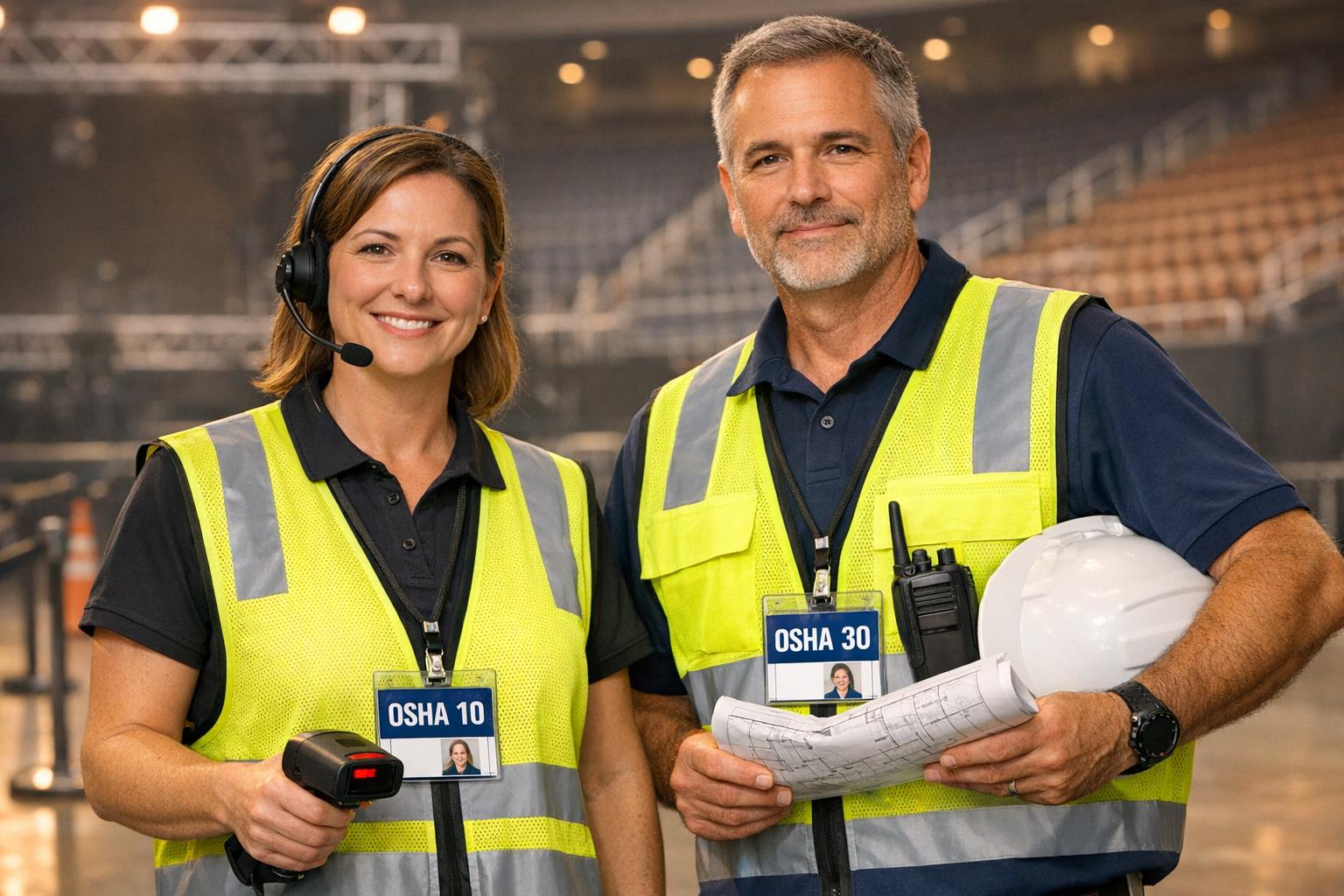
When deciding between OSHA 10 and OSHA 30 for event staff, the key difference lies in the roles and responsibilities of the workers. OSHA 10 is designed for entry-level staff, focusing on basic safety awareness and hazard recognition. OSHA 30, on the other hand, is for supervisors and department heads, covering advanced safety management and oversight responsibilities.
Key points to consider:
Quick Comparison:
| Feature | OSHA 10 | OSHA 30 |
|---|---|---|
| Audience | Entry-level workers | Supervisors, leads |
| Duration | 10 hours (2 days) | 30 hours (4–6 days) |
| Focus | Basic safety awareness | Advanced safety management |
| Key Topics | PPE, hazard recognition | Emergency plans, fall protection, hazard management |
| Cost (Online) | $60–$150 | $130–$250 |
Choosing the right training ensures compliance, reduces risks, and aligns with state laws, much like having a complete event planner kit to stay prepared. Always match the course to the worker’s role and responsibilities.
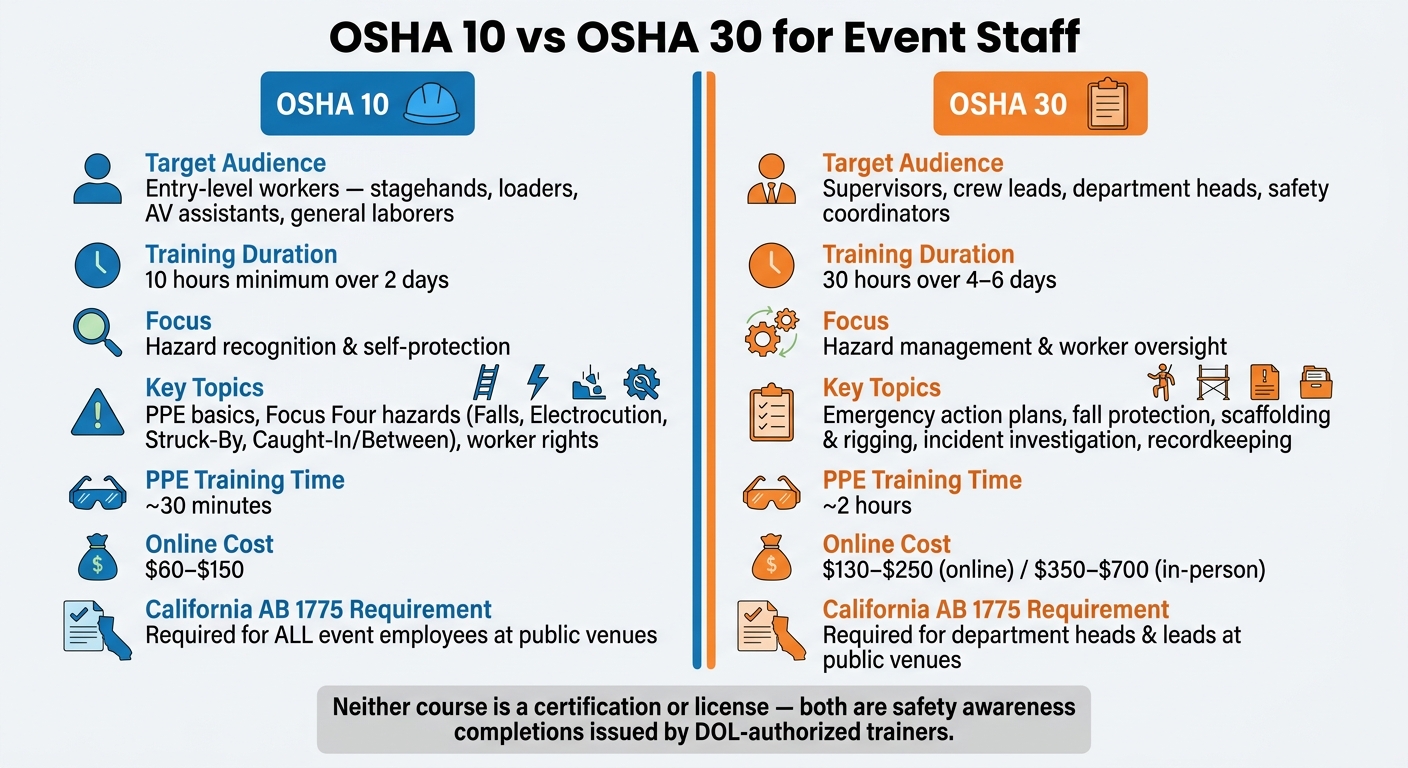
OSHA 10 vs OSHA 30 for Event Staff: Side-by-Side Comparison
The OSHA Outreach Training Program is a voluntary safety awareness initiative created by the U.S. Department of Labor. Its goal is to help workers identify hazards, prevent accidents, and understand their rights. Between fiscal years 2021 and 2025, over 6.51 million workers are expected to complete this training.
To clarify, OSHA emphasizes:
"It is important to note that this is a voluntary program and does not meet the training requirements for any OSHA standards... None of the courses within the Outreach Training Program is considered a certification."
Simply put, the 10-hour and 30-hour completion cards show that a worker has attended a safety awareness course. These cards are not licenses or certifications, nor do they replace specific training for tasks like forklift operation or handling bloodborne pathogens. Consider them as a foundational layer of safety knowledge rather than a comprehensive solution.
With this foundation in place, OSHA offers training tracks designed to address the unique risks faced by event staff.
The Outreach Program provides different training tracks, and selecting the right one is crucial. For event staff, the two most relevant tracks are:
While most event professionals stick to the General Industry track, certain roles, like stagehands assembling large temporary structures or riggers handling load-bearing trusses, may require the Construction track instead. Organizations such as the Event Safety Alliance have adapted OSHA 10 and 30-hour outreach courses specifically for live event settings, addressing hazards unique to stages and venues. Similarly, IATSE (International Alliance of Theatrical Stage Employees) offers specialized "OSHA-10/General Entertainment Safety" courses tailored to industry-specific risks.
These tailored tracks help determine which event roles benefit the most from OSHA training.
Live events often involve roles with physical risks. The table below highlights common event positions and their primary hazard exposures:
| Role | Primary Hazard Exposure |
|---|---|
| Stagehands | Falls, heavy lifting, struck-by incidents |
| Riggers | Working at heights, overhead load failures |
| AV/Lighting Technicians | Electrical hazards, cable trip risks |
| Loaders & Warehouse Crew | Forklift proximity, manual handling injuries |
| Production Managers | Responsibility for crew safety across all departments |
| Site Supervisors | Hazard identification, emergency response coordination |
The level of risk varies by role, so the training should align with the responsibilities. Frontline workers need to recognize hazards and protect themselves, while supervisors must manage hazards and ensure the safety of others while maintaining compliance checks. This distinction is what separates the OSHA 10 from the OSHA 30. Up next, we’ll compare these two courses to identify which is best suited for each role.
OSHA 10 is an introductory safety program designed for frontline, non-supervisory workers. Its main goal is to equip workers with the skills to identify hazards, avoid them, and understand their workplace rights.
"The 10‑hour class is intended to provide workers with awareness of common job‑related safety and health hazards." - Occupational Safety and Health Administration
The program covers essential topics like hazard recognition, worker rights, employer responsibilities, and the process for filing safety complaints. It’s important to note that OSHA 10 is not a certification or license - it’s a foundational safety course. For event staff, this training is particularly relevant because live events often involve physical risks from the moment they step onto a venue floor.
The course must be completed over at least two days (7.5 hours per day), and online participants must finish within six months.
The next section breaks down the specific topics covered and highlights the differences between training tracks.
The topics in OSHA 10 vary depending on the track chosen. For event staff, the most relevant tracks are General Industry (29 CFR 1910) and Construction (29 CFR 1926). The table below outlines the key differences between the two tracks:
| Topic Area | Construction Track | General Industry Track |
|---|---|---|
| Core Hazards | Focus Four: Falls, Electrocution, Struck‑By, Caught‑In/Between | Walking/Working Surfaces, Machine Guarding |
| Electrical Safety | Temporary wiring and power tools | Installed systems and panel safety |
| Event Application | Stage builds, scaffolding, heavy rigging | AV setup, venue operations, warehousing |
| Mandatory Intro | 2 hours: Introduction to OSHA | 2 hours: Introduction to OSHA |
Both tracks include training on selecting personal protective equipment (PPE), such as hard hats, gloves, and hearing protection. They also cover emergency egress and action planning, which are essential for crews working in crowded venues.
The Construction track places a strong emphasis on the Focus Four hazards: falls, electrocution, struck-by incidents, and caught-in/between accidents. These hazards are responsible for about 65% of construction worker fatalities. These same risks are relevant in event production, whether it’s rigging heavy loads overhead or working near forklifts during load-ins.
Based on the hazards discussed, OSHA 10 is ideal for entry-level, non-supervisory event staff. This includes stagehands, loaders, seasonal setup crews, AV assistants, and others working under supervision to set up or tear down event spaces, often managed through event staff scheduling systems.
"The 10‑hour course is built for non‑supervisory workers whose job is to perform tasks safely under direction. It gives them hazard awareness, the right to a safe workplace, and the vocabulary to escalate concerns to supervisors." - SmartQHSE
In some states, OSHA 10 training is legally required. For example, California’s AB 1775 law, effective January 2023, mandates that entertainment event vendors at public venues (like state fairgrounds or university facilities) certify that all employees involved in setup, operation, or teardown have completed OSHA 10 training. Workers in other states should confirm local requirements, as regulations may differ depending on the role or venue.
For teams handling large temporary stage builds or load-bearing rigging, the Construction track is usually the better fit. On the other hand, the General Industry track is more suitable for roles like lighting assistants, sound crew, or warehouse loaders.
OSHA 30 goes beyond basic safety awareness, equipping participants with the skills to lead and manage safety practices on the job. This 30-hour program is designed for individuals who oversee others, such as supervisors, team leads, department heads, and safety coordinators.
"The 30-hour class is more appropriate for supervisors or workers with some safety responsibility." - OSHA
Unlike OSHA 10, which focuses on compliance with safety rules, OSHA 30 delves into managing and improving safety for entire teams. The program is offered in two tracks: Construction (29 CFR 1926) and General Industry (29 CFR 1910). Online participants can complete up to 7.5 training hours within a 24-hour period. The course usually takes 4 to 6 days to complete. This comprehensive approach prepares supervisors to tackle complex safety challenges, as outlined in the advanced topics below.
OSHA 30 builds on the basics covered in OSHA 10, addressing more specialized topics that are crucial for event operations. Here's how these advanced areas apply directly to event staff:
| Advanced OSHA 30 Topic | Relevance to Event Operations |
|---|---|
| Scaffolding & Rigging | Essential for assembling stages, lighting trusses, and audio arrays |
| Electrical Standards | Critical for temporary power setups and large-scale AV installations |
| Emergency Action Plans | Key for managing crowds, fire safety, and evacuation procedures |
| Materials Handling | Important for moving heavy equipment and managing overhead "dead hangs" |
| Fall Protection | Necessary for work on stages, catwalks, or aerial lifts |
| Hazard Communication | Crucial for handling pyrotechnics, fog fluids, or cleaning chemicals |
These topics highlight how OSHA 30 prepares event staff for the unique safety challenges they face. The program also includes training on Job Hazard Analysis, incident investigations, and OSHA documentation requirements under 29 CFR 1904.
"The 30-hour program... adds depth on managing safety and health programs, conducting hazard assessments, and understanding a wider range of OSHA standards." - Dr. William Foster, PhD Safety Science
OSHA 30 is tailored for those responsible for directing work at event sites, such as production managers, stage managers, rigging leads, AV department heads, and site safety coordinators.
In California, OSHA 30 training is legally required under AB 1775 for department heads and leads working at public entertainment venues. These individuals must certify in writing that they have completed the training. California defines a "lead" as anyone supervising or directing workers in an ETCP-certifiable occupation. This regulation emphasizes the importance of specialized safety training for effective event management. For more insights on managing teams, visit The Event Staff Blog.
It's worth noting that OSHA 10 is not a prerequisite for OSHA 30. Workers with experience who are stepping into leadership roles can enroll directly in OSHA 30. Online courses typically cost between $130 and $250, while in-person training ranges from $350 to $700, depending on the location.
To ensure safety and meet compliance standards, it's important to understand the differences between OSHA 10 and OSHA 30. Here's a side-by-side breakdown of the key distinctions, focusing on audience, duration, content, and costs.
| Feature | OSHA 10 | OSHA 30 |
|---|---|---|
| Primary Audience | Entry-level workers, stagehands, apprentices | Supervisors, crew leads, department heads |
| Training Hours | 10 hours (minimum 2 days) | 30 hours (minimum 4–5 days) |
| Focus | Hazard recognition and self-protection | Hazard management and worker oversight |
| Key Topics | Focus Four hazards, PPE basics, introductory OSHA content | All OSHA 10 topics plus recordkeeping, safety programs, and incident investigation |
| PPE Training | Approximately 30 minutes | Approximately 2 hours |
| Legal Requirement (CA) | Required for all event employees at public venues | Required for department heads and leads at public venues |
"OSHA 10 teaches someone how to spot danger. OSHA 30 teaches someone how to spot it, address it, and think about how it affects everyone else too." - Colton Hibbert, SEO Content Writer, Coggno
Now, let’s match specific event roles with their recommended training levels.
Choosing the right training for each role ensures compliance and workplace safety. Below is a guide to aligning event positions with their ideal OSHA certification.
| Event Role | Recommended Training | Reason |
|---|---|---|
| Stagehand / General Laborer | OSHA 10 | Covers basic hazard awareness for physical job site risks |
| Apprentice (Lighting, Sound, etc.) | OSHA 10 | Introduces foundational safety concepts for new workers |
| Loader / Assembler | OSHA 10 | Focuses on materials handling and physical hazard exposure |
| Lift Operator | OSHA 10 + Equipment License | Combines general safety with task-specific certification |
| Rigger / Lead Rigger | OSHA 30 | High-risk role requiring oversight and advanced safety knowledge |
| Department Head (Lighting/Audio) | OSHA 30 | Supervisory role with legal requirements in California |
| Project Manager / Site Superintendent | OSHA 30 | Responsible for site-wide safety and crew management |
| Safety Coordinator | OSHA 30 | Requires advanced skills in hazard assessment and recordkeeping |
Other factors like event scale, venue type, and legal mandates also play a role in determining the appropriate training.
Event Size and Complexity: Smaller events with straightforward setups involve fewer risks, so OSHA 10 may suffice for most roles. However, large-scale productions - such as multi-day festivals with rigging, aerial lifts, and temporary power - demand OSHA 30-trained supervisors to handle detailed hazard assessments and manage diverse teams.
Venue Type and State Law: Location matters. For example, California's AB 1775 mandates OSHA 10 certification for all event employees and OSHA 30 for department heads at public venues like state fairgrounds, parks, and universities. Other states, such as Nevada and New York, have similar requirements, so compliance often depends on where the event takes place.
Union Agreements and Venue Contracts: Industry organizations like IATSE have created entertainment-specific OSHA courses that align with union standards. Additionally, many general contractors and insurance programs - especially those tied to Owner-Controlled Insurance Programs (OCIPs) - demand OSHA 30 certification for supervisory roles before work begins.
Finally, selecting the right industry track is crucial. Event crews working on construction-related tasks, such as stage building or rigging, should take the Construction track (29 CFR 1926). Meanwhile, staff handling logistics or warehousing are better suited for the General Industry track (29 CFR 1910). This ensures training aligns with the specific hazards workers are likely to encounter.
Once you've matched roles with the necessary training, the next step is to document, verify, and incorporate these certifications into your hiring and scheduling systems. Often, the challenge isn't providing the training itself but ensuring the records are tracked and maintained properly. By integrating this into your process, safety training becomes more than just a compliance checkbox - it becomes a proactive part of managing your event staff.
OSHA requires more than just conducting training - it demands proof that the training happened and was effective. Each record should include key details like the employee's name, job title, course title, training date, and the trainer's qualifications. Simply having attendance logs won't cut it. Inspectors expect evidence of understanding, such as quiz results (with an 80% pass rate often being the standard) or hands-on demonstrations.
"If your training records can't be produced quickly during an inspection, OSHA treats the training as if it never happened." - Coggno
Digital record-keeping is highly recommended, as paper documents are prone to being misplaced, especially during staff changes. Experts advise keeping these records for the duration of employment plus at least five years after an employee leaves. It's worth noting that issues with documentation account for about 25% of OSHA citations.
Using a role-based training matrix can help align certifications with specific job responsibilities. This approach differentiates between non-supervisory and supervisory roles, ensuring the right level of training for each position. Retraining should be scheduled whenever new equipment is introduced, new hazards are identified, or employees transition into supervisory roles.
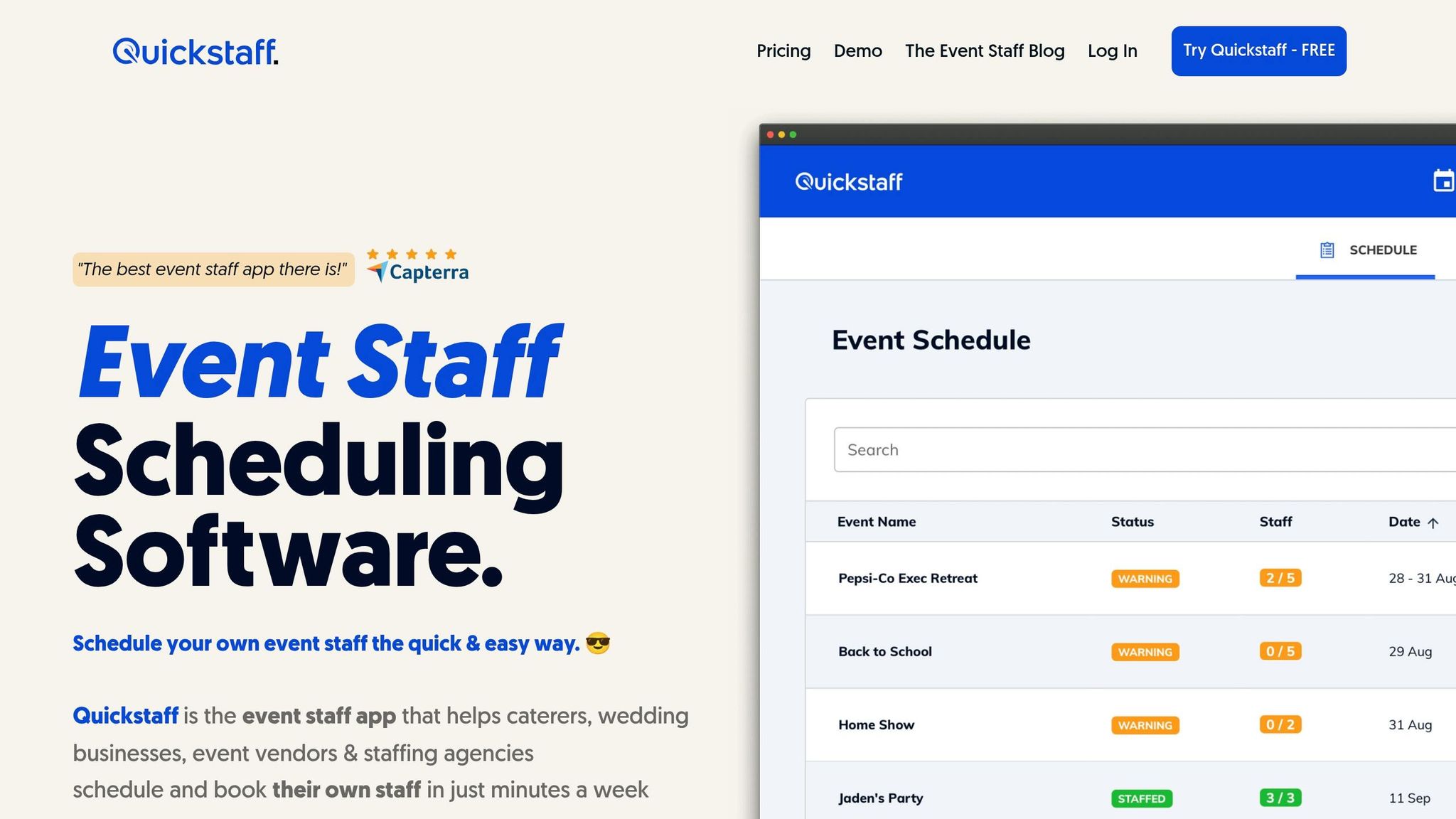
Managing OSHA 10 and OSHA 30 certifications for gig workers and event staff can be a logistical headache without budget-friendly staff scheduling tools. Quickstaff streamlines this process by centralizing staff profiles, certifications, and scheduling in one platform. The system tags roles based on certification levels, making it easy to assign appropriately trained staff to higher-risk positions. Its mobile-friendly interface also ensures staff are ready from day one, giving them access to event details, role-specific requirements, and safety reminders before they even arrive on-site. For staffing agencies working in a dual-employer setup - where both the staffing firm and the event host share responsibility for training - Quickstaff's centralized system makes it far simpler to demonstrate compliance.
OSHA 10 and OSHA 30 serve different purposes: OSHA 10 focuses on helping workers identify hazards, while OSHA 30 is tailored for supervisors tasked with overseeing safety on a broader scale. OSHA 10 is ideal for entry-level roles like stagehands, technicians, and general laborers. Meanwhile, OSHA 30 equips department heads, leads, and supervisors with the tools to manage site-wide safety, perform hazard analyses, and ensure their teams' well-being.
This distinction matters because choosing the wrong training can have serious consequences. As SmartQHSE warns:
"Picking the wrong course can render the card unusable for the work being performed."
In states like California, compliance carries even more weight. AB 1775 requires OSHA 10 training for general event workers and OSHA 30 for department heads and leads at public venues. Failing to meet these requirements can lead to hefty fines and legal risks.
The solution is straightforward: match roles to the correct training, confirm Department of Labor-authorized cards, and keep digital records ready for inspections. Incorporating OSHA training into your staffing process not only ensures compliance but also keeps operations running smoothly. This proactive approach minimizes risks like work stoppages, site dismissals, and penalties.
Ultimately, selecting the right OSHA training level is one of the simplest - and most effective - ways to protect your team, clients, and business.
When deciding on the right safety training track, focus on the nature of the work rather than the employer's classification. Jobs like event production or managing stage setups typically fall under General Industry, as they involve hazards related to facility operations. On the other hand, the Construction track is designed for tasks like building, demolition, or other traditional construction activities. It's crucial to ensure your team receives the correct training and oversight to meet safety standards effectively.
Whether an OSHA 10 or OSHA 30 card is sufficient depends on factors like your job role, state regulations, and specific venue agreements. While OSHA itself doesn’t require these certifications, many states and venues do. Generally, OSHA 10 suits entry-level workers, while OSHA 30 is more appropriate for supervisors and managers. It’s always a good idea to review local laws and venue contracts to ensure you meet the necessary standards. Tools like Quickstaff can simplify this process by keeping staff certifications organized and readily available for events.
OSHA's 10 and 30-hour courses are a great starting point for general safety awareness, but they don't dive into training for specific hazards. For example, handling equipment like forklifts requires extra steps. OSHA mandates formal instruction, hands-on practice, and site-specific training tailored to the workplace.
On top of that, employers have to evaluate each operator's performance, document the training process, and re-assess operators at least once every three years. And here's a key point: all of this training must be completed before anyone gets behind the controls of such machinery.