OSHA Training for Temporary Event Staff
August 12, 2026

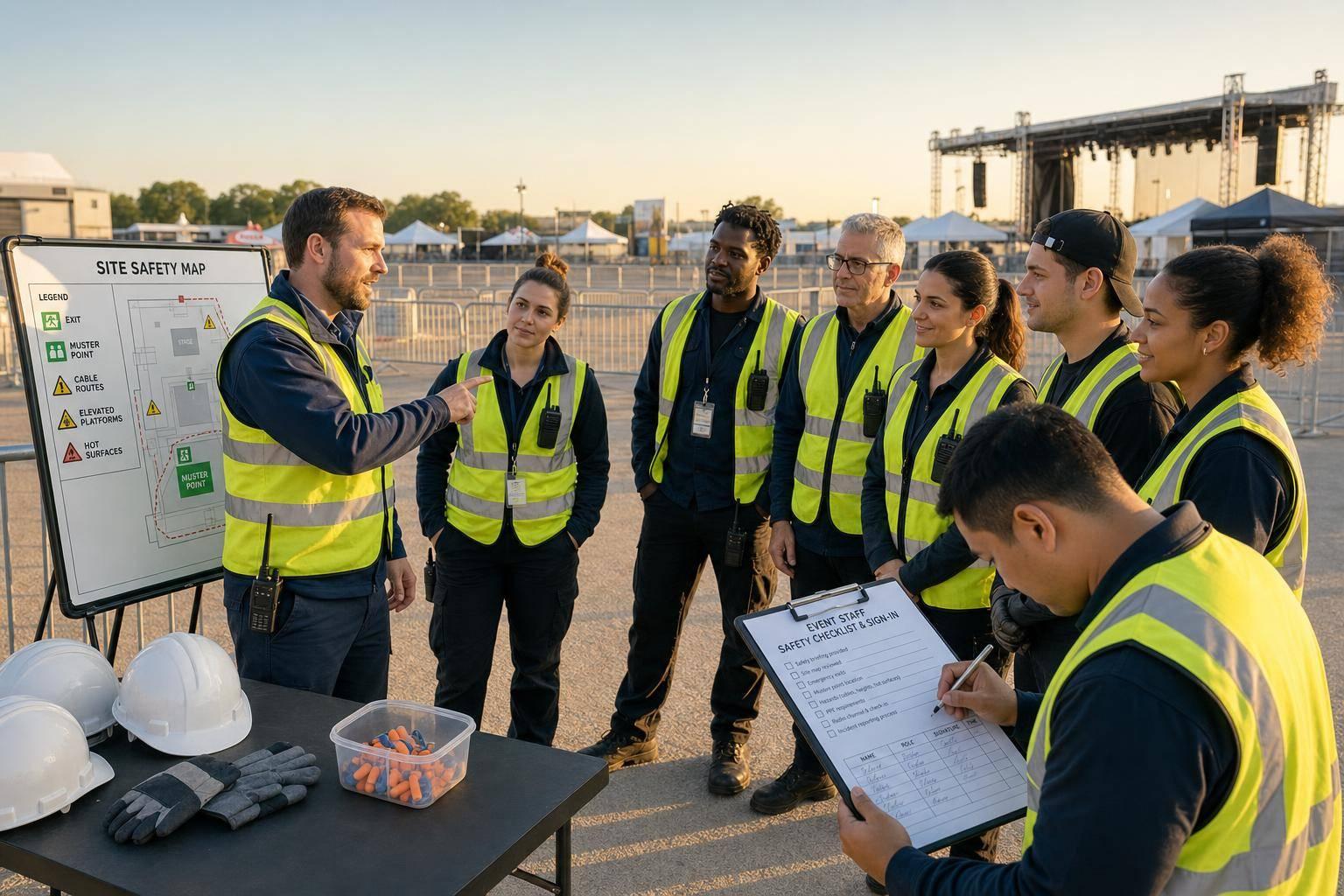
If you use temp event staff, a short safety huddle before every shift is the fix. In event food-service work, the injury and illness rate hit 107.6 cases per 10,000 workers, higher than the 89.4 rate for all private industry.
I’d keep OSHA training for temp staff simple:
The main point is simple: temp workers need the same level of training as other workers doing the same job, and they need it before they start work. For event teams, that means short, clear, site-based instruction on slips, lifting, kitchen hazards, stage and dock risks, and what to do if someone gets hurt.
A few details matter most:
I’d also keep the briefing format the same every shift:
And I’d document every huddle with a one-page sign-in sheet that lists the date, time, event, location, roles, topics covered, trainer, and worker acknowledgment.
That’s the article in plain English: keep training short, site-specific, and consistent, then file the record the same day.
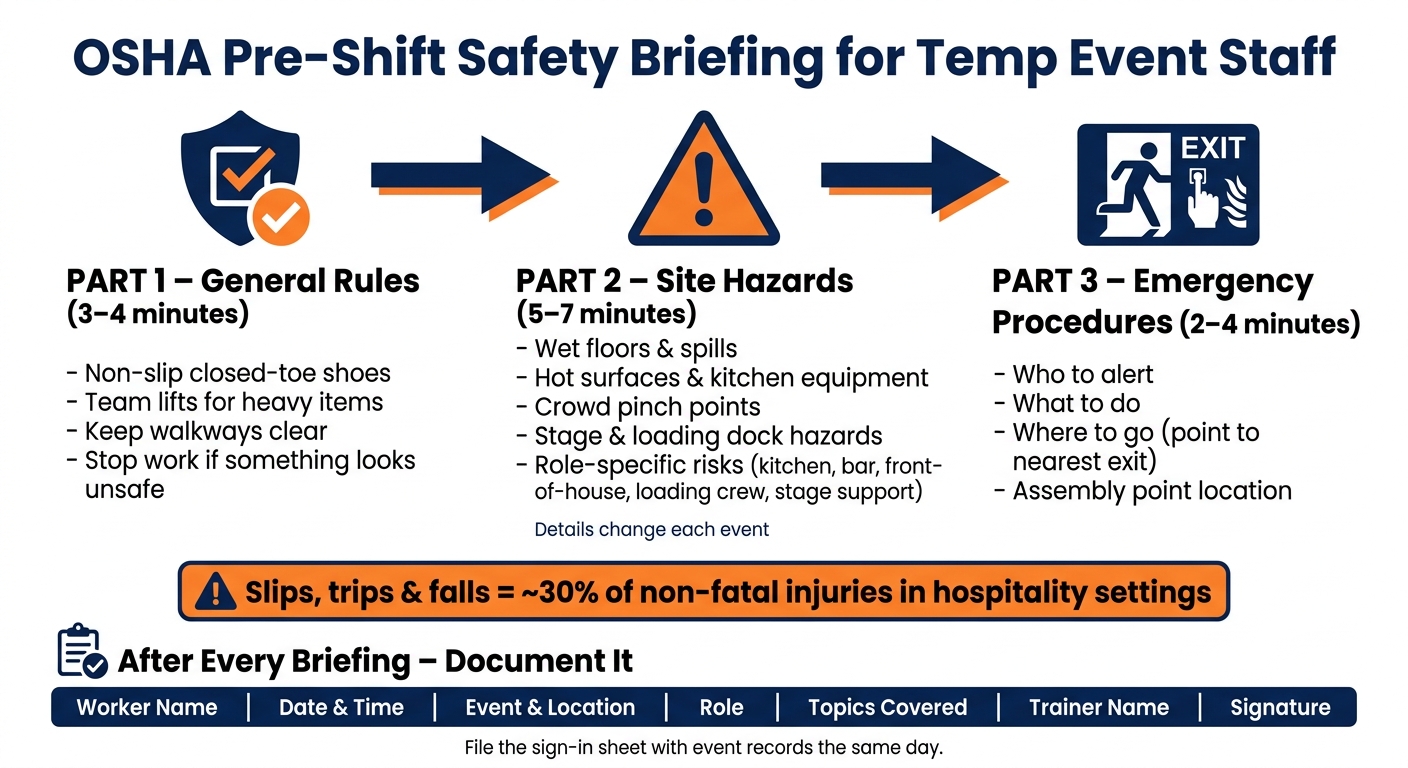
OSHA Pre-Shift Safety Briefing for Temp Event Staff
Temporary event workers need the same, or an equivalent level of, training as permanent staff doing the same or similar work. OSHA's Temporary Worker Initiative makes one thing plain: both the staffing agency and the host employer have a role. That split shapes what gets covered before placement and what must be handled on-site.
OSHA treats staffing agencies and host employers as jointly responsible for training, hazard communication, and recordkeeping. In most cases, the staffing agency handles general safety orientation before placement. The host employer - such as the caterer, venue, or production company - handles site- and task-specific training because it controls the worksite. That division gives you a simple way to build a short, repeatable pre-shift briefing.
It also keeps the briefing tight and helps avoid the classic problem where each side assumes the other covered something.
| Area | Staffing Agency | Host Employer |
|---|---|---|
| Training | General safety orientation before placement | Site- and task-specific instruction for the actual event venue |
| Supervision | Stays in contact and confirms the assignment is safe | Directs day-to-day work and enforces safety rules on-site |
| Hazard communication | Shares general chemical hazard awareness basics | Provides site-specific hazard info, labels, and SDS access |
| Injury reporting | Coordinates with host; tracks worker issues through placement | Sets the reporting process. |
Neither party can assume the other handled it. Contracts between host employers and staffing agencies should spell out who covers each training topic, who provides PPE, and how injuries are reported and logged.
Before a temporary worker touches a tray, steps behind a bar, or walks into a kitchen, five points need to be clear: their worker rights, who manages safety on-site, how to report a hazard or injury, what PPE their role requires, and where the emergency exits and assembly points are located.
OSHA requires training in a language workers understand. If those basics aren't clear, the shift shouldn't start.
General safety training from the staffing agency is only the starting line. The host employer then needs to add instruction tied to the actual event space, because the risks at a hotel ballroom are not the same as those at an outdoor festival or a stadium loading dock.
Walk workers through the space before work starts. Show them cables, dock access points, hot equipment, staging zones, and restricted areas. That's the kind of plain, location-based instruction OSHA expects from host employers, and it matters even more when workers move from one layout to another from event to event.
Next, turn these duties into a 10–15 minute briefing built around the day's actual hazards.
Turn those site-specific duties into a short pre-shift huddle. This is a brief, on-the-floor safety talk before work starts. Keep it to 10–15 minutes and stick with the same format each shift. That way, the briefing stays fast, clear, and easy to repeat.
A simple way to make the briefing reusable is to split it into three fixed parts: general safety rules, site hazards, and emergency procedures. The format stays the same every shift. Only the event details change.
Part 1 – General rules (3–4 minutes). Start with the day’s non-negotiables: closed-toe, non-slip shoes, team lifts for heavy items, and clear walkways. Be direct. If something looks unsafe, staff should stop work and call a supervisor.
Part 2 – Site hazards (5–7 minutes). This is the part that changes from one event to the next. Walk through hazards by area using plain language. For example:
wet floors near Bar 2 from ice melt - put out a sign and report it immediately.
Also flag hot equipment, crowd pinch points, and any stage or loading-dock hazards that matter that day.
Part 3 – Emergency procedures (2–4 minutes). Cover three things: who to alert, what to do, and where to go. Have staff point to the nearest exit and say the assembly point out loud.
A common mistake is trying to cover too much. That usually slows the huddle down and makes people tune out. Put more time on the risks that show up most often. Slips, trips, and falls alone account for roughly 30% of all non-fatal injuries in hospitality environments.
Once the huddle is set, make it easy to repeat and track. Use a one-page script with three headings and blank lines for the event name, location, and that day’s hazards. Supervisors can fill in the blanks before each shift, then use the same opening and closing every time. A laminated script with a dry-erase marker makes this even easier.
Before work starts, ask two or three quick check-back questions to make sure the message landed. For example:
If the event uses more than one space, give the main briefing to the full group first. Then add short station-specific notes once staff are at their posts. This keeps the core huddle tight while still covering role-based risks without turning it into one long talk.
Use the pre-shift huddle to cover the hazards tied to the job each person will do that day. Not every risk fits every role, and trying to cover everything at once usually makes people tune out. A kitchen temp needs to hear about hot surfaces and knife safety. A loading crew member needs to hear about vehicle traffic and heavy lifting. Keep it role-specific.
Hazard awareness is simple: spot anything that could hurt someone, especially anything out of place, and fix it or report it right away. Teach staff one short habit: Look, Think, Act.
Near-misses matter too. If a tray almost fell or a guest nearly tripped on a cord, that still needs to be reported. Use one standard method every time, whether that's a paper form, a text template, or scalable event scheduling software. Keep the format the same: who saw it, what happened, where and when it happened, what action was taken right away, and who was told.
Treat every report as helpful, not as a problem.
For lifting, give staff one phrase they can remember under pressure: Keep it close, bend, and turn with your feet. That applies to banquet tables, beverage cases, AV crates, and chair stacks. If something is awkward or heavy, ask for help. If a dolly or cart is there, use it.
In the kitchen, most injuries come from three trouble spots: sharp tools, hot surfaces, and slippery floors. Keep knives on stable cutting boards. Carry them point-down at your side. Never leave them sitting in a sink. Oven mitts need to be dry before touching hot pans or chafer lids, and lids should open away from the face to avoid steam burns. Clean spills at once, and put out wet-floor signs before people walk through.
For food-service staff, hot food must stay at 135°F or above, and cold food must stay at 41°F or below. Throw out food held in the danger zone for more than 4 hours. Handwashing means warm water, soap, and scrubbing for at least 20 seconds - before gloves go on, after handling trash, and after touching your face or hair. Gloves don't replace handwashing. Wash first, then put gloves on, and change them when switching tasks.
Keep temp staff out of marked stage and technical zones, including behind the main stage, rigging areas, and lighting or sound control booths. They should never move sandbags, trusses, lighting stands, or other stage gear unless the stage crew tells them to. If anything overhead looks loose or unstable, report it at once and keep people clear of that spot.
Tell staff to walk around loose cables, not across them. If a cable cover is lifting or curling, report it right away. Use the same short script each day to call out stage, dock, and back-of-house risks. In loading docks and back-of-house areas, staff should stay in marked pedestrian lanes, make eye contact with forklift or vehicle operators before crossing, and never ride on powered equipment. Chairs and boxes should be stacked only to a safe height, and aisles need to stay clear.
If there's an emergency, guest-facing staff should guide guests to exits and assembly points using plain language. Follow the venue's emergency lead and security team. For a medical incident, do not move the guest unless there's immediate danger. Contact a supervisor, onsite medical staff, or security right away, then stay with the guest until help arrives. If something feels off - a guest seems disoriented, crowd pressure is building near a doorway, or a fight looks like it's starting - send it to a supervisor or security immediately.
Use this table to match each role with the right hazard points for that shift:
| Role | Common Hazards | Key Talking Points | When to Stop and Report |
|---|---|---|---|
| Kitchen | Wet floors, hot surfaces, knives, cleaning chemicals | Non-slip shoes, dry oven mitts, knife handling rules, check hot holding temps (135°F or above) | Chemical spills, equipment malfunction, suspected food contamination |
| Front-of-House | Cluttered walkways, cords, crowd pressure, blocked exits | Keep paths clear, monitor guest queues, know evacuation routes and assembly points | Blocked exit, crowd surge, guest medical emergency |
| Bar | Broken glass, spills, heavy kegs, intoxicated guests | Sweep glass immediately, wipe spills fast, use two-person keg lifts, escalate over-intoxication concerns | Unsafe crowd behavior, injury, broken glass, intoxication concern |
| Loading Crew | Lifting injuries, vehicle traffic, dock edges, unstable stacks | Use dollies, two-person carries, stay in pedestrian lanes, make eye contact with drivers | Vehicle near-miss, falling load, dock edge hazard |
| Stage Support | Cable trip hazards, restricted zones, falling objects, overhead rigging | Stay out of tech zones, walk around cables, never move stage gear without instruction | Unsecured equipment, wobbling structure, anything overhead that looks loose |
Record the hazards covered and who was present before the shift starts.
Once the briefing is done, document it the same way on every shift. That part matters. A briefing only counts if you can show that it happened.
The easiest way to do that is to build a simple record for each pre-shift huddle. Then file it with the event paperwork so it’s easy to pull during an inspection or after an incident review.
A simple one-page template usually does the job. It works as both a training guide and a sign-in sheet.
The supervisor follows a short, standard script that covers the day’s main hazards, how workers should report problems or injuries, and what to do in an emergency. At the same time, staff sign in as they’re briefed. Role checklists help confirm that each assignment’s hazards were covered.
OSHA's sample Employee Training/Staff Sign-In Sheet includes fields for date, topic, company name, training location, trainee names, signatures, and trainer signature.
Use the same fields every time so each event record is easy to file and review side by side. Include these fields in every briefing record:
| Field | Purpose | Paper Method | Digital Method |
|---|---|---|---|
| Worker full name | Links training to the individual who performed the work | Printed sign-in sheet | Spreadsheet or scheduling platform roster |
| Date and start time | Confirms training happened before hazard exposure | Handwritten on the form | Auto-populated in a digital form or scheduling tool |
| Event name and location | Ties the record to a specific site and its hazards | Pre-printed on the template | Event field in scheduling software |
| Staff role or assignment | Confirms role-specific hazards were addressed | Checkbox or written entry | Role assignment in scheduling platform |
| Topics covered | Shows training matched the actual risks at that event | Checkboxes on the script | Dropdown or checklist in a digital form |
| Trainer name and title | Shows that a competent person led the briefing | Trainer signs the form | Name field with supervisor login |
| Signature or digital confirmation | Provides evidence that the worker received the briefing | Handwritten signature on paper | Digital acknowledgment or timestamped confirmation |
File completed records with the event folder right after the shift. Keep those records for the retention period required by the applicable standard.
If you use scheduling software, it helps to keep the roster, reminders, and briefing notes in one place. Quickstaff can centralize event details, role assignments, reminders, and attendance confirmations so supervisors can match the briefing to the scheduled team.
Before a shift, you can add briefing notes and hazard summaries to the event details so every scheduled worker sees the same information. Then pair that with a paper sign-in sheet collected onsite. That gives you a clear record of who was assigned, who got pre-event information, and who signed off at the briefing.
Three reference tables support the briefing system. The first shows host employer and staffing agency training duties:
| Responsibility | Host Employer | Staffing Agency | Shared |
|---|---|---|---|
| General hazard awareness and OSHA rights training | ✓ | ||
| Site-specific safety briefing (layout, hazards, emergency routes) | ✓ | ||
| Long-term worker training records | ✓ | ||
| Event-specific briefing logs | ✓ | ||
| Injury and illness reporting process | ✓ | ||
| Coordinating on roles and hazard information | ✓ | ||
| Sharing incident reports | ✓ |
The hazard-by-role pre-shift briefing table in Section 3 and the training record fields table above round out the set. Together, they give supervisors a ready-to-use documentation system for each event.
Temporary event staff face the same physical hazards as full-time workers: wet floors, hot surfaces, heavy loads, and crowded back-of-house corridors. OSHA expects employers to protect both groups to the same standard.
The risk goes up when training is rushed or vague. A 10–15 minute pre-shift huddle helps fix that. For that reason, the huddle should use the same format every shift.
Keep the briefing the same each time. Cover hazard awareness, reporting, lifting, kitchen rules, stage and back-of-house risks, and emergency steps. Keep each topic tight, with just one or two rules.
After that, document the huddle the same way every time. A one-page sign-in sheet is enough. File it with the event records that same day.
Then end with one simple expectation for the team: report unsafe conditions immediately to a supervisor or team lead.
Short, specific, and consistent training is the standard.
Training temporary event staff is a shared job between staffing agencies and event vendors.
In most cases, staffing agencies handle general safety training and basic work rules. Vendors then cover the stuff that changes from site to site, like job-specific hazards, equipment use, and day-to-day tasks.
That split matters. If no one spells it out, gaps can show up fast.
Written agreements should clearly define who handles what so both sides stay compliant. A simple, plain-English breakdown can help avoid confusion and make it easier to show that training duties were assigned and completed.
Quickstaff can help by putting staff profiles and certifications in one place, which makes it easier to track training status in a dual-employer setup.
A pre-shift safety huddle should be brief, consistent, and tied to the site so the team knows what to watch for before the event starts.
Cover the main risks on site, such as trip hazards, blocked fire exits, and exposed cabling. Then touch on safe lifting, proper PPE use, working-at-height rules, and the emergency action plan.
That plan should include:
The goal is simple: make sure everyone starts the shift prepared for the hazards in front of them, not just the ones on paper.
Keep verifiable records, not just attendance logs. For each temp staff member, record their name, job title or role, course title, training date, trainer qualifications, and proof that they understood the training, such as quiz scores or hands-on sign-offs.
Digital records help cut down on lost paperwork. Keep these records for the full length of employment plus at least 5 years after the worker leaves. Update them any time hazards, equipment, or job duties change.