Illinois Temporary Worker Rights for Event Staff
July 22, 2026

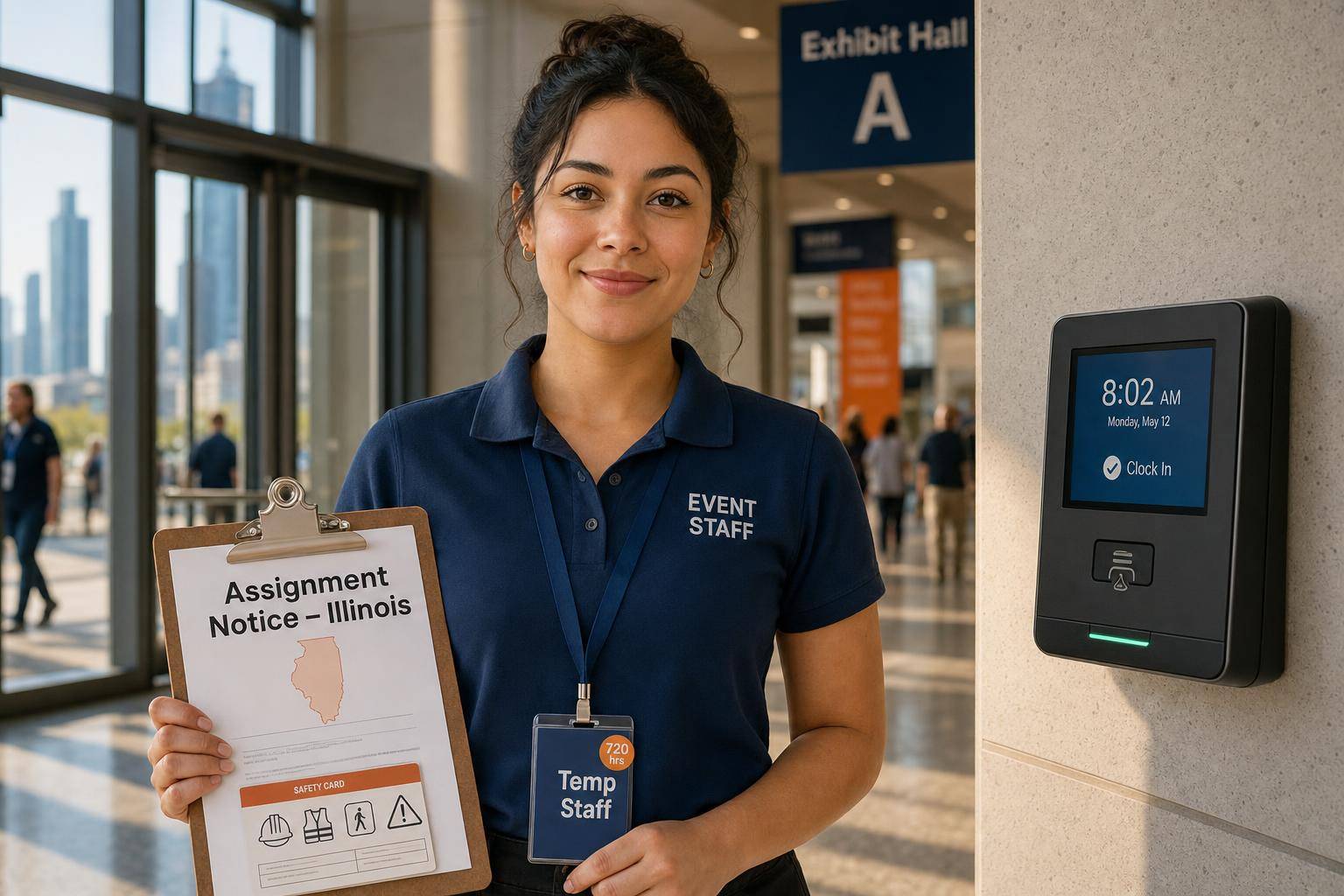
If you use temp event staff in Illinois, both the staffing agency and the client can get fined when pay, notices, safety steps, or records are missing.
I’d boil this article down to four rules: track hours, send written assignment notices before dispatch, handle safety training on both sides, and watch the 720-hour mark. Once a temp worker hits 720 hours with the same client in a 12-month period, pay and benefits rules change, and the agency may owe a higher hourly rate plus benefit value.
Here’s the short version:
A few numbers stand out: 40 hours is the overtime line in a workweek, 720 hours is the equal-pay trigger with the same client, and agencies generally must keep records for at least 3 years.
| Topic | Main Rule |
|---|---|
| Pay | At least minimum wage, plus overtime after 40 hours |
| Long-term assignments | Equal-pay and benefits rules can start after 720 hours with one client |
| Assignment paperwork | Written notice before dispatch |
| Safety | Agency handles pre-dispatch training; client handles site-specific hazards |
| Records | Keep records for at least 3 years |
If I were running event staffing in Illinois, I’d treat this as a paperwork-and-tracking law as much as a wage law.
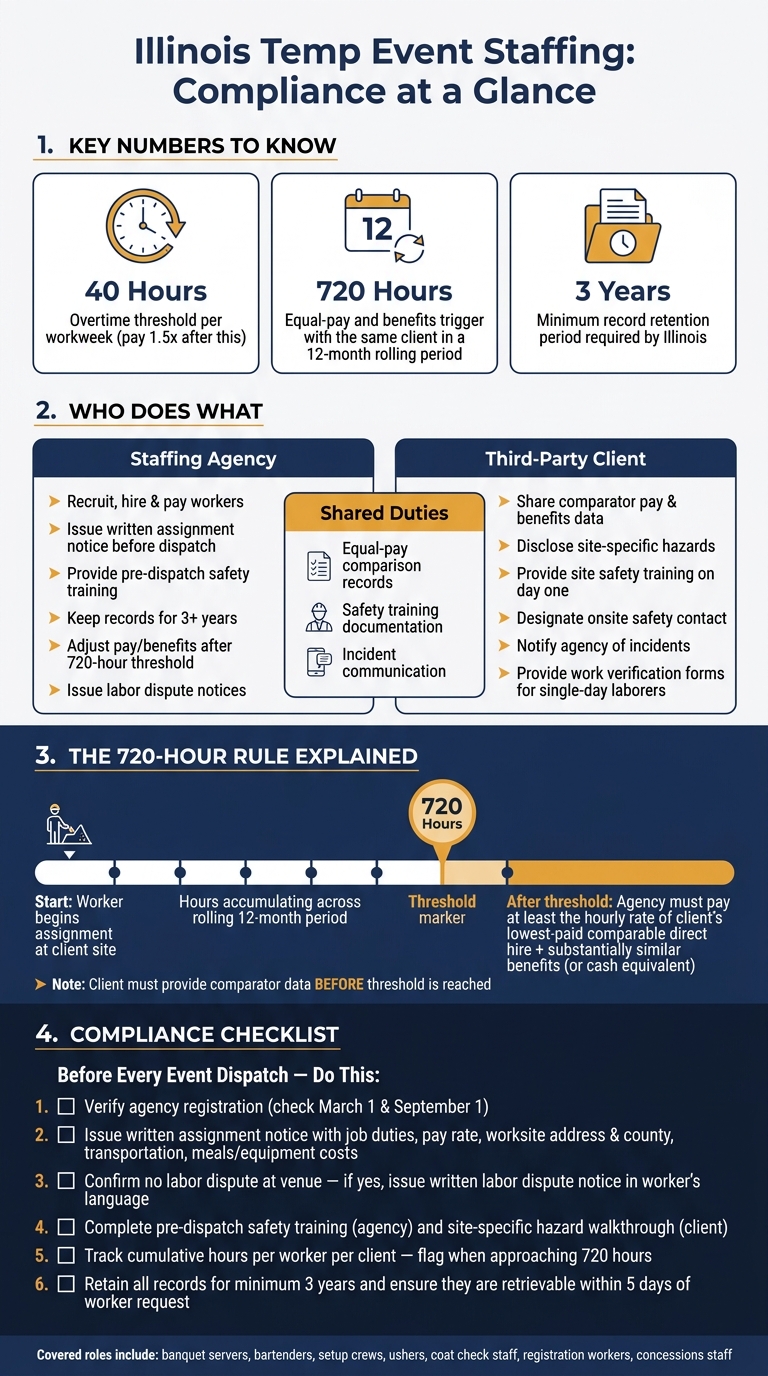
Illinois Temp Worker Compliance Checklist for Event Staffing
Once coverage is in place, the next step is figuring out who does what when it comes to pay and information. Illinois splits those duties across three parties.
The staffing agency recruits, hires, and pays the workers. The worker is the person sent to the event assignment, like a banquet server or registration clerk. The third-party client is the caterer, hotel, venue, or production company that directs the work on-site and gets the labor's day-to-day output.
Illinois looks at where the work happens, not where the agency or client is located.
At a bare minimum, agencies must pay temporary event workers at least the Illinois minimum wage. And if a local rule sets a higher rate, like in Chicago or Cook County, that higher rate applies. Overtime starts after 40 hours in a workweek, and those extra hours must be paid at no less than 1.5 times the worker's regular rate.
Agencies can make deductions only when the law allows them, and those deductions can't push pay below minimum wage.
The pay rules change once a worker stays with the same client long enough. After 720 hours with the same client during a rolling 12-month period, the agency must pay at least the straight-time hourly rate paid to the client's lowest-paid direct hire doing substantially similar work. If there isn't a direct-hire worker in a similar role, the comparison shifts to the client's lowest-paid direct-hire employee who is entitled to overtime.
That means agencies and clients need to track hours by worker and by client across assignments. If that tracking slips, the pay rate can slip too.
Pay isn't the only issue here. Once the 720-hour mark is reached, agencies also must provide substantially similar benefits, or pay the hourly cash equivalent of what those benefits actually cost the client. Only the agency's actual benefit cost counts for this rule. Deductions taken from the worker's paycheck do not reduce that duty.
That setup depends on one thing: the client has to give the agency the right comparison data.
Agencies can't set the proper pay rate if the client doesn't hand over solid information. Illinois puts that duty squarely on third-party clients. They must provide job duty, pay, and benefits details for their directly hired comparison employees so the agency can work out what equal pay and benefits should be.
In practice, clients must share the comparator role, pay rate, overtime status, and benefit details the agency needs to calculate equal pay and benefits. Without that information, the agency can't price the assignment the right way.
Once pay terms are set, the next step is getting the assignment in writing before anyone is sent out. In Illinois, a worker must receive a written assignment notice before dispatch.
That notice must include the worker's name, the nature of the work and basic duties, wages offered, the full name and address of the worksite, including county, transportation terms, and whether meals or equipment are provided and what they cost.
For event roles, the notice should be specific. It should say whether the worker is assigned to banquet service, teardown, or another task. It should also spell out any uniforms, equipment, or food-handling rules tied to the job.
If anything material changes, that change has to be documented before the worker starts the new assignment terms. For multi-day events, the agency must issue a new notice before any change in pay, duties, or location takes effect. So if someone moves from a ballroom to an outdoor tent, or from banquet service to teardown, that shift calls for a new notice.
There's another step that often gets missed. If a worker applies in person, by app, or online and does not get assigned work that day, the agency must provide a written receipt on the required state form. That receipt records the worker's name, the date and time they sought work, how they sought it, and the types of jobs they were seeking.
This matters more than it may seem at first glance. If workers report for event work, check in, and then end up unassigned, that receipt helps create a paper trail for what happened that day.
If an assignment involves a site where there is a strike, lockout, or other labor dispute, the agency must give the worker written notice before dispatch. The notice has to be in a language the worker understands, and it must state both that a labor dispute exists and that the worker may refuse the assignment without losing future opportunities.
A compliant notice should restate the event details, briefly describe the dispute, and clearly explain the worker's right to decline without retaliation.
Agencies should have dispute-notice templates ready to go and translated into common worker languages, such as Spanish, Polish, or other languages commonly used in the area. On the back end, refusals should be logged in neutral terms. They also must not lead to fewer future assignments. If scheduling drops after a lawful refusal, regulators may view that pattern as retaliation.
Assignment communication isn't just about pay and location. It also covers safety.
Illinois places pre-dispatch safety duties on both agencies and clients. Before sending workers out, agencies must ask clients about worksite hazards, safety practices, and the designated safety contact. For a hotel banquet, that can mean asking about slip-and-fall risks, hot kitchen areas, and evacuation routes. For an outdoor festival, it can mean heat stress procedures, crowd flow planning, and severe weather steps.
That information should feed into the agency's pre-dispatch safety training. Before workers arrive, the agency must train them on hazards, PPE, and how to report concerns.
Clients handle the site-specific side. They must disclose hazards tied to the venue, show workers loading docks, stairways, and emergency exits, and identify an onsite safety contact for temporary staff. Put simply: the agency covers pre-dispatch prep, while the client covers what workers need to know once they reach the site.
| Safety Duty | Agency Responsibility | Client Responsibility |
|---|---|---|
| Pre-assignment hazard inquiry | Ask clients about known hazards, safety practices, and emergency procedures before dispatch | Respond accurately and completely to agency inquiries |
| General safety training | Provide pre-dispatch safety training on hazards, PPE, and reporting before workers arrive | - |
| Site-specific training | - | Walk workers through venue-specific hazards, exits, and equipment on day one |
| Safety contact | Inform workers who to contact at the agency if issues arise | Designate an onsite supervisor for temporary worker questions |
| Incident communication | Stay informed of incidents involving placed workers | Promptly notify the agency of any incidents or near misses involving temp staff |
Both agencies and clients should document this coordination. That's especially important at busy venues where multiple staffing agencies and vendors are working side by side. Regular communication records can help show who shared what, when they shared it, and how safety issues were handled.
Once pay, notice, and safety rules are in place, records become the proof. If the Illinois Department of Labor reviews your staffing setup, documentation is what shows whether you followed the law. Under the DTLSA, staffing agencies must keep records for at least three years, and those records must be available for IDOL inspection during normal business hours.
A simple way to handle this is to split record ownership clearly:
| Record Type | Primary Keeper |
|---|---|
| Assignment notices with job duties, pay rate, and worksite | Agency |
| Hours worked and wages paid per pay period | Agency |
| Itemized deductions and net pay records | Agency |
| Equal-pay comparison data for long-term assignments | Agency + Client |
| Labor dispute notice records | Agency |
| Safety training records and hazard disclosures | Agency + Client |
| Work verification forms for single-day assignments | Client |
| Direct-hire compensation data for comparable roles | Client |
Workers can also request access, in writing, to key assignment and hours-billed records, and agencies must respond within five days. That means records can't just exist somewhere in a folder. They need to be organized and easy to pull up.
These records often show where event businesses slip up.
The biggest problem is treating each event like its own little world. On paper, a worker may look like they only handled a few short shifts. In practice, that same person may have worked across an entire season. When cumulative hours aren't tracked, the 720-hour equal-pay trigger gets missed. Then an IDOL investigator asks for the full assignment history, and there's no clean record to show it.
Another weak spot is covered roles that don't feel covered. Setup crews, coat check staff, registration workers, and concessions staff supplied through an agency are covered under the DTLSA. Because those jobs can seem casual or one-off, businesses often skip written assignment notices, pay records, or safety training documentation.
Safety records also tend to fall apart in the handoff between venue and agency. A venue may have house rules and safety guidance, but there is often no record showing that temporary workers got that information before the event or confirmed that they received it. That's a problem when you're trying to show who knew what and when.
Labor-dispute notices are another miss. If a hotel or venue is dealing with a strike or lockout, the client must notify the agency in writing. The agency then has to give workers written notice and keep proof that the notice was delivered. In many cases, this step gets skipped from start to finish, which leaves both sides exposed.
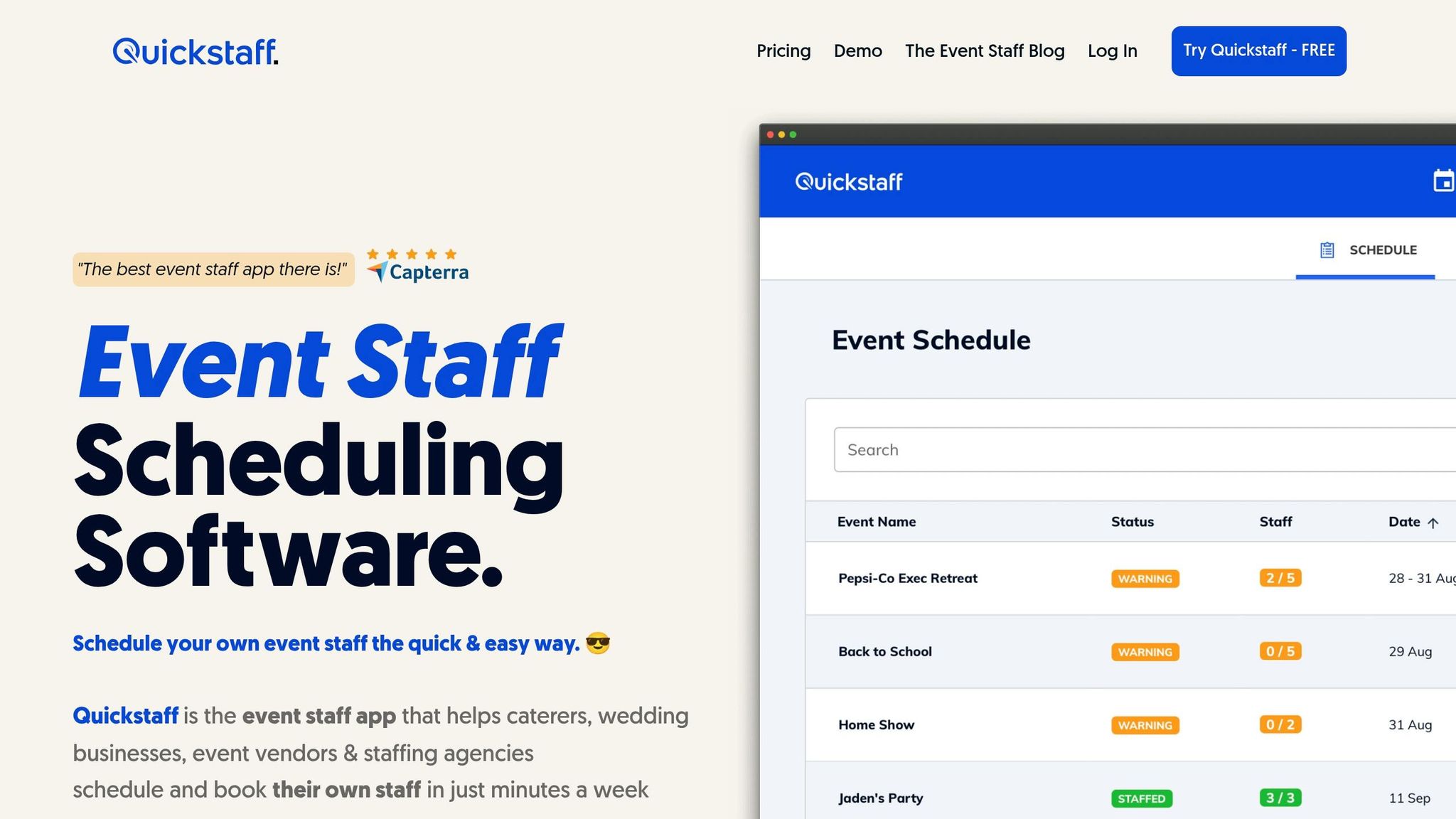
Keeping assignment logs in one place makes a big difference. It becomes much easier to track hours, notices, and role changes across multiple events without piecing things together after the fact.
Quickstaff helps organize assignment history by client, venue, role, date, and shift. That makes compliance checks faster and record retrieval simpler. It doesn't replace required notices, pay records, or safety logs, but storing assignment activity in one system can help cut down on missed steps when those records are needed.
Once you know the rules, the hard part is execution. For event staffing teams, compliance tends to work best when it’s built right into scheduling, dispatch, and contract setup. Keep your eye on four jobs: classify the role, assign responsibility, track hours, and document notices, pay, and safety.
A written responsibility matrix helps keep all of that straight. Put the key duties in writing, including comparator data, safety training, and single-day work verification forms.
Use this simple split of duties as a checklist:
| Step | Who Acts |
|---|---|
| Check agency registration at contract start and on March 1 and September 1 | Client |
| Issue written assignment notice before each dispatch | Agency |
| Provide comparator pay and benefits data before the threshold is reached | Client |
| Adjust pay and benefits once a worker exceeds 720 hours at a client site | Agency |
| Disclose site-specific hazards and provide safety training | Client |
| Confirm training occurred and keep documentation | Agency + Client |
| Provide work verification form for single-day laborers | Client |
| Keep required records for the required period | Agency + Client |
For standard assignments, use a repeatable process. When something falls outside the norm, escalate it. If you’re dealing with multi-site work, mixed roles, or a venue labor dispute, bring in Illinois employment counsel before the event.
It also helps to review current Illinois Department of Labor guidance on a regular basis, since the rules keep changing. That kind of workflow cuts down on missed notices, mispaid hours, and last-minute event-day problems.
The materials provided do not mention a 720-hour rule.
What they do say is much more direct: overtime is based on a fixed 168-hour workweek. That means you look at all hours worked during that one-week period and add them together.
This includes hours from:
Once those combined hours pass the 40-hour threshold within that 168-hour workweek, overtime rules apply.
The search results available here don’t say which party must legally provide the written assignment notice under Illinois law.
What they do show is more practical: for event staff, Quickstaff can help automate assignment notices. Those notices can include details like the date, time, location, role, expected attire, and pay rate.
Keep detailed payroll and personnel records for at least three years.
That means holding onto each employee’s:
You should also keep W-2 forms for employees. If you work with independent contractors, keep their business insurance records, invoices, and proof that they own their equipment.
Store all of these records in a way that’s both secure and easy to access when needed.