Georgia Break Laws for Event Staff: FAQ
August 20, 2026

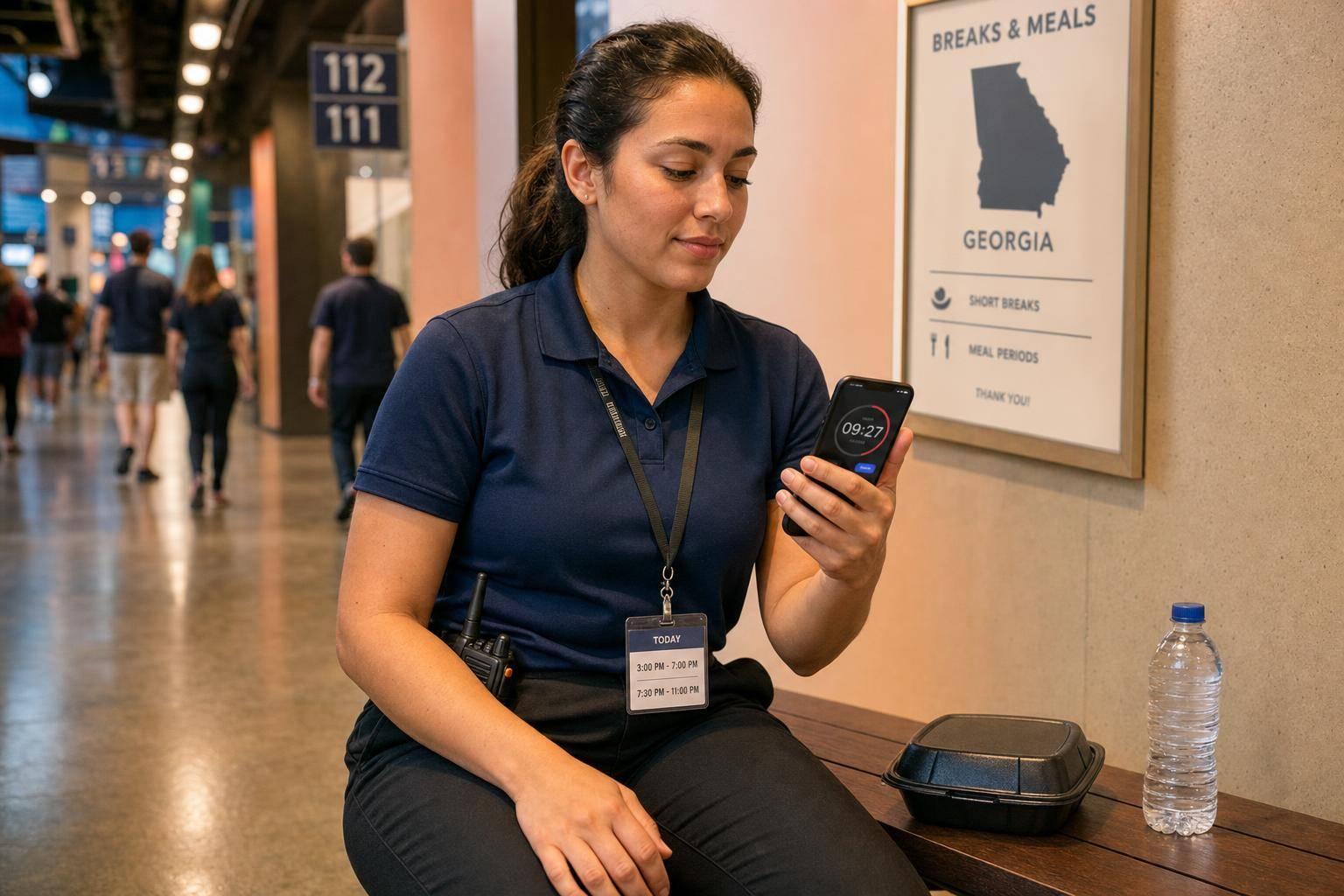
If you work event shifts in Georgia, the short answer is this: adult workers do not have a state right to meal or rest breaks. The main pay rule is federal: short breaks of 5 to 20 minutes are paid, and a meal break can be unpaid only if it lasts 30+ minutes and you are fully off duty.
That means a long event day - even 8, 10, or 12 hours - does not automatically give you a legal break. It also means split shifts do not trigger extra pay by themselves. What matters is whether you are still under the employer’s control, whether you are doing any work during the break, and whether your total time goes over 40 hours in a workweek.
Here’s the plain-English version:
A few numbers matter most here: 5–20 minutes, 30 minutes, and 40 hours. If I had to check one thing on every event timesheet, I’d check whether a “break” was a real break or just unpaid work with a different label.
This guide boils down the rules so you can spot pay issues fast and keep records straight.
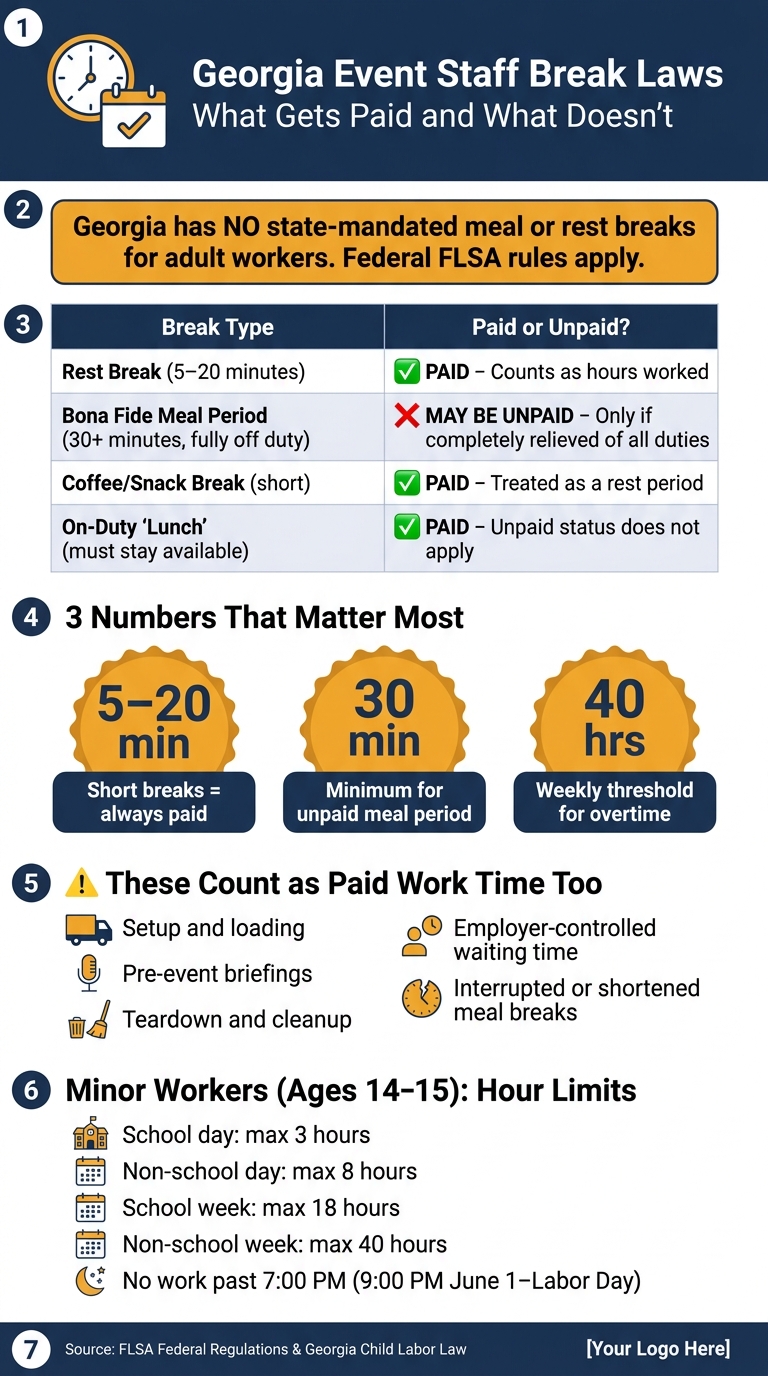
Georgia Event Staff Break Laws: Paid vs. Unpaid Time at a Glance
When event employers offer breaks, the big issue is whether that time has to be paid under federal law. That’s where most of the risk sits. A common starting point is the meal period: can it be unpaid?
A meal period can be unpaid only when it lasts at least 30 minutes and the worker is completely relieved of all duties. In event work, that standard often isn’t met. If someone has to stay available while eating, that time is paid work time. A bartender who must remain available to guests has not been relieved of duties. In that situation, the time should be treated as paid work time.
Federal regulations state that an employee is not relieved from duty if they must perform duties "whether active or inactive" while eating.
So if you want a meal period to be unpaid, staff need to be OFF the clock in a real sense. No monitoring radios, no answering texts, and no keeping an eye on guests.
Short rest breaks work differently.
Short breaks, usually 5 to 20 minutes, are generally counted as compensable work time and must be included in total hours worked. That rule applies even when the worker isn’t handling a specific task during the break.
Here’s the basic breakdown:
| Break type | Typical length | Paid or unpaid | Key condition |
|---|---|---|---|
| Rest break | 5–20 minutes | Paid | Counts as hours worked under the FLSA |
| Bona fide meal period | 30 minutes or more | May be unpaid | Employee must be completely relieved from all duties |
| Coffee/snack break | Short | Paid | Treated as a rest period, not a meal period |
| On-duty "lunch" | Varies | Paid | Unpaid status does not apply if the worker must stay available |
Managers can stagger short breaks to keep coverage in place, but those breaks still have to be paid. Using scheduling software for catering can help automate these rotations while ensuring compliance.
Minor workers bring a separate set of scheduling limits, which can matter a lot for evening events and late-night shifts.
For event employers, minors come with separate hour limits that can affect scalable staffing plans. Georgia does not impose a separate meal or rest break rule for minors, but child labor rules do limit when and how long younger workers can be scheduled.
Minors ages 14 and 15 have the tightest limits. They may work no more than 3 hours on a school day, 8 hours on a non-school day, 18 hours during a school week, and 40 hours during a non-school week. They also generally cannot work past 7:00 p.m., although that extends to 9:00 p.m. from June 1 through Labor Day.
Workers ages 16 and 17 generally do not face added state work-hour limits beyond federal law.
If short breaks are given to minor staff, those breaks should still be treated as paid time under the same FLSA rules that apply to adults.
Break issues in event work usually end up being pay issues. The basic rule is simple: if a staff member isn't fully relieved from duty, the time is usually paid.
Use the same test that applies to unpaid meal periods: if the employee is not completely relieved of all duties, the time counts as paid work time. A server eating while keeping an eye on the buffet is still working. The same goes for a team lead who has to answer client questions during a break.
Georgia follows federal FLSA rules on hours worked, including time when the employee is under the employer's control.
The same idea applies when a break shifts into waiting time. Georgia does not require extra pay for split shifts for private-sector workers. But a gap is unpaid only when staff are free to leave and use that time for themselves.
If a banquet server is told to stay in the ballroom, remain in uniform, and be ready for the next course, that gap is likely compensable waiting time.
This is one of the most common trouble spots for event employers. Loading vans, pre-event briefings, and teardown are work, and that time must be paid. Georgia treats setup and teardown as paid time.
Federal rules also say that work the employer knew about, or should have known about, must be paid even if it was not approved in advance. So if someone clocks in early and starts working without permission, the employer can still discipline that worker. What it can't do is refuse to pay for the time.
The better move is to train supervisors to stop off-the-clock work before it starts, not deny pay after the fact.
Accurate event staff scheduling and time records should cover meal periods, gaps between event segments, and any work done before clock-in or after clock-out.
Document break and pay records clearly. Once your break rules are in place, your records are what show they actually happened.
Keep accurate records of daily hours, weekly totals, overtime, and each shift segment.
For long events or split shifts, track the exact clock-in and clock-out time for each shift segment. That includes schedule changes like late call times, early releases, or added event segments. You should also note whether any gap between segments was off-duty time or paid waiting time.
For meals, record the actual start and end time. Don’t rely on a flat 30-minute deduction. If a meal is missed, cut short, or interrupted, flag it and treat that time as paid work time.
You should also record work that often gets missed in event settings, such as:
Written policies make recordkeeping more consistent. They tell staff what to expect, and they give you proof that the rules were shared. At a minimum, the policy should explain whether and when meal and rest breaks are offered, when meal periods are unpaid, how staff should report a missed or interrupted meal, and that all hours worked must be recorded.
Require staff to report interrupted meals right away, and make clear when breaks are paid and how they should be logged. It also helps to keep signed acknowledgments and records of any training sessions that covered timekeeping rules.
Scheduling tools can cut down on missed or conflicting time entries. In event work, messy schedules often lead to messy records.
Use Quickstaff to keep event times, shift segments, and assignments in one place. Its built-in messaging and reminders can also leave a clear communication trail for last-minute changes, like an added reset segment or a changed call time.
For long event shifts, these are the rules behind most break and pay disputes. In Georgia, adult event staff do not have a state right to meal or rest breaks. That means employers get to set the schedule for breaks. But once you offer them, you need to classify them the right way.
Here’s the basic split: short breaks are paid, while unpaid meal periods of 30 minutes or more only count as unpaid if the worker is fully relieved of duty. If someone is still answering questions, watching equipment, or staying available for the employer, that time must be paid.
Split shifts can get messy fast. The key issue is whether the gap is real off-duty time or just waiting time controlled by the employer. If the worker can’t use that time freely, it may still count as hours worked.
Overtime starts after 40 hours in a workweek. So when you review event payroll, don’t just look at the main shift. Track setup, teardown, paid breaks, and meal periods that got interrupted.
Use this summary when reviewing each event timesheet.
| Rule | What it means for event staff |
|---|---|
| No state-mandated breaks for adults | You decide whether to offer breaks, but your policy should be clear and consistent. |
| Short breaks (5–20 min) are paid | Count them as hours worked, including toward overtime. |
| Unpaid meals require full duty relief | Any work during a meal break makes it compensable. |
| Overtime after 40 hours/week | Track all hours - including setup, teardown, and employer-controlled waiting time - across the full workweek. |
| Accurate records are required | Document shift times, meals, interruptions, and off-duty gaps. |
Being fully off duty means the worker is completely free from job tasks during the break. They don’t have to work, stay on call, or remain ready to jump back in.
This matters most with meal breaks. A meal break of at least 30 minutes can be unpaid only when the employee is fully relieved of duties for the entire break. It’s also a good idea for employers to keep records showing the worker was fully off duty during any unpaid meal break.
Waiting time must be paid when an employee has to stay ready or available and is still under the employer’s direction or subject to job-related limits.
On the other hand, if the employee is fully relieved of duties and free to leave, that time usually does not count as work time.
The same basic idea applies to breaks:
Keep complete, audit-ready time records for each split shift. That means listing each work block on its own, not lumping the day into one entry.
For every block, record:
Include all time worked: setup, service, and teardown.
Also show any unpaid gaps between work blocks. If there’s a clock edit or a missed punch, note the reason, who made the change, and when the change was made.
Your daily and weekly totals should line up with payroll records exactly. If the time records say one thing and payroll shows another, that’s a problem waiting to happen.