How Massachusetts Temp Law Affects Event Staffing
August 10, 2026

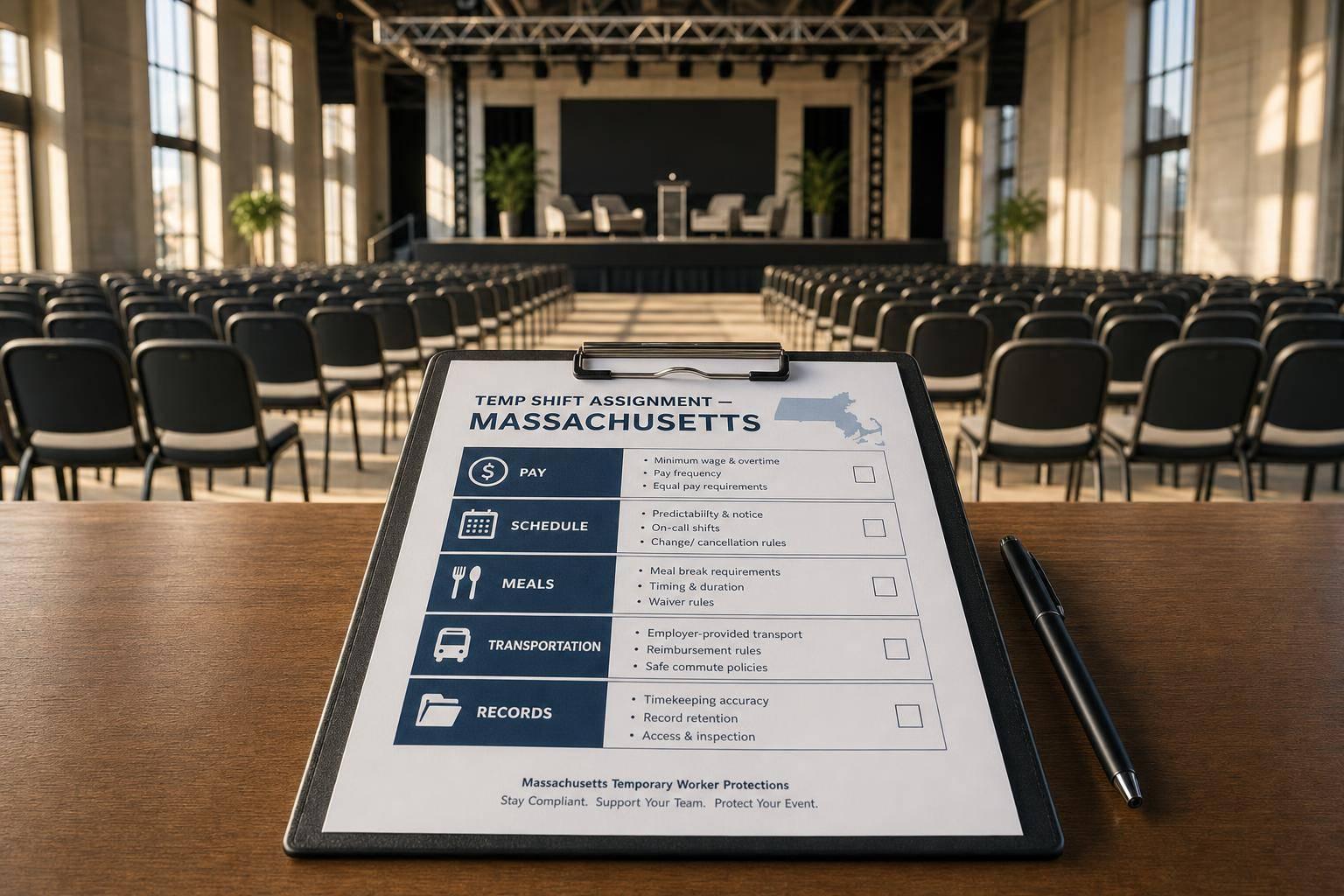
If you use temp staff for events in Massachusetts, every shift needs a written record before people show up. That is the core issue. If pay, venue, schedule, dress code, meals, or transportation are missing or changed without a written update, your team can face fines of up to $15,000 per violation, or $25,000 for willful violations.
Here’s the short version:
A simple way to think about it:
| Area | What I need to do |
|---|---|
| Shift details | Put pay, time, place, duties, contact info, dress code, and transport notes in writing |
| Worker confirmation | Get proof the worker received the assignment details |
| Charges and deductions | Check that any charge is allowed, written, and does not cut pay below minimum wage |
| Transportation | Stay within the 3% of daily wages cap when allowed, and do not charge if transport is required |
| Recordkeeping | Keep one file with notices, updates, acknowledgments, and payroll records using a scalable event scheduling system to automate compliance checks. |
Bottom line: if I wait until event day to sort out staffing details, I create legal risk. The safer move is to lock down the shift terms, send them in writing, and keep one clear record for each assignment.
The Massachusetts Temporary Workers Right to Know Law (M.G.L. c. 149, § 159C) applies when a staffing agency sends workers to an event site that directs their work. In plain terms, if the agency supplies the people and the event site tells them what to do, this law is in play.
That can look like a catering staffing firm using scheduling software for caterers to send banquet servers to a hotel, a promotional staffing company booking brand ambassadors for a trade show, or a labor agency supplying setup crews to a rental company.
If your business hires workers directly, without a third-party agency, and your team supervises them, TWRTK may not apply the same way. Those direct hires still need to follow Massachusetts wage and hour rules. Once you know who employs the worker and who directs the shift, the next step is simple: build a shift notice that includes every required detail before staff arrive.
Massachusetts defines a staffing agency as a company that places temporary workers under a client's supervision. The work site employer is the client that directs the worker's day-to-day tasks.
Both sides have clear duties. The staffing agency takes the lead on written assignment notices, posting workers' rights information, and handling pay in line with wage laws. The work site employer shares responsibility too, especially when it comes to banned fees, worker safety, and lawful treatment.
So a venue, exhibitor, or client company can't just shrug and assume the agency has it all covered. If your team runs the shift, your team has compliance risk too.
For event managers, this usually comes down to five shift-level controls (often managed via last-minute scheduling tools):
| Compliance Area | What It Requires |
|---|---|
| Written assignment details | A job order with agency info, worksite, job description, pay rate, schedule, meals, transportation, and any required clothing or equipment before each new assignment |
| Fee and charge restrictions | No placement fees; no added fees for payment methods, background checks (CORI), or drug screens; any charge for meals, uniforms, or equipment must be voluntary, written, non-profit, and cannot reduce pay below minimum wage |
| Transportation rules | Charge only actual transportation cost, capped at 3% of daily wages; no charge when transportation is required; reimburse workers sent to a site with no work |
| Worker notices and posting | The agency must post the official TWRTK notice in its offices in languages workers understand |
| Recordkeeping and deductions | Written authorization is required for any wage deduction, and records should support hours, rates, and any deductions or charges |
The penalty piece matters. Violations can lead to civil penalties of up to $15,000, or $25,000 for willful violations. That’s why many managers turn these rules into a standard assignment notice for every event shift, instead of trying to sort it out on the fly.
Use the job order as the shift record for each assignment. In practice, that means the standard notice becomes the default record for every booking. It turns legal notice rules into a day-to-day scheduling process instead of one more admin task.
Before a worker shows up, the written job order needs to include the staffing agency's name, address, and phone number; the workers' compensation carrier; the worksite employer's name and address; the on-site contact and phone number; and a plain description of the role duties.
It also needs to spell out the hourly rate, pay date, whether overtime may happen, the start and end time, dress code and equipment, any training or certifications the worker must have, and meal and transportation details.
That may sound like a lot. But if you've ever had a worker text, "What am I wearing?" or "Who's my contact when I get there?" you already know why this matters.
The simplest way to avoid missing details is to build them into every event record. When each event has set fields for the venue address, role, pay rate, start and end time, dress code, certifications, and meal and transportation notes, managers enter the info once and send a complete notice to staff.
Quickstaff supports structured event records and role-based scheduling, mobile shift details, reminders, and a clear communication log.
The next move is linking each record to worker acknowledgment.
Once the job order is set up in a standard format, you need proof that the worker got it. Massachusetts law allows initial notice by phone, but that info must be confirmed in writing before the end of the first pay period, using the worker's chosen method.
A good rule here is simple: mark a worker as confirmed only after the written job order has been sent and acknowledged. If someone has only said they're available, keep them in a tentative or offered status. Once they confirm receipt - by tapping Accept in an app, replying to a structured email, or signing a digital notice - the record can update, and the communication timestamp stays attached to it.
If a core detail changes after that, such as pay rate, schedule, venue, or role, send the update right away and ask for acknowledgment again. Automatic logs handle this far better than scattered text messages.
Once the assignment notice is set, the next thing to check is pay-related costs. On the surface, these can look routine. In practice, they carry real risk under Massachusetts temp worker law. So pay, charges, meals, and transportation shouldn't be left for day-of problem-solving. They need to be part of shift setup.
These costs create problems because they're often handled after scheduling, when fixing mistakes gets messy. Before workers accept a shift, managers should decide a few things up front.
Uniforms and required attire. Massachusetts law generally bars employers from deducting uniform costs from wages. In many cases, it also requires reimbursement when workers must buy required items, including special cleaning costs. So if banquet servers need branded logo shirts or formal catering aprons, charging for those items through payroll deductions is generally not allowed.
Transportation fees. Transportation charges need extra care. You can charge only the actual cost, the fee must stay within the 3% daily-wage cap, and you can't charge anything if the transportation is required.
Equipment deposits and damage charges. Taking $50 from a promo worker's pay for a lost radio, or charging a rental crew member for broken chair covers without clear written authorization, is usually not allowed and may break wage deduction rules.
Meal charges. Staff meals at long events are common. But if workers are charged, that charge must be authorized in writing and can't push pay below minimum wage.
Once those risk points are clear, the next move is simple: put them into the shift record before anyone accepts the assignment.
Use the assignment notice to set pay, transportation, and meal terms before the event. In plain English, finalize pay, transport, meals, and parking before staff accept the shift.
For transportation, start with the per-worker cost of any shuttle. Then compare that number to the 3% daily wage cap and the minimum wage floor. If the numbers don't work, or if workers must use that transportation, the ride needs to be free. Parking should be settled at the same time. Will workers use a free lot? Will the company reimburse paid parking? Does the venue garage create a different issue? Those answers should be set early. Deducting parking costs from wages is usually not allowed because it shifts a business expense onto workers.
All of this belongs in the assignment notice before a worker accepts the shift. That cuts down surprises on event day and helps stop managers from making up fees at the venue entrance.
The goal isn't just staying within the rules. There are many benefits of using event staff scheduling software, including having a record that shows what was approved, when it was approved, and who approved it. Last-minute verbal instructions often lead to missed charges, uneven charges, or both. When each event record requires managers to enter a role-specific pay rate, transportation notes, meal policy, and any worker-paid costs before the schedule goes live, those decisions get made in advance. Workers also receive the same terms in writing. Quickstaff centralizes pay rates, transport notes, meal terms, and acknowledgments in one shift record.
That setup also makes audits much easier. If a worker later disputes a charge, or if the state looks into a complaint, one event record with attached pay rates, transportation notes, communications, and acknowledgments is much easier to review than a pile of scattered texts, emails, and verbal instructions.
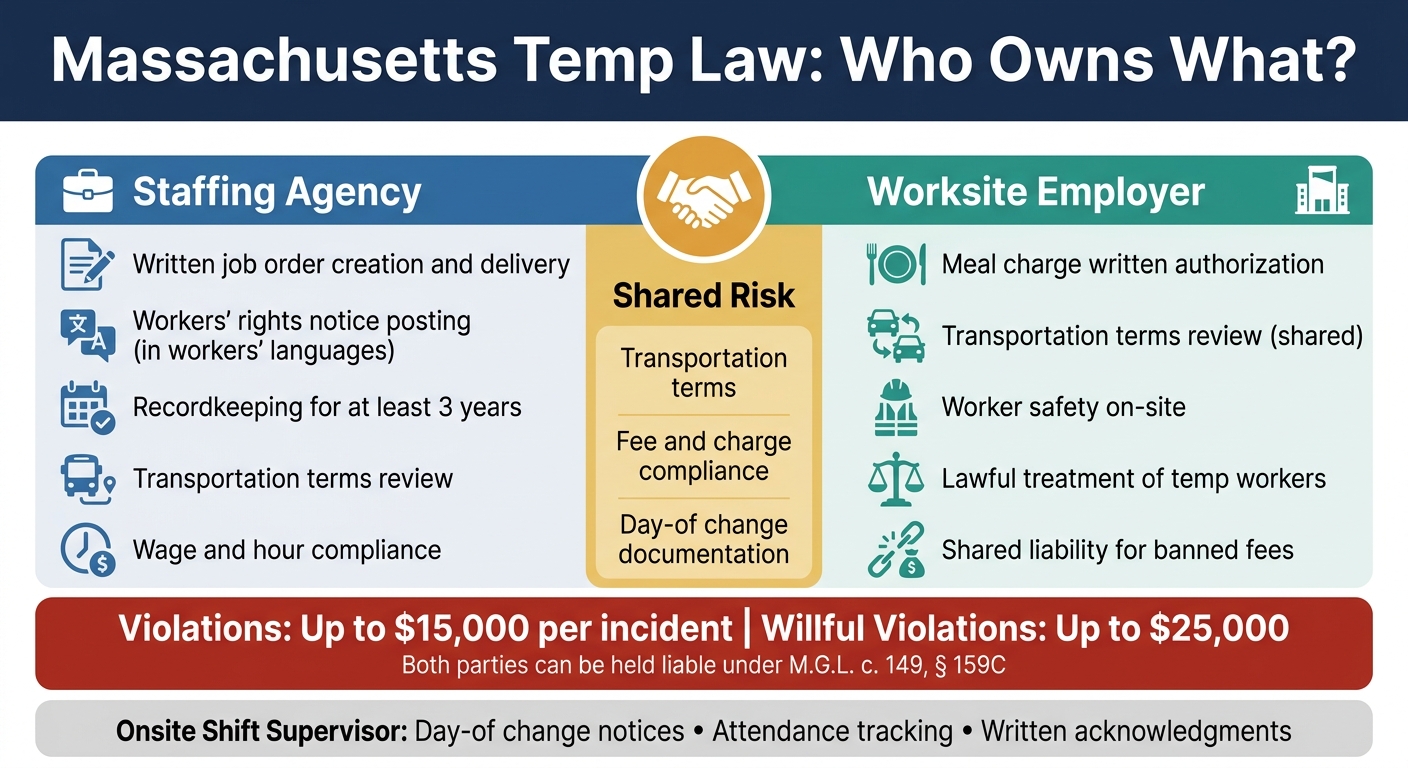
Massachusetts Temp Law Compliance: Staffing Agency vs. Worksite Employer Responsibilities
Compliance tends to fall apart when the staffing agency, worksite employer, and onsite supervisor are all looking at different records.
Once the assignment notice and pay terms are set, the next move is simple: decide who owns each compliance task.
The best way to avoid confusion is to assign each requirement to a specific role before the event starts, not in the middle of it. Under Massachusetts law, the staffing agency is mainly responsible for the written job order, rights notices, and recordkeeping. The worksite employer should handle meal charge authorization and share responsibility for transportation terms. Onsite managers should handle day-of updates, attendance tracking, and written change notices.
Here’s what that split can look like:
| Compliance Step | Who Owns It |
|---|---|
| Job order creation and delivery | Staffing agency |
| Transportation terms review | Staffing agency + worksite employer |
| Meal charge authorization | Worksite employer |
| Day-of change notices and acknowledgments | Onsite shift supervisor |
| Record retention | Staffing agency HR or records manager |
If nobody owns a step, there’s a good chance it gets missed. And when two teams each think the other handled it, you usually end up in the same spot.
Once ownership is clear, the next job is keeping the record each role creates.
Massachusetts regulations require staffing and employment agencies to keep all day-to-day business records for at least three years, or longer if an appeal is pending. For each event assignment, that file should include the job order, acknowledgment, change notice, and payroll record. It should also include the worker list with roles, transportation records if they apply, and written authorization for any deductions.
The goal is pretty simple: keep one searchable record for each event and assignment. That way, if a complaint or audit comes up, you’re not digging through email threads, text messages, and half-finished spreadsheets. Digital storage helps a lot here, especially if you use the same naming format every time, such as event date, client name, and venue.
With ownership and records in place, last-minute changes are much easier to handle.
Massachusetts-compliant event staffing comes down to four steps:
That setup makes changes, complaints, and audits easier to manage.
Yes. In event staffing, direct hires brought on by the event host or business for a set role or time period are usually covered.
Here’s the simple rule: if you set a worker’s schedule, give them the tools or equipment they need, and tell them how to do the job, they’re usually an employee - not an independent contractor.
And that matters. Employees are entitled to the same labor protections as other nonexempt workers, including minimum wage and overtime pay.
A written assignment notice for temporary event staff should spell out the key details of the job clearly. That helps prevent mix-ups and supports legal compliance.
At a minimum, it should include the worker’s role, responsibilities, job title, start date, pay rate, and approved tasks. It can also include the event date, call time, venue address, dress code, and the specific tasks for that shift.
Under the joint employer doctrine, staffing agencies and host employers can both be held jointly and severally liable for wage and hour violations, even when only one side controlled the shift change.
That means shared responsibility can turn into shared legal exposure. If your business has any role in scheduling, assigning tasks, or setting working conditions, you may still face penalties or back-pay claims.
A smart way to cut risk is to document every shift change in one centralized system with a clear approval trail.