5 Texas Labor Laws Every Event Manager Must Know
May 20, 2026


Managing event staff in Texas requires understanding key labor laws to avoid fines, disputes, or disruptions. Here’s what you need to know:
Quick Tip: Keep payroll records for at least four years and ensure compliance with these laws to protect your operations and reputation.
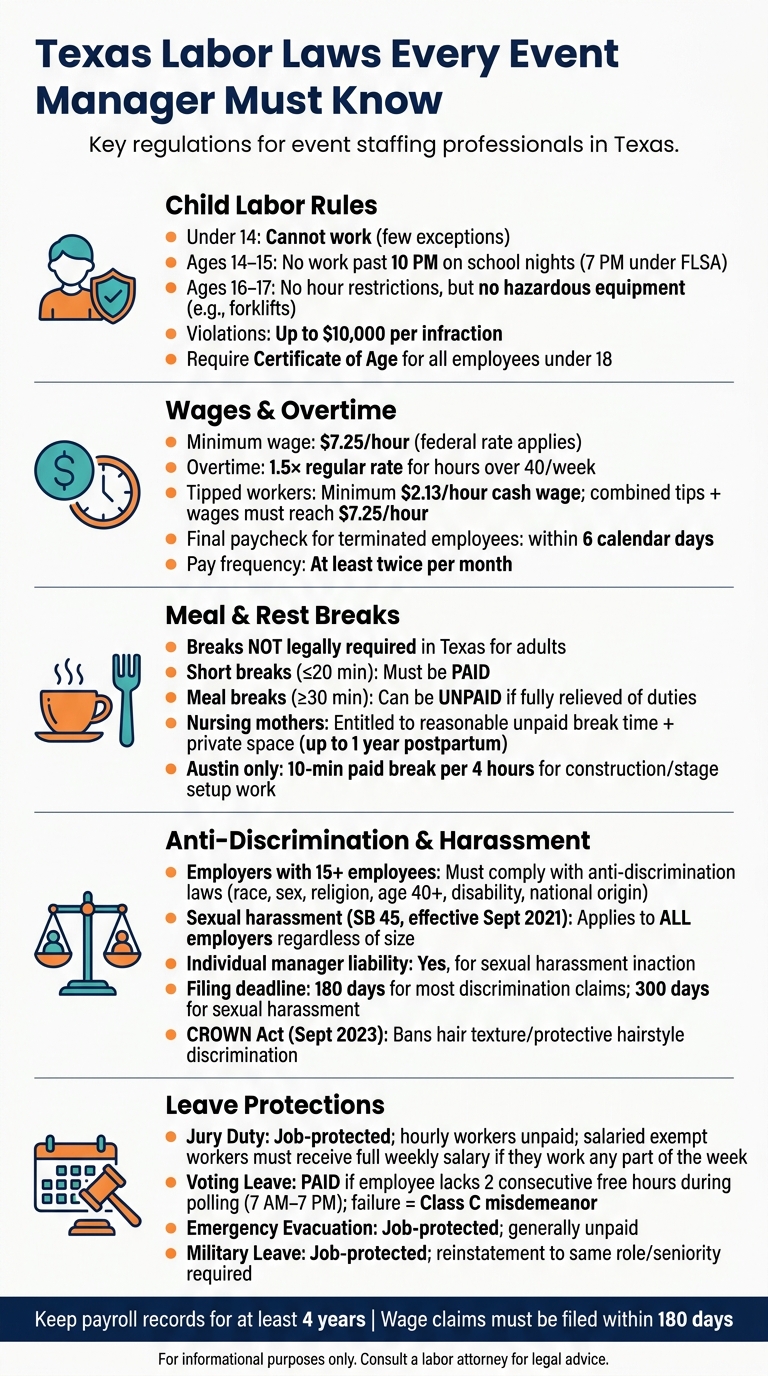
Texas Labor Laws for Event Managers: Quick Reference Guide
In Texas, it's illegal to employ children under 14, with a few exceptions: child performers, newspaper delivery workers, or those doing non-hazardous tasks for a family-owned business. For event managers, this means verifying the ages of minors before assigning them any responsibilities. Using event staff scheduling software can help track these details efficiently.
Minors aged 14 and 15 face specific work-hour restrictions. They can't work past 10 p.m. on school nights, and for businesses covered by the Fair Labor Standards Act (FLSA), the cutoff is even earlier - 7 p.m. - during the school year. This highlights the importance of carefully planning tasks for younger workers. The Texas Workforce Commission (TWC) offers this guidance:
"If your business is covered by the FLSA and follow a less restrictive provision, you will be violating federal law. If in doubt, or when both Federal and State laws apply, businesses should follow the stricter guidelines." - Texas Workforce Commission
For 16- and 17-year-olds, there are no restrictions on working hours in Texas. However, they cannot be assigned to operate hazardous equipment, such as forklifts. Even allowing a 17-year-old to briefly use a forklift can result in penalties of up to $10,000 per violation.
To ensure compliance, event managers should obtain a Certificate of Age from the TWC for every employee under 18. This document can serve as a legal safeguard if a minor misrepresents their age. Additionally, posting the Texas Child Labor Law notice in a visible area helps keep everyone informed about these rules.
In Texas, the federal minimum wage of $7.25 per hour applies to all non-exempt workers, including full-time, part-time, and temporary employees. Overtime kicks in at 1.5 times the regular hourly rate for any hours worked beyond 40 in a single workweek.
Texas does not have its own overtime laws, relying instead on the Fair Labor Standards Act (FLSA). This means there’s no daily overtime rule - so a non-exempt employee can work a 12-hour shift without earning overtime, as long as their total weekly hours stay under 40.
Corey Pollard, a workers' compensation lawyer, emphasizes the importance of compliance:
"I would put overtime compliance on the same level as food safety for any restaurant owner. It's not the most glamorous aspect of the business, but it can turn into a disaster in no time."
For event managers, it’s important to remember that time spent on tasks like event setup, teardown, mandatory pre-shift meetings, and travel between event locations counts as hours worked. Additionally, short breaks lasting 20 minutes or less must be paid.
Tipped employees, such as servers and bartenders, can receive a cash wage as low as $2.13 per hour, provided their combined cash wage and tips equal at least $7.25 per hour. If tips fall short, employers are required to make up the difference. For overtime, the calculation is based on the full $7.25 hourly rate, not the reduced cash wage.
Texas law also specifies pay frequency and final paycheck rules. Non-exempt workers must be paid at least twice a month, typically on the 1st and 15th. Terminated employees are entitled to their final paycheck, including any earned overtime, within 6 calendar days. If an employee resigns, they must be paid on the next scheduled payday. Knowing these rules is essential for efficiently managing event staff while staying compliant with labor laws. Fair compensation is also a key factor in retaining the best event staff.
In Texas, private employers are not legally required to provide meal or rest breaks for adult employees, no matter how long their shifts are. Federal law under the Fair Labor Standards Act (FLSA) aligns with this - so if you're running a 10-hour event and decide not to schedule official breaks, you're still within the law.
That said, once breaks are offered, federal regulations kick in. Short rest breaks of 20 minutes or less must be paid and treated as regular work hours. Meal breaks lasting 30 minutes or more can be unpaid, but only if the employee is fully relieved of all duties during that time.
One common issue is allowing employees to take a break while still being on call.
"The most common pitfall for employers is allowing some work to be performed during a meal break, which renders the break compensable." - Poster Compliance Center
For example, if a server is eating but required to monitor a station or respond to a radio, that meal break must be paid. This also applies to any setup or teardown tasks that overlap with scheduled breaks.
There are two notable exceptions to keep in mind. Under federal law, nursing mothers are entitled to reasonable, unpaid break time and a private space (not a bathroom) to express breast milk for up to one year after childbirth. Employers with fewer than 50 employees may be exempt if they can prove that providing such breaks would cause undue hardship. Additionally, in Austin, there’s a local ordinance requiring at least one 10-minute paid rest break for every four hours worked for construction-related jobs, such as stage setups or booth installations. Austin is currently the only city in Texas with this requirement.
| Break Type | Duration | Paid? | Required in Texas? |
|---|---|---|---|
| Rest break | 20 min or less | Yes | No (employer's choice) |
| Meal break | 30+ min | No (if fully relieved) | No (except for minors on shifts >5 hrs) |
| Nursing break | Reasonable | No | Yes (under federal law) |
| Austin construction break | 10 min per 4 hrs | Yes | Yes (Austin ordinance only) |
To keep things clear, it's a good idea to have a written break policy. Document break durations and outline the consequences for unauthorized extensions to avoid any unexpected pay obligations. Tools like Quickstaff can streamline communication about these policies with your event staff ahead of time, minimizing confusion during the event.
In addition to wage and break regulations, event staffing in Texas must adhere to strict laws ensuring equal treatment. Texas event managers are required to comply with both state and federal anti-discrimination laws. Under the Texas Labor Code Chapter 21, businesses with 15 or more employees cannot discriminate based on race, color, disability, religion, sex, national origin, or age (40 and older). Federal laws like Title VII, the Americans with Disabilities Act, and the Age Discrimination in Employment Act provide further safeguards. Section 1981 also extends protection to all employers, including independent contractors.
Sexual harassment protections were expanded through SB 45, effective September 2021, which applies to all employers regardless of size. This legislation holds supervisors, managers, and HR professionals personally accountable if they fail to take immediate corrective action. Attorneys Michael Royal and Alyssa Peterson from Littler Mendelson highlighted this responsibility:
"Supervisors, managers, human resources professionals, other employees and third parties may be named individually as defendants in an employee's sexual harassment complaint and held personally liable for damages."
Timelines for filing claims differ: most discrimination claims must be submitted to the Texas Workforce Commission (TWC) within 180 days, while sexual harassment claims have a 300-day window.
Recent legislation also addresses evolving workplace issues. The CROWN Act, effective September 1, 2023, bans discrimination based on hair texture or protective hairstyles like braids, locs, or twists. Additionally, the Texas Responsible Artificial Intelligence Governance Act (TRAIGA), set to take effect on January 1, 2026, will prohibit AI systems from making discriminatory decisions in employment.
Here’s a quick comparison of sexual harassment claims under SB 45 versus other types of discrimination claims:
| Aspect | Sexual Harassment (SB 45) | Other Discrimination (Race, Religion, etc.) |
|---|---|---|
| Employer Size Threshold | 1+ employee | 15+ employees |
| Individual Manager Liability | Yes | No |
| Filing Deadline (TWC) | 300 days | 180 days |
| Response Standard | Immediate and appropriate corrective action | Prompt remedial action |
To stay compliant and promote a safe workplace, it’s crucial to document anti-harassment policies, provide regular training, and address complaints swiftly and effectively. For broader preparation, consult an event planner kit to ensure you have everything needed for a successful event day.
Event schedules can face unexpected disruptions when employees need time off for jury duty, voting, or emergencies. Texas law is clear about how employers must handle these situations, and ignoring these rules can lead to serious consequences.
Jury duty is protected leave. According to the Juror's Right to Reemployment Act, employers cannot fire, threaten, or intimidate permanent employees for serving on a jury. As outlined in Tex. Civ. Practice & Remedies Code Section 122.001:
"An employer may not discharge, threaten to discharge, intimidate, or coerce any permanent employee because the employee serves as a juror."
Violating this law is a Class B misdemeanor. Civil penalties can include damages ranging from one to five years of the employee's pay. Hourly employees aren’t entitled to pay during jury service, but salaried exempt employees must receive their full weekly salary if they work any portion of that week. Additionally, jury duty hours don’t count toward overtime calculations.
Voting leave has its own set of rules. Texas law requires employers to provide paid time off to employees for voting if their work schedule doesn’t allow for two consecutive free hours between 7:00 a.m. and 7:00 p.m. on Election Day. Employers can decide when employees take this time off, as long as it’s reasonable:
"The employer can prescribe the hours the employee will have off to vote so long as it is reasonable and sufficient for the employee to vote." - Texas Workforce Commission
Failing to provide paid voting leave is a Class C misdemeanor, and retaliating against employees for their political choices is a third-degree felony. To keep operations running smoothly, employers might stagger voting times or adjust shifts or use scheduling tools to naturally accommodate the required two-hour window.
Emergency leave protections also come into play during critical situations. For example, Texas Labor Code § 22.002 ensures employees won’t face penalties for leaving work during an officially ordered public evacuation. Similarly, military leave is safeguarded by both federal (USERRA) and Texas state law, requiring employers to reinstate employees to their previous role with no loss of seniority or benefits after active duty or training.
Here’s a quick look at the key rules for these types of leave:
| Leave Type | Job Protected? | Paid? | Key Condition |
|---|---|---|---|
| Jury Duty | Yes (permanent employees) | No* | *Exempt salaried employees must be paid if they work any part of the week |
| Voting | Yes | Yes | Only if less than 2 consecutive hours free outside work hours |
| Emergency Evacuation | Yes | Generally no | Must follow an official evacuation order |
| Military Leave | Yes | Generally no | Reinstatement to the same role/seniority required |
To avoid complications, event managers should create a clear policy covering these leave types. This policy should outline notice requirements, PTO usage, and shift coverage plans. Employees should be encouraged to notify management promptly when they receive a jury summons, and supervisors must avoid comments that could be seen as pressuring someone to skip jury duty - these remarks could be interpreted as unlawful coercion.
Here’s a quick guide to key Texas labor laws that impact event staffing:
| Law | Who It Affects | Scheduling Impact | Key Compliance Risk |
|---|---|---|---|
| Texas Child Labor Rules | Minors under 18 | Limits for 14- and 15-year-olds: 3 hours on school days, 18 hours in a school week; curfews may apply. | Violations can lead to fines up to $10,000 per infraction and potential misdemeanor charges. |
| Wage & Overtime Requirements | Non-exempt employees | Non-exempt staff earn 1.5× their regular pay for hours over 40 in a week; travel between event sites counts as work. | Violations may result in doubled back wages (liquidated damages) and civil penalties. |
| Meal & Rest Break Rules | All staff; nursing mothers | Short breaks (5–20 minutes) must be paid. Meal breaks (30+ minutes) can be unpaid. Nursing mothers require a private space. | Non-compliance can result in FLSA violations for unpaid breaks or lack of nursing accommodations. |
| Anti-Discrimination & Harassment | All employees (Title VII applies to employers with 15+ employees) | Scheduling must accommodate reasonable religious observances and avoid retaliatory practices. | Non-compliance risks include back pay, damages, and mandatory reinstatement. |
| Jury, Voting & Emergency Leave | All employees | Paid time must be provided for voting if employees lack two consecutive off-duty hours while polls are open. Jury duty leave must be job-protected. | Failure to comply can result in wrongful termination claims or criminal penalties for interfering with voting rights. |
These guidelines are essential for event managers to ensure compliance with Texas labor laws. Violations - like wage and overtime infractions - carry hefty penalties, including fines up to $10,000 and doubled back wages. Title VII protections apply to employers with 15 or more employees, but sexual harassment rules cover all employers, which is crucial when managing small teams or lean crews.
Maintaining accurate payroll records for at least four years is critical, as wage claims must be filed within 180 days. Tools like Quickstaff can simplify tracking employee hours and break times, helping you stay organized and avoid compliance headaches.
Event managers in Texas need to stay on top of labor laws to avoid costly consequences. Penalties for non-compliance can include hefty fines, doubled back wages, and, in some cases, criminal charges. A solid understanding of these regulations is key to reducing risks.
One critical requirement in Texas is keeping payroll records for at least four years. These records become essential if a wage claim is filed with the Texas Workforce Commission, as they serve as your primary defense.
"Non-compliance can lead to private lawsuits... Beyond legal defense costs and potential financial damages, companies also risk significant reputational harm that can affect their brand and employee morale." - Oyster Team
Failing to follow these laws can lead to more than just financial losses - it can also damage your reputation and employee trust. To stay ahead, consider using reliable scheduling tools to help enforce compliance. For example, Quickstaff simplifies staff scheduling while supporting adherence to labor laws. Their plans start at $49/month for teams of up to 35 members.
Stay informed, maintain accurate records, and leverage the right tools to protect your team and ensure your events run without a hitch.
Yes, travel time between work locations during the same workday is generally considered paid time. This includes trips from a main office or kitchen to event venues, as well as between multiple event locations. However, the time spent commuting from home to the first work site and back home at the end of the day is usually not compensated. Tools like Quickstaff can assist in tracking these hours and keeping accurate records to help ensure compliance with labor regulations.
In Texas, overtime pay for tipped employees is calculated based on their regular rate of pay, not just their base cash wage. According to federal law, non-exempt employees must receive 1.5 times their regular rate for any hours worked beyond 40 in a workweek. If a tip credit is applied, both the cash wage and the tip credit amount need to be factored into this calculation. Maintaining detailed records is essential to ensure compliance with these requirements.
To protect yourself in the event of a Texas wage claim, maintaining detailed and accurate records is critical. Ensure you have the following information for each employee:
If you work with independent contractors, it's equally important to keep documentation such as:
While it’s common to keep these records for three to four years, many experts suggest holding onto them for up to seven years for added security. This extended timeframe can provide extra protection should any disputes arise down the line.