Illinois Final Pay Rules for Event Staff
September 23, 2026

If employment ends in Illinois, final pay is due at separation or by the next regular payday, whichever comes first. For event staff, that means I need to track three things fast: the worker’s last day worked, whether employment actually ended, and the next scheduled payday.
Here’s the short version:
One point matters a lot in event staffing: a person can finish a shift on 9/24/2026 and still not be separated from employment. That’s why payroll cannot rely on time records alone. It needs separation records too.
A few facts stand out:
If I were turning this into a payroll checklist, I’d keep it simple:
This article explains those steps in plain English for Illinois event employers and staffing teams.
Under the Illinois Wage Payment and Collection Act, 820 ILCS 115/5, final wages are due at separation or by the employee's next regularly scheduled payday, whichever comes first. In plain English: the clock follows that worker's normal payroll cycle. So before you assume one payday works for everyone, check the person's actual pay schedule.
Illinois does not set a different statutory final-pay deadline based on how the separation happened. Someone who quits, someone who is fired, someone laid off, and someone finishing a temporary assignment all fall under the same timing rule.
What changes is the paperwork and the internal review. The payment deadline does not change.
For temporary event assignments, use the actual end of employment as the trigger point, not just the last shift - unless the worker is still on staff for future bookings.
For each separated worker, keep it simple:
Do not issue partial pay while waiting on earned commissions, bonuses, or vacation pay.
Once you've pinned down the deadline, the next step is figuring out what the final paycheck must include.
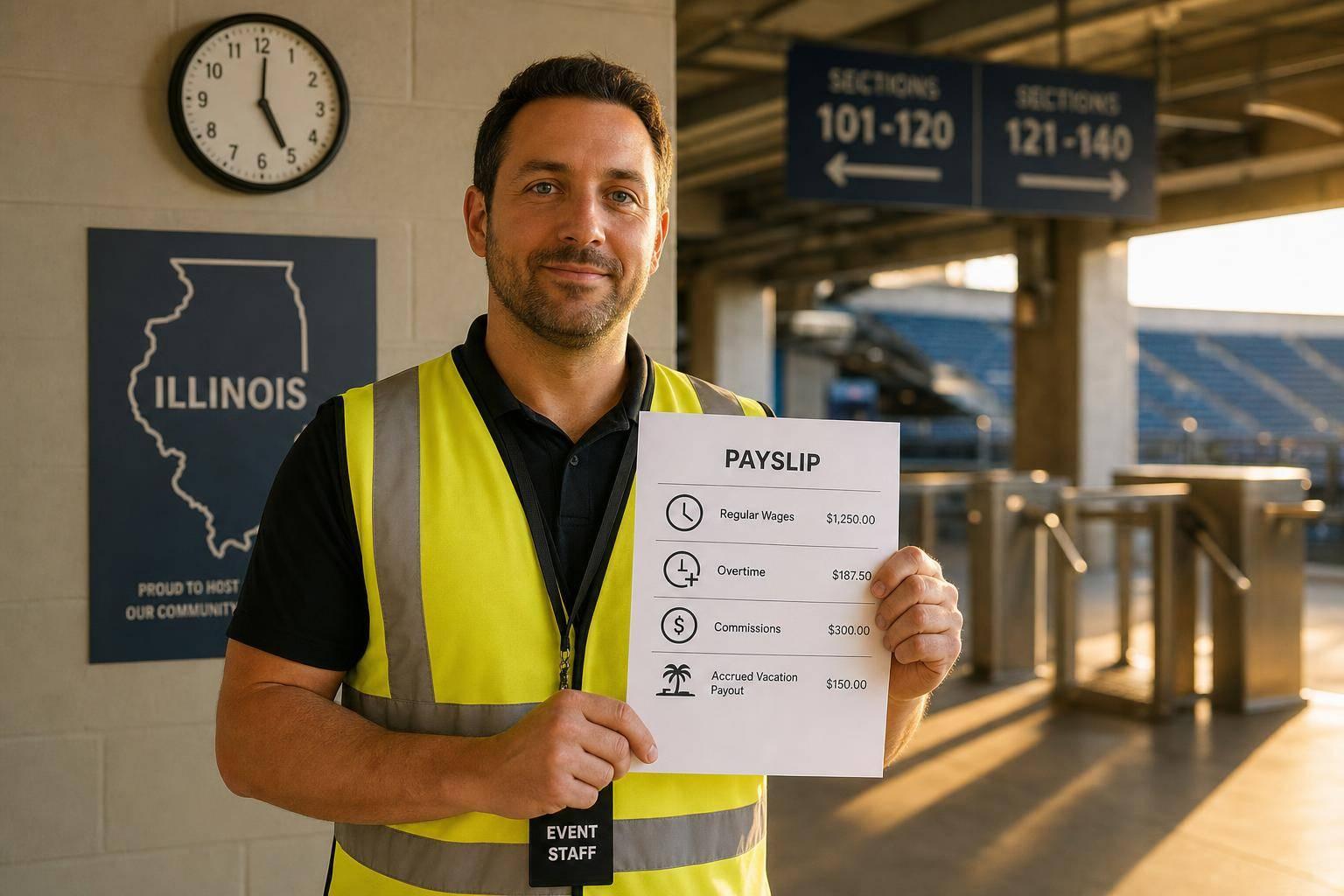
Final pay isn't just the hours from the last shift. Under the Illinois Wage Payment and Collection Act (820 ILCS 115/5), final pay includes all wages, salaries, earned commissions, earned bonuses, and earned vacation, plus any earned holiday pay promised by policy. For event staff, that often means pulling together multiple shifts, roles, and pay rates before payroll closes. Once the deadline is set, the next job is simple: make sure every item that belongs in final pay is there.
For event staff, final pay should include all regular hours worked through the last day, overtime at 1.5 times the regular rate, and any earned shift differentials or premium rates. If a worker earned a commission or bonus under an agreement, that amount must be paid. If the exact figure can't be calculated by the final payday, it must be paid when the amount is known.
Illinois law requires payout of earned, accrued vacation, and any PTO your policy treats as vacation at separation. A written policy also can't force forfeiture of earned vacation time. Sick leave, holiday pay, and severance are owed only if your written policy, employee handbook, or contract clearly promises them.
| Final-pay item | Category | Requirement in Illinois |
|---|---|---|
| Regular wages & salaries | Required if earned | Mandatory for all hours worked |
| Overtime & shift differentials | Required if earned | Mandatory if earned under law or agreement |
| Earned commissions | Required if earned | Mandatory when amount is known |
| Earned bonuses | Required if earned | Mandatory if earned under agreement |
| Accrued vacation / PTO | Required if earned | Mandatory payout of all earned time |
| Sick leave | Only if promised | Only if promised in contract/policy |
| Holiday pay | Only if promised | Only if promised in contract/policy |
| Severance pay | Only if promised | Only if promised in contract/policy |
Don't delay final pay because of unreturned equipment. Handle that issue separately.
Next, match these pay items to the reason the worker separated and your payroll controls.
The separation type changes what payroll needs to verify, not when pay is due. Once you know the final-pay deadline, the next step is simple: confirm whether the person is actually separated from employment. That’s the part that drives the recordkeeping.
What changes from case to case is the file payroll needs to show whether employment ended.
| Separation type | What to record | Key payroll note |
|---|---|---|
| Voluntary resignation | Written resignation, date received, stated last day, notice period, last event worked, future-assignment status | A no-notice resignation does not justify withholding earned wages. |
| Termination | Effective separation date, decision-maker, reason, last shift worked, notice delivered or written notice retained | Document the effective date clearly to anchor the deadline. |
| Layoff | Effective layoff date, final event or shift, recall or future-work status | Confirm whether the worker is fully separated or on temporary leave. |
| Temporary assignment ending | Event name, assignment end date, final shift, whether only the assignment ended or employment ended, future scheduling status | If employment continues, treat the worker as active. |
This matters more than it may seem at first glance. A worker can finish one event, one project, or one assignment without ending the employment relationship. If the person remains available for future events, document whether only the assignment ended or employment ended. That status decides whether final pay is due.
Illinois generally prohibits deductions from final wages unless an exception applies. So if a uniform, phone, radio, keys, or other property is missing, that does not let you hold up final pay.
Instead, deal with the property issue on a separate track. Use a documented return request or send the matter for legal review. But do not subtract the item’s value from earned wages unless the deduction meets Illinois rules, including any required express written authorization at the time of the deduction.
Once worker status is confirmed, payroll can finish the file by locking in hours, earnings, and approved deductions. For each separated worker, check:
If a worker sends a written request for a mailed check, Illinois requires you to honor it. Log the request, confirm the mailing address, and keep proof of delivery or returned mail.
Before payroll closes the file, flag any missing timecards, disputed commissions, or unclear worker status. If part of the pay is still in dispute, pay the undisputed amount on time.
These records are what payroll uses to track deadlines across separated workers. In plain English: good records make it much easier to track each worker’s final-pay deadline.
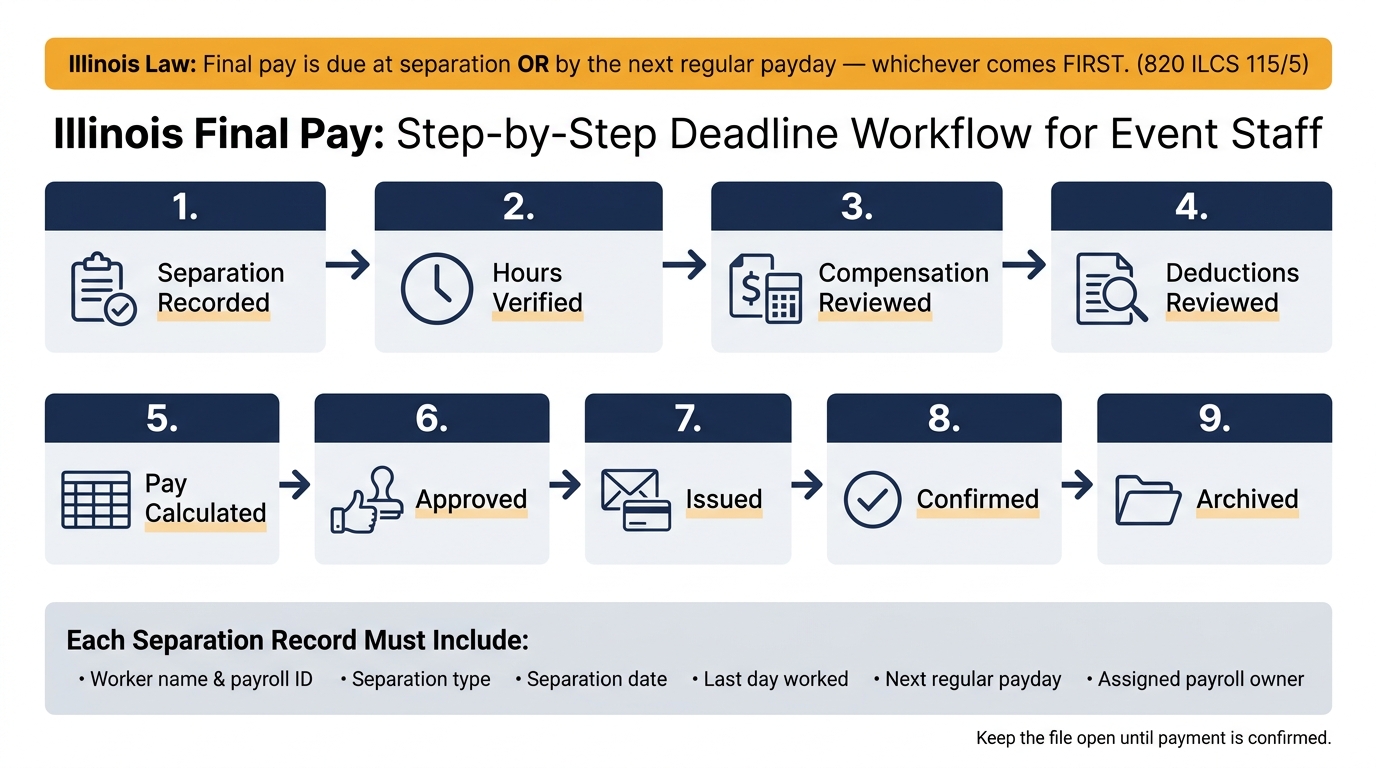
Illinois Final Pay Checklist for Event Staff
Use payroll separation details to track each deadline. When a worker’s employment ends, create one separation record per worker.
That record should include:
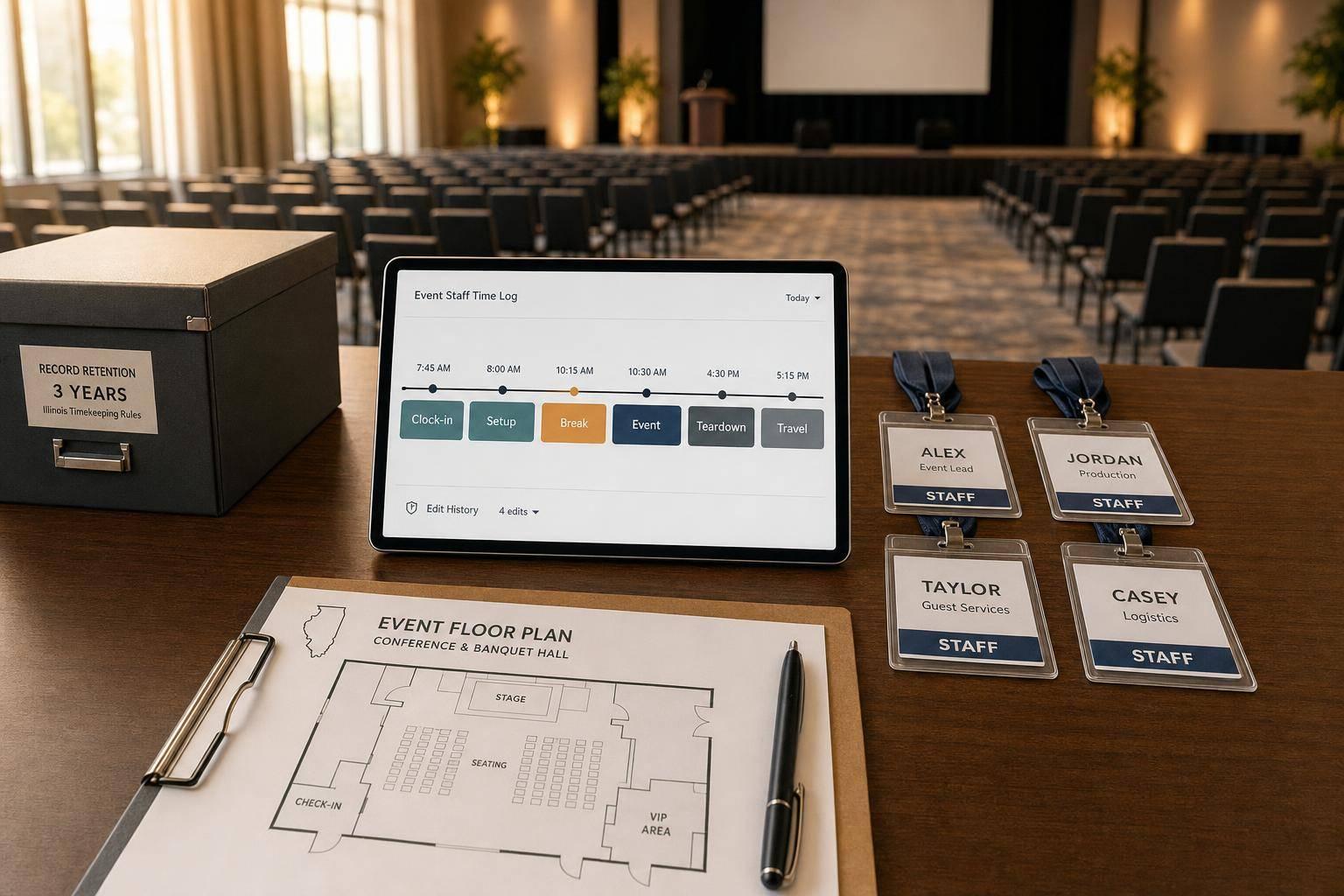
It also helps to track separation date, last day worked, and final payday in separate fields. That makes the file easier to review and cuts down on mix-ups when several event workers leave around the same time.
To keep each file moving, use a simple status flow:
Keep the file open until payment is confirmed.
Staffing and scheduling records give payroll a starting point. Quickstaff can store assignment history, roles, event dates, schedule changes, and communication records for payroll handoff. That kind of system helps teams stay on the same page, especially when people move between events, shifts, and job roles.
Still, event staff scheduling software is only part of the process. Payroll must verify hours, calculate pay, and keep proof of payment.
The rule is straightforward: track each separation, verify each payment, and archive the proof. Final pay should include all earned compensation: wages, commissions, bonuses, and any vacation pay required by policy or agreement.
For an Illinois event employer, the records that matter most are the separation date, verified hours, calculation worksheet, payment date, payment confirmation, and archived file. Those records show that each duty was handled on time for each worker.
No. A single finished event does not automatically count as separation. Separation happens when the employment relationship ends, not just when a shift or event wraps up.
For event staff, a worker may stay on through a season or work across many events. That’s why you should track the actual separation date and keep clear shift records. If you treat each event as its own separation, you can muddy assignment history and run into compliance issues.
If commissions or bonuses aren’t finalized yet, they’re usually due only if the employee earned them under a written policy or agreement.
If you can’t calculate the amount before the final paycheck deadline, document the payment status clearly. It also helps to keep centralized records of agreements and performance metrics. That can reduce payroll disputes and help with compliance.
Yes, but there are strict legal limits.
You can deduct pay for missing uniforms or equipment only if the deduction does not drop the worker’s earnings below the federal minimum wage or reduce overtime pay.
You also can’t sidestep this rule by telling workers to pay out of pocket instead.
To stay compliant, document what you issued and explain the policy during onboarding.