Federal Tip Record Rules: Guide for Events
September 23, 2026

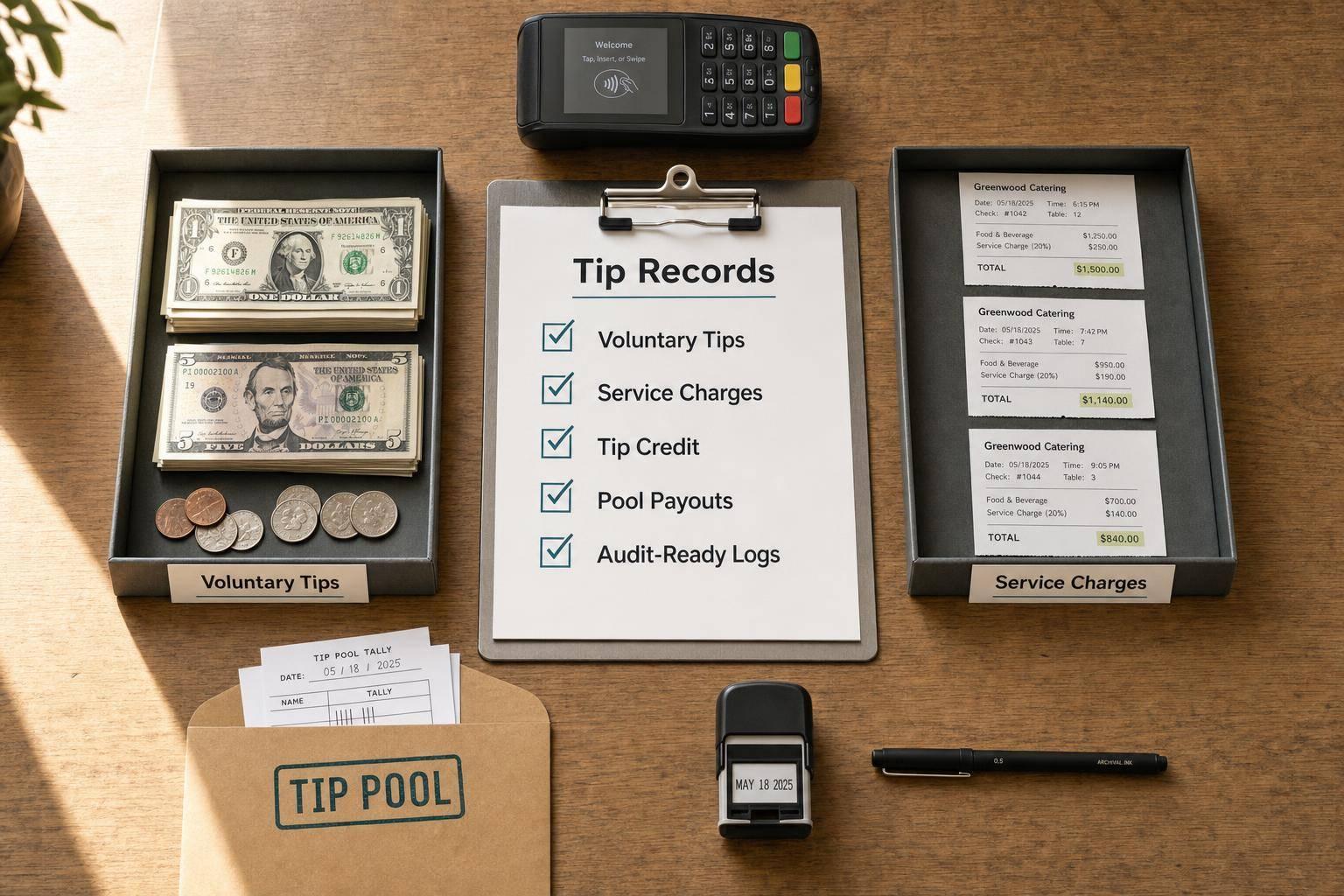
If you mix up tips, service charges, and payroll records, you can underpay staff and fail a wage audit. For event businesses, the core rule is simple: track each worker, each event, each shift, and each dollar separately.
Here’s the short version in plain English:
A simple example shows why this matters. Under federal law, the minimum wage is $7.25/hour. If you pay a tipped worker $2.13/hour for a 6-hour shift, that is $12.78 in cash wages. To reach $43.50, tips must cover $30.72. If the worker only gets $20.00 in tips, you must pay the $10.72 shortfall.
The main points I’d keep in front of me are:
This guide is about one thing: making sure your tip records match what happened at the event and what ended up on payroll.
These rules decide what employers need to record, track, and pay.
Federal rule: A tip is money a customer voluntarily gives an employee in recognition of service. A tip is voluntary: the customer chooses whether to pay and how much.
Event staffing implication: A 20% banquet service charge listed on a catering contract is not a tip because the customer didn’t have a real choice. But if a guest adds money on a tip line at the same event, that amount is a tip.
The label alone doesn’t settle it. What matters is how the charge works in the transaction. That’s why it helps to keep the contract, invoice, payment record, and customer disclosure, or use catering staff scheduling tools to track labor costs. Those records show which amounts were optional and which were required.
Federal rule: The federal minimum wage is $7.25 per hour. Where allowed, an employer may pay a tipped employee a direct cash wage as low as $2.13 per hour and claim a tip credit of up to $5.12 per hour, as long as all federal rules are met. If tips do not make up the gap in any workweek, the employer must pay the difference in cash.
Event staffing implication: Here’s what that looks like in practice. Six hours at $2.13/hour equals $12.78 in direct wages. If the employee must get to $43.50 for those six hours, tips need to cover the $30.72 difference. If the event is slow and tips total only $20, the employer still owes $10.72 for that shift.
One point matters a lot here: the shortfall is measured by workweek, not by blending busy events with slow ones.
Before using the tip credit, employers must give advance notice. That notice must say:
Late notice does not count.
Federal rule: Employers, owners, managers, and supervisors may not keep any part of employees’ tips - not from a tip jar, not through a pool distribution, not for any reason. This rule applies no matter what the arrangement is called inside the business.
Event staffing implication: Don’t rely on job titles by themselves. Look at the person’s actual duties and authority. If you use a tip credit, the pool should stay limited to employees who customarily and regularly receive tips, such as servers and bartenders. If you do not use a tip credit, the pool can include more roles, but managers and owners still cannot take part.
Those classifications should line up with the records you keep for each event and shift.
Once you know who can receive tips, the next step is paperwork. You need records that show each employee’s hours, tip reports, and how payroll handled those amounts. Event staff scheduling records can show who worked an event, but they do not replace the wage, tip, notice, and payroll records the FLSA requires.
Those records should tie each employee to each event, shift, and payment method.
Under 29 CFR § 516.28, employers that claim a tip credit must keep certain records for every tipped employee.
| Record Category | What to Capture | When It's Created | Why It Matters in an Audit |
|---|---|---|---|
| Employee designation | Identifies the worker as a tipped employee | During onboarding new event staff or role changes | Confirms tip-credit eligibility for each event and shift |
| Tip reports | Employee-reported tips for each pay period | Each pay period | Shows actual tips received vs. the credit claimed |
| Tip credit amount | The specific hourly credit applied (up to $5.12/hr federally) | Each workweek | Verifies the credit amount used in payroll |
| Tipped hours | Daily and weekly tipped hours and regular wages paid | Each shift | Supports the minimum wage calculation for each event and shift |
| Non-tipped hours | Hours in a separate, non-tipped occupation and wages paid for those hours | Each shift | Prevents improper use of the tip credit |
Track tipped and non-tipped hours separately. That split matters. After the 2024 Restaurant Law Center decision, no tip credit applies to non-tipped hours.
The tip credit notice rule matters too. Before taking a tip credit, employers must tell employees the cash wage, the tip credit amount, and that all tips must stay with the employee except for valid pooling. The safest move is to keep a written acknowledgment signed by the employee on file.
The name on the line item doesn’t decide the issue. Customer choice does. If a charge is mandatory, it is not a tip, even if you later pay it out to employees.
| Payment Type | Customer Choice | Belongs To | Counts Toward Tip Credit | Overtime Treatment |
|---|---|---|---|---|
| Voluntary tip | Yes - customer decides the amount | Employee | Yes | Excluded from regular rate |
| Mandatory service charge | No - set by the employer or contract | Employer | No | Must be included in the regular rate when distributed |
| Distributed service charge | No | Paid out as wages | No | Included in the regular rate |
The 2022 case Compere v. Nusret Miami, LLC shows how this works. The 11th Circuit held that an 18% mandatory service charge was not a tip because the customer did not control the amount.
That’s why separate line items on BEOs, contracts, and receipts matter so much. They help keep tips and service charges apart and show whether each amount was optional or required.
Each tip payment method leaves a different trail. Your records need to let you match reported tips with amounts paid for each event and shift.
For cash tips, the employee reports the amount to you - usually on IRS Form 4070 or a similar written record - at least monthly. Keep those reports by employee and pay period.
For card and digital tips, record:
Those employee-level records should also match the event-level tip-pool records and payout totals.
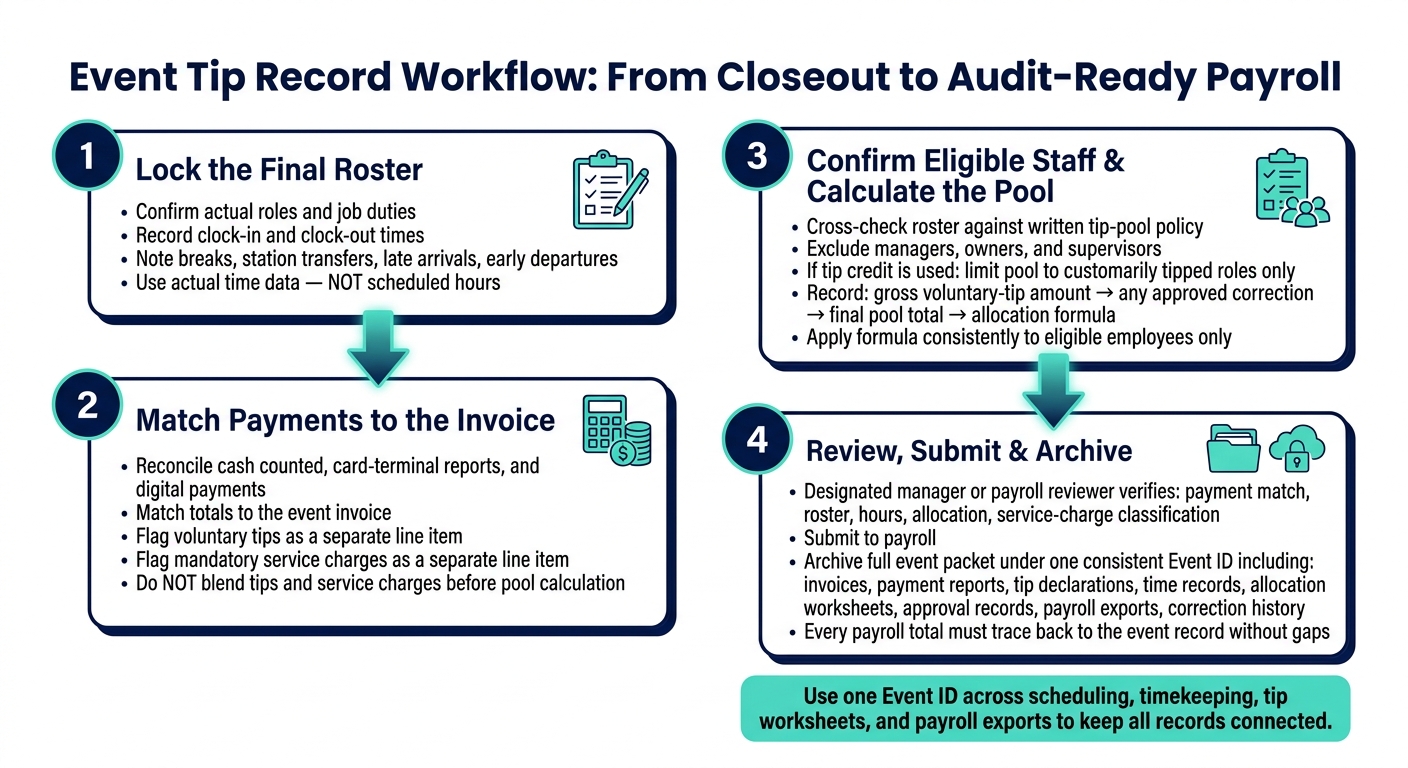
Event Tip Record Workflow: From Closeout to Audit-Ready Payroll
Once individual tips are in the system, the next step is tracking them through pooling, event closeout, and payroll.
Each pooled-tip record should connect the money collected to the people who earned it and the work they did. At the event level, that means recording the event ID, date, venue, shift times, employee identity, role, hours, tip source, pool total, allocation method, payout amount, and reviewer approval.
Keep voluntary tips and mandatory service charges in separate records. That split matters because only voluntary tips should go into the pool.
Build one closeout packet for each event so payroll can total a pay period without losing the detail behind each number.
Confirm actual roles, clock-in and clock-out times, breaks, station transfers, and any staff who arrived late or left early. Use actual time data, not scheduled hours.
Match cash counted, card-terminal reports, and digital payment records to the event invoice. Flag voluntary tips and mandatory service charges as separate line items before you calculate the pool.
Check the roster and job duties against your written tip-pool policy. Leave out anyone who is not legally allowed to receive employee tips. Then record the gross voluntary-tip amount, any approved correction, the final pool, and the allocation formula. Apply that formula the same way for eligible employees only.
A designated manager or payroll reviewer should verify the payment match, roster, hours, allocation, and service-charge classification before payroll submission. Archive the full event packet under the same event ID: invoices, payment reports, tip declarations, time records, allocation worksheets, approval records, payroll exports, and correction history.
Every payroll total should trace back to the event record without gaps.
A consistent event ID keeps those records connected across scheduling, timekeeping, and payroll.
Quickstaff can help keep the same event ID across the closeout packet. Quickstaff can help keep one event ID across scheduling, timekeeping, tip worksheets, and payroll exports.
That said, Quickstaff is an organizational tool, not a compliance record. The business is still responsible for maintaining the compliance record itself.
After closeout, build each event packet so it’s ready for an audit. That usually comes down to one plain question: Can you trace every dollar paid to employees back to the event where it was earned?
Keep core payroll records for 3 years, wage-computation records for 2 years, and employment-tax records for 4 years or longer if state law, disputes, or litigation holds apply.
From there, tie each event total back to payroll. Match the signed contract and final invoice against POS reports, cash counts, card settlements, and digital-payment records. Then split voluntary tips from mandatory service charges before payroll is finalized. If the event totals don’t line up with the payroll register, document why.
This isn’t busywork. It’s what keeps a small mismatch from turning into a big problem.
Enforcement examples make that plain. The DOL recovered $179,878 in back wages from Garcia's Mexican Restaurant in Franklin, Tennessee, after investigators found the employer could not document which servers contributed to the tip pool, how much they contributed, or when.
A searchable file system with steady naming rules makes record pull much less painful. Use the date format YYYY-MM-DD in every file name so everything sorts in time order. Pair that date with the event ID and a numbered document label, like this:
| File name | Contents |
|---|---|
2026-09-24_EVT-1042_01-Contract-Invoice |
Signed contract, final invoice, receipts |
2026-09-24_EVT-1042_02-Schedule-Time |
Roster, clock records, approved time edits |
2026-09-24_EVT-1042_03-POS-Payments |
POS reports, card settlements, cash counts |
2026-09-24_EVT-1042_04-Tips-Pool |
Tip declarations, pool worksheet, distributions |
2026-09-24_EVT-1042_05-Payroll-Reconciliation |
Payroll register, wage statements, GL tie-out |
2026-09-24_EVT-1042_06-Approvals-Corrections |
Manager sign-offs, adjustment history |
Store original reports in read-only form. If a worksheet gets revised, keep the version history too. That way, if someone asks what changed, you’re not left piecing it together after the fact.
Internal controls matter just as much as storage. When possible, split the main duties across different people:
Also restrict access to employee and payroll data by job role, require manager approval for time edits or tip-pool changes, and do not allow undocumented cash distributions.
A monthly exception report can help catch problems before they snowball. Flag:
Use this checklist before closing each pay period.
| Record group | What to confirm |
|---|---|
| Employee records | Identity, role, pay rate, tip-credit documentation, signed policy acknowledgment, approved time records |
| Event records | Contract, event ID, date, venue, schedule, staffing list, invoice, receipts, refunds, manager approvals |
| Payment records | Cash, card, and digital payments reconciled; voluntary tips separated from service charges; deposits documented |
| Tip-pool records | Eligible participants confirmed, allocation formula applied, each employee's share recorded, distributions and corrections documented |
| Payroll records | Event wages and reported tips tied to payroll register, wage statements, payroll-tax filings, and general ledger; differences explained |
A few rules carry the most weight.
Voluntary tips and mandatory service charges must always be recorded separately. Tip-credit records must identify each tipped employee, the tips reported by the employee, the tip-credit amount used, hours worked in tipped and non-tipped duties, and the corresponding straight-time earnings. And records stored only on one employee's device are not audit-ready; they should be backed up, access-controlled, and recoverable.
Run a monthly sample audit across multiple events. For more operational tips, visit our event staff blog.
The main difference comes down to who decides the payment.
A tip is optional. The customer chooses whether to leave it, and how much to give.
A service charge is mandatory. The business sets the fee and adds it to the bill.
Under federal labor rules, service charges count as business revenue, not tips. That means you should label them as service charges on invoices and payroll reports.
If you pay any part of that money to employees, run it through payroll as regular wages with standard tax withholding.
For each event, keep a file for every worker that ties shift details to payroll and tip records.
Include:
If tips apply, record those details too. That means reported tips, tip pool allocations, tip credits claimed, service charges, deductions, and proof of distribution.
Use the same format every time so records stay easy to track and check.
Under federal law, a tipped employee still has to earn at least $7.25 per hour over the full workweek.
That means if an employee’s tips plus direct cash wage fall short of that amount, the employer has to make up the gap.
Here’s a simple example: if a worker gets $4.00 per hour in tips and a $2.13 cash wage, their total comes to $6.13 per hour. Since that’s below $7.25 per hour, the employer must pay the extra $1.12 per hour.