Ohio Pay Stub and Record Rules for Event Staff
July 31, 2026

If you run event staff payroll in Ohio, your file needs to show 3 things without gaps: hours worked, how pay was figured, and how tips or service charges were handled. If those records do not match, wage claims, overtime disputes, and audits get harder to answer.
Here’s the short version:
A few numbers matter right away:
What I take from this article is simple: clean records beat memory every time. For Ohio event employers, the main job is to make each shift easy to trace from scheduling software to time records, pay stubs, and payroll files.
| Record area | What must match |
|---|---|
| Pay stub | Hours, rates, overtime, deductions, tips, service-charge wages |
| Time records | Clock-in/out, edits, daily hours, weekly totals, event details |
| Tipped pay | Tipped-role hours, reported tips, tip pool payouts, tip credit |
| Retention | FLSA, IRS, Ohio unemployment, and workers’ comp time frames |
Below, I break down the article into the main rules, the common problem spots, and the records Ohio event employers should keep on hand.
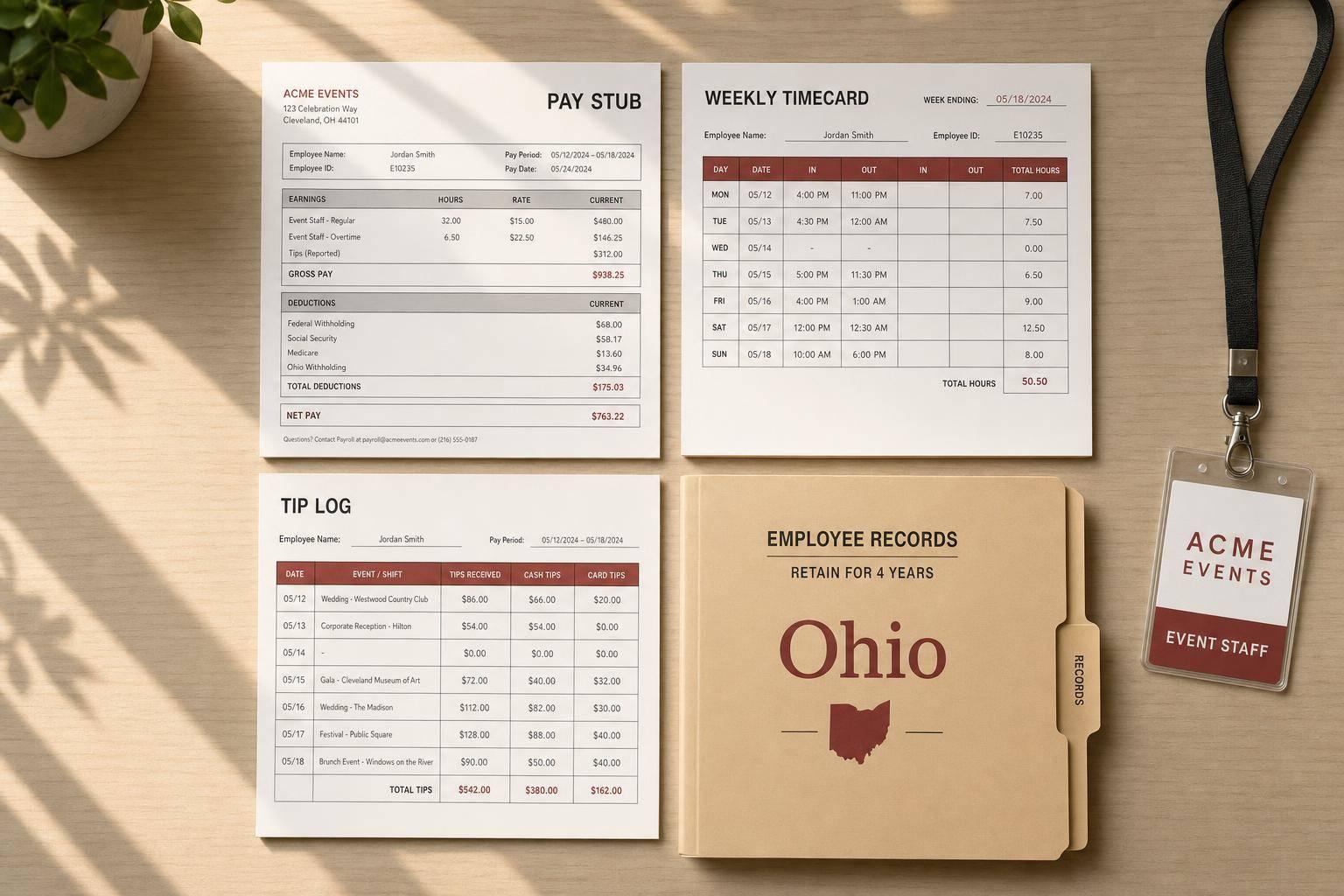
Once hours are logged, the pay stub needs to match them. Under Ohio's Pay Stub Protection Act, employers must give workers a written or electronic earnings-and-deductions statement every pay period. For event staff, that statement should line up with the shift that was worked.
Each hourly event worker's stub must show the employee's name and address, the employer's name, the pay date, the pay period, gross pay, net pay, and each addition and deduction with its amount and purpose.
For hourly staff, the stub must also show total hours worked during the pay period, the hourly wage rate, and overtime hours over 40 in a workweek as a separate item. That matters a lot in event work, where one person may work a wedding on Friday, a banquet on Saturday, and a catering job on Sunday.
One common error is hiding overtime in a single pay line instead of listing regular hours and overtime hours separately. When that happens, it's much harder to check whether overtime was paid at 1.5× the regular rate.
Another issue is vague deduction labels. A line that says "Misc" or "Other" does not meet Ohio's rule that each deduction must show both its amount and its purpose. The same goes for lumping voluntary tips and mandatory service charges together under one "Gratuities" line. Under federal law, those are not treated the same way, and mixing them can lead to wage disputes. Once records get muddy, back-pay claims get harder to fight.
The best setup is simple: every line on the pay stub should trace back to a timecard, a tip log, or a payroll report. A sample earnings section for an event server might look like this:
| Earnings Line | Hours / Amount | Rate | Total |
|---|---|---|---|
| Regular hours – Smith wedding | 24.00 hrs | $14.00/hr | $336.00 |
| Overtime hours – Downtown banquet | 6.00 hrs | $21.00/hr (1.5×) | $126.00 |
| Tip pool distribution | - | - | $180.00 |
| Service charges distributed as wages | - | - | $60.00 |
| Event travel reimbursement (non-wage) | - | - | $25.00 |
Deductions should follow that same pattern. Each line should spell out its purpose, such as Federal income tax, Social Security (FICA), or Court-ordered garnishment – Case #XXXX. If a worker handled more than one role in the same week, each role should have its own earnings line with its own rate and hours. If overtime uses a weighted average across those rates, show the blended rate and the overtime pay as separate lines.
Include the event name or event code on each earnings line so payroll can match the schedule and the event file. Those entries should also match the timecard and any approved edits.
Every pay stub rests on clean time records. In event work, that's not always easy. Staff move between venues, switch roles in the middle of a shift, and often work odd start and end times. If those records don't line up with the pay stub, the file can fall apart in an audit. Getting this right from the start helps cut wage issues and audit trouble.
Ohio event employers should follow federal FLSA recordkeeping rules for each nonexempt worker, including temporary event staff. That means keeping each worker's name, address, job, workweek start, daily hours, weekly total, and approved edit history, along with clock-in and clock-out times, meal breaks, shift changes, and approved edits.
It also helps to tie each time entry to the event itself. Add the event name or event code to every entry so the hours match the event scheduling records, shift edits, and payroll file.
The workweek start should be set once, then written into policy and payroll settings. That way, overtime is calculated the same way for every shift.
A lot of timekeeping systems round punches to the nearest 5 minutes, 1/10 hour, or quarter hour. That can be lawful, but only when the rounding stays neutral over time.
Manager edits can cause the same kind of problem if they cut out paid time without a record. Say a bartender forgets to clock in, or a setup crew member starts working before the time clock is up and running. In those cases, don't trim the shift unless there's a written reason.
Under FLSA, all time an employee is allowed to work is compensable, including pre-event briefings, post-event teardown, and travel between venues during a shift.
A simple workflow can keep records clean and easier to back up later:
A clean edit trail makes the final payroll file much easier to defend. For tipped event roles, keep tip logs and service-charge records with those timecards.
Tipped event staff can earn cash tips, card tips, and pooled payouts in the same shift. So once hours are in the system, tipped roles need their own paper trail too. Each tip record should tie back to the event and the role worked.
Ohio defines a tipped employee as someone who customarily and regularly receives more than $30 per month in tips. If you claim a tip credit, keep a written notice in each worker's file that shows:
For each tipped shift, record the worker's name, date, start and end times, tipped-role hours, direct cash wages, reported tips, tip credit claimed, and a pay-period total showing Ohio minimum wage was met.
The key point is simple: match tip records to the exact hours worked in the tipped role. If someone moves between tipped and non-tipped work during the same event - for example, a server who also helps with setup - track those hours separately. The tip credit applies only to time spent in the tipped role.
This is where people often get tripped up. Service charges are not tips. A voluntary tip is money the customer chooses to leave. A service charge, such as an automatic banquet fee, is business revenue unless payroll treats it as wages.
To keep records clean, label it as "service charge" on invoices, settlement sheets, and payroll reports. If any part of that charge is paid out to workers, show it as wages or service-charge compensation, and document the tax treatment separately.
When service charges are paid to workers, run those amounts through payroll as regular wages, with standard income tax, Social Security, and Medicare withholding. Mixing them in with voluntary tips can muddy the record during an audit and lead to W-2 reporting errors.
These reports should stay with the payroll file. The IRS requires workers to keep daily tip records and report cash tips of $20 or more per month per employer. As the employer, keep those written tip reports in your payroll files.
For large food or beverage establishments, if reported tips are less than 8% of gross receipts, the IRS may require you to allocate more tip income and report it in Box 8 of each worker's W-2.
For tip pools, record the contributors, recipients, allocation formula, final payout, and distribution date. An audit-ready tip log should be tied to each event and include the event name, date, location, each worker's assigned role, cash tips, card tips, tip-outs, and pool allocations, all matched back to POS settlement reports or banquet check reconciliations.
Keep tip logs, pool sheets, and service-charge records together in the same payroll file.
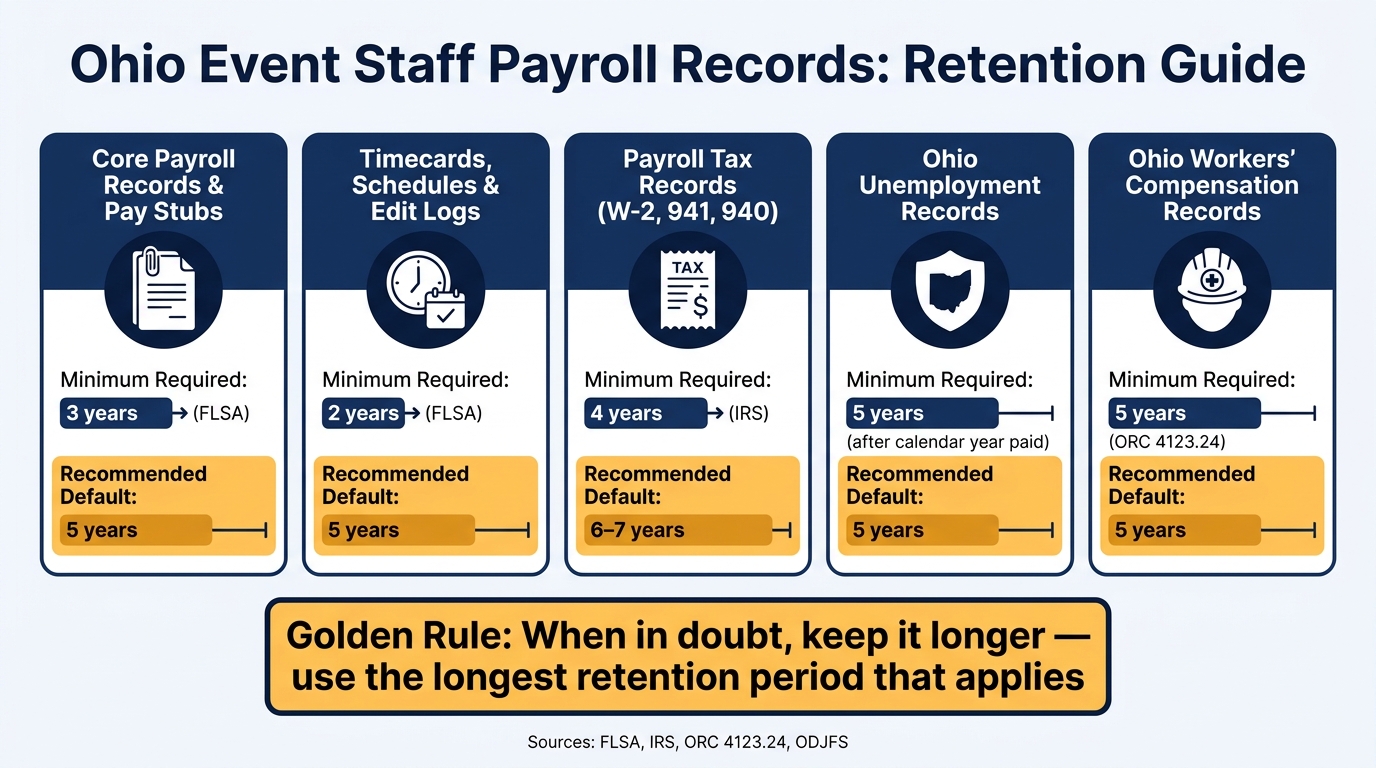
Ohio Event Staff Payroll Records: Retention Periods at a Glance
Once pay, time, and tip records are in order, retention is the last compliance step. The safest move is simple: keep each record for the longest rule that applies. That includes pay stubs, timecards, tip logs, and edit approvals.
Here’s a clear schedule to help keep each event file complete and easy to pull when needed:
| Record Type | Minimum Required | Default |
|---|---|---|
| Core payroll records & pay stubs | 3 years (FLSA) | 5 years |
| Timecards, schedules, edit logs | 2 years (FLSA) | 5 years |
| Payroll tax records (W-2, 941, 940) | 4 years (IRS) | 6–7 years |
| Ohio unemployment records | 5 years after calendar year paid | 5 years |
| Ohio workers' compensation records | 5 years (ORC 4123.24) | 5 years |
A good rule of thumb: if a record ties back to pay, taxes, or hours worked, keeping it longer usually saves headaches later.
Pull the records from the earlier sections into one file for each worker. If the DOL, IRS, Ohio BWC, or ODJFS asks for records, they’ll want one complete file per worker, not bits and pieces spread across different systems.
That file should include:
Keeping all of this in one folder or digital file makes audits much less painful. Instead of digging through email threads, scheduling tools, and payroll platforms, you can hand over one complete record set.
Quickstaff can help here by keeping event rosters and shift reports with the payroll file. Exported shift reports and event rosters, kept for the right retention period, can become part of that audit-ready file.
Focus on the records that tend to matter most: itemized pay stubs, accurate time records, separate tip and service-charge logs, and five-year retention for anything tied to wages, taxes, unemployment, or workers' compensation.
All hours an employee works in different roles during the same 168-hour workweek have to be added together. You can't split hours by role or by event to get around overtime rules.
If the total goes over 40 hours, the employee must be paid overtime at 1.5 times their regular rate for those extra hours.
And one more thing: classification is based on the work the person actually does, not the job title on paper.
Generally, no. Service charges are not treated as tips for payroll purposes.
Here’s the plain-English difference: tips are voluntary payments that customers choose to give employees. Service charges, on the other hand, are mandatory fees set by the business.
Because the employer controls those charges, they don’t count as tips under federal labor standards.
Keep clear records of employee hours, wages, personnel files, payroll documents, and day-to-day employment practices. Under federal law, you need to keep payroll records for 3 years and time cards or work schedules for 2 years.
That usually means holding on to details like:
You should also keep safety training records for the full length of employment plus 5 years.