Temporary Event Food Permits: 5 Staff Training Topics
October 31, 2026

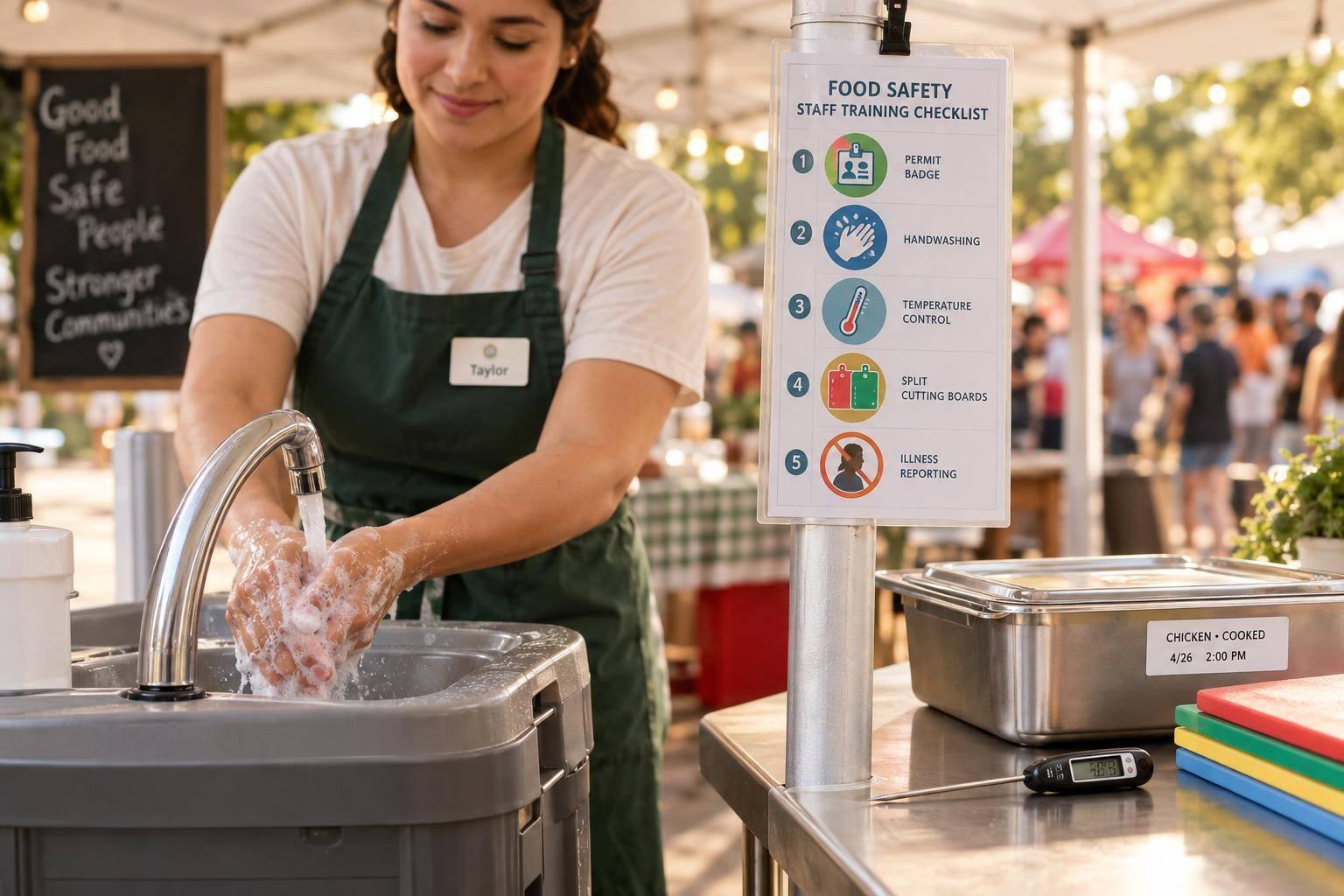
Before food prep starts, I check that every worker knows the permit rules and can perform their assigned food-safety tasks. My training checklist covers five topics:
I assign a lead and backup for each shift, check skills before prep, and give replacement workers the same briefing. A food-handler card alone isn’t enough. <u>Your event permit and local health department rules set the requirements.</u>
Use the permit as the rulebook for every shift assignment. Before scheduling staff, check the local permit terms for staffing, menu, hours, and site setup. Confirm whether food sold or served requires a permit - and whether mobile units, off-site preparation, alcohol service, or multiple sites need separate approval.
Train staff to follow the approved menu and preparation steps. Get approval before changing either. Check that the approved site has the required handwashing station, potable water, soap, paper towels, waste containers, and equipment suited to the menu. Staff must also know the water supply, wastewater disposal, and setup rules that affect service.
Confirm application deadlines, inspection timing, and which records must stay on site. Allow enough time in the arrival schedule for staff to prepare their stations before inspection.
Once the permit requirements are clear, assign a person in charge (PIC) and a backup for each shift. Assign responsibility for receiving checks, cooking controls, and service practices that protect exposed food and prevent bare-hand contact. Include sanitation duties, such as restocking handwashing supplies and handling wastewater. During service, the PIC monitors compliance, records, inspections, and corrective actions.
Check locally required credentials. A food-handler card does not replace site-specific permit training. Before service, have each worker state their tasks, point out the handwashing station, and name whom to notify if equipment fails or conditions become unsafe.
Once the permit terms are clear, turn them into shift-specific duties. Brief everyone whose work can affect compliance or food safety—one of the biggest event staff scheduling challenges: the person in charge (PIC), cooks, servers, bartenders handling garnishes or ice, setup and breakdown workers, dishwashers, runners, delivery staff, and backup personnel. The PIC oversees the operation during the event and must maintain day-to-day control of food-safety risks.
Train each role on the permit limits that apply to its work. Review the approved site, dates, hours, menu, prep kitchen, layout, water, wastewater, handwashing, equipment, and local restrictions.
Create role cards that give each worker the permit rules for their job. Cooks need to know which foods they may prepare onsite and which must come from an approved kitchen. Servers need to understand the permit’s service limits.
Setup staff should check that the booth or tent, sinks, potable water, wastewater containers, refrigeration, and shielding match the approved plan. Runners and delivery staff need to know where they may receive and store food.
Give everyone the same response when a required condition fails: stop the affected task, protect or isolate the food, notify the PIC immediately, and record the issue. Staff must not change the process without approval or keep serving food when required facilities are unavailable.
The PIC then decides whether to fix the problem, discard affected food, suspend service, or contact the local health department.
Before opening, use an event day checklist to confirm permit documents, the approved menu and site, water and wastewater systems, handwashing supplies, refrigeration and hot-holding equipment, food protection, and staff assignments. Confirm who staff should contact if a permit limit is broken. Record the check time and any corrective action.
Once event staff scheduling and permit duties are set, train staff on the hygiene habits that prevent contamination during service.
Train everyone who handles food, ice, utensils, food-contact surfaces, or service equipment. That includes volunteers and temporary hires.
Match the training to each job: cooks wash before prep, servers after clearing dishes, and bartenders after handling money or waste. Everyone must wash when moving from dirty to clean tasks. Check for any additional local hygiene requirements before service.
Use the designated handwashing station with clean, running water and soap. Wet hands and exposed parts of the arms, then apply soap. Scrub all surfaces - including fingertips, between fingers, backs of hands, and under fingernails - for 10–15 seconds. Rinse thoroughly, then dry with a single-use paper towel or an approved drying method. The full process should take at least 20 seconds.
Wash before preparing food, handling ready-to-eat food, or putting on gloves. Also wash after:
Hand sanitizer and gloves do not replace handwashing. Discard torn or contaminated disposable gloves - never wash and reuse them. Use gloves or utensils to prevent bare-hand contact with ready-to-eat food.
Before work starts, have each worker point to the handwashing station, demonstrate the full washing sequence, and name three times they must wash. Record the results and correct missed steps right away.
Assign a lead and a backup to keep stations accessible, supply potable running water, soap, and paper towels, and manage wastewater. Set check intervals, log checks and corrections, and watch handwashing during service - not just at orientation.
Assign temperature checks by role. Receiving staff check delivery temperatures and packaging. Transport staff check food on arrival, cooks verify cooking temperatures, and buffet attendants monitor holding temperatures. Prep leads handle cooling and reheating.
Assign a trained backup for each duty. Everyone must follow the permit’s temperature limits and local health rules.
Use the permit limits for every check. Check the food, not the display. If local rules follow the FDA Food Code limits, keep cold food at 41°F or below and hot food at 135°F or above. Cooking limits depend on the food, so post a food-specific chart showing required temperatures and holding times.
Cool food from 135°F to 70°F within 2 hours, then to 41°F or below within 6 hours total. Use shallow pans, smaller portions, or ice baths. Log progress before each deadline. For food that has been cooked, cooled, and reheated for hot holding, reheat quickly to 165°F for 15 seconds, unless local rules differ. Don’t use a slow warmer as the main reheating step.
Check thermometer accuracy before service, after a drop, and whenever a reading seems wrong. Follow the manufacturer’s calibration instructions; a properly prepared ice-water slurry should read 32°F.
Probe the thickest part of the food, avoiding bone, fat, and gristle. Insert the probe from the side for thin foods, and check several spots in large items. Wait for a stable reading. Between uses, wash, rinse, sanitize, air-dry, and store the probe.
Have each worker demonstrate temperature checks for their role, calibration checks, probe cleaning, and log entry. Each log should include the food or batch, location, date, time, temperature, employee initials, and corrective action.
Set check intervals and review logs during service. Confirm that staff complete permit-required checks and record corrections.
When food falls outside the required limits, stop service and recheck it with a sanitized, calibrated thermometer. Determine how long temperature control was lost, then follow local rules for recooking, rapid reheating, cooling, or disposal. Discard food if you can’t verify its safety.
After temperature control, teach staff to keep raw food separate from ready-to-eat food. Train everyone who handles food or food-contact equipment, including runners, loaders, servers, and dish staff.
Match training to each person’s duties: raw-food separation for prep workers, ready-to-eat food protection for servers, and cleaning and sanitizing for dish staff. Include the local rules that apply to each role.
Follow the approved permit rules to keep raw animal foods and their juices away from cooked and ready-to-eat foods. Store raw foods in sealed, leak-resistant containers below ready-to-eat items, with raw poultry on the lowest level. Keep raw and ready-to-eat foods separate during transport and service, too.
Wash hands after raw-food tasks and before touching ready-to-eat food. Change gloves between tasks and whenever they’re torn or contaminated. For exposed ready-to-eat food, use clean tongs, disposable tissue, utensils, or single-use gloves, following local bare-hand rules.
Use dedicated, labeled boards, knives, pans, and utensils to keep equipment separate. Never use raw-food equipment for cooked food without cleaning and sanitizing it first.
Clean first, then sanitize. Remove debris, wash with detergent and water, and rinse as required. Then apply an approved food-contact sanitizer at the rate and contact time listed on its label. Let surfaces air-dry as directed.
Before service, have workers demonstrate storage order, equipment selection, handwashing, glove changes, and cleaning followed by sanitizing. Check utensil and glove use during service - not just during training. Record training completion by role, and retrain workers when their duties change.
Correct contamination immediately. Stop the affected task, replace contaminated tools and utensils, and discard exposed food when necessary. Clean and sanitize affected surfaces before restarting. Use the same role-based checks for illness reporting and work restrictions.
After contamination control, cover the final stop-work rule: illness reporting and work restrictions.
Train every worker, including backups, to report illness and know who approves their return. Supervisors and the person in charge (PIC) need extra training on restriction, exclusion, confidential records, and health-department notification. When a report requires exclusion or restriction, the PIC must adjust assignments immediately to maintain permit compliance and safe service.
Staff must report vomiting, diarrhea, jaundice, sore throat with fever, infected wounds, or any reportable diagnosis or exposure before work or as soon as symptoms begin. Post one private phone or text contact for illness reports to the PIC, plus a backup contact.
Workers who develop symptoms must stop food work and notify the PIC right away. Exclusion keeps the worker out of the event. Restriction limits them to nonfood tasks, away from exposed food, clean equipment, utensils, linens, and unwrapped single-use items. The PIC decides which applies. Active vomiting or diarrhea generally requires exclusion - not reassignment.
Securely cover any infected, open, or draining wound before handling food. If the wound cannot be securely covered, reassign the worker or send them home.
Follow the required return-to-work period, along with any testing, medical documentation, or health-department approval required by local rules.
Before service, ask staff to explain whom they would contact and what triggers a stop to food work. Supervisors should keep reports and decisions confidential and notify the health department when required.
Before approving a return, verify the required time away from work, any required clearance, and wound protection. Do not override exclusion or restriction rules to fill a staffing gap.
Put these triggers on each role card and shift checklist.
Assign food-safety duties based on the work - not the job title. Pair each responsibility with a named worker. Use permit conditions and local rules to define each role’s limits, equipment, and records.
Turn the five training topics into specific duties for each role and shift.
| Staff role | Contamination risk | Required behavior | Manager verification |
|---|---|---|---|
| Cooks | Raw foods or juices contaminating ready-to-eat food | Separate raw foods, wash hands after handling them, and use clean, sanitized tools and a calibrated thermometer. | Watch prep flow, check storage order, and review cooking-temperature records. |
| Servers and buffet attendants | Guest contact, dirty utensils, and unsafe holding temperatures | Replace dropped or contaminated utensils immediately. Avoid bare-hand contact with ready-to-eat food, use covers or barriers where required, and check and log holding temperatures. | Check utensils and food barriers; review buffet temperature checks. |
| Runners | Temperature loss or contamination during transport | Keep containers closed. Use insulated carriers or ice packs as needed, and check temperatures at dispatch, arrival, and placement into service. | Review records for food item, time, temperature, carrier, and corrective action. |
| Setup and dishwashing staff | Missing handwashing supplies or dirty equipment contaminating clean items | Keep handwashing stations stocked. Separate dirty and clean equipment and utensils, and wash, rinse, sanitize, and air-dry tools. | Check station supplies, sanitizer concentration, and protected utensil storage. |
| Person in charge (PIC) | Uncorrected hazards across stations | Oversee staff practices, review records, make illness-response decisions, and direct corrective actions under local rules. | Review completed logs and documented corrections; confirm oversight throughout operating hours. |
The table connects training to checks and actions on each shift.
For workers with multiple duties, use one sheet that lists both roles and the handwashing, glove changes, and equipment changes required between tasks.
Use the assignment sheet during pre-service checks to give every shift a named lead and backup.

Temporary Food Permit: Pre-Service Readiness Checks
After training, confirm that staff are ready before prep starts. Align the written checklist with the local health department’s permit and inspection instructions.
Use the checklist to confirm that each worker can perform their assigned role before each shift. Complete these six checks before any prep:
Do not start the duty until the gap is fixed. Record the issue, time, owner, correction, and manager verification. Retrain and recheck anyone who cannot demonstrate a required skill. If the gap cannot be fixed, suspend the duty or menu item.
Repeat brief checks before opening, during peak service, after breaks or station changes, and whenever staff or equipment changes. Continue temperature monitoring at locally required intervals. Keep a printed checklist on hand in case mobile service fails.
Use the same checklist for replacement staff. Quickstaff can help managers track availability and contact replacements fast. Availability is not proof of qualification: verify role-specific training, required credentials, and actual shift availability. Then complete the same briefing and readiness checks. Shared messages should state only the staffing need - not symptoms or diagnoses.
These five topics help teams meet permit requirements and serve food safely when training fits each worker’s duties.
Follow the event permit and local health department rules. The FDA Food Code is a model, not the final authority.
Once the permit requirements and staff duties are clear, use skills checks to confirm readiness. Staff must perform tasks correctly and follow local rules during service.
Contact the health department, fire marshal, or relevant labor and alcohol authorities where the event will take place. Requirements vary by jurisdiction, venue, and staff role. Don’t assume general or out-of-state credentials will be accepted.
Confirm certificate validity, renewal schedules, accepted providers, and whether records must stay on-site. Document the specific rule source, the name of the official you consulted, and the verification date so your compliance records stay accurate and ready for inspection.
Match training to specific tasks, not just job titles. Before assigning someone to a new role, check that their credentials cover every duty. Review compliance records whenever roles or venues change. Credentials that apply in one setting may not apply in another.
Keep staff IDs, roles, and training status in one central system so you can spot gaps before shifts begin.
Keep staff names, roles, credential details, completion and expiration dates, and certification jurisdictions on file. For each verification check, record who reviewed it, when, the source used, and any follow-ups. Training attendance records should include event names, dates, trainers, topics covered, and pre-shift sign-ins or confirmations.
Store records securely in a centralized system that authorized managers can access during inspections - not on personal devices. Ask your local health department which records must be kept physically on-site.