7 Incident Command Drills for Event Crews
October 7, 2026

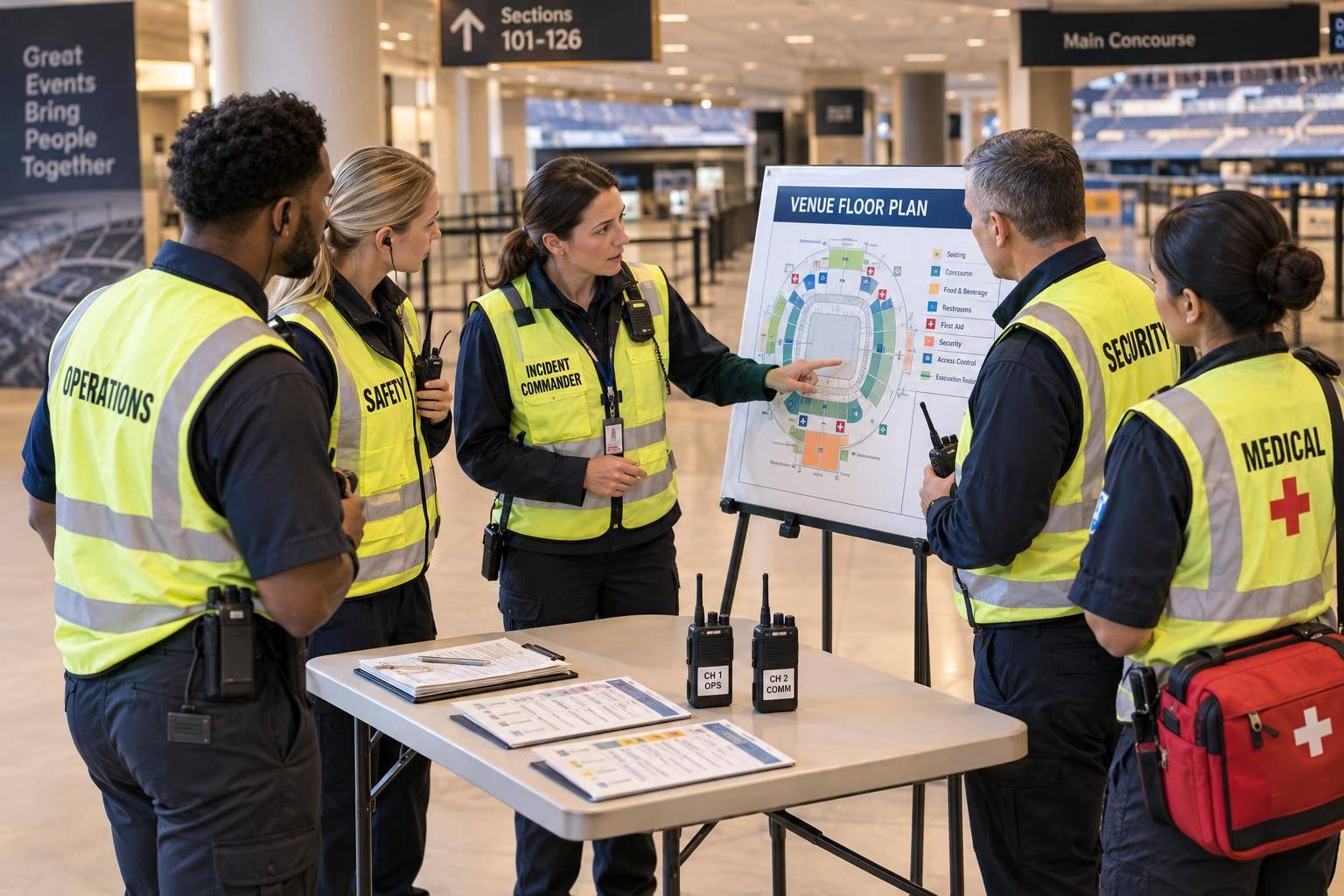
I use seven drills to check whether event crews can take charge, send clear reports, and keep emergency routes open. Before starting, I assign roles and backups, confirm safe routes, and label every drill message “EXERCISE.”
Here’s what I test:
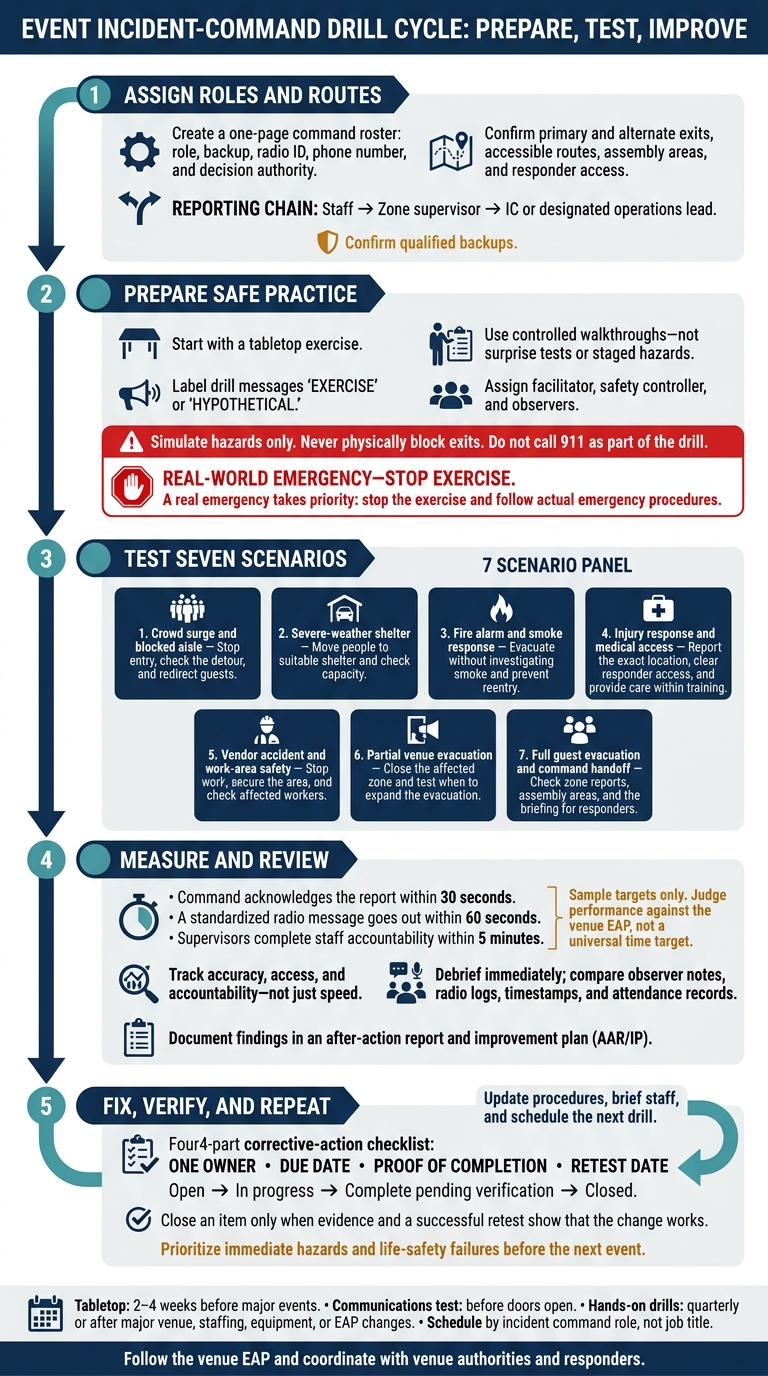
I start with a tabletop exercise, then use controlled walkthroughs - not surprise tests or staged hazards. Sample targets include acknowledging reports within 30 seconds and checking staff accountability within 5 minutes, but the venue’s emergency action plan sets the standard.
My rule: <u>every gap gets an owner, a deadline, and a retest</u>. I schedule drills by role, confirm qualified backups, and verify fixes before the next event.
Event Crew Incident Command Drill Cycle
Before any drill, put the command structure on paper. Create a one-page command roster using the venue’s emergency action plan (EAP). Include each person’s role, backup, radio ID, phone number, and decision authority. Attach maps showing primary and alternate exits, accessible routes, areas of refuge, assembly areas, AEDs, utility shutoffs, and responder access points. Define each zone supervisor’s boundaries, and include emergency contacts and the venue address.
Assign an Incident Commander (IC), zone supervisors, a safety officer, a communications lead, medical support, and vendor/production contacts. Use the same chain of command for all seven drills. Medical support coordinates with EMS, while vendor or production contacts handle equipment and work-area hazards. Assign trained staff to provide accessibility support, including accessible instructions and evacuation assistance.
Use one reporting chain: staff report to their zone supervisor, who reports to the IC or designated operations lead. Set primary and backup communication methods. Each radio report should state the sender, exact location, hazard, action taken, and help needed. Have receivers repeat critical instructions. Use plain language rather than unexplained codes, and follow this structure in every drill below.
Document who can stop work, order shelter or evacuation, and approve re-entry. No one should enter smoke, disable alarms, or provide care beyond their training. At small events, combine roles only if staff can still carry out each duty, following a scalable event scheduling model. Larger events need separate leads and more zone supervisors. Do not assign someone to direct an evacuation while also providing first aid.
Practice command transfer when public-safety responders arrive, including during the evacuation drills below. Brief responders on hazards, injuries, missing people, evacuation progress, access routes, and available resources. Transfer command only when jurisdiction and incident needs require it. Announce the transfer, record the time, and keep the event IC available as a venue liaison.
Once roles are assigned, use a safe drill to test command, communication, and route control. A tabletop exercise lets teams practice decisions and coordination without moving guests or equipment. A walkthrough lets them practice routes, shelter areas, and assembly locations. Walk at normal speed, and keep exits and emergency access lanes usable.
Prepare a one-page exercise brief with the scenario, timing, boundaries, and communication channel. Notify venue management, security, vendors, temporary staff, medical providers, and accessibility support personnel. Label all drill signs, announcements, and messages:
“EXERCISE” or “HYPOTHETICAL.”
Use separate drill-only radio channels or test-message groups.
Assign drill-only roles, not a separate incident command structure: a facilitator introduces updates, a safety controller stops unsafe activity, and observers record performance without coaching. Set measurable objectives:
Record timestamps, communication errors, route availability, and accessibility gaps. Track accuracy, access, and accountability - not just speed.
Simulate hazards only. Do not allow crowd compression, running, pushing, staged physical contact, smoke, flames, hazardous equipment conditions, or blocked exits. Do not call 911 as part of the drill.
Arrange alarm testing in advance with venue management, the fire-alarm contractor, the monitoring provider, and local authorities as required. Confirm approval for activation, how notifications will be handled, and how the system will be restored afterward. Otherwise, simulate the alarm verbally.
Tell everyone the stop signal:
“REAL-WORLD EMERGENCY - STOP EXERCISE.”
Anyone may stop the drill for an unsafe condition. A real emergency takes priority: stop simulated actions, follow actual emergency procedures, and call 911 when needed. The safety controller must confirm that the exercise has stopped and allow it to restart only after the real situation is resolved. Use the same drill rules in each scenario below.
Use the command structure above to test the most common flow failure: a blocked aisle. Pick a busy spot, such as the main entrance, a concession line, or a seating aisle. Mark the simulated blockage with cones or a training sign, and use observers or a few role-players. Test whether staff notice the blockage, stop entry, reroute traffic, keep responder access clear, and escalate if the detour fails.
Assign an incident commander (IC) to make decisions about access control, rerouting, pauses, and escalation. A zone lead manages staff near the blockage, a safety officer stops unsafe activity, and a communications lead handles radio traffic and public messages. Give each role a backup, a radio channel, and clear authority limits. Include the IC’s authority to order an evacuation or shutdown.
Position staff before and after the blockage to create a visible buffer. Keep traffic moving in one direction. Before redirecting guests, confirm that the detour is open, accessible, and staffed.
Keep radio and PA messages short: state the location, what’s closed, and what people should do. The same command team should escalate immediately if the detour fails. Also escalate if an exit is affected, someone falls or reports distress, or congestion exceeds the team’s authority.
Hold a short debrief. Compare observer notes, radio logs, and timestamps to review when staff discovered the blockage, sent notifications, rerouted traffic, and escalated. Check that exits and responder access stayed clear and that staff gave consistent directions people could act on. Assign each gap an owner, a deadline, and a recheck date.
Run a tornado-warning drill at an outdoor event to test how fast incident command shifts from normal operations to weather response. Check how quickly crews move guests to shelter while keeping clear counts. The IC, shelter coordinators, and accountability lead should act on the same warning: the IC orders sheltering, coordinators manage occupancy, and the accountability lead tracks counts.
Confirm that crews know the difference: a watch means prepare; a warning requires immediate protective action. Check the shelter’s usable capacity before the drill. If space is short, identify a backup evacuation site and the route or transport plan to reach it.
Assign an alert monitor to check National Weather Service notifications and NOAA Weather Radio. Give the incident commander authority to stop the event and order sheltering.
Shelter coordinators manage occupancy. A communications lead delivers plain-language updates, an accessibility lead checks assistance needs, and an accountability lead tracks staff, vendors, and known guest groups using event staff scheduling tools. Do not delay protective action once an official warning indicates immediate danger.
Direct people to a basement, safe room, or the lowest interior room or hallway away from windows. Tents, canopies, and vehicles are not tornado shelters. Check whether the team can move people while maintaining access control and accountability.
Stop outdoor work, and do not send crews back for equipment once the warning escalates. Test PA announcements, backup loudhailers, and visual or multilingual directions. Keep accessible routes usable and companions together.
Shelter coordinators should report occupancy and anyone who needs first aid or medication support without blocking entrances.
Record the times for alert receipt, the shelter order, the first announcement, arrival, and accountability. Review whether all areas received the alert, how fast decisions were made, and whether messages were clear. Also check occupancy control and accessible routing.
Treat any instruction to use tents - or any request to retrieve equipment - as a safety failure. Assign corrections before the next event.
After sheltering drills, test how quickly crews shift to evacuation when an alarm sounds. Coordinate with venue management and, if the venue plan requires it, the fire department. Announce that this is a controlled exercise. When testing recognition and response, keep the exact location and timing undisclosed to staff. Use this scenario:
“A guest reports smoke near the catering kitchen, and the building alarm activates.”
Mark the area as simulated and use the venue’s approved alarm-testing process. Test prompt reporting, alarm notification, evacuation, reentry control, staff and vendor accountability, and responder handoff. Assign clear roles before the alarm starts.
The incident commander (IC) directs the response and evacuation. The notification lead manages the approved alarm process and makes the emergency call when the venue plan requires it. Area wardens guide people out, while the accountability lead checks staff and vendor rosters. Staff report to the IC through their zone supervisor.
The fire department liaison meets responders with the venue address, incident location, hazards, access routes, and missing-person information. Only the fire department or another authorized official may approve reentry.
Do not enter smoke, open doors to investigate, or delay evacuation for confirmation. During evacuation, wardens check only safe, visible areas. Direct occupants to the nearest safe marked exit and change routes if smoke blocks that exit. Follow the venue’s plan for guests who need assistance, and tell responders about anyone awaiting help.
Test whether the liaison can report the incident location, occupant status, blocked routes, and hazardous materials - such as propane or cooking fuel - within one minute of responders arriving.
At the assembly area, keep fire access lanes clear and stop anyone from returning for belongings. Immediately report missing people by name and last known location. During the debrief, compare evacuation timing, route changes, and handoff quality.
Debrief after the all-clear and document findings within 24 hours. Compare notification, clearance, accountability, and handoff times. Record unsafe investigation, missed vendor counts, inaccessible exits, and attempted reentry.
Give each correction an owner, deadline, and retest date. Never count an unconfirmed person as safely evacuated.
Simulate an injury in a controlled area using a mannequin or consenting role-player. Tell venue management, staff, and required partners that this is a drill. Assign a safety observer, and allow the role-player to stop the exercise at any time. Use a mock call unless dispatch has approved participation.
Test fast medical access, accurate reporting, care within training, patient privacy, and responder handoff. The drill should show whether staff can reach the patient, clear the access route, and hand off care without delay.
Follow the established command chain. The IC pauses nearby activity, while the Medical Lead provides care only within their training. The Communications Lead sends the medical call and updates. The Access Lead clears the responder route, and an observer records actions and times.
Once roles are set, act immediately to secure the scene, control access, and protect privacy. Check scene safety before approaching. Look for glass, spills, electrical hazards, and moving equipment. Do not move the patient unless they face immediate danger or qualified medical personnel direct it.
Use barrier protection as trained, and keep spectators back. Keep names and medical details off shared radio channels. Leave the emergency responder route clear, and identify a safe staging point for equipment. Privacy measures must never delay emergency care.
Report the room or zone, floor, nearby landmark, and best responder entrance. Include the number of patients, their responsiveness and breathing, and any hazards. Require a location read-back. Post an escort at the entrance and verify a backup route.
The Medical Lead’s handoff should cover what happened, the location, the patient’s condition, care given, any changes, and hazards - not a diagnosis.
Compare the reported location with the venue map. Record the time to medical notification, care within training, route clearance, and responder arrival at the patient.
Check whether staff provided care beyond their training, exposed private information, or directed responders to the wrong entrance. Give each gap an owner, a deadline, and a retest date.
Simulate a spill, burn, loading incident, or electrical hazard without real liquid, heat, moving equipment, or exposed wiring. Test whether staff stop work promptly, secure the area, report the hazard, keep medical access open, account for affected staff using event staff scheduling software, and prevent reopening too soon. Then assign roles with authority to stop work, secure the area, and keep access clear.
Assign an IC, vendor lead, Safety Officer, medical contact, operations lead, communications lead, and evaluator. The vendor lead can stop work and account for vendor employees. The Safety Officer can halt unsafe acts.
The medical contact keeps responder access clear, while operations controls nearby activity. Communications sends updates, and the evaluator records actions and times. Only the IC or designated safety authority can approve reopening.
Stop work before anyone approaches the hazard. Mark a boundary that keeps carts and pedestrians away without blocking exits or medical access. This boundary must protect responders while keeping their access clear.
Match the response to the hazard:
Require the vendor lead to report the exact location, hazard, affected staff, equipment status, actions taken, and assistance needed. Account for missing or relocated workers - not just those at their stations. Keep nearby vendors outside the boundary and prevent them from restarting related work while command assesses the situation.
Review three checks: discovery-to-response timing, staff accountability, and reopening approval. Compare the times for stopping work, sending notifications, setting the boundary, and providing medical access. Verify head counts and record any entry or restart without permission.
Reopen only after hazard control, accountability, inspections, and explicit approval. Assign each correction one owner and a deadline, then file the report with event safety records.
If the hazard spreads into guest space or blocks routes, escalate to partial evacuation.
If a contained hazard affects only one area, test partial evacuation before moving to a full building exit. On the venue map, mark the affected zone, closure points, safe destination, and accessible alternate route. Identify which areas will stay open.
Use observers or role-players to simulate route problems. Never physically block exits.
The IC decides whether to close an area or escalate. The zone lead stops entry, safely sweeps the area, and reports its status: clear, unchecked, or needs assistance.
Communications sends instructions, accessibility coordinates assistance, and accountability tracks everyone assigned to the zone.
With the zone marked, test whether staff can close it, redirect guests, and keep access routes open. Send location-specific instructions through both audible and visual channels. Explain which zone is closed, where guests should go, and which areas remain open.
Check the alternate route for locked doors, opposing traffic, stairs, and conflicts with responder access. Ask people what assistance they need. Keep support persons and service animals with the people they assist.
Introduce a simulated report that the alternate route is unavailable or the hazard has crossed the boundary. Failed containment triggers an IC decision to expand the closure or order full evacuation, with sheltering used if the venue plan requires it. Send revised instructions and explicitly cancel the earlier ones.
Compare timestamps for the initial report, command decision, first announcement, zone check, and final personnel check. Review boundary placement, route conflicts, accessibility, missing personnel, and the decision to escalate.
Give each gap an owner and a deadline. Update maps and instructions, and retest after layout or staffing changes. Any failure should trigger the next level of evacuation planning.
If a partial evacuation fails or the hazard spreads, test a full guest evacuation and command transfer. Start with a tabletop exercise. Follow with a controlled walkthrough only if venue management and local authorities approve it.
Label every message EXERCISE - EXERCISE - EXERCISE. Test more than exit routes: check evacuation authority, assembly-area capacity, emergency access, accountability, and the handoff to responders.
Assign assembly-area leads, a responder liaison, and alternates. Keep backups, radio channels, and decision authority on one page so staff can find them fast. Assembly-area leads should manage arrivals while keeping fire lanes and responder staging areas clear.
Send evacuation instructions through PA announcements, text alerts, radios, and staff directions. As guests reach assembly areas, shift staff attention from route control to accounting for everyone.
Test audible and visual messages, assigned accessibility assistance, and both primary and alternate assembly areas. Require a status report from every zone: silence means unknown, not clear. Check staff scheduling challenges and vendor rosters against guest counts, and keep confirmed counts separate from estimates.
At the responder meeting point, prepare a briefing that covers the hazard, cleared and unchecked zones, missing or injured people, blocked routes, fuel or propane, and available maps and keys.
Document who transfers command, who accepts it, and when the transfer happens. Include unresolved risks and decisions still pending. Practice the handoff without activating a real response unless local authorities approve it, and brief responders before command transfers.
Record how long it takes to identify missing people, establish emergency access lanes, and complete the responder briefing. Count conflicting messages and unmet assistance needs.
Within 48 hours, document these gaps and any missing handoff information. Assign fixes and steps to verify them, then retest the parts that failed.
Hold a brief debrief right after each crowd, weather, fire, injury, vendor, or evacuation drill. Record what was clear, what caused delays, and what information or equipment was missing. Compare participant feedback with observer notes, radio logs, and attendance records. Separate facts from assumptions and identify root causes. Use the same review process after every drill so you can compare results across scenarios.
Prepare a short AAR/IP in HSEEP format. Include the drill date, venue area, scenario, teams, objectives, assumptions, safety controls, and observer names. Document key times, strengths, gaps, and supporting evidence. Keep tabletop AARs to one page. For full-venue drills, include maps, logs, attendance, and photos. Use the report to decide what needs fixing before the next drill.
Assess objectives, command roles, communication, safety, access, and accountability. Check whether crews understood stop-work signals and used them correctly. Judge performance against the venue EAP, not a universal time target. Record key times, but focus on whether crews followed approved procedures and completed required actions.
Give each gap a corrective action with one owner, a due date, proof of completion, and a retest date. List any resources or approvals needed. Address immediate hazards and life-safety failures first, before the next event.
Keep one improvement log for all seven drills, sorted by risk and due date. Mark each item as open, in progress, complete pending verification, or closed. Review open items at event-planning meetings, and confirm that temporary staff and vendors receive updated procedures. Close an item only when evidence and a successful retest show that the change works. Carry the log into the next drill schedule, using open items to set retest dates and confirm staff availability.
Use the open-items log to create an annual or seasonal calendar for all seven drills. Hold a tabletop exercise 2–4 weeks before major events, run a short communications test before doors open, and conduct hands-on drills quarterly or after major changes to the venue, staffing, equipment, or EAP. Allow time for an after-action review and corrective follow-up to keep command, communication, and access control sharp.
Schedule by incident command role, not job title. Use the same command structure for every drill. Confirm coverage for command, communications, zone leads, medical access, accountability, vendor coordination, and venue liaison, with one backup for each critical role. Check specialized qualifications through training records and responsible supervisors. Availability alone isn’t enough.
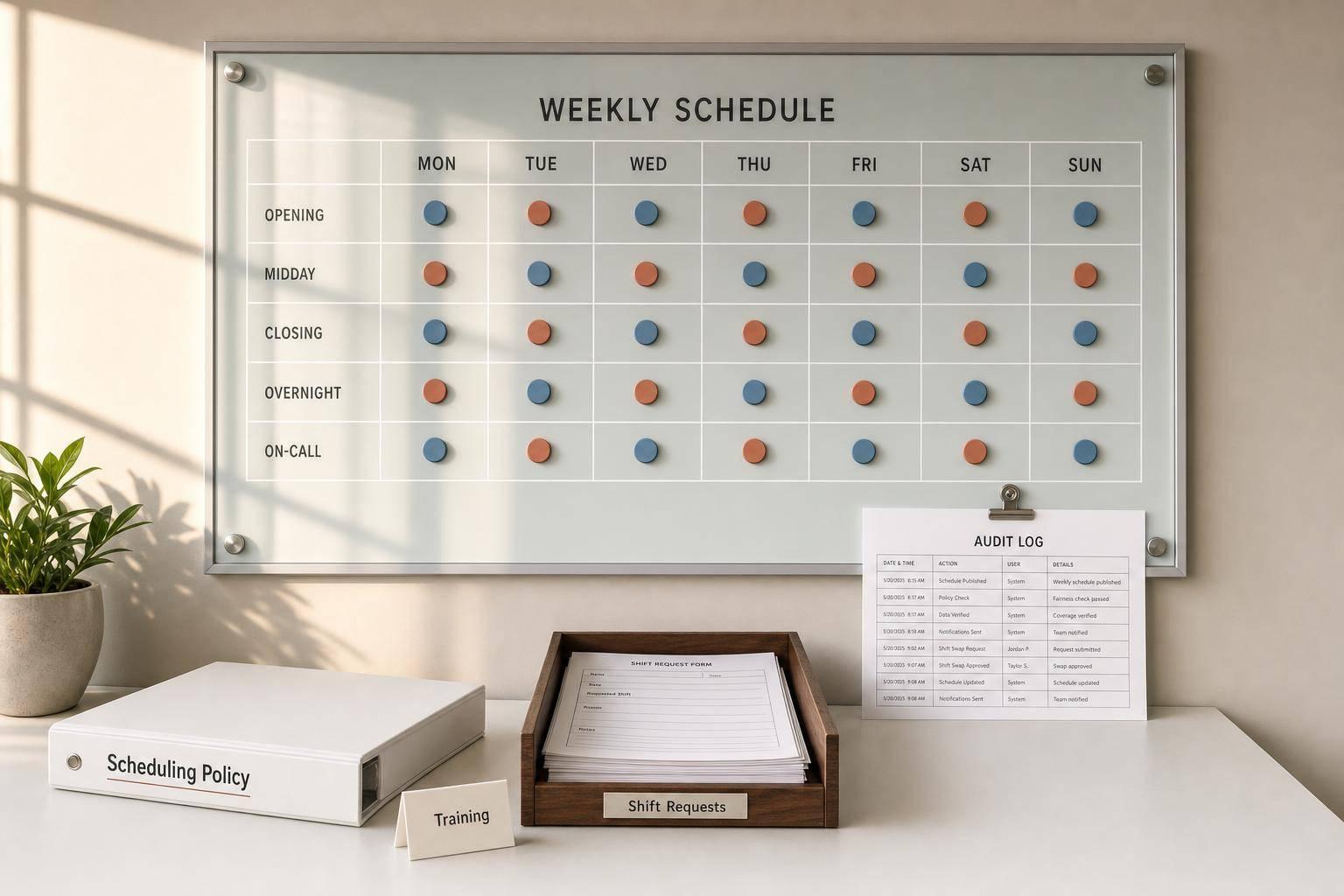
Send assignments when you schedule the drill, role briefs one week before, an attendance check 24–48 hours before, and a day-of reminder. Clearly label every message as a drill and include the date, start and end times, time zone, meeting location, assigned role, required equipment, EAP, and assigned radio or phone channel. Give staff one contact to report an absence.
Quickstaff can help you create drill events, assign staff by role, track availability, manage waitlists, and keep reminders in one place. It does not replace emergency qualifications, the EAP, or coordination with venue authorities and responders.
If someone cancels, confirm the backup, update the roster, notify the IC and communications lead, and brief the replacement before they participate. If no qualified replacement is available, reduce the exercise scope or postpone it rather than put an untrained worker in a specialized role. Carry unresolved gaps into the next drill date.
Every drill tests the same question: can incident command protect people, keep routes open, and hand off without confusion?
Start with a tabletop review. Move to controlled movement only after roles, routes, and communications work. If any step fails, log the gap and retest before the next event.
Document each gap in the after-action report and improvement plan. Give every corrective action an owner, a deadline, the resources it needs, and a verification check. Brief all affected staff on the changes before the next drill. A revised route map doesn’t mean staff are ready. They must prove the route works and responders can reach the scene.
Retest before major events and whenever staffing, layout, or hazards change. Keep practice, correction, and verification in the drill cycle. Judge improvement by performance, not impressions.
Start with a site walk drill. Walk through the venue with your crew to locate emergency exits, evacuation routes, assembly points, first aid kits, and fire extinguishers. Use the walkthrough to spot hazards and explain each person’s emergency responsibilities.
With Quickstaff, you can assign emergency roles - such as Muster Point Lead or Responder Liaison - directly in staff schedules. That way, everyone knows their duties before the event.
Make staff roles and communication clear. At pre-shift roll call, ask each person to state their assignment and who they report to. Have staff repeat key instructions, such as evacuation routes or emergency contacts, to check that they understand.
During drills, send non-emergency ping messages to test acknowledgments and response times. Assign a logkeeper to record major decisions and resource deployments. This gives the team a clear, auditable record for post-event reviews.
Postpone your event or pause operations if a drill exposes critical gaps in safety, communication, or emergency response. These include:
Fix these gaps before proceeding.