5 Key Roles in Event Emergency Teams
June 21, 2026

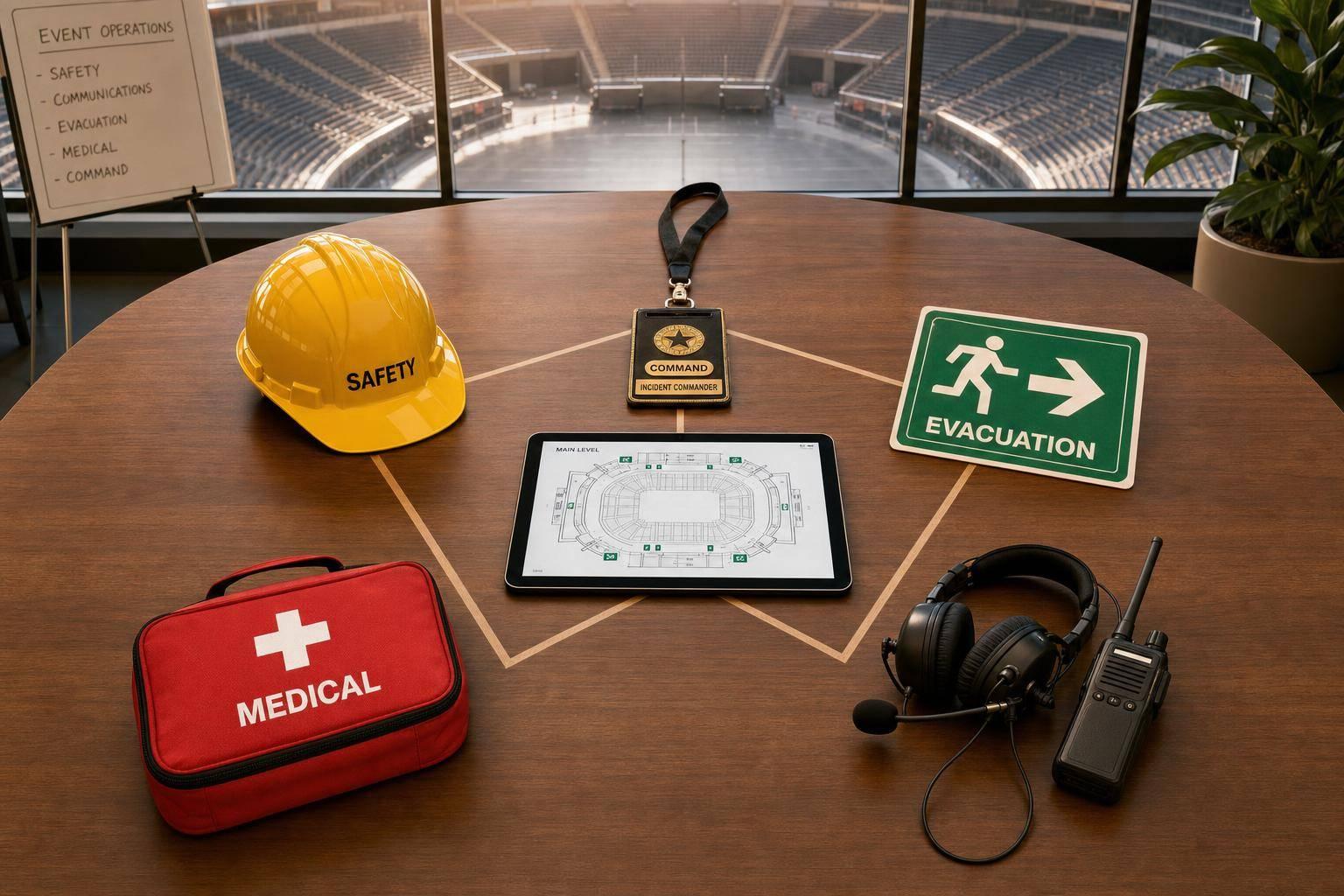
If your team can’t say who leads, who checks hazards, who moves people, who handles patient care, and who sends updates, your emergency plan has a gap.
I’d boil this article down to one point: event safety depends on five named roles set before doors open. Those roles are the Incident Commander, Safety Officer, Evacuation Coordinator, Medical Response Lead, and Communications and Liaison Officer. Each one owns a clear part of the response, and each one needs a backup.
A few numbers make the case fast:
Here’s the short version of what each role does:

5 Key Roles in Event Emergency Teams: Responsibilities at a Glance
| Role | Main job | Key focus during an incident |
|---|---|---|
| Incident Commander | Final decisions | Stop, resume, evacuate, or close |
| Safety Officer | Hazard control | Spot risk early and act |
| Evacuation Coordinator | Crowd movement | Move people to exits or shelter areas |
| Medical Response Lead | Patient care | Triage, treatment, EMS handoff |
| Communications and Liaison Officer | Information flow | Clear alerts, radio use, outside responder contact |
I’d use this article as a event day checklist: name the five roles, assign backups, write first actions, drill the plan, and tie each role to the event schedule. That’s how a written plan turns into action when time is short.
The Incident Commander (IC) is the one person in charge during an emergency. This person makes the final call on whether to pause the event, evacuate, resume, or shut it down. The IC also activates the emergency plan and sends site-wide alerts when the situation calls for it.
That clear chain of command matters. Without it, teams can get mixed messages at the worst possible time.
The IC isn't expected to handle every task by hand. Instead, this role works directly with police, fire, and EMS, and in larger incidents, that coordination can shift into a unified command structure.
It's also smart to name a backup IC so command stays in place if the primary commander can't continue. Quickstaff can help track role assignments and backup coverage.
With command in place, the Safety Officer can focus on spotting hazards and cutting risk.
The Safety Officer’s job is simple in theory and high-stakes in practice: spot hazards early and step in before a bad situation gets worse. This role also carries the authority to pause or stop the event if a hazard shows up or a safety threshold is crossed.
Before the event, the Safety Officer runs risk checks, confirms that exits are visible, unlocked, and clear, and works with vendors so temporary structures and equipment don’t block egress routes. That sounds basic, but it’s one of those things that can make or break a response when people need to move fast.
During the event, the focus changes. The Safety Officer tracks crowd density at choke points like entrances, restrooms, bars, and stairwells, keeps an eye on weather conditions, and flags hazards such as spills or suspicious items.
Weather checks should start 72 hours before the event and follow pre-set trigger points written into the plan. For example, outdoor activities may be suspended if lightning is detected within 10 miles. Crowd density needs the same kind of hard limits. If density hits 5–7 people per square meter, entry should stop. At 7 or more, crowd-relief actions should start at once.
If hazards force people to move, the Evacuation Coordinator then takes over crowd flow.
Once a life-safety threat is confirmed, the Evacuation Coordinator takes charge of movement. Their job is simple in theory but high-pressure in practice: move people to the right place, fast. That could mean guiding attendees to primary or backup exits, or directing them to shelter-in-place areas based on the threat. For fires, gas leaks, or structural failure, the response is evacuation. For tornado warnings, lightning, or high winds, the safer move is to shelter in place.
Before any area is marked clear, staff need to follow a scalable event scheduling plan to sweep restrooms, dressing rooms, storage areas, and back-of-house spaces. It also helps to split the venue into clear zones, such as the stage, concessions, main hall, and back-of-house, with one Zone Leader assigned to each. That way, one person isn't trying to manage the whole building at once. Each Zone Leader handles movement in that section, keeps an eye on conditions, reports status, and flags problems when they come up.
The plan also has to work for guests with mobility needs. Accessible evacuation routes should be kept clear so faster-moving crowds don't overrun them. Staff assigned to those routes should guide guests with mobility limits through them, and refuge areas should be picked in advance for anyone who can't leave right away.
Reverse flow is a serious problem. When people start pushing against the direction of the crowd, falls and trampling can happen fast. Zone Leaders help stop that with clear hand signals and short, direct verbal instructions that keep movement orderly and going one way.
Once the area is cleared, accountability becomes the next task. Each Zone Leader reports headcount and status to the Coordinator, and the Coordinator passes that update to the Incident Commander.
Once crowd movement is under control, the Medical Response Lead takes over the health side of the incident: injuries, collapse, and any other patient care issue. This person identifies patients, sorts cases by urgency, and dispatches the nearest trained responder until EMS arrives and takes over.
The first job is triage. That means making a fast check of who needs help first by looking at consciousness, breathing, and visible bleeding. Use a standard triage method such as START. The target response times are 4 minutes for BLS and 8 minutes for ALS. Hitting those time goals depends on prep work that happens before the event:
If EMS needs to be called, the Lead should activate 911 with an exact location callout. Use clear location codes like "Zone C North, Row 14." One team member should meet the ambulance at the venue perimeter and escort it straight to the patient. The nearest appropriate trauma center should also be confirmed before the event starts.
Medical staffing should match both attendance and risk level. At a minimum, on-site staff should have First Aid, CPR, and AED certifications. For larger or higher-risk events, you may need licensed medical staff such as EMTs, paramedics, nurses, or physicians, based on local rules. Several U.S. states, including New York, Pennsylvania, Maryland, Georgia, Iowa, Oregon, and Washington, D.C., have passed laws that set minimum on-site medical resources. There’s also a strong operational case for physician coverage: on-site physicians have been shown to reduce ambulance transport by 89%.
After each patient contact, the Lead records the patient’s condition, what care was provided, and the timeline of the response. That record should track triage, treatment, and handoff quality for insurance needs and post-event review. Once patient care is stable, that documentation helps the team move into the next phase of coordination and review.
When an incident starts to unfold, someone needs to keep people aligned. That job belongs to the Communications and Liaison Officer.
The first part of the role is managing radio traffic. Channel 1 stays open for emergencies, while routine operations, security, and medical traffic move to Channels 2, 3, and 4. The Officer also enforces call-sign discipline and uses plain language instead of coded jargon, so police, fire, and EMS can understand each other without confusion. Under stress, wording matters. That’s why messages should follow the Location → Issue → Need format.
That radio discipline carries over into public messaging. PA announcements should sound calm, direct, and clear. The Officer should use a steady voice and say things like "move toward the exits" instead of "there might be an emergency". The same message should also go out through PA, digital signage, SMS, and staff runners. Relying on just one method is risky. People may be in bathrooms, outside, or wearing headphones.
A tiered alert system helps match the message to the moment without causing extra panic:
| Alert Level | Audience | Example Scenario |
|---|---|---|
| Tier 1: Informational | Staff Only | Suspicious item, minor injury, parking blockage |
| Tier 2: Precautionary | Staff + Vendors | Severe weather in 30 minutes, EMS request |
| Tier 3: Emergency | All (Staff, Vendors, Attendees) | Fire, active threat, tornado warning, structural emergency |
The Officer also acts as the main point of contact for outside responders. Police, fire, and EMS should hear one clear event-side voice when they arrive. Vendors matter here too. Their supervisors should be part of the same notification system used for internal staff.
Just as important, every message needs a record. Log each alert as soon as it goes out, including when it was sent, who approved it, and what happened next. It also helps to prepare templates before the event for evacuation, severe weather, medical incidents, and all-clear messages. Quickstaff can centralize staff contacts and message templates, which makes escalation faster.
Each of the five roles has its own job: command, safety, movement, care, and information. But no one operates on an island. They overlap, hand work off to each other, and keep the response moving.
| Role | Primary Focus | Typical Training Required | Works Most Closely With |
|---|---|---|---|
| Incident Commander | Final decision-making and overall leadership | ICS certification, tabletop exercises, leadership drills | All leads, especially Safety and Communications |
| Safety Officer | Hazard identification, risk monitoring, and protocol compliance | Risk assessment, venue walkthroughs, safety regulations | Incident Commander, Medical Response Lead |
| Evacuation Coordinator | Crowd flow, exit management, and ADA-compliant egress | Crowd management, evacuation drills, ADA routing | Safety Officer, Zone Leaders, Security Lead |
| Medical Response Lead | Patient triage, immediate care, and EMS handoff | First Aid/CPR, EMT or Paramedic certification | Incident Commander, external EMS, Security for access routes |
| Communications and Liaison Officer | Internal and external information flow | Radio protocols, alert platforms, crisis communications | Incident Commander, vendor supervisors, all zone leads |
The differences are pretty clear in practice. The Incident Commander leads the team and makes the final call. The Safety Officer watches for hazards and checks that protocols are followed. The Evacuation Coordinator manages crowd movement and exit flow. The Medical Response Lead handles triage, immediate care, and EMS handoff. The Communications and Liaison Officer keeps updates moving so the whole team stays on the same page.
The key is the handoff. A plan can look solid on paper, but if one role misses a cue or passes bad information, the whole response can slow down fast.
With the roles mapped, the next step is turning them into a working event response plan.
Turn those five roles into a plan your team can actually use. The simplest way to do that is with three moves: document, drill, and schedule.
Start with documentation. Every role should have a named lead, a backup, and a written first-action checklist. Be clear about who has the authority to pause the event, order an evacuation, or resume operations. That kind of clarity matters more than most teams think. 44% of event managers have no documented communication chain beyond "call me".
Once the roles are on paper, put them to the test. Run a 30–45 minute tabletop exercise, a 30-minute venue walkthrough, and a 10-minute pre-event comms check. On paper, a plan can look fine. Under stress, weak spots show up fast. And that gap is common: only 31% of event organizers have rehearsed their plan with the full team.
Then tie each role to the staffing schedule to avoid common scheduling problems. A title alone isn't enough. Each person should have:
For multi-day events, name rotating leads ahead of time. That way, nobody is left guessing who has authority during overnight or early-morning shifts. Quickstaff can centralize role-based scheduling, availability, reminders, and emergency contacts.
With the roles documented, practiced, and tied to the schedule, the plan is ready for final review.
These roles turn a written plan into action.
Good event response starts with clear roles, named backups, and authority set before anything goes wrong. When people know who’s in charge and what they’re responsible for, the team can move fast without wasting time sorting things out in the moment.
The five roles - Incident Commander, Safety Officer, Evacuation Coordinator, Medical Response Lead, and Communications and Liaison Officer - give any event a workable emergency structure. The key is simple: assign each role before the event begins. Even a small event is better off with a short emergency action plan that spells out who does what.
Documented, rehearsed plans cut response time and help staff spot problems fast. That kind of speed doesn’t happen by luck. It comes from planning and rehearsal. Clear roles also make it easier to work with outside responders. When your team uses the ICS structure and plain language, it stays in step with police and fire departments under pressure. That shared setup helps keep the response coordinated when it matters most.
Yes. One person can handle more than one emergency role when needed, which often happens at smaller events or when staff is tight.
That said, it's best to give each role its own person when you can. If someone needs to wear more than one hat, spell out their main duties clearly and set a backup for every critical role so another person can step in right away if needed.
For a small event, keep roles clear and give them to people who can stay calm under pressure. Pick one Incident Commander who has the final say. Then assign communications, site safety, and logistics to other team members as needed.
If your team is small, one person can handle more than one job. That said, every role should still have a backup. Before doors open, hold a short meeting to confirm who owns what and who reports to whom.
Practice the plan on a regular basis so the team knows what to do when the pressure is on. That can mean tabletop exercises that run 30–45 minutes, venue walkthroughs, and 10-minute micro-drills focused on one action at a time.
It also helps to revisit the plan a few times each year, run a short drill the day before the event, and hold a 15–20-minute all-hands briefing shortly before doors open.