How Scheduling Policies Reduce Bias
September 26, 2026

Bad scheduling is often a process problem, not just a people problem. If I want to cut bias, I need written rules for assignments, one request process, clear approval steps, records that show why each decision was made, and training so managers use the same standards every time.
Here’s the short version:
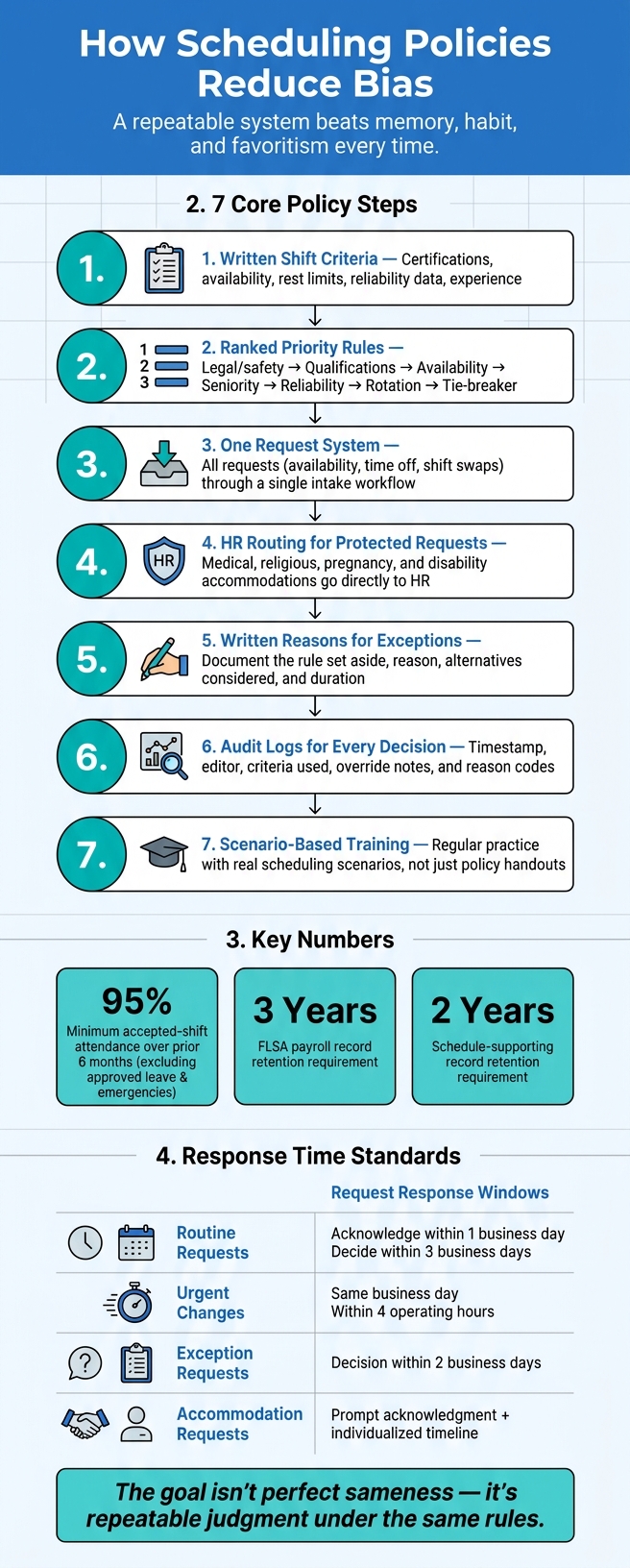
A few numbers stand out. The article points to a sample attendance rule of 95% accepted-shift attendance over the prior 6 months, excludes approved leave and emergencies, and notes FLSA record rules such as keeping payroll records for 3 years and schedule-supporting records for 2 years.
At its core, the message is simple: don’t let schedules depend on memory, favoritism, or who speaks up first in a hallway. Write the rule, apply it the same way, and check the record.
Bias-Free Scheduling: 7-Step Policy Framework
Written rules take shift decisions out of people’s heads and tie them to objective job needs. That’s the point. Instead of relying on memory, habit, or a manager’s gut call, you put the rules on paper and use them the same way each time, creating a rules-based event staffing system.
The EEOC recommends that employers establish written, objective qualification standards, communicate them in advance, and apply them consistently when making assignment decisions.
Each shift assignment should run through the same documented checklist. In plain terms, every worker gets measured against the same yardstick. Core factors usually include required certifications, confirmed full-shift availability, legal rest limits, objective reliability data, and relevant experience.
Reliability should be defined by data, not by a supervisor’s opinion. For example, a policy might define it as confirmed attendance for at least 95% of accepted shifts during the previous six months, excluding approved leave, documented emergencies, and employer-caused cancellations.
It also helps to track who gets overtime, weekends, holidays, and premium events. If you don’t track those assignments, patterns can build quietly in the background. A monthly review by worker makes it easier to spot drift early, before it turns into a larger issue. And when criteria pull in different directions, the policy should spell out which one comes first.
Sometimes two qualified workers won’t line up neatly across every factor. When that happens, the fix is simple: use the same priority order every time.
A practical sequence looks like this:
That order should be written into the policy and followed the same way every time. So if a high-risk event needs a certified bartender, the certified bartender gets the shift ahead of a more senior worker who does not have that certification.
There’s also a simple gut-check that helps keep decisions straight: can this assignment be explained using the same criteria used for every comparable worker? If not, stop and review it before the schedule goes out.
Even if assignment rules are set, request handling can still lead to uneven treatment. Once the rules are fixed, the request process needs to stay just as steady. If staff ask for schedule changes through hallway chats, text messages, or verbal requests, results can start to depend on who knows whom instead of what the policy says.
Put every request through one intake workflow. That includes availability updates, time off, shift preferences, and shift swaps. Use the same form, the same fields, and the same deadlines for all of them.
The form should collect:
Use one U.S. date-and-time format across the board. Deadlines matter here. A workable setup might look like this: availability updates due by the 15th of each month, time-off requests submitted at least 14 calendar days before the shift, and shift-change requests sent as soon as the conflict is known.
Coordinators should acknowledge routine requests within one business day and give a decision within three business days. Urgent changes that affect client commitments, staffing, overtime, or safety need a same-day response, usually within four operating hours. Putting these response windows in writing cuts down on gray areas and makes it harder for timing to shift based on personal ties.
One intake path also helps flag requests that need HR review.
Not every request should follow the same review path. A preference for a Saturday evening shift is a routine request. A request tied to a disability, religious belief or practice, pregnancy, childbirth, or a related medical condition should go to HR or a designated compliance contact, not get handled informally by a coordinator. That matters because off-the-cuff decisions at the coordinator level can lead to uneven treatment.
Employees should not need to use legal language or share a diagnosis to start that review. If a request is tied to a medical limitation, send it to HR.
Coordinators should acknowledge the request, protect confidentiality, and route it to HR or a designated compliance contact without digging into it or pushing back. The coordinator can note the scheduling impact, like affected dates, shift limits, or other staffing needs. But they should not ask for a diagnosis or challenge whether a religious practice is legitimate. That line matters. It helps protect both the employee and the organization.
A clear approval chain helps make sure one person does not control both the scheduling decision and the exception to that decision. Here’s a practical model:
| Request Type | Primary Owner | Required Documentation | Approval Level | Target Response |
|---|---|---|---|---|
| Routine availability, time off, preference, or shift trade | Scheduling coordinator | Standard request form and affected shift or dates | Scheduling coordinator using written criteria | Acknowledge within 1 business day; decide within 3 business days |
| Urgent schedule change | Coordinator, then supervisor | Reason, affected shift, coverage plan, and contact information | Supervisor if staffing, client service, overtime, or safety is affected | Same business day, usually within 4 operating hours |
| Exception request | Coordinator documents the request | Rule, reason, and operational impact | Supervisor or designated operations manager | Decision within 2 business days when practicable |
| Accommodation request | HR or designated compliance contact | Initial request record; confidential supporting details handled separately | HR/compliance reviewer | Prompt acknowledgment and an individualized timeline |
Send discrimination, retaliation, and unequal-treatment concerns straight to HR, compliance, or ethics staff.
Every approved exception should leave a record the schedule team can review later. If a supervisor overrides the standard criteria, the policy should require a written explanation that covers the rule set aside, the reason, the other options considered, and how long the exception will last. “We usually let this person do it” is not enough. Written reasons make patterns easier to spot. If the same kind of exception keeps showing up, that’s a sign worth noticing.
A quarterly review of exceptions by coordinator, supervisor, shift type, and worksite helps stop one-off decisions from quietly turning into a pattern.
If your team uses Quickstaff, use standardized request categories, approval roles, and timestamped records to support the policy, not replace human review.
Records show whether a policy was used the same way every time. If a coordinator can't explain a Saturday wedding assignment or an overtime denial, the policy is hard to defend and hard to fix. Once assignments and exceptions are made, the record should show how each one followed the same rule.
Every scheduling decision should leave a full audit trail. Keep the original schedule, then log each change with the timestamp, editor name, criteria used, worker availability, decision, and override note. Under the Fair Labor Standards Act, covered employers must retain payroll records for at least three years and records that support wage calculations, including work and time schedules, for at least two years. A scheduling audit log adds something wage records don't: the reasoning behind the decision. For example, log why the assignment was made, who approved it, and whether someone else replaced that worker later.
Use standard reason codes so entries stay consistent. Good examples include:
A short code plus a brief explanation is much easier to review than a vague note.
Logs can also show whether premium shifts, overtime, and preferred events keep going to the same people. That's where review matters. Looking at one decision at a time won't tell you much, but a monthly or quarterly review can spot patterns in overtime, premium events, cancellations, denials, and exceptions. If the same workers keep getting the high-paying Saturday events while others stay on the waitlist despite similar availability and qualifications, that deserves a closer look. If your team uses Quickstaff, keeping events, availability, waitlists, and messages in one record makes event staff scheduling and review much easier.
The rules also need to be taught, or the record starts drifting away from the policy. Training helps keep personal preference out of assignment decisions. In practice, regular scenario-based training works better than a one-time policy review.
Training should cover anti-discrimination and anti-retaliation basics, the organization's written assignment criteria, how to apply availability, qualification, rotation, and overtime rules, how to document decisions and overrides, how to handle accommodation requests while protecting confidentiality, and how to escalate complaints or retaliation concerns. Supervisors should also be told not to write down subjective labels such as not committed or family obligations. Every written reason should tie back to a job-related, observable fact that matches the written policy.
Scenario practice is where the rules start to stick. Walk coordinators through a last-minute callout for a premium event, two equally qualified workers asking for the same overtime shift, a worker requesting a schedule change tied to a medical limitation, and a supervisor trying to skip the normal rotation for a preferred worker. After each scenario, require a written decision note. That turns an abstract rule into a repeatable habit and gives managers a clear way to check their own judgment.
EEOC guidance emphasizes training managers and supervisors on policy requirements, enforcing those policies, holding managers accountable, and using objective criteria rather than stereotypes.
Before publishing a schedule, another trained manager should be able to trace each assignment back to the written rule.
Scheduling bias usually begins with informal habits, not deliberate intent. Uneven handling is where unequal treatment starts. It shows up in how shift assignments are made, how requests are processed, and how exceptions get approved or denied. The goal isn't perfect sameness. It's repeatable judgment under the same rules.
Written criteria, one request process, clear approval paths, written reasons for exceptions, audit logs, and training all help cut down bias. Consistency doesn't mean everyone gets the exact same outcome. It means similar cases are handled by the same rules.
For any event-staff operation, start with one high-impact policy, such as weekend or premium-event assignments. Spell out the criteria, the request deadline, who approves exceptions, and what gets recorded. Then apply that policy through one full scheduling cycle and review the records to check whether the outcomes line up with the rule.
Start small. Test the policy on one assignment type. Then refine it based on what the records show. Using event staff scheduling software can help keep that process on track. Quickstaff keeps events, staff availability, assignments, and communication in one place, which makes it easier to spot patterns and review records when you need them.
Write the rule. Apply it the same way. Review the records regularly.
An objective scheduling rule is a clear, written standard that applies the same way to every staff member. The goal is simple: cut down on confusion and limit personal bias.
It should spell out specific eligibility criteria, such as required certifications, seniority, or availability. It should also rely on objective records - like hire dates, recorded availability, or verified skills - to show why assignments were made.
Escalate scheduling requests to HR when shift assignment rules are being set or changed, labor agreement language is unclear, or disputes over jurisdiction or task assignments could turn into grievances.
HR should also handle bias or discrimination complaints, review materially adverse changes involving someone in a recent complaint, and guide requests tied to harassment, retaliation, termination, or other complex legal or policy issues.
Keep a centralized, timestamped audit trail of scheduling decisions, including:
It also helps to document communications around shift swaps, accommodation requests, and dispute resolutions. That way, if questions come up later, you have a clear record of what changed, when it changed, and why.
Quickstaff brings event logs, staff assignments, and availability data into one place, making it easier to maintain objective, version-controlled records.