When Scheduling Errors Trigger Union Grievances
August 30, 2026


One scheduling mistake can turn into a union grievance fast. In union event and hospitality jobs, a skipped senior worker, uneven overtime, a same-day cancellation, or out-of-rate work can lead to claims for back pay, 3 to 4 hours of reporting pay, or a higher wage rate.
If I had to sum it up in plain English, it would be this:
Here’s the short version of what matters most:
| Issue | Common mistake | Common result |
|---|---|---|
| Seniority | A junior worker gets the better shift first | Grievance and lost-pay claim |
| Overtime | The same crew keeps getting extra hours | Back pay claim |
| Reporting pay | Staff are canceled too late | Minimum pay owed |
| Classification | Higher-level work paid at a lower rate | Rate-difference pay owed |
The main takeaway: if I treat each schedule change like a contract decision, keep a clear log, and make supervisors follow the same steps each time, I lower the risk of grievances and make disputes easier to answer.
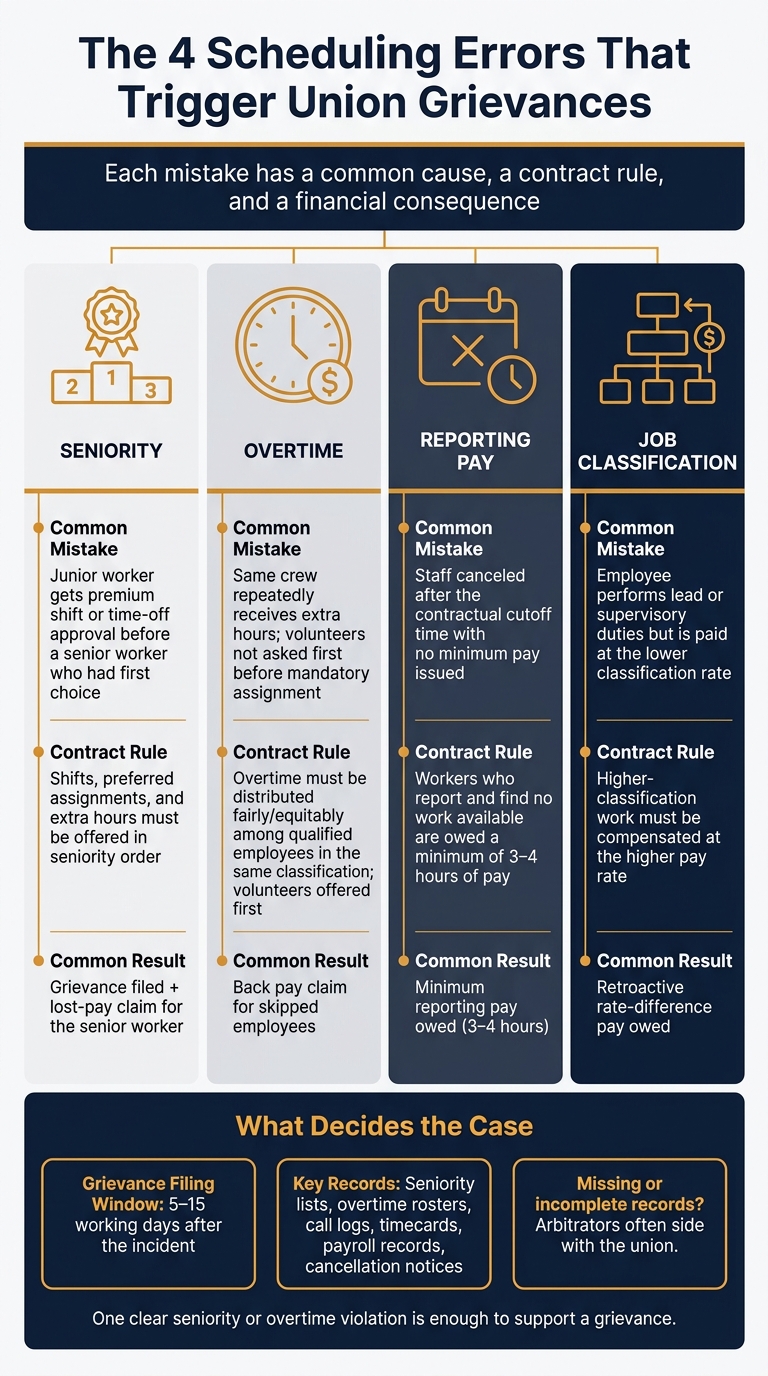
Union Grievance Triggers: Scheduling Errors, Mistakes & Remedies
These disputes usually come back to three repeat mistakes.
Seniority grievances often start when managers assign premium shifts, extra hours, or time-off requests out of contract order. That usually means better assignments - weekend events, high-profile jobs, or higher-paying shifts - go to less-senior employees even though more-senior workers were available and had first choice under the agreement.
The same thing can happen with time off. If a junior employee gets a prime holiday period approved before a senior employee who asked for the same dates under the contract’s rules, that can lead to a grievance issue. And it doesn’t take a long pattern to set this off. One clear seniority violation can support a grievance.
That kind of roster mistake also tends to spill into overtime fights.
Many collective bargaining agreements say overtime must be distributed fairly, equally, or equitably among qualified employees in the same classification. So when managers skip people on the rotation list, fail to update equalization records, or keep sending overtime to the same teardown crew, unions often see a pattern of favoritism.
Forced overtime is a separate pressure point. Many union contracts require managers to ask for volunteers first before assigning overtime involuntarily. If a supervisor skips that step and simply tells employees to stay late, the issue is twofold: a procedure breach and a contract breach.
A simple paper trail can make a big difference here. Keep an offer log that shows:
The third common trigger is a last-minute change that affects pay or job level.
When an event is cut back or canceled after the contractual cutoff, reporting pay often kicks in. Many collective bargaining agreements guarantee a minimum of 3 to 4 hours of pay when staff report and no work is available. Ignore that rule - or apply it unevenly - and a grievance can follow fast.
Job classification disputes show up when employees do higher-classification work but get paid at the lower rate. For example, a worker may be scheduled to handle lead or supervisory duties but still receive the lower classification rate. That can trigger a grievance.
In these cases, arbitrators compare the duties that were assigned with the contract’s job descriptions and pay rates. If the assignment was improper, back pay at the higher rate is a common remedy.
When a seniority, overtime, or cancellation mistake happens, the grievance usually follows a set path: informal discussion, a written grievance filed within 5 to 15 working days, meetings, and then arbitration. The written grievance needs to name the exact contract provision that was violated, explain what happened, and spell out the remedy being requested. After that, the case often comes down to one thing: the paperwork. If the records line up with the contract, that usually tells the story.
On both sides, people usually look at the same core records:
Arbitrators tend to give the most weight to records that were created before the dispute began and kept in the normal course of business. That makes sense. Notes made after the fact can feel shaky, but a timecard or schedule created at the time of the event often carries more weight.
When records are full and consistent, they often back up management's version of events. But when documents are missing, incomplete, or full of holes, arbitrators often give more weight to the union's account, especially when several employees tell the same story. In plain terms, if the records don't match the assignment, the error usually drives the remedy.
The usual remedies can include back pay for missed overtime, reporting pay, retroactive higher-rate pay for out-of-class work, and changes to schedules or procedures going forward.
Those same records don't just decide the grievance. They also point to where scheduling rules may need to be rewritten, where staff may need retraining, or where the process should be handled through one central system.
To cut repeat claims, your procedures, training, and records need to line up with the contract. In most workplaces, the fix comes down to three simple things: written procedures that match the contract, supervisors who use those rules the same way every time, and records that show what happened.
Start with the rules supervisors use most. Take each contract article and turn it into a short, plain-English SOP.
For seniority, that means spelling out how shifts are offered, how preferred assignments and extra hours are handled, and how employees are picked when openings come up. For overtime, it means defining how the voluntary overtime list is built, how offers rotate, what gets logged, and when mandatory overtime starts after voluntary options are used up. For cancellations, it means stating how much notice is needed, which communication methods count as official notice, and when reporting pay applies. Job classification rules should also make clear which tasks belong to each classification, when cross-assignment is allowed, and how pay changes when staff perform higher-rated work.
A one-page checklist can help a lot in high-risk situations, like event changes close to start time. It gives supervisors a clear path instead of forcing a judgment call in the moment. If an event changes at the last minute, the supervisor should:
It also helps to review the SOP with union representatives during contract updates. That step can head off confusion before it turns into a dispute.
Written rules don't do much if supervisors use them differently. That's why short, scenario-based training sessions tend to work well. They put supervisors into situations that feel like the job itself: a banquet canceled the morning of the event, a wedding that needs last-minute overtime, or a server asked to cover bartender duties.
The biggest trouble spots to cover are seniority list interpretation, overtime offer order and documentation, reporting-pay obligations, job classification boundaries, and grievance timelines. A one-page quick reference guide helps too, especially if supervisors can pull it up on their phone during an event. When decisions need to happen fast, people don't want to dig through a binder.
The goal is simple: consistent CBA application across all supervisors. If the same issue keeps showing up in grievances, use that pattern to shape the next training session.
Fragmented records make scheduling grievances much harder to deal with. If one supervisor has a spreadsheet, another has phone logs, and someone else has paper notes, even a basic question can turn into a mess. When a union representative asks who was offered a shift and when, the answer should come from one record system, not a pile of scattered notes.
Quickstaff can centralize rosters, availability, waitlists, classifications, and schedule messages in one mobile-friendly system. Because the platform logs communication and confirmations, managers get a time-stamped record of who was offered work, when they responded, and what role they were assigned. That can stop small mistakes from turning into formal disputes.
Centralized records also help managers catch errors before the schedule is posted.
Union grievances usually begin when a scheduling decision clashes with the CBA. Seniority, overtime, cancellations, and classification assignments are the flash points that come up most often. And in many cases, the record is what determines whether the employer can defend the decision.
Once a grievance is filed, paperwork matters fast. If schedules, overtime offers, cancellation notices, and classification-related assignments are stored in one place, it becomes much easier to show that contract rules were followed. It also helps settle disputes before they turn into something bigger.
One skipped overtime assignment can create immediate back pay exposure.
The answer isn't complicated: match day-to-day practice to the contract and keep every scheduling decision in one record. Review the contract, make sure supervisors follow it, and store scheduling records in one system. Quickstaff centralizes availability, assignments, and communications with an audit trail, so when the union asks, the record is already there. Fair, documented scheduling helps turn avoidable mistakes into corrected records instead of grievances.
A seniority violation happens when union-covered shifts are assigned or ranked in a way that doesn't follow the CBA's seniority rules for that shift type.
Common examples include:
Managers should keep one clear, centralized record for the full overtime process. Follow the contract’s posting and log rules, and track every offer, acceptance, and refusal against each employee’s overtime balance.
Use a consistent ranking system for overtime offers. In most cases, that means going by descending seniority among available, qualified staff. If you depart from that order, write down why. Include the reason, the related Collective Bargaining Agreement clause, and the other options you reviewed.
Keep a centralized audit trail that shows what changed and why.
The records that matter most include:
This gives you one place to check the full story. If a question comes up later, you’re not stuck piecing things together from texts, emails, and last-minute notes.