NY Meal Period Rules: Event Shift Examples
October 14, 2026

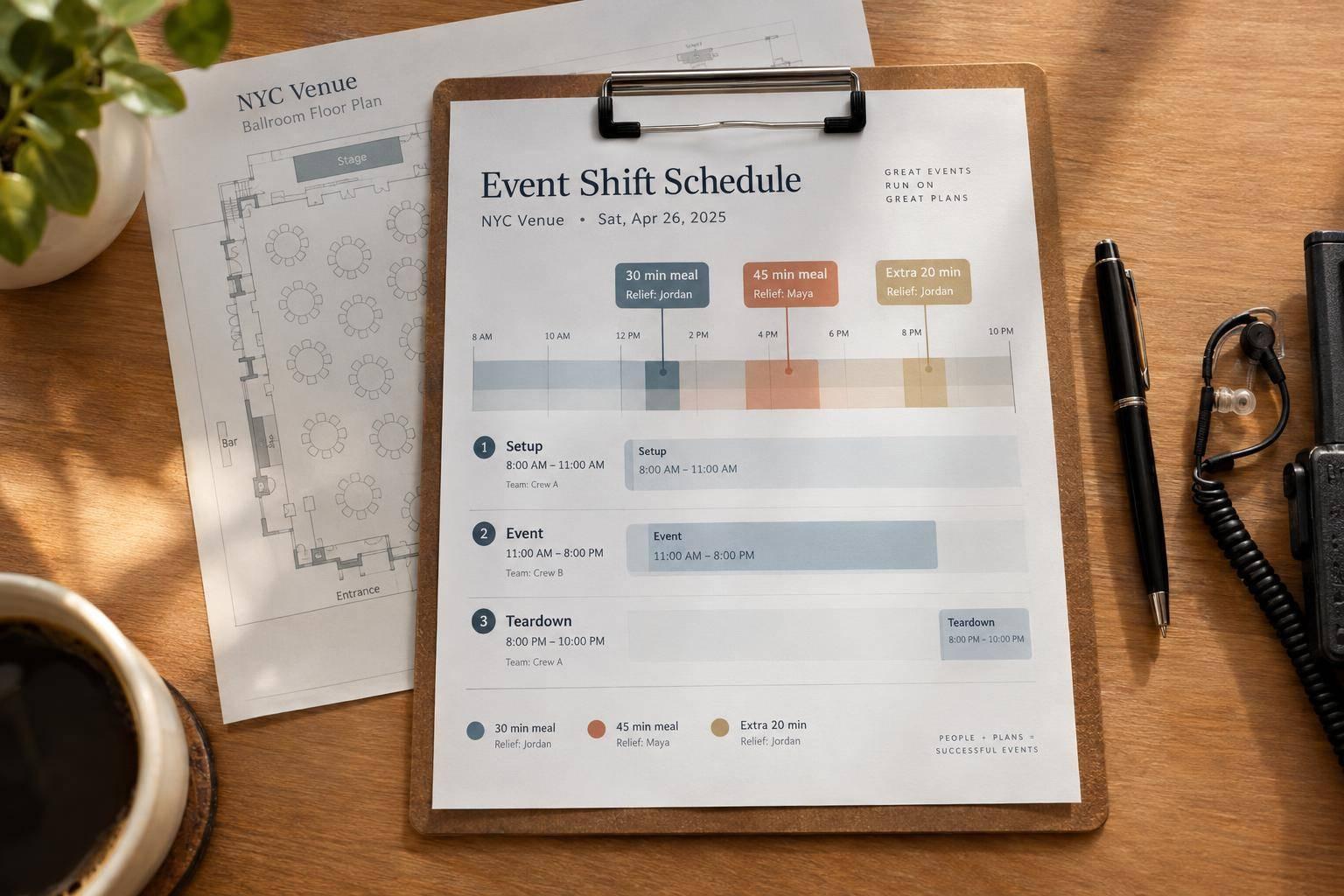
For non-factory event staff in New York, a shift longer than six hours can require a 30- or 45-minute meal, depending on when it starts. I count setup and teardown before planning meals - not just guest-service hours, as part of your catering staff scheduling checklist.
Quick Comparison
| Sample shift | General meal requirement |
|---|---|
| 10:00 a.m.–3:00 p.m. | Five hours: no meal required under these rules. |
| 10:00 a.m.–4:00 p.m. | Exactly six hours: no meal required unless added work changes the total. |
| 10:00 a.m.–6:00 p.m. | At least 30 minutes within 11:00 a.m.–2:00 p.m. |
| 2:00 p.m.–10:00 p.m. | At least 45 minutes near the shift midpoint. |
| 6:00 p.m.–2:00 a.m. | At least 45 minutes near the shift midpoint. |
| 10:00 p.m.–6:00 a.m. | At least 45 minutes near the shift midpoint. |
There’s another rule to check: work that starts before 11:00 a.m. and continues past 7:00 p.m. requires an additional meal of at least 20 minutes between 5:00 p.m. and 7:00 p.m.
My scheduling rule: <u>plan the meal and the person covering it</u>. Using event staff scheduling software can help automate these complex shift requirements. Staff generally must be fully relieved for an unpaid meal; answering calls or watching equipment is still work. Check current state guidance and any permitted exceptions before applying these examples.

NY Event Staff Meal Rules by Shift
This five-hour shift falls below New York’s general six-hour threshold for non-factory employees, so no statutory meal period is required. It’s the clearest no-meal baseline in this set. The noon window doesn’t affect that result unless the shift runs longer.
The shift overlaps the 11:00 a.m.–2:00 p.m. noonday window, but its under-six-hour length controls. That overlap alone doesn’t trigger a meal requirement.
If you offer a break, clearly mark it as paid or unpaid and make sure the employee is fully off-duty. An on-duty pause doesn’t count as a meal period.
Continuous-duty roles still need coverage, even when no meal is required. Assign someone before staff step away, and record who covered the bar or lead coordinator role, the break’s status, and its exact start and end times.
If the shift may run past six hours, reassess early enough to schedule any required meal before the window closes.
A 10:00 a.m.–4:00 p.m. shift is exactly six hours, so it does not trigger the general non-factory meal rule. But required setup, teardown, return, or paperwork can push actual work time past that mark.
This shift crosses the 11:00 a.m.–2:00 p.m. window. If required setup or cleanup extends work beyond six hours, the meal requirement changes.
If required setup pushes the shift past six hours, provide 30 uninterrupted minutes for a meal within the noonday window.
For example, schedule the meal from 12:00–12:30 p.m.
Include cleanup and check-out when addressing scheduling problems for a 4:00 p.m. release. If extra work is likely, schedule the meal and relief coverage before the event starts.
For event shifts longer than six hours, start time determines the meal requirement: a 30-minute noon meal or a 45-minute midpoint meal.
A 10:00 a.m.–6:00 p.m. shift crosses the noonday window and requires a 30-minute meal. A 2:00 p.m.–10:00 p.m. shift starts in the midpoint-meal range and requires 45 minutes.
| Comparison point | 10:00 a.m.–6:00 p.m. | 2:00 p.m.–10:00 p.m. |
|---|---|---|
| Applicable trigger | Lasts more than six hours and crosses the 11:00 a.m.–2:00 p.m. noonday window. | Lasts more than six hours and starts between 1:00 p.m. and 6:00 a.m. |
| Required break length | Generally at least 30 uninterrupted minutes. | Generally at least 45 uninterrupted minutes. |
| Required timing | Within 11:00 a.m.–2:00 p.m. | Around the shift midpoint, about 6:00 p.m. |
Schedule the daytime meal within 11:00 a.m.–2:00 p.m. For the afternoon shift, place the meal near the 6:00 p.m. midpoint - not at the end of the assignment.
Assign replacements before publishing the roster, and stagger server and bartender meals to keep guest-facing posts covered. If service changes the schedule, record the actual meal times. Late-night shifts add another timing layer.
These late starts use the afternoon shift’s 45-minute meal period, rather than the daytime 8-hour example above, with the break at a later midpoint.
Midnight does not restart the clock for meal timing. Both shifts are continuous eight-hour assignments that exceed the six-hour threshold.
Both shifts start within the 1:00 p.m.–6:00 a.m. window, so the 45-minute midpoint rule applies - not the noonday meal rule. The meal length stays the same; only the midpoint changes.
| Comparison point | 6:00 p.m.–2:00 a.m. next day | 10:00 p.m.–6:00 a.m. next day |
|---|---|---|
| Start-time trigger | Starts within the statutory window | Starts within the statutory window |
| Approximate midpoint | 10:00 p.m. | 2:00 a.m. |
| Non-factory meal requirement | At least 45 minutes, at the shift midpoint | At least 45 minutes, at the shift midpoint |
| Relief coverage | Cover reception service and guest requests | Cover overnight access, equipment, and safety duties |
Calculate the midpoint using the full assignment, not midnight or the end of guest service. Before scheduling a shorter meal period, check the worker’s role classification and any shorter-meal authorization.
Arrange relief using catering staff scheduling tools before critical posts are left without coverage. If only one person covers a critical post, add relief staff, stagger overlapping shifts, or redesign the assignment. Low guest volume does not remove the meal requirement.
A worker who monitors equipment or answers radio calls is not fully relieved. Don’t automatically deduct that time as an unpaid meal. Check whether it must be paid as time worked.
The examples above show when a meal is triggered. Here’s how setup, timing, and staff coverage affect the plan.
Count the full scheduled shift, including setup, briefing, and teardown. Meal deductions do not remove the meal obligation. Base the plan on actual duties, not a shorter posted schedule designed to avoid meals.
Adjusted schedule Total time Exceeds six hours? Meal trigger Required action Mandatory setup, 9:45 a.m.–4:00 p.m. 6 hours, 15 minutes Yes More than six hours across the noonday window Plan at least 30 minutes within the noonday window. Mandatory teardown, 10:00 a.m.–4:15 p.m. 6 hours, 15 minutes Yes More than six hours across the noonday window Include teardown; do not rely on the original six-hour plan.
Requirements shown apply to covered non-factory work.
Once the full assignment exceeds six hours, match the meal rule to the shift’s start time.
Shift length alone doesn’t determine the rule. Start time matters, too. A separate evening meal applies when work starts before 11:00 a.m. and continues past 7:00 p.m. That meal must last at least 20 minutes and fall between 5:00 p.m. and 7:00 p.m.
Hypothetical comparison: A 10:00 a.m.–8:00 p.m. assignment requires a noonday meal plus an additional meal of at least 20 minutes between 5:00 p.m. and 7:00 p.m. A 10:00 a.m.–6:00 p.m. assignment requires the noonday meal, but does not trigger that additional evening meal.
Once you identify the rule, check whether relief staff can cover the required meal.
The earlier meal times are examples, not fixed start times. Schedule the 30-minute noonday meal within 11:00 a.m.–2:00 p.m. Place the 45-minute afternoon or overnight meal around the shift midpoint - not at the end of the shift. Five-hour and exactly six-hour assignments have no general placement requirement under these triggers.
Meeting the timing requirement is only part of the job. The employee must also be fully relieved.
Assign named relief staff to cover tables, bar/cash duties, guest areas, and equipment. Using scheduling software for caterers helps ensure these relief roles are filled based on real-time availability. Job title alone does not determine meal eligibility. An employee who monitors any work-related task is not fully relieved. Bona fide meals generally may be unpaid only when the employee is fully relieved from duty. Employer-provided rest breaks of up to 20 minutes generally are paid.
Record actual meal times and interruptions. Check any shortened-meal exception against compliance checks and current New York Department of Labor guidance and any required written permit.
| Shift pattern | Scheduling advantage | Primary risk | Coverage response |
|---|---|---|---|
| Five hours | Simpler meal planning | Added duties extend the assignment | Check setup and teardown before posting. |
| Exactly six hours | Defined service block | Even a short extension changes the analysis | Arrange relief before approving extra work. |
| Eight-hour daytime | Longer staffing continuity | Noonday meals overlap service | Stagger coverage by station. |
| Eight-hour afternoon | Sustained evening coverage | Midpoint falls during peak service | Schedule overlapping staff. |
| Late-night or overnight | Continuous closing coverage | Limited relief availability | Assign a named relief worker in advance. |
| Long event running past 7:00 p.m. | One team covers a long event | Additional evening meal is overlooked | Reserve separate relief windows for the noonday and evening meals. |
Compare these four sample shifts to see how shift length and start time determine the meal rule.
Sample shift Trigger Meal length and timing 10:00 a.m.–3:00 p.m. Five hours Length alone does not trigger a statutory meal period. 10:00 a.m.–4:00 p.m. Exactly six hours Exactly six hours does not trigger the more-than-six-hours rule. 10:00 a.m.–6:00 p.m. Over six hours; crosses the noonday window 30 uninterrupted minutes within 11:00 a.m.–2:00 p.m. 6:00 p.m.–2:00 a.m. the next day Over six hours; evening start 45 minutes at the midpoint of the shift.
For shifts over six hours, the start time - not the shift label - controls the meal rule. Plan meals and coverage around the full assignment rather than the posted shift label.
None of these four examples triggers the separate 20-minute evening meal.
Plan meals around the full assignment, not just the posted hours. That distinction applies to the 5-hour, 6-hour, 8-hour, and late-night examples above. Count all required work first: setup, service, cleanup, teardown, and compensable travel.
To set meal timing and length, check the noonday rule, the midpoint rule for later-starting shifts, and the separate 20-minute evening meal for work that starts before 11:00 a.m. and runs past 7:00 p.m. Use those rules to plan both schedules and coverage.
Name the relief person - not just the meal time. Cover stations, guest requests, and radio duty so staff are fully relieved during an unpaid meal. Document any interruption or missed meal. Recheck the plan whenever hours or roles change so the written schedule matches the relief staff receive.
Quickstaff can help organize schedules, availability, reminders, and relief coverage.
No. New York law requires most employees to get an uninterrupted, unpaid meal break of at least 30 minutes when their shift lasts more than six hours and spans the noon period. Employers and employees cannot agree to waive this requirement.
If you work or remain responsible for tasks during your break, that time must be paid. It does not count as an unpaid meal period.
Use actual clock-in and clock-out times, not scheduled hours, to calculate compensable time accurately. Check those hours against federal and New York rules for overtime pay and spread-of-hours pay when the workday spans more than 10 hours.
If the added time causes an employee to miss a required meal period or requires another meal break under New York Labor Law, document any interruptions and make sure the employee is paid properly.
In New York, employees must be completely relieved of duties during an unpaid meal period. Handling work tasks, responding to guest requests, or staying on call may make the entire period paid work time.
Employers should keep staff fully off-duty during 30-minute breaks. Quickstaff helps prevent interruptions by letting you plan break windows and assign coverage in your event schedule.