How Overtime Equalization Guides Union Schedules
August 28, 2026

If overtime is handed out in the wrong order, one extra shift can turn into a grievance, back-pay claim, or both.
I’d sum up the article like this: union overtime scheduling is about using the right employee list, offering hours in contract order, tracking credited overtime totals, and logging every offer, reply, and assignment. In many shops, that means the next overtime shift goes to the qualified employee with the lowest credited overtime hours, with seniority, shift rules, and job qualifications breaking ties or limiting who can take the work.
Here’s the full takeaway in plain English:
A few details matter a lot. Many U.S. union rules tie overtime to work past 8 hours in a day or 40 hours in a week. Some contracts start with employees already on duty, while others use the full qualified list. And if volunteers don’t fill the shift, mandatory overtime may move by inverse seniority.
Bottom line: if I use the right list, follow the contract order, and keep timestamped records, the schedule is much easier to support later.
| What I need to do | What it means in practice |
|---|---|
| Build the right list | Use the correct classification, department, shift, and volunteer status |
| Offer in order | Usually lowest credited overtime hours first |
| Apply tie rules | Use seniority and required credentials when totals match |
| Update totals | Add accepted hours and any other credited hours the contract requires |
| Log everything | Track offers, replies, times, and final assignments in one place |
That’s the core idea behind overtime equalization in union event scheduling.
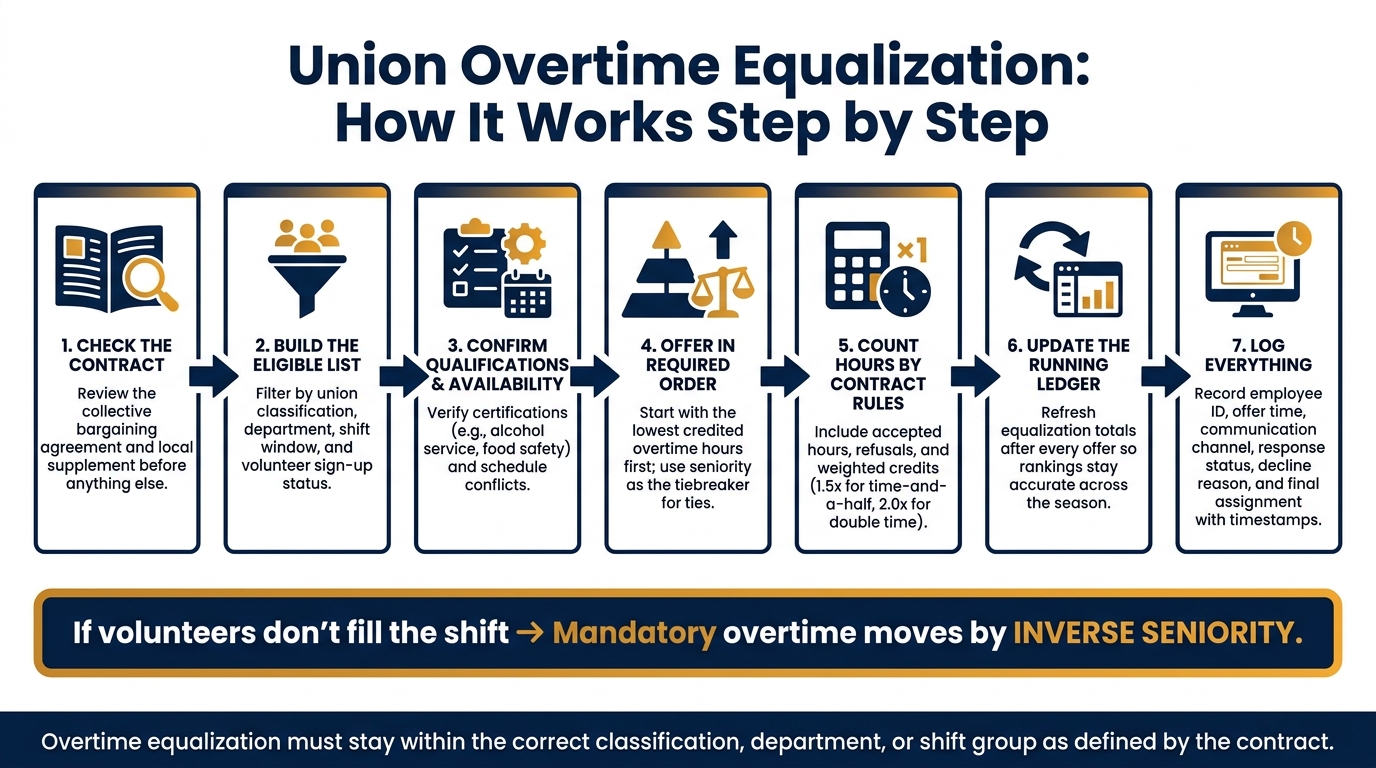
Union Overtime Equalization: Step-by-Step Scheduling Process
Before you send out any overtime offer, check the collective bargaining agreement and local supplement. You need to confirm who is eligible based on union status, classification, department, and whether the employee is already scheduled for regular duty that day.
The list also needs to show who actually volunteered for overtime. In many contracts, employees must state their interest in writing before the scheduling cycle starts. So the offer list should include only the people who signed up for that period.
Once the list is set, match each opening to the right classification and shift. That means lining up each event task - guest service, bar service, food production, setup, teardown, and supervision - with its union classification. Overtime equalization should happen within each classification, not across different groups.
Shift timing matters just as much as job title. A bartender who can cover a 4:00 p.m.–midnight banquet shift may not work for a late-night teardown from 11:00 p.m.–3:00 a.m. Maybe the contract requires minimum rest. Maybe that person is already scheduled early the next morning. Either way, those details matter. Separate equalization lists by shift window so the same employees don't keep getting stuck with late-night hours.
Refresh the roster every week, and update the event list before offers go out. These rosters can change fast. New hires, transfers, reclassifications, and leaves can all affect who belongs on the eligible list.
If someone is unavailable, keep them on the roster but mark the reason and dates clearly, such as "vacation Aug. 1–7" or "FMLA through Sept. 15." That way, approved leave isn't treated the same as a declined offer.
It also helps to track qualifications and certifications in a separate column. For example:
If a certification expires, remove the employee from that role until it's renewed.
Quickstaff can tag staff by union classification, availability, certifications, and shift window, then filter the roster before offers go out.
With the eligible list in place, managers can move to the required overtime offer order.
For a banquet add-on or wedding teardown, the contract decides who gets the next overtime offer.
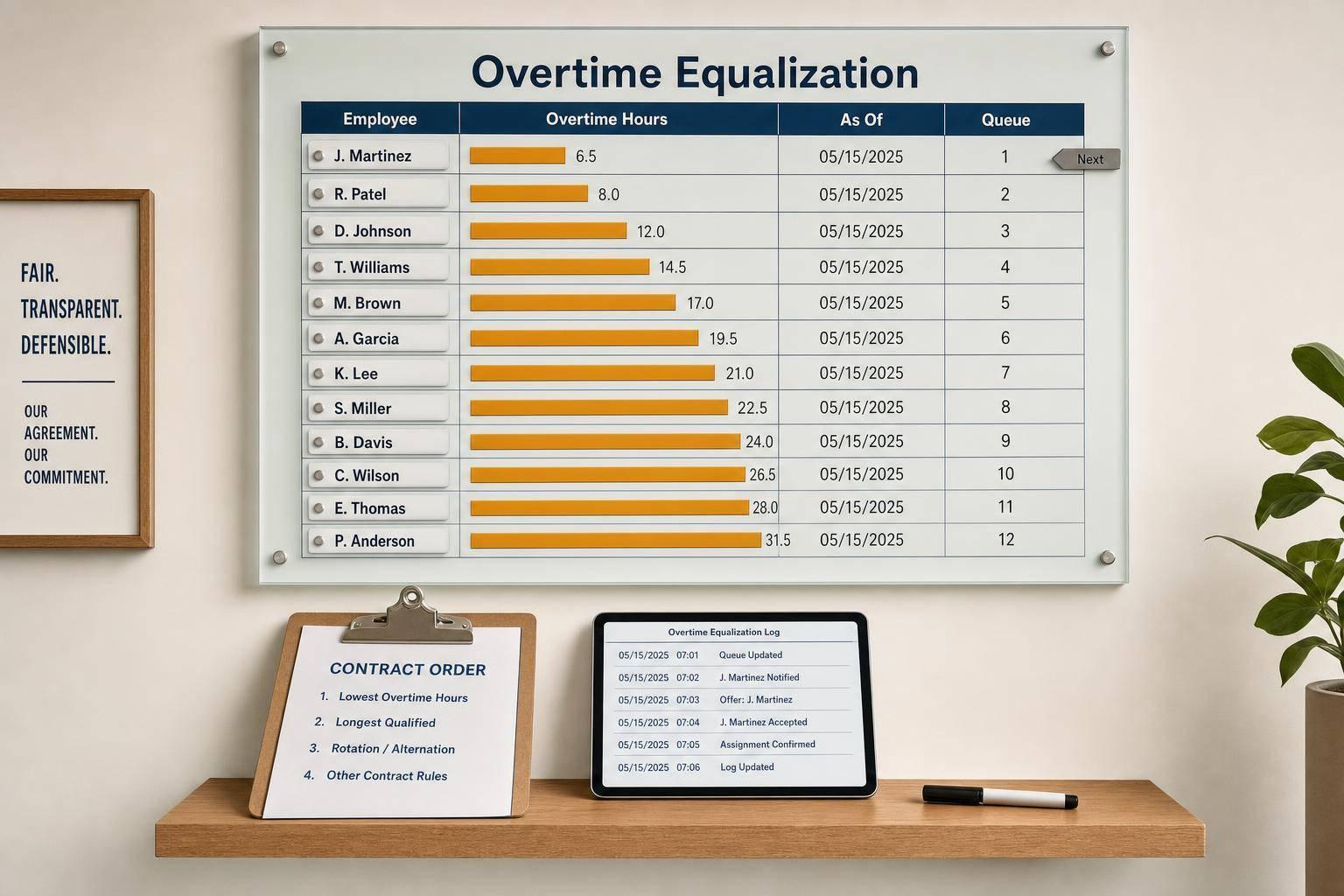
First, check whether the contract starts with employees already on duty or with the full list of qualified employees in that classification. Then sort the eligible group by total credited overtime hours, from lowest to highest. The employee with the fewest hours gets the first offer.
If two employees are tied, the tiebreaker is usually seniority. If the job needs a specific credential, qualifications can also shape the order. Once the order is set, log each offer and update the running total before filling the next opening.
If volunteers don't cover the shift, the contract may call for mandatory overtime in inverse seniority order. Record declines in the equalization log so the same employee doesn't remain first in line.
The exact order depends on the contract, but these factors usually work together like this:
| Factor | When It Controls | Typical Priority Level |
|---|---|---|
| Overtime hours (equalization) | Main rule within the eligible group; lowest credited hours gets the first offer | 1st |
| Seniority | Tiebreaker when overtime totals are equal | 2nd |
| Qualifications / certifications | Applies when the role needs a specific skill or credential | 2nd or 3rd, depending on the contract |
| On-duty vs. off-duty status | Decides whether the offer starts with employees already working the shift | Pre-sort |
| Classification / department | Sets which employees belong in the eligible pool | Pre-sort |
| Shift window | Limits eligibility to employees in the event shift | Pre-sort |
Use that ranking when you update equalization totals after each offer. If the contract uses weighted credits, count time-and-a-half as 1.5 hours and double time as 2 hours.
Once the offer order is in place, the next move is tracking hours so the team stays balanced across the schedule.
Banquet and wedding overtime can pile up fast during busy event periods. That's why managers need a running ledger, not a shift-by-shift guess.
Once the offer order is set, keep that ledger current so overtime stays even across the season. The usual rule is lowest-hours-first: offer the next shift to the employee with the lowest counted overtime hours in the pool. Put simply, the offer order only holds up if those running totals stay up to date.
Most union contracts say overtime must be equalized within a defined work group under the collective bargaining agreement. In practice, that usually means a classification, department, or specific shift. Keep separate lists for each contract work group.
Use a running equalization log: a list of every eligible employee in the pool, ranked from lowest to highest counted overtime hours and updated as events are scheduled. One point matters a lot here: overtime hours are counted whether the employee accepts or refuses the offer, so repeated refusals don't leave the same person sitting at the top of the list.
Post updated totals on the required schedule so employees can check their standing. Stick with one method every time so the same pool is ranked the same way.
| Method | How It Works | Best Fit |
|---|---|---|
| Lowest-hours-first | Offers go to the employee with the lowest counted overtime hours in the pool | Contracts that stress strict numerical fairness; high-volume banquet departments |
| Rotating offer order | The list moves forward each event, so each employee gets a turn being first in line | Stable teams with similar overtime totals and a predictable event rhythm |
| Seniority as tiebreaker | When two employees have equal overtime totals, the more senior employee is offered first | Union contracts that use seniority as a secondary rule |
Use the contract hierarchy to update the ledger, then record each offer and response.
Once the offer order is set, record every offer in the same log. That means every overtime offer gets logged, whether the employee said yes, said no, or never replied.
Your record should include employee ID, classification, event details, date, offer time, communication channel, role, shift window, response status, response time, decline reason, final assignment, and the contract rule used.
A declined offer or no-response case needs the same level of detail as an accepted one. Don’t just write “no response.” Write what happened. For example:
"Offer sent 09/01/2026, 2:10 PM via text; no response by 4:30 PM; moved to next eligible employee per equalization procedure."
That kind of note matters. Many union contracts treat a declined or missed chance as an offered overtime shift for equalization purposes. If the equalization log is missing pieces, you can end up with the exact dispute you were trying to prevent.
The log should also make it plain that the lowest-hours-first order was followed. And when it comes to timestamps, memory isn’t enough. Use digital tools that stamp each action with the date and time automatically. Keep all records in the venue’s local time zone from start to finish. If you make offers by phone, log the call right away - before moving to the next person on the list.
Keep all of this in one system so it’s easy to review later.
Scattered records create headaches fast. A text on a personal phone, a note in a notebook, and an email in a personal inbox might seem fine in the moment. Later, they’re tough to pull together and even tougher to defend.
Use one central system for event details, availability tracking, offers, responses, and communication history. Quickstaff supports this with event creation, staff scheduling, availability tracking, waitlists, and centralized event management in one system that works across devices. When an offer is sent and answered through the platform, the equalization log is already there - timestamped and tied to the event - instead of spread across channels that don’t connect.
Preserve schedule versions, changes, timestamps, user IDs, offers, and responses in the same record.
That record is what shows the equalization order was followed.
Overtime equalization only works when managers follow the contract order, keep hours balanced, and document every offer. Complete records help keep the schedule fair and defensible.
Credited overtime hours usually include all compensable work. That means more than just the main event or shift itself.
In practice, it can include:
Here’s the plain-English version: if someone is on the clock in any way that counts as paid work, those hours generally belong in the overtime total.
And there’s another part employers can’t brush aside. If a supervisor knows - or reasonably should know - that the work is happening, federal law requires that time to be tracked.
Some union agreements go a step further. They also count standby time toward daily and weekly overtime thresholds, which can help push a worker into time-and-a-half.
Yes. Refusals still matter in overtime equalization.
Managers should track every overtime offer, acceptance, and refusal in each employee’s cumulative overtime balance. That record is what shows how overtime was offered and how the balance changed over time.
If a senior qualified employee turns down a shift, document the refusal right away. Include the date, time, and response status. This creates a clear, auditable record that shows the assignment followed contract equalization rules.
Mandatory overtime can be assigned only when your Collective Bargaining Agreement (CBA) allows it. Before doing anything, managers should check the contract for emergency exceptions or management-rights language that permits mandatory shifts.
When those hours need to be assigned, follow the union’s overtime log and posting procedures exactly. Also, document every offer, acceptance, and refusal so there’s a clear audit trail.