How to Train Event Staff for Medical Emergencies
October 11, 2026

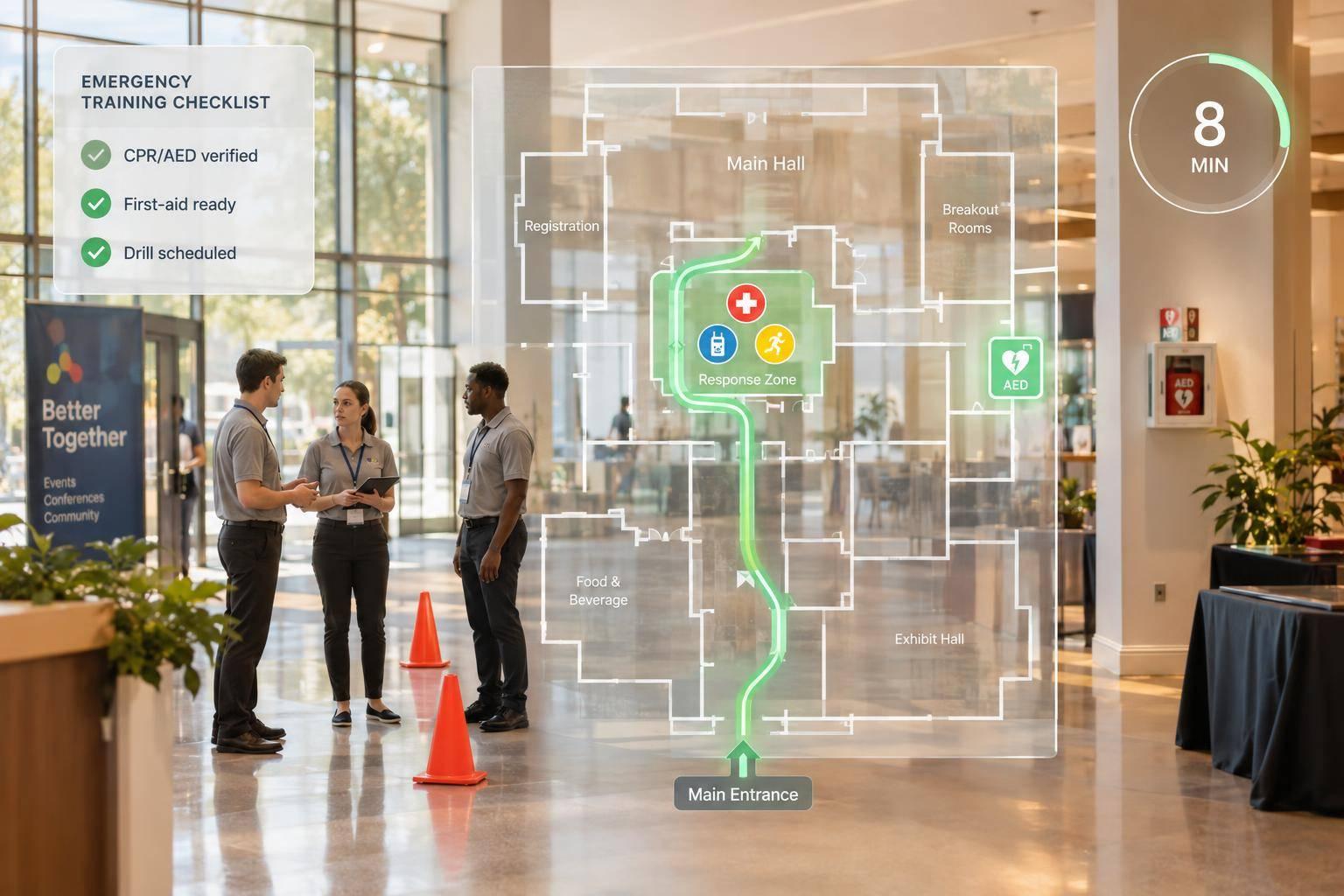
Train event staff to spot an emergency, call 911, and give care within their training. I start with named roles and backups, the venue’s exact address, EMS access routes, and AED locations - then test the plan with a 5–10-minute drill.
Here’s what I cover before staff begin work:
My rule: <u>Internal notifications must never delay a needed 911 call.</u> Staff don’t need to diagnose a condition. They need to know their role - and when to get help.

Event Staff Medical Emergency Training Workflow
Turn the basics into a written response plan. Work with venue management, security, medical staff, and the staffing lead, and involve EMS when needed. Specify who activates the response, controls access, and meets responders. Get venue approval for access routes and procedures.
Before the event, confirm that workers can identify their role and backup, find equipment, explain when to call 911, and show responders the route to the patient.
Give every task a primary person and a backup.
| Staff role | Primary responsibility | Required preparation | Backup assignment |
|---|---|---|---|
| First observer | Recognize the emergency, check scene safety, alert the response team, and stay with the patient when safe | Know warning signs and the internal reporting procedure | Nearest trained staff member or supervisor |
| 911 caller | Call 911, give the exact location and patient condition, answer dispatcher questions, and remain available for instructions | Practice the 911 script; know the street address, cross streets, entrance, and callback number | Supervisor or designated radio operator |
| Trained care provider | Begin CPR, use the AED, and provide first aid within current training | Current CPR, AED, and first-aid training from a recognized provider; hands-on practice | Second qualified responder |
| Crowd and access coordinator | Clear space, control bystanders, keep EMS routes open, and escort responders to the patient | Walk the access route and understand crowd-control and evacuation procedures | Security staff member or venue representative |
| Venue liaison | Notify venue management, unlock or secure required areas, and coordinate with building personnel | Know venue procedures, contacts, radio channel, and restricted areas | Assistant manager or venue designee |
| Incident recorder | Record times, actions, witnesses, equipment used, and EMS arrival or transfer details | Know the approved incident form and privacy and reporting rules | Manager not directly involved in patient care |
Small teams can combine tasks - but not if doing so interrupts CPR, delays a 911 call or AED retrieval, or leaves the patient unattended. American Heart Association planning materials identify at least three trained people for cardiac arrest response: one to begin CPR, one to retrieve the AED, and one to call 911.
Create a one-page briefing and map with the full street address, cross streets, emergency entrance, EMS vehicle route, and building access instructions. Include elevator or stair information and the locations of AEDs, first-aid kits, and the medical post.
Add the radio channel, backup phone method, key contacts, event hazards, restricted areas, evacuation routes, shelter locations, and staff assembly point. Walk the route with venue personnel. Check for locked gates, blocked corridors, and equipment hidden by décor.
Internal notifications must never delay a necessary 911 call. Once roles are assigned, match coverage to each phase of the event.
Check each designated responder’s training provider, covered skills, completion date, and expiration date. Arrange qualified instruction to fill any gaps.
Schedule trained coverage across separate areas from setup through guest arrival and teardown. Account for breaks and shift changes, and require a handoff before a responder leaves their area.
Use Quickstaff to assign roles, track backups, and send briefing reminders. Orient every worker, then record attendance, the date, trainer, topics, assignments, and any open gaps. Base staffing levels on venue risks and local requirements - not a fixed national ratio. Store certification verification and sensitive records in approved recordkeeping systems, not general scheduling notes.
Once roles are assigned through event staff scheduling, train each temporary staff member on exactly what to do in the first minute. Use hands-on drills to practice Check–Call–Care: check, call, then give care within their training.
Written guidance or an event briefing isn't enough. Use qualified instruction, and have a qualified medical educator or clinician review materials against current Red Cross, American Heart Association, and CDC guidance. Start with scene safety, then practice calling 911 and giving care.
Before approaching, the first observer should check for traffic, electricity, fire, violence, chemicals, and bodily fluids. Practice using appropriate PPE, obtaining consent from a responsive adult, and checking responsiveness, normal breathing, severe bleeding, and other clear signs of a life-threatening emergency.
Rehearse what the caller will tell the dispatcher: the address, EMS entrance, exact patient location, condition, hazards, and callback number. Use speakerphone when possible, follow instructions, and stay on the line until told otherwise.
Do not force care on an adult who can make decisions and refuses help. If their ability to make decisions is unclear, call 911 and follow the dispatcher's instructions.
Use a manikin to practice responding to an adult collapse. Check responsiveness and normal breathing, call 911, get the AED, and start CPR if the adult is unresponsive and isn't breathing normally or is only gasping. Assign the caller to contact 911 and the trained caregiver to perform CPR.
Practice compressions in the center of the chest at 100–120 per minute, at least 2 inches deep, but no deeper than 2.4 inches. Allow full chest recoil and keep interruptions as short as possible.
Hands-only CPR is appropriate for an untrained bystander - or someone unwilling to give breaths - who witnesses a sudden adult collapse. Trained responders should practice 30 compressions and 2 breaths according to their training.
Practice turning on an AED trainer, placing pads as shown, and following its prompts. Keep everyone clear during rhythm analysis and shocks, then resume CPR promptly when instructed. Follow dispatcher guidance and continue until signs of life appear, EMS or another qualified responder takes over, the scene becomes unsafe, or the responder cannot physically continue.
Staff assigned to children's events should also receive training in pediatric CPR and first aid.
After CPR and AED drills, practice the injuries and medical events staff are most likely to face. Use the table below to guide hands-on drills for care until EMS arrives. Have the incident recorder practice documenting onset times and care provided.
Teach choking care and tourniquet use through qualified, age-appropriate instruction. In every scenario, avoid unnecessary movement and withhold food or drink from seriously ill or injured people. Keep all care - including medication assistance - within current training, authorization, and applicable protocols.
| Emergency scenario | When to call 911 | Immediate staff action | Limits of staff care |
|---|---|---|---|
| Severe bleeding | Heavy, uncontrolled, spurting, or life-threatening bleeding; signs of shock. | Apply firm direct pressure. Add dressings without removing soaked layers. Apply a tourniquet according to training and protocol. | Do not remove embedded objects or loosen an applied tourniquet. |
| Severe choking | The person cannot speak, cough effectively, or breathe, or becomes unresponsive. | Give age- and size-appropriate choking care. If the person becomes unresponsive, lower them safely, begin CPR, and send someone for an AED. | No blind finger sweeps. Do not use adult techniques on infants or children. |
| Chest pain or suspected heart attack | New, severe, persistent, or unexplained chest pressure or pain; shortness of breath, sweating, nausea, or pain spreading to the arm, back, neck, or jaw. | Stop activity, keep the person at rest, call 911, monitor breathing, and follow dispatcher instructions. | Do not use private transport when EMS is indicated. |
| Stroke signs | Sudden facial drooping, arm weakness, speech difficulty, vision or balance problems, severe headache, or confusion. | Keep the person safe, record symptom onset or last-known-well time, monitor their condition, and give EMS location and access details. | Do not wait for symptoms to improve or give medication. |
| Seizure | First seizure; a seizure lasting longer than 5 minutes; repeated seizures without recovery; injury, breathing trouble, pregnancy, diabetes, or water exposure. | Clear hazards, cushion the head, time the seizure, and turn the person onto their side afterward if safe. | Never restrain the person or put anything in their mouth. |
| Heat illness | Confusion, altered mental status, collapse, seizure, very hot skin, or suspected heat stroke. | Move the person to shade or a cooler area, remove excess clothing, cool rapidly with cold water, wet towels, or ice, and stay until EMS arrives. | Do not give fluids if the person is confused, vomiting, or unable to swallow safely. |
| Severe allergic reaction or anaphylaxis | Trouble breathing, throat or tongue swelling, widespread hives with other symptoms, faintness, or rapidly worsening symptoms. | Help with prescribed epinephrine according to protocol, call 911, monitor breathing, and prepare for CPR. | Do not delay EMS because symptoms improve. |
| Fall or suspected serious injury | Loss of consciousness, neck or back pain, severe bleeding, deformity, inability to move, confusion, or breathing problems. | Keep the person still, control bleeding, monitor responsiveness and breathing, and protect them from hazards. | Move the person only to escape danger or provide lifesaving care. |
| Substance-related emergency or suspected overdose | Unresponsiveness, abnormal or stopped breathing, seizure, severe confusion, blue or gray lips, or suspected poisoning or overdose. | Check scene safety, avoid unknown substances, call 911, provide CPR if indicated, and use available naloxone according to event policy and protocol. | Do not induce vomiting, handle drug paraphernalia unnecessarily, or leave the person alone. |
Once staff know the plan and have the skills, test the full response with a timed drill.
Before doors open, run a 5–10-minute adult-collapse drill using assigned roles and backups. Assign a patient attendant, caller, AED runner, crowd-control lead, EMS greeter, and recorder. Someone must stay with the simulated patient throughout. Use a simulated dispatcher or designated observer - never make a real 911 call during a drill. The goal is to test staff roles and venue readiness.
Time notification, AED retrieval, door access, and EMS handoff. Walk the actual ambulance route, check locked doors and elevators, and confirm where the greeter will meet responders.
Keep radio updates in plain language. Share the exact location, observable condition, number of people affected, hazards, and equipment needed - not names or medical history. The greeter should guide responders to the patient. The patient attendant should summarize observations, care provided, and recorded times.
Use drill timings to spot delays, not judge staff performance. Then use those timings and observations to complete a practice incident report.
Use one standard incident form to record the event name, venue, address, event date, report completion date, exact patient location, hazards, number affected, responding staff, and witness statements.
Record the times of discovery, the 911 call, care, equipment use, EMS arrival, and handoff. Note equipment problems and supplies that need replacement. Use consistent U.S. dates and times with a.m. or p.m., adding the time zone for traveling teams. Complete the report promptly once handoff is finished and immediate scene needs are addressed.
Collect only reportable facts. Secure paper records and restrict electronic access to authorized people with a legitimate need to know. Keep patient details out of broad staff chats and shared radio channels. Prohibit patient photographs, videos, and identifiable incident posts on social media. Follow state law, venue policy, and record retention rules.
Hold a short debrief while details are still clear. Review recognition, notification speed, roles and backups, EMS access, equipment, communication, privacy, and handoff. Confirm that staff stayed within their training.
Give every fix an owner and deadline, then verify completion. Replace used supplies. Confirm that the AED is back in its designated location, passes its readiness check, and is current on inspections. Include the fixes in the next event briefing.
Before setup, confirm who fills each role, who serves as backup, and whether trained staff will cover breaks, teardown, and late departures. Brief staff on the exact address, designated EMS entrance, access routes, AED and first-aid locations, and responder meeting point.
Finish with a short Check–Call–Care review: check scene safety and responsiveness, call 911 for life-threatening signs, send a trained person to retrieve the AED, and provide only the care your staff are trained to give.
Quickstaff can help organize staffing, availability, and briefing reminders. Managers still need to verify qualifications and follow medical protocols.
Use this pre-opening checklist for the final readiness check:
| Item | Confirm |
|---|---|
| Exact address and route | Street address, city, ZIP code, cross streets, designated EMS entrance, and meeting point |
| Caller, backup, and EMS greeter | Assigned people, information for the dispatcher, and who stays on the line |
| AED and first-aid access | Accessible equipment, readiness status, and a trained person assigned to retrieve it |
| Qualified coverage | Verified qualifications, named responders, backups, and coverage throughout the event |
| Primary and backup communication | Designated radio or phone channel and backup method |
| Recorder and secure storage | Assigned recorder, form location, reporting deadline, and secure storage |
Temporary staff should review emergency training every quarter through escalation drills, role-playing, and crisis simulations to stay prepared and confident. Support that training with 10–15-minute pre-shift reviews each day, tailored to the event, plus brief on-shift walkthroughs to keep emergency procedures up to date.
Staffing depends on your event’s complexity, venue layout, and command structure - not a fixed headcount. Before the event, assign a primary person and a backup to every critical function.
At minimum, include an Incident Commander, Safety Officer, Medical or First Aid Lead, Security Lead, and communications lead. Use an escalation matrix to map incident types to the right responders. Define the chain of command and set response time thresholds for each role.
Untrained staff should put safety and clear communication first. Alert the designated lead or medical team right away. Stay calm, keep exit routes clear, and follow the instructions from your pre-shift briefing. Do not investigate hazards or enter restricted areas.
Leave immediately if an evacuation is ordered or you face immediate danger. Do not wait for more instructions or stop to collect personal belongings.