Michigan Labor Laws: Overtime Rules for Event Staff
July 1, 2026

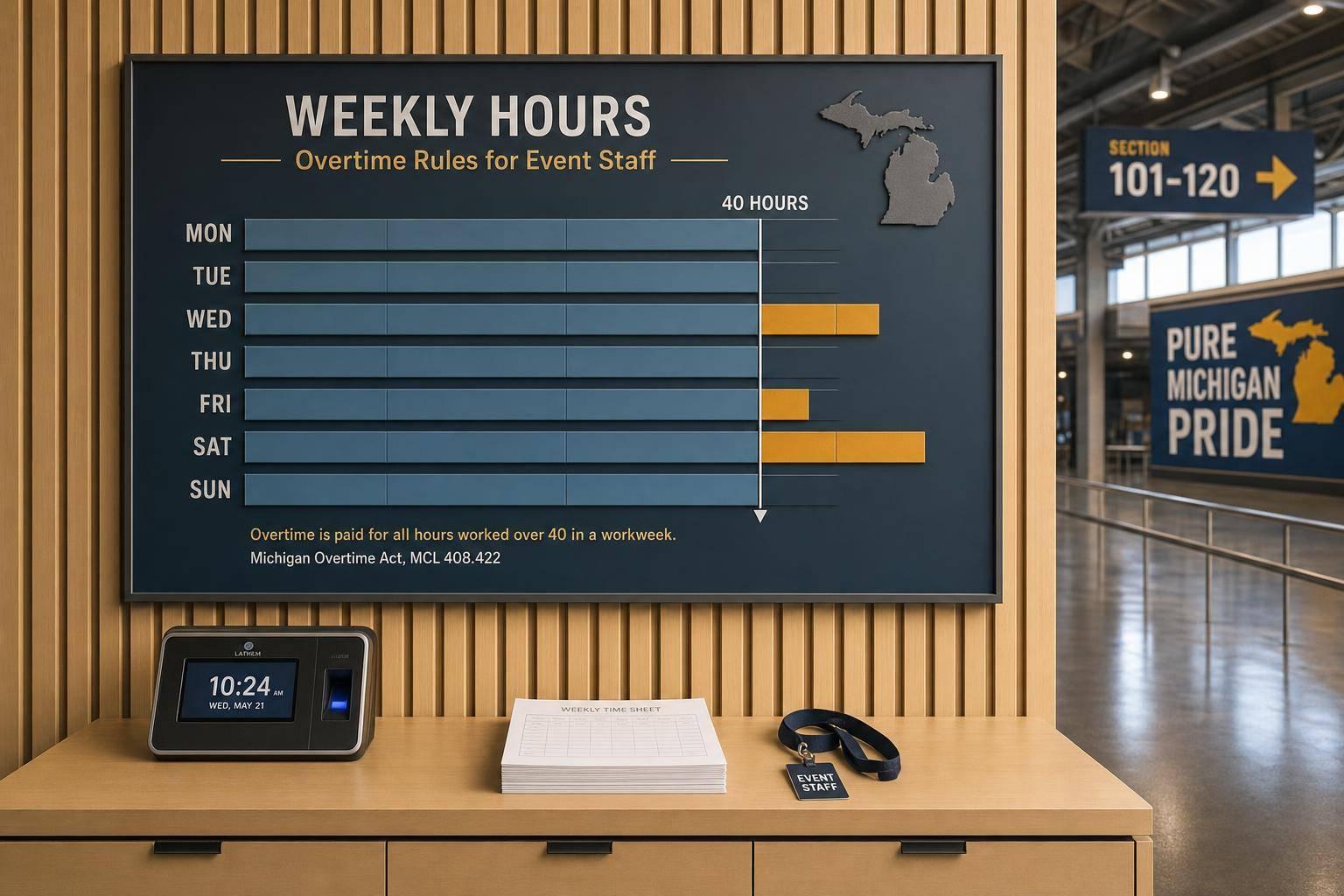
If you run event staff in Michigan, overtime starts after 40 hours in one fixed 7-day workweek - not per shift, not per event, and not across two weeks.
I’d sum up the whole issue like this: most pay problems come from missed hours, wrong worker status, and weak time records. For event teams, that often means setup time, teardown time, travel between sites, waiting on-site, and last-minute shift extensions that never make it into payroll.
Here’s the short version:
A few trouble spots show up again and again:
| Issue | What to know |
|---|---|
| Overtime trigger | Over 40 hours worked in one 168-hour workweek |
| Overtime rate | 1.5 times regular rate |
| PTO counted? | No |
| Hours that count | Setup, teardown, cleanup, site-to-site travel in many cases, and required waiting time |
| Common nonexempt roles | Servers, bartenders, crew, drivers, warehouse staff, many junior coordinators |
| Main fix | Track scheduled hours, actual hours, and overtime hours each week |
If I were reducing overtime risk fast, I’d do three things first: cap weekly hours, keep all scheduling and approvals in one system, and review total hours before payroll closes.

Michigan Overtime Rules for Event Staff: Key Facts & Compliance Checklist
In Michigan, nonexempt employees must be paid 1.5 times their regular rate for any hours over 40 in a single 7-day workweek. Michigan's WOWA applies alongside the FLSA, so you need to follow the stricter rule. For event teams, that can get messy fast. People bounce between short shifts, different venues, and last-minute assignments, and those hours still add up.
"Nonexempt employees should be paid 1-1/2 times their regular rate of pay for hours worked over 40 in a 7-day workweek." - Michigan Department of Labor and Economic Opportunity
Paid time off, including vacation days, sick leave, and holidays, does not count toward the 40-hour threshold. Only hours actually worked can trigger overtime.
For event managers, that leads to the next issue: which jobs are usually nonexempt.
In event staffing, most hands-on jobs are usually nonexempt. That often includes servers, bartenders, setup and teardown crews, drivers, and warehouse support staff. These roles usually don't meet the duties tests needed for exemption.
Junior event coordinators are also usually nonexempt. A job title by itself doesn't satisfy the administrative exemption. To qualify as exempt, an employee must earn at least $684 per week ($35,568 per year) and pass a duties test.
Once roles are classified the right way, the next problem is how all those hours pile up over the week.
A workweek is a fixed 168-hour period that must stay the same each week. All hours worked across events, venues, and shifts during that workweek must be added together. So even if no single shift looks long, a staffer can still go over 40 hours.
Weekend and holiday hours count too, but overtime applies only when total weekly hours go past 40.
| Role | Typical Status | Key Reason |
|---|---|---|
| Servers & Bartenders | Nonexempt | Hands-on or service work; usually do not meet duties tests for exemption |
| Setup & Teardown Crews | Nonexempt | Physical labor; all setup and teardown hours must be paid |
| Drivers & Warehouse Support Staff | Nonexempt | Routine operational tasks; title does not determine exemption |
| Junior Event Coordinators | Nonexempt | Title alone does not satisfy the administrative exemption |
| Executive Event Directors/GMs | Exempt only if salary and duties tests are met | Must supervise 2+ employees, have management as a primary duty, and earn at least $684/week |
| Administrative Leads | Exempt only if salary and duties tests are met | Must perform office or non-manual work tied to business operations and use significant independent judgment |
At that point, the biggest risk usually moves from job classification to hour tracking across multiple events.
Misclassifying a lead coordinator or salaried event worker as exempt can create overtime liability if the duties test isn't met.
Even when job classifications are right, overtime problems still show up. Usually, the issue isn’t the law itself. It’s the missing hours that slip through normal daily work. Once the workweek begins, every shift has to be tracked inside the same 7-day window.
This is where event staffing can go sideways fast.
A server might work a Friday corporate dinner, a Saturday wedding, and a Sunday brunch teardown and log 8, 10, and 8 hours. That’s 26 hours in just three days. Add a Monday setup call and a midweek warehouse shift, and that worker can pass 40 hours before payroll even notices.
Setup, teardown, and cleanup are all compensable work time. Required travel between job sites counts too. And waiting time must be paid when a staffer has to stay on-site before the event opens and can’t leave.
Last-minute client changes make this worse. A shift set for 6 hours turns into 9 when a reception runs long. In many cases, that extra time never makes it into the formal record. It gets mentioned in a text, maybe passed along verbally, and then disappears.
The risk is simple: those hours fall into the same workweek and never get counted.
Michigan requires employers to record start and end times to the nearest tenth of an hour. That sounds straightforward. In practice, handwritten timesheets, texted shift updates, and late approvals can turn payroll into a guessing game.
When that happens, weekly totals come out wrong, and wage-claim risk goes up. Michigan employees have up to three years to file a claim for unpaid wages, and employers must keep payroll records for at least three years.
Temporary and on-call workers often get hit hardest here. If your company controls their schedule and gives them their equipment, they should be treated as employees, not contractors.
The most common trouble spots are easier to see when you line up the cause, the payroll risk, and the manager response.
| Compliance Failure | Common Cause | Payroll Risk | Manager Fix |
|---|---|---|---|
| Unpaid Setup/Teardown | Treating prep time as off-the-clock work | Underpayment of minimum wage and overtime; audit risk | Mandate clock-ins for all setup, teardown, and cleanup |
| Treating controlled temporary staff as contractors | Misclassifying workers the company schedules and equips | Unpaid payroll taxes; back-pay liability | Treat controlled temporary staff as employees, not contractors |
| Inaccurate Daily Logs | Handwritten edits or rounding to the hour | Violation of Michigan's nearest-tenth-of-an-hour record rule | Use digital timekeeping that records start and end times to the nearest tenth of an hour |
| Missing Waiting Time | Not paying staff while they wait for a venue to open | Unpaid compensable time; wage claims | Define required waiting time as active work hours if the employee cannot leave |
| Unapproved shift extensions | Client requests or last-minute cleanup overruns | Unrecorded overtime hours | Require manager approval in the timekeeping system for all extensions |
These breakdowns are usually easy to prevent. Tighter scheduling, one approval flow, and a weekly review can catch most of them before payroll closes. The next section turns these weak spots into scheduling and approval controls.
These problems are usually easy to stop if you stick to three habits: weekly hour caps, one scheduling system, and an end-of-week review.
Day-of availability doesn't tell you enough. Before you assign a shift, check the worker's total hours for the week.
For example, if a server is already at 32 hours by Thursday, assigning that person an 8-hour Saturday shift can push them into overtime.
A simple fix is to flag workers as they get close to 40 hours. That gives managers time to move shifts around before the workweek ends.
Once you can see weekly totals, the next step is making sure every change lives in one place.
Scattered communication causes a lot of surprise overtime. If availability is in one app, assignments are in a text thread, and shift changes are shared by phone, there's no single total to check before payroll closes.
Use one mobile scheduling system for:
Record shift extensions right away so added hours make it into payroll. And require shift-extension approval inside the scheduling system.
Quickstaff is built for this type of event staffing workflow. It supports availability tracking, role-based scheduling, centralized event management, and mobile-friendly communication in one place.
That same system should also support the end-of-week review.
Before payroll closes, compare projected hours with actual hours for every nonexempt worker. Check that all last-minute changes, including extended shifts and added cleanup, were recorded. Only confirm overtime after all shifts are logged.
This step also helps protect the business if a wage claim is ever filed. A documented weekly review creates a clean approval trail showing that hours were tracked, reviewed, and approved before pay was calculated.
Document the review before payroll closes.
Use the review to confirm hours before payroll closes.
After the weekly review, compare what you planned with what people actually worked. That step matters because payroll may begin with scheduled hours, but event staffing can shift fast.
Michigan law says hours must be recorded to the nearest tenth of an hour, with start and end times logged for every shift. When actual time runs past the schedule, that level of detail helps you catch the gap before payroll goes out.
It helps to track these numbers on their own:
When those figures are split out, it's much easier to apply time-and-a-half only to the correct hours and keep a cleaner payroll record. You should also keep timekeeping and payroll records for at least three years.
Once scheduled and actual hours match up, overtime mistakes are much easier to spot and stop.
Each workweek stands on its own for overtime. In Michigan, overtime begins after 40 hours in a single workweek and must be paid at 1.5 times the regular rate. There’s no averaging across weeks, and there’s no easy way around that rule.
The simplest way to cut overtime risk is to keep schedules and time records in sync, separate scheduled hours from actual hours, and run a manager review before payroll is locked in. Tools like Quickstaff support that process by keeping availability tracking, staff scheduling by role, and centralized event management in one place, so fewer details slip through when it’s time to calculate pay.
These controls prevent most overtime errors.
In Michigan, overtime is based on hours actually worked. That includes time spent on tasks like event setup and teardown. Only time a person is physically working counts toward the 40-hour weekly overtime mark.
Paid time off does not count toward that total. This includes holidays, vacation, and sick leave. Each workweek is treated on its own, so employers should keep accurate records of all hours actually worked.
Only actual hours worked count toward the 40-hour weekly overtime threshold under federal and Michigan law.
Travel and waiting time count only when they qualify as work time. That usually means the employee must stay available, do job duties, wait for an event to start, or travel between job sites during the workday.
Managers can avoid overtime errors by tracking all hours worked. That includes time spent on setup, cleanup, and teardown - not just the hours an employee is actively on the main job. They also need to make sure each worker is classified the right way.
Overtime is figured by the workweek, and you can’t average hours across two or more weeks to smooth things out. That’s where tools like Quickstaff can help. They can automate time tracking, watch hours in real time, and keep the records employers are required to maintain.