Catering Staff Roles: Full-Service vs. Buffet Events
June 28, 2026

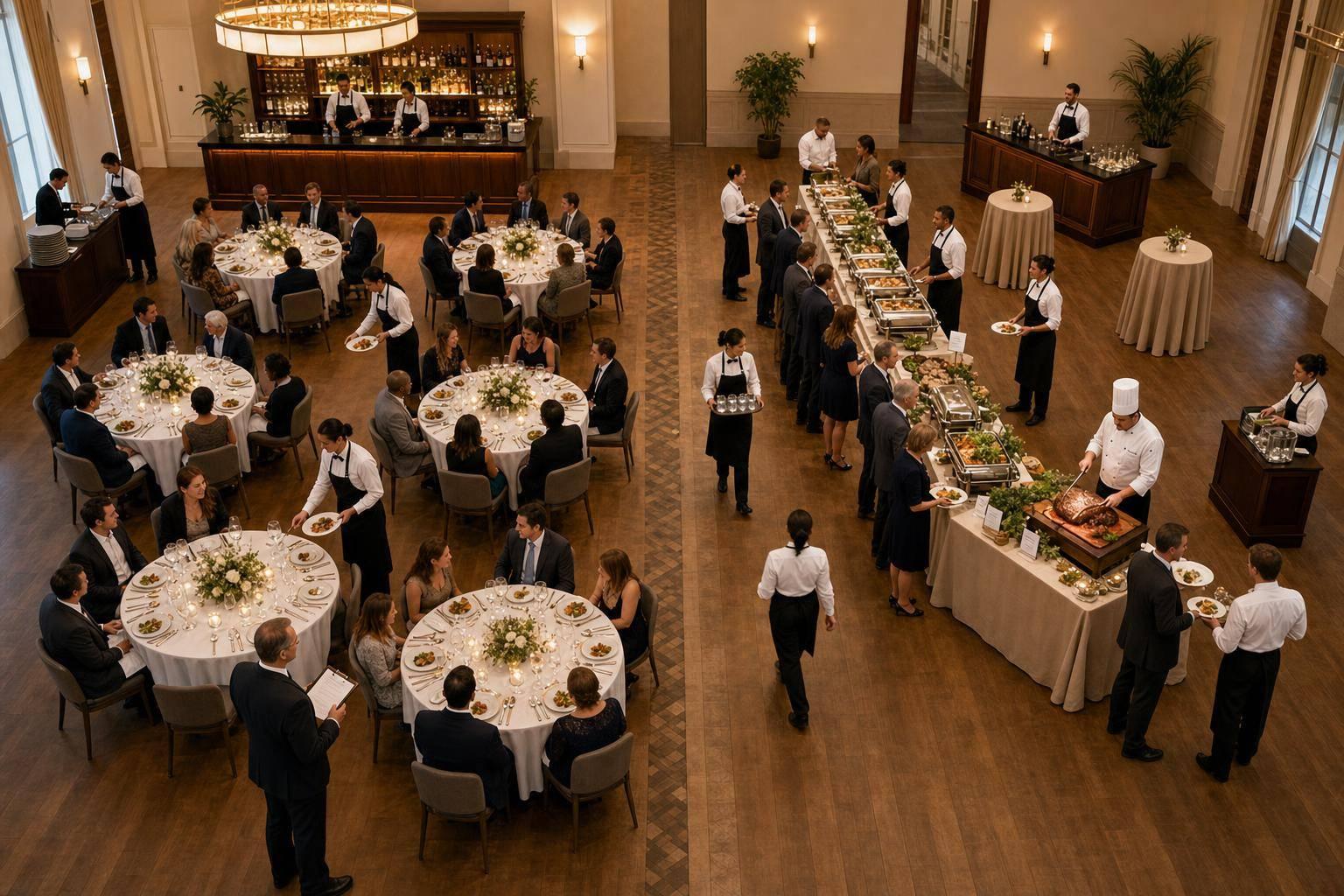
If you staff a plated dinner and a buffet the same way, you’ll miss the mark. For 100 guests, plated service often needs 8–10 servers at about 1 server per 10–15 guests, while a buffet usually runs with 4–5 servers at about 1 per 25–35 guests.
Here’s the short version:
If I were planning staffing fast, I’d think about it like this:
Quick Comparison
| Service style | Server ratio | Main staff focus | Common pressure point |
|---|---|---|---|
| Full-service | 1:10–1:15 | Table service, course timing, clearing and resetting | Getting every course out on cue |
| Buffet | 1:25–1:35 | Line flow, restocking, beverage refills, clearing | Preventing backups and empty pans |
The bottom line: full-service means tighter table coverage; buffet means tighter line support. Once I know the format, I can build the rest of my catering staff scheduling checklist with a lot less guesswork.
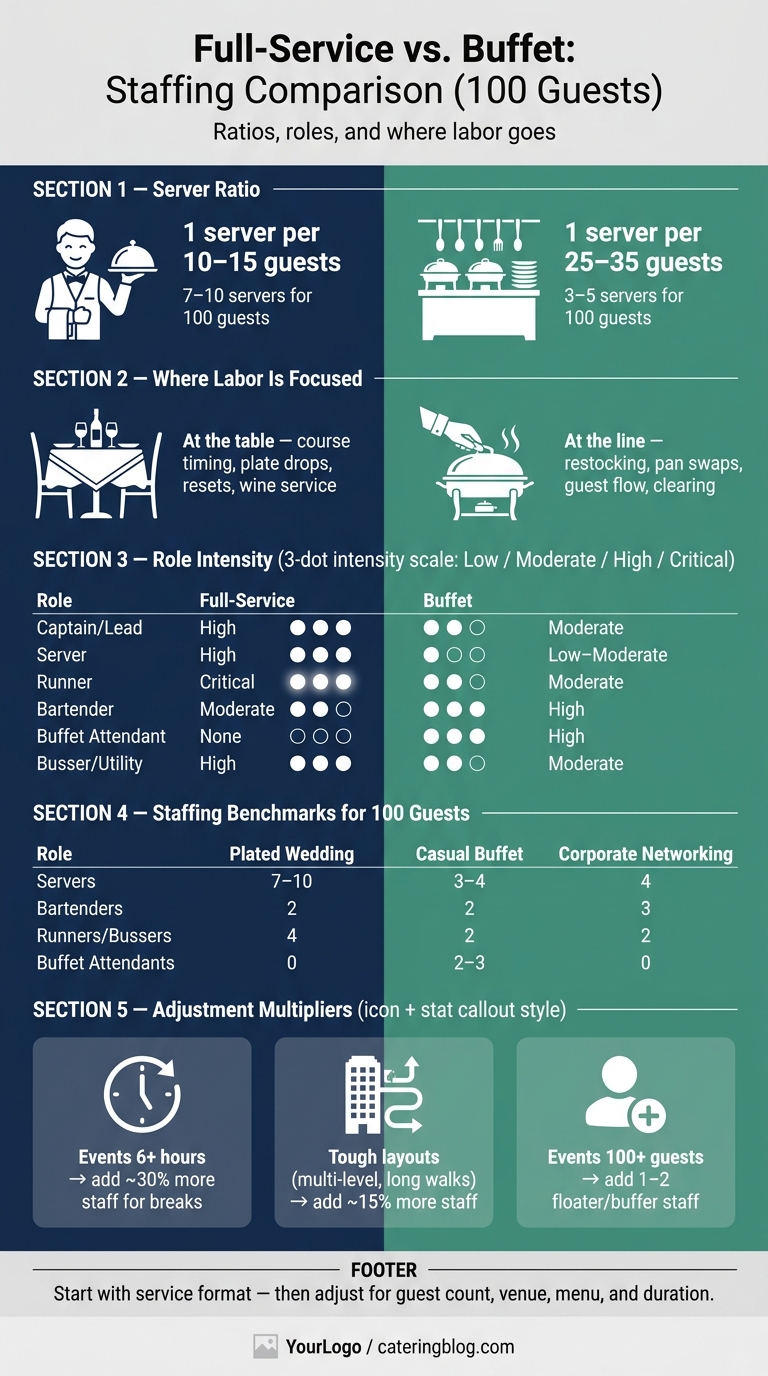
Full-Service vs. Buffet Event Staffing: Roles, Ratios & Priorities
Full-service events put more pressure on timing, table coverage, and coordination. Courses need to land in sync, sections need close attention, and the whole room has to move almost like a stage cue. That pressure changes how each front-of-house and back-of-house role works, often requiring event staff scheduling software to manage the complexity.
The event captain acts as the point person between the kitchen, bar, and dining room. Their main job is keeping course timing on track so service doesn’t drift.
Servers usually work assigned sections of 10 to 15 guests each. They clear the last course, reset flatware, and stay set for the next drop. Just as important, they need to keep tables feeling looked after during the quiet moments between courses, not just when plates hit the table.
Bartenders at plated events have a more timed role than they do at many buffet setups. They coordinate wine service with the meal, time toasts, and often help with table-side wine service along with servers. A common benchmark is 1 bartender per 40 to 50 guests for a full bar. For beer and wine only, that can stretch to 1 per 75 guests.
While servers stay focused on guests, runners manage one of the most time-sensitive jobs in the room: getting hot plates from the kitchen to the right server section, fast. That handoff matters. It lets servers stay present on the floor instead of making repeated trips in and out of the kitchen.
"Plated dinner service requires the most skill. It requires menu knowledge to communicate specifics in every course, etiquette, and unspoken communication with guests." - Grant Morningstar, CEO, Eleven8 Staffing
Utility and scullery staff keep the reset cycle moving. They clear, sort, and move used dishware and rentals fast enough to avoid slowing down the next course. For plated service, one busser per 25 to 30 guests is a solid benchmark.
Plated service puts more weight on timing, handoffs, and table resets. Buffet service leans more toward line movement and restocking.
| Role | Full-Service Intensity | Buffet Intensity | Key Difference |
|---|---|---|---|
| Captain/Lead | High - syncs kitchen timing with speeches and course drops | Moderate - manages station flow and replenishment | Timing vs. logistics |
| Server | High - 1:10–1:15 ratio; multi-course delivery, wine, clearing | Low - 1:30–1:40 ratio; drink refills and table clearing | Guest contact depth |
| Runner | Critical - moves individual hot plates to specific sections | Moderate - transports bulk pans to buffet stations | Precision vs. bulk move |
| Bartender | Moderate - timed toasts, wine coordination, table-side service | High - main guest stop during service | Meal timing vs. guest flow |
| Utility/Busser | High - rapid clearing and flatware resets between courses | Moderate - ongoing plate and trash removal | Synchronized clearing vs. continuous clearing |
Buffet service shifts those priorities toward line flow and restocking.
With plated service, most labor happens at the table. With buffet service, that labor shifts to the line.
That changes the staffing plan in a big way. Instead of loading up on table servers, buffet events lean more on setup, guest flow, replenishment, and clearing.
In plain English: buffets usually need fewer servers and more people covering the line, plate clearing, and restocking.
At a buffet, each role has a different job.
Buffet attendants watch food levels, keep serving utensils in place, and help guests with ingredient or allergen questions. A useful benchmark is 1 attendant for every 2 chafing dishes.
Servers usually run at 1 per 25–30 guests. Their focus is less about full table service and more about beverage refills, clearing plates, and helping the line keep moving.
The captain plays a key part here. At a buffet, the captain’s main task is managing staggered table releases. Instead of letting everyone hit the stations at once, they release tables or sections in waves. That simple move can cut down on backups fast.
And once you handle line flow this way, the rest of the staffing mix starts to look different too.
When buffet service begins, timing matters. If the line slows down or a pan runs empty, guests notice right away.
That’s where runners come in. They connect the kitchen and the buffet stations, swapping pans before dishes run out. A common trigger is for attendants to alert the kitchen when a tray is about one-quarter full. That gives the kitchen enough time to prep a fresh pan and gives the runner time to make the switch without creating a mess at the station.
Food safety puts a hard limit on how long you can wait. FDA guidelines say hot buffet items must be held at 140°F or warmer. To keep food quality steady and stay within safety rules, reserve 8–10% of staff for kitchen monitoring and replenishment.
| Role | Buffet Priority | Full-Service Priority | Buffet Task |
|---|---|---|---|
| Captain/Lead | High | High | Managing staggered table releases and line flow |
| Attendant | High | None | Monitoring food levels, temperatures, and signage |
| Runner | Critical | Supporting | Pan swaps between kitchen and buffet line |
| Server | Moderate | High | Beverage service and line support |
| Busser | High | Moderate | Clearing used plates and keeping the dining area tidy |
| Kitchen Staff | Moderate–High | High | Bulk replenishment and food safety monitoring |
For events with more than 100 guests, it helps to add buffer staff using scheduling tools for last-minute shifts. That extra coverage gives you room to handle bottlenecks, late changes, and those moments when the line gets slammed all at once. From there, staff the event based on guest count, venue layout, and menu complexity.
Once you’ve locked in the service style, the next step is figuring out the right mix of people. That usually comes down to four things: the venue, the menu, the bar, and how long the event runs.
Guest count gives you a starting point. But in practice, a few event details can change staffing needs fast.
Venue layout is a big one. A multi-level space, a long walk between the kitchen and dining room, or an event that moves from outdoors to indoors can put extra strain on runners and bussers. In many cases, that means adding about 15% more staff.
Menu complexity shifts the balance too. On plated events, extra courses, wine pairings, and tableside prep all add work. That usually means more demand for servers, runners, and kitchen support.
Bar service changes bartender needs in a direct way. A craft cocktail bar takes more hands than a simple beer-and-wine setup.
Event duration matters just as much. If an event runs six hours or more, you’ll often need about 30% more staff to cover breaks and help prevent burnout.
These examples work well as planning anchors. From there, you can adjust based on the venue layout and how involved the menu is. The table below shows how role priorities change across three common U.S. event formats for 100 guests.
| Role | Plated Wedding | Casual Buffet | Corporate Networking Event |
|---|---|---|---|
| Servers | 7–10 | 3–4 | 4 |
| Bartenders | 2 | 2 | 3 |
| Runners/Bussers | 4 | 2 | 2 |
| Buffet Attendants | 0 | 2–3 | 0 |
A few trends jump off the page.
If the event is large or has more moving parts, it also helps to add 1–2 floater staff. They can step in for late arrivals, last-minute changes, or any gap that opens up during service.
Once you know the mix, the next job is putting the right people in the right shifts. Quickstaff lets you assign role-based shifts, track availability, and fill cancellations from one dashboard. You can also duplicate a past event, tweak the roles, and keep staffing lined up as plans change.
Your service style should drive your staffing structure. Full-service events need tight table coverage and timed course drops that hit the room together. Buffets need fewer servers on the floor and more support at the line for restocking, guest flow, and clearing. That one shift changes every staffing call that comes after it.
The shared roles - captains, servers, runners, bartenders, attendants, and bussers - form the base for both formats. But each service style asks those roles to do different work. Plated service puts labor at the table. Buffets move labor to the line, where attendants and runners keep stations stocked and traffic moving.
With those role shifts in mind, start your staffing plan with the service format, not just the guest total. That’s where many teams get tripped up. Headcount matters, of course, but it doesn’t tell the whole story. Match each role to the work the format creates, then adjust for guest count, venue layout, menu complexity, and event length.
Choose the service style that fits your budget, guest count, and the kind of feel you want.
Plated service tends to feel more formal and hands-on. It usually comes with guest-to-server ratios of 1:6 to 1:12, which makes it a solid choice for smaller events with fewer than 75 guests.
Buffet service is often a lower-cost option for bigger groups. It’s commonly used for gatherings of 75 or more, with leaner staffing ratios of about 1:20 to 1:30.
Add extra catering staff when the event calls for more than baseline service. This often happens in venues with tricky layouts, like multiple rooms or long distances between the kitchen and service areas. It also comes up at events that run longer than five to six hours, or when the service is more hands-on, such as VIP sections or menus with a lot of moving parts.
A simple rule of thumb:
Keep supervision in line too. A common setup is one captain for every 10 team members.
For buffet events, the main jobs are less about table-by-table service and more about keeping lines moving and guests at ease.