Allergen Training Checklist for Event Crews
August 19, 2026

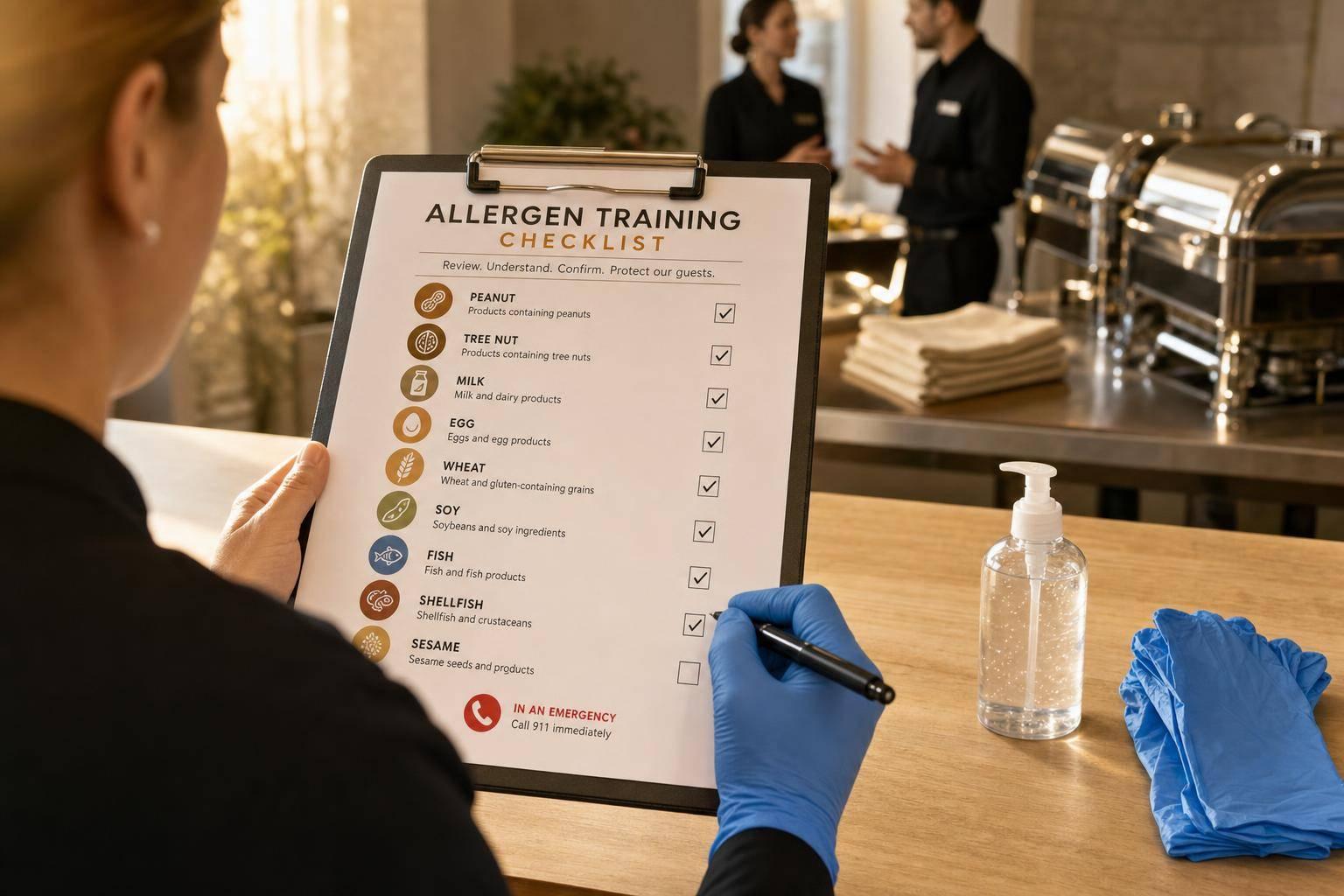
One missed allergy note or one shared utensil can turn event service into a 911 call.
If I were training an event crew, I’d keep the message simple: brief the team, check the menu, stop cross-contact, confirm guest needs, and act fast if someone gets sick. That matters because about 33 million people in the U.S. live with food allergies, and even small traces can cause a severe reaction.
Here’s the short version of what this article covers:
What stands out to me is this: a study cited in the article says 53.9% of restaurant food allergy reactions happened even after staff had been told ahead of time. So disclosure alone is not enough. The crew needs a clear process that works under pressure.
Use this piece as a plain-language shift guide for catering teams, banquet staff, buffet crews, and temp event workers.
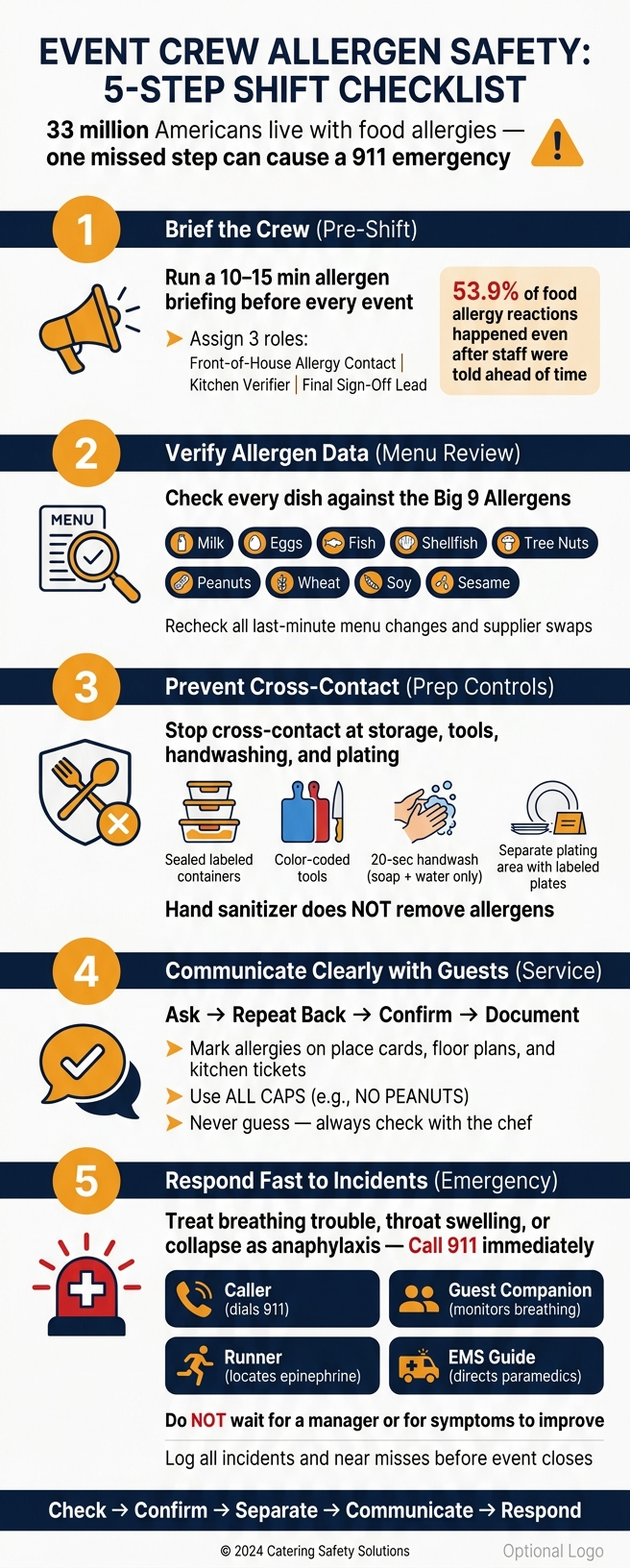
Event Crew Allergen Safety: 5-Step Shift Checklist
Run a 10–15 minute allergen briefing before every event. This isn't just a box to check. A U.S. study found that 53.9% of restaurant food allergy reactions happened even when staff had been told ahead of time. That tells you something pretty plain: guest disclosure by itself doesn't prevent mistakes. Use the briefing to set clear roles before service begins.
Assign three roles before service starts so each allergy question has one clear owner.
Say these roles out loud during lineup and put them on the shift briefing sheet. No crew member should answer an allergen question on the fly without checking with the designated verifier.
Before guests arrive, review every item being served: passed appetizers, buffet dishes, plated entrées, sauces, and garnishes. Recheck any last-minute menu changes and supplier swaps. Then place printed copies of the allergen chart at the pass, podium, and stations as backup.
That way, the team works from the menu that's actually going out, not yesterday's version.
If you already have guest allergy notes from RSVPs or banquet event orders (BEOs), turn them into a service-ready list by table or seat. Read that list aloud during the briefing so the whole crew hears the same details at the same time.
Use Quickstaff to keep allergy notes visible to scheduled crew before and during service. Supervisors can add guest allergy notes, role assignments, and allergen chart references straight into the event record. That gives each crew member the same information on their mobile device, and last-minute updates reach the full team right away instead of getting passed from person to person.
Once the briefing is set, move to the menu review and cross-contact checklist.
Before service starts, check every item against the Big 9 allergens: milk, eggs, fish, crustacean shellfish, tree nuts, peanuts, wheat, soybeans, and sesame. That means every dish, sauce, and garnish. Do this before service, then use a simple matrix during prep and line setup so the team can check items fast.
Build a plain allergen matrix and print it for the pass, kitchen, and buffet station. If anything changes at the last minute - a new bread brand, a swapped pesto, a different sauce - you need a quick allergen check before the item leaves the kitchen, perhaps using tools for last-minute catering staff scheduling to ensure the right supervisors are on hand to verify.
Below is a sample matrix:
| Menu Item | Milk | Eggs | Fish | Shellfish | Tree Nuts | Peanuts | Wheat | Soy | Sesame | Notes |
|---|---|---|---|---|---|---|---|---|---|---|
| Herb-Roasted Chicken with Lemon Jus | N | N | N | N | N | N | N | N | N | Jus thickened with cornstarch; sheet pans used only for non-breaded items |
| Creamy Garlic Mashed Potatoes | Y | N | N | N | N | N | N | N | N | Cannot be made dairy-free on-site |
| Penne Pasta with Pesto & Parmesan | Y | T | T | N | Y | N | Y | N | N | Pine nuts in pesto; consider an alternate nut-free pasta option for nut-allergic guests |
| House Caesar Salad with Croutons | Y | Y | Y | N | N | N | Y | T | N | Can be modified - hold croutons and cheese, swap dressing, and use separate bowls and utensils |
| Chocolate Brownie Bites | Y | Y | N | N | T | T | Y | Y | N | Commercial bakery item; label says manufactured in a facility with peanuts and tree nuts - not suitable for severe nut allergies |
Y = contains, N = does not contain, T = may contain.
Cross-contact often begins in storage. Keep nuts, sesame seeds, bulk dairy, and eggs in sealed, labeled containers. Store them below allergen-free items so leaks or spills don’t drip onto safer foods. During transport and on-site setup, use marked bins to keep high-risk items apart.
Tools matter too. The safest option is a color-coded set used only for allergy orders - cutting boards, knives, tongs, and ladles kept in a labeled container. If you don’t have a separate set, clean tools all the way through: wash, rinse, sanitize, and air-dry before using them again.
Handwashing needs to be just as strict. Staff should wash hands with soap and water for at least 20 seconds before touching allergy orders. Hand sanitizer does not remove allergens.
For plating, set up allergy orders in a separate area or in a spot that has just been cleaned. Keep that work away from the main line. Before the plate goes out, cover it and label it clearly.
Choose the station setup that fits your crew, kitchen space, and the number of allergy requests you expect.
| Factor | Dedicated Allergen-Safe Station | Cleaned Shared Station |
|---|---|---|
| Safety margin | Highest - no shared surfaces or tools | Moderate - depends on cleaning quality and consistency |
| Speed during service | Faster once set up; no cleaning between orders | Slower - requires full wash/rinse/sanitize between tasks |
| Space requirement | Needs a separate prep area | Fits tighter kitchens |
| Staffing needs | Requires at least one assigned crew member | Can be managed by existing staff with clear protocols |
| Best for | Events with multiple allergy requests or higher-risk guests | Events with fewer allergy requests and lower-risk needs |
| Main risk | Underused if crew isn't trained to use it consistently | Cross-contact if cleaning steps are skipped or rushed |
After prep controls are in place, train staff to answer guest questions and send allergy orders to the right place without guessing. On a buffet, put allergen-free items at the start of the line, use separate serving utensils for each dish, and keep nuts, sesame seeds, and croutons in separate containers with clear labels.
Once the menu is set, train staff to handle guest questions and reaction reports without guessing.
Once prep controls are in place, the last big risk comes down to guest communication and fast action. Every allergy question needs a clear answer, and that answer needs to be documented.
Train every crew member to use the same ask–repeat–confirm pattern at every service point.
At check-in, ask about allergies and repeat them back. During passed service, lead with the ingredient. At plated service, confirm the dish. At the buffet, invite guests to ask before they choose anything.
If you’re not sure, say that you’re not sure, then check with the chef. Staff should never guess.
Once an allergy is confirmed, mark it everywhere: the guest’s place card, the floor plan, and the kitchen ticket. Use clear notes like NO PEANUTS in all caps. No plate should leave the kitchen without an allergen check.
If you use Quickstaff, preload confirmed allergies into the event record so scheduled staff can see them right away.
When explaining shared-equipment limits, be direct. Use clean utensils and a cleaned surface, but don’t promise zero trace in a shared kitchen.
If a reaction starts, switch from service mode to emergency mode right away. Staff need to know what to look for and act fast.
Mild symptoms include localized hives, itching, mild redness, or stomach discomfort. Severe symptoms include generalized hives, swelling of the face or tongue, throat tightness or swelling, wheezing, shortness of breath, vomiting, dizziness, pale skin, weak pulse, or sudden confusion. Any mix of breathing trouble, throat tightness or swelling, or collapse should be treated as suspected anaphylaxis - a 911-level emergency.
The response plan works best when roles are assigned during the pre-shift briefing:
| Role | Responsibility |
|---|---|
| Caller | Dials 911, gives venue address, describes the reaction, follows dispatcher instructions |
| Guest companion | Stays with the guest at all times; monitors breathing; keeps them seated or lying down with legs elevated |
| Runner | Locates venue epinephrine or medical supplies; alerts onsite security or medical staff |
| EMS guide | Waits at the entrance to direct EMS directly to the guest |
Do not delay calling 911 while looking for a manager or waiting to see whether symptoms get better. The caller should also note what the guest ate, when symptoms started, and whether the guest self-administered epinephrine. That information should be given straight to EMS when they arrive.
After the guest is safe, write down what happened while the details are still fresh. Record every incident and near miss before breakdown. A near miss may feel small in the moment, but it often points straight to a gap in the process.
| Field | What to Record |
|---|---|
| Date/Time | Exact time the incident or near miss occurred |
| Event Name or ID | So the record can be linked to a specific event |
| Location | Room or station where it happened |
| Allergen Involved | Known or suspected allergen |
| Food/Drink Item(s) | What was served or almost served |
| Description | What happened and who reported it |
| Immediate Actions Taken | 911 call, plate replaced, epinephrine used, etc. |
| Root Cause | Missed ticket note, unlabeled item, miscommunication |
| Corrective Action | What changes will prevent a repeat |
| Staff Initials | Who documented the record |
After each event, review these logs for patterns. If near misses keep showing up at the buffet line or during last-minute menu swaps, that’s the pressure point. That’s where training and process updates need to happen.
Managers using Quickstaff can log incidents inside the event record. Over time, that builds a searchable history for trend analysis and helps tighten allergen checklists for future events.
Run these five checks every shift: brief the crew, verify allergen data, prevent cross-contact, communicate clearly with guests, and respond fast to incidents. If even one gets missed, the risk goes up for guests and for the operation.
Keep the checklist up to date. When the menu, ingredients, venue, or crew changes, update it right away.
At the end of the shift, close the loop: confirm incident logs are complete, make sure allergen materials are stored the right way, and fix any near misses before the next event.
If you use Quickstaff, store allergen notes, role assignments, and last-minute menu updates in each event record so scheduled crew can see them before service starts.
A good allergen program is simple: check, confirm, separate, communicate, and respond.
All staff should know how to spot allergens and talk about them with guests. But in most cases, frontline service staff are the ones who need to flag dietary needs to the kitchen right away.
During pre-shift briefings, make each person’s role clear. That way, there’s no guesswork about who handles guest communication and who handles food prep. Keep the instructions simple and direct, like telling staff to notify the kitchen immediately when a guest mentions an allergy.
Cross-contact happens when a food allergen gets into food that was meant to be allergen-free. That transfer can come from a surface, utensil, or ingredient.
It often happens through shared equipment, prep surfaces, storage areas, or during service. And even tiny amounts can put guests at risk.
Call 911 for a major medical emergency, especially if a guest doesn’t respond to voice or touch. Staff should place the call within 3 minutes of spotting the incident.
For smaller issues, like feeling lightheaded, call 911 if the guest doesn’t get better within 5 minutes. Clearly share the incident location and follow directions to clear space for responders.