Hourly Rates vs. Flat Fees: Staffing Budget Comparison
February 14, 2026


When deciding how to pay event staff, the choice between hourly rates and flat fees can significantly affect your budget and event execution. Here’s a quick breakdown:
Key Considerations:
Quick Comparison:
| Factor | Hourly Rates | Flat Fees |
|---|---|---|
| Budget Predictability | Low; costs depend on hours worked | High; fixed cost upfront |
| Flexibility | High; adjusts to schedule changes | Low; harder to modify mid-event |
| Administrative Effort | High; requires time-tracking | Low; no need to track hours |
| Best For | Large, unpredictable events | Small, well-defined events |
Choose the payment model that aligns with your event’s complexity, size, and budget. For hybrid needs, combine both approaches to balance cost control and flexibility.
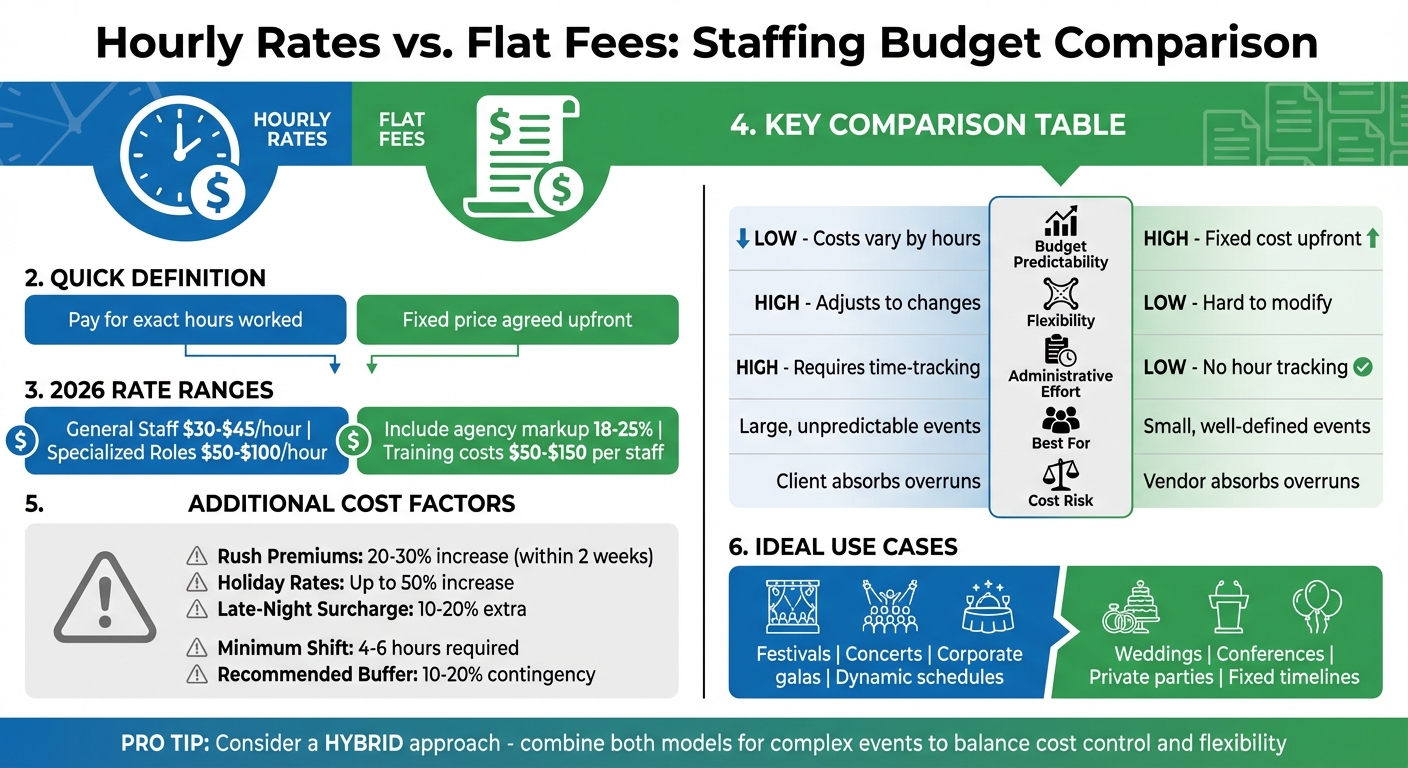
Hourly Rates vs Flat Fees for Event Staffing: Complete Budget Comparison
Paying by the hour is simple: you’re billed for the exact time staff work. For example, if a bartender clocks in at 5:00 PM and finishes at 11:00 PM, you pay for six hours. This system is ideal for events where timing can be unpredictable.
Think about festivals where weather might delay setup, concerts with shifting load-in schedules, or corporate galas where last-minute adjustments are common. Roles like setup crews, stagehands, waitstaff, and brand ambassadors often operate under hourly arrangements because their tasks can expand or shrink depending on the event’s real-time needs.
Efficient event staff scheduling and accurate time-tracking are essential, including start and end times, breaks, and any overtime. Many staffing agencies enforce a minimum shift length, typically between 4-6 hours. As of 2026, W-2 compliant hourly rates average $30-$45 for general event staff, while specialized roles - like AV technicians - can range from $50-$100 per hour.
The hourly rate you’re charged includes everything: wages, payroll taxes (like FICA, FUTA, SUTA), benefits, insurance (Workers' Comp and General Liability), and agency fees. On average, 60-85% of the total rate covers direct costs like wages and taxes, while agency markup accounts for 15-30%.
"When you hire event staff, you need clear pricing and dependable service... knowing the true cost upfront, no surprises." - Daniel Meursing, CEO, Premier Staff
Hourly rates also differ from flat fees because they account for detailed cost tracking. However, rush premiums can significantly impact your budget. Booking staff within two weeks of your event may increase rates by 20-30%, while holiday weekends can push that hike to 50%. To manage unexpected overtime or delays, it’s wise to add a 10-20% buffer to your budget. These details play a crucial role in the upcoming budget calculations.
A flat fee is a set amount you agree to pay upfront, covering labor, equipment, and the vendor's profit margin. For example, hiring a DJ for $1,500 for your wedding reception means that’s the total cost, whether they work four hours or six.
This pricing model works well for events with clearly defined scopes and deliverables. Weddings, conferences, and private parties often use flat fees because timelines and tasks are predictable. Roles like photographers, emcees, event coordinators, and DJs typically operate under flat fee arrangements since their value lies in their expertise and the specific deliverables they provide. For instance, a wedding coordinator might charge a flat fee to oversee the entire event, from setup to the final farewell, without tracking hours worked.
"A fixed fee or flat-rate pay upfront makes total staffing costs clear, ensuring budget certainty and simplifying client proposals." - StaffConnect
Unlike hourly billing, flat fees require vendors to estimate total costs upfront. This involves calculating expected hours, multiplying by a base rate (around $22.95 as of August 2025, the average for U.S. leisure and hospitality workers), and adding material costs, a profit margin, and a 10–20% contingency to cover unforeseen tasks. Additional costs, such as training and onboarding ($50–$150 per staff member) and uniforms or equipment ($20–$80 per shift), are also factored into the total.
One advantage of flat fees is that they don’t increase if the event runs longer than expected, promoting efficiency. Vendors are motivated to complete tasks quickly since finishing ahead of schedule effectively raises their hourly earnings. However, this shifts the risk to the vendor - if the event takes more time than planned, they absorb the extra cost. In contrast, hourly billing directly increases costs for additional hours worked. Up next, we’ll examine how flat fees compare to hourly rates, weighing their pros and cons.
Hourly billing can offer a level of flexibility that flat fees often struggle to match. For instance, if your event wraps up earlier than expected, you only pay for the hours worked, which can result in some savings. Additionally, hourly rates naturally adjust to changes in the event's scope without requiring you to renegotiate contracts, making them adaptable to dynamic situations.
That said, this model comes with its own set of challenges. One of the biggest concerns is the uncertainty in budgeting. Unlike flat fees, where costs are fixed, hourly billing can lead to fluctuating final expenses based on the actual hours worked. This approach also demands scalable event scheduling with precise time tracking, which adds an administrative burden. Without automated systems, these tasks can become cumbersome and may even lead to disputes over hours worked.
Another downside is the potential lack of motivation for vendors to complete tasks quickly. Since longer hours mean higher earnings, there's a risk of inefficiency or unnecessary time padding. To mitigate this, GPS-verified time-tracking tools and clear performance expectations can help ensure accountability.
Additional charges can also complicate hourly billing. For example, late-night shifts often come with a 10–20% surcharge, and rush bookings may add another 15% to the bill. Even minor schedule overruns can trigger minimum pay requirements, further straining your budget. To navigate these uncertainties, it’s wise to build a 10–20% buffer into your estimates to account for unexpected expenses.
Here’s a quick breakdown of the pros and cons of hourly rates:
| Advantages | Disadvantages |
|---|---|
| Pay only for the actual time worked, which can save money if events end early | Final costs are unpredictable, leading to budget uncertainty |
| Adjusts easily to scope changes without requiring contract updates | Requires detailed and accurate time tracking, adding administrative tasks |
| Transparent rate comparisons across vendors | Higher risks of inefficiency or time padding |
| Covers unforeseen tasks or last-minute problem-solving | Additional costs like late-night premiums (+10–20%) and rush booking fees (+15%) |
As you can see, while hourly rates offer flexibility and adaptability, they also come with risks that require careful planning. Up next, we’ll dive into how these factors compare to the flat fee model.
Flat fees make budgeting straightforward and eliminate the hassle of tracking hours or calculating overtime. With this approach, you know exactly what you'll pay before the event begins, which means no surprises when it’s time to settle the bill. It also speeds up the billing process, enabling upfront payments or quick settlements after the event. Plus, flat fees encourage vendors to work efficiently.
"A flat-rate project rewards you for being efficient. The faster you can complete a project, the more profit you make." - Sean Collins, Toggl
That said, flat fees come with challenges. The biggest issue is underestimating the scope or time required. If an event takes longer or involves more work than anticipated, the vendor absorbs the extra cost. This can lead to rushed work or shortcuts as they try to stay within the agreed budget. Misjudging timelines is common due to the planning fallacy, where people tend to be overly optimistic about how long tasks will take, often resulting in inaccurate quotes.
Another downside is inflexibility. Once a flat fee is locked in, making changes during the event can be tricky. Adjustments, like adding staff or extending hours, often require renegotiation or may lead to disputes over additional charges. On the flip side, if the event ends up being simpler than planned, you might feel like you overpaid. These challenges highlight the importance of precise planning, especially for events with unpredictable needs.
To make flat fees work, clear scope definitions and realistic buffers are essential. Experts often suggest including a contingency of 10–20% in your calculations to account for unexpected tasks. For training or onboarding staff, flat-rate costs typically range from $50–$150 per person for large events, while agency markups usually fall between 18% and 25% of total labor costs.
| Advantages | Disadvantages |
|---|---|
| Predictable costs eliminate budget surprises | Risk of underestimating time or scope, leading to vendor losses |
| No need for time-tracking or overtime calculations | Hard to adjust scope mid-event without renegotiation |
| Encourages vendors to work efficiently | Rushed work or cost-cutting may occur to protect profit margins |
| Faster billing with upfront or immediate payment options | Potential overpayment if the event is simpler than anticipated |
| Transparent pricing simplifies client proposals | Relies on accurate estimates, which can be challenging to achieve |
These pros and cons provide a foundation for comparing flat fees with hourly rates in greater detail.
When deciding on a pricing model, it’s important to consider your event's specific needs. Flat fees provide a fixed cost, making budgeting straightforward, while hourly rates offer flexibility for events with changing schedules, like festivals or large corporate gatherings. The following table highlights the key differences between these two approaches.
Hourly rates are highly adaptable, allowing adjustments as schedules evolve. On the other hand, flat fees set a defined scope, which can limit flexibility if unexpected changes arise mid-event.
"Hourly pay is ideal for flexibility, fairness, and adjustable budgeting. Flat-rate pay excels for efficiency, predictable costs, and simpler administration".
Another major difference lies in the administrative effort required. Flat fees simplify billing by removing the need for detailed time-tracking - no need to monitor breaks, overtime, or bill by small increments. Hourly rates, however, demand precise tracking of hours worked, breaks taken, and overtime calculations using labor cost control tools.
Cost risks also vary. With hourly rates, clients may face budget overruns due to unexpected delays. In contrast, flat fees shift this risk to vendors, who are responsible for managing overruns. This makes hourly rates better suited for unpredictable events, while flat fees work best for clearly defined functions. Additionally, hourly pay can sometimes incentivize workers to stretch tasks, whereas flat fees encourage efficiency since the payment remains the same regardless of how quickly the work is completed.
Here’s a quick breakdown of the key differences:
| Factor | Hourly Rates | Flat Fees |
|---|---|---|
| Budget Predictability | Low; costs depend on actual time worked | High; total cost is agreed upon upfront |
| Flexibility | High; easily accommodates schedule changes and extra hours | Low; harder to adjust once the scope is set |
| Administrative Effort | High; requires detailed logs, break tracking, and overtime calculations | Low; no need for exact time-tracking |
| Staff Motivation | Risk of time padding to increase earnings | Promotes efficiency and quicker task completion |
| Risk of Cost Overruns | Client assumes risk for delays and budget overruns | Vendor absorbs risk if work takes longer than planned |
| Best For | Unpredictable events like festivals, concerts, or large functions | Well-defined events like weddings, conferences, or specialized roles |
Deciding between hourly rates and flat fees often comes down to how predictable your event is. For events with clear schedules and well-defined roles, flat fees offer straightforward budgeting. But for larger, more dynamic events - like festivals, concerts, or corporate functions - hourly rates can provide flexibility, ensuring you only pay for the time actually worked.
Event size is another key factor. For smaller gatherings, where roles like DJs, photographers, or coordinators are involved, flat fees simplify billing and provide budget clarity. However, for larger events requiring extensive staff - such as setup crews, waitstaff, or stagehands - hourly rates allow you to adjust staffing levels as needed with event staff scheduling software. Keep in mind that larger events often involve additional management, which can increase overall costs even if the base hourly rates are lower.
Budget constraints also influence your choice. If you're working with a fixed budget, flat fees can prevent unexpected costs, even if the event runs longer than planned. On the other hand, hourly rates allow for adjustments and potential savings if the event finishes early. Just remember that most staffing agencies enforce a 4–6 hour minimum shift, so factor that into your planning. For those looking for a balance, a hybrid model might be the answer.
A hybrid approach works well for complex events. For instance, you could apply a flat fee for predictable tasks - like bartending during a cocktail hour - and switch to hourly rates for unexpected changes or additional needs. This gives you budget stability for the main event while ensuring fair compensation for any surprises.
"Hourly pay works best when your event schedule is unpredictable or flexible. For festivals, concerts, or large corporate functions where start and end times may change, hourly pay ensures you only pay for the time actually worked." – StaffConnect
Timing also plays a crucial role in keeping costs under control. Booking early helps you secure standard rates, while waiting until the last two weeks could add a 20–30% premium to your staffing expenses. If your event falls on a holiday weekend, costs can rise by as much as 50%. Planning ahead not only saves money but also gives you more flexibility when deciding between hourly and flat-fee models.
When deciding between hourly rates and flat fees, the first step in building your staffing budget is to outline your event's specific needs. Start by listing all event zones, the roles required for each, and the total operating hours, including setup and breakdown. For instance, if you're hosting a 10-hour event with a maximum shift of 8 hours, you'll need 1.25 shifts per position to cover the full duration. Don't forget to add an extra hour before and after the event for team briefings and cleanup.
Next, calculate your staffing headcount using an event staffing needs analyzer using industry-standard ratios. For a plated dinner, you'll typically need 1 server for every 10–12 guests. Buffet service requires fewer staff, with 1 server for every 20–30 guests. If you're running a full cocktail bar, plan for 1 bartender per 35–50 guests, while beer and wine bars can handle 50–75 guests per bartender.
Once you've determined the number of staff needed, calculate the total working hours for each role and multiply it by the standard hourly rate. As of 2026, general event staff earn $28–$45 per hour, bartenders range from $35–$65, and event captains command $45–$75 per hour. However, keep in mind that the hourly rate isn't the full picture. When working with staffing agencies, the bill rate includes a markup - typically 25–60% - to cover payroll taxes, workers' compensation, and administrative costs. To estimate the "all-in" rate, multiply the base hourly rate by 1.35 to 1.60. Additional fees for services, training, and uniforms should also be factored into your calculations.
"Guesswork leads to last-minute scrambles. A data-driven staffing plan is the foundation of a flawless event." – Daniel Meursing, CEO of Premier Staff
To ensure your budget aligns with your event's financial plan, always add a 10–20% contingency buffer. This extra margin helps cover unexpected issues like staff no-shows, illness, or last-minute client requests. Also, remember that most staffing agencies require a minimum shift of 4–6 hours, so even if your event ends early, you'll still pay for the minimum. Rates can also spike for late bookings or events on holiday weekends, so securing your staff 6–8 weeks in advance can help lock in better rates.

After crafting your staffing budgets, having the right tools can simplify the management process. Quickstaff makes it easy by combining event creation, staff scheduling, and budget tracking into one platform. No more juggling spreadsheets - set hourly or flat-fee pay rates upfront for complete budget transparency.
Quickstaff’s flat monthly subscription model ensures straightforward budget management. Unlike platforms that charge per staff member or event, Quickstaff’s pricing stays consistent no matter how many events you plan. For instance, the Boutique Plan costs $49/month for up to 35 staff, the Growing Plan is $99/month for up to 70 staff, and the Large Plan is $249/month for up to 175 staff. This means you can schedule as many events as you need without worrying about unexpected software costs cutting into your budget.
The system’s centralized database helps you spot staffing shortages or surpluses, so you can adjust schedules and costs in real-time. Whether you’re using hourly or flat-fee pay structures, Quickstaff lets you recalculate budgets on the fly. Its mobile-friendly design keeps your team connected, while automated reminders and messaging reduce admin tasks, helping you keep labor costs in check.
For those working with tight margins, Quickstaff offers a 14-day free trial - no credit card required - so you can see how centralized scheduling improves budget accuracy without any upfront commitment. Need to manage more than 175 staff? Custom quotes are available to meet your specific requirements.
Choose the payment model that aligns with your event's scheduling and budgeting needs. Hourly rates are ideal for events where schedules are flexible or prone to changes - think festivals or large corporate gatherings where setup times may shift. On the other hand, flat fees work better for events with fixed timelines and clearly defined roles, such as weddings or conferences, where sticking to a set budget is essential. Deciding between these models helps you plan budgets accurately and manage staffing efficiently.
"When you hire event staff, you need clear pricing and dependable service... knowing the true cost upfront, no surprises".
Achieving this clarity starts with assessing your event's complexity, service style, and administrative capacity. For instance, a plated dinner that requires a 1:16 staff-to-guest ratio will have very different demands compared to a buffet setup with a 1:30 ratio.
It's wise to include a 10–20% contingency in your budget to handle last-minute changes, overtime, or unforeseen tasks. Tools like Quickstaff can simplify this process by combining scheduling and cost management into one platform.
Quickstaff eliminates the need for spreadsheets by streamlining scheduling and providing real-time cost tracking. With flat-rate pricing starting at $49/month, it offers a clear view of staffing costs, helping you maintain profitability while reducing the stress of event management.
When deciding between hourly rates and flat fees, it’s essential to weigh factors like the event's length, complexity, and your budget preferences.
Your choice ultimately hinges on whether you value adaptability or prefer the certainty of a fixed expense.
When calculating hourly staffing costs, there are often hidden expenses that can catch you off guard. These include health insurance, retirement contributions, onboarding and training costs, downtime pay, and last-minute premium rates. On top of that, you might face overtime charges or need to meet minimum shift requirements, which can quickly add up.
Other potential fees, like those for uniforms, travel, or equipment, can also sneak into the equation. If you don’t factor in these costs ahead of time, they can have a big impact on your budget. Proper planning is key to avoiding surprises.
When managing projects, combining a hybrid hourly and flat-fee structure can strike a good balance. Flat fees work best for tasks that are straightforward and easy to estimate upfront, while hourly rates are ideal for handling unpredictable or more complex aspects of the work.
For staffing, this approach is especially useful. Core staffing needs can be packaged into a flat fee, ensuring cost predictability. Meanwhile, additional hours or specialized roles can be billed hourly, giving you the flexibility to adapt to the shifting demands of events without overspending.